play

RECENT POSTS

Balancing Math Skills and Play in Kindergarten

Flickr:Woodleywonderworks

By Eleanor Yang Su

It’s one of the biggest debates going on among early childhood development experts: Is it more important for kindergartners to focus on academics and learn their ABC’s and numbers? Or spend more time on social and emotional issues, like how to play nice and pay attention?

Recent research by a UC Irvine education professor shows that math skills among kindergartners turn out to be a key predictor for future academic success.

Professor Greg Duncan and his colleagues analyzed studies conducted with close to 20,000 kindergartners, assessing their knowledge of math, literacy and other skills, including their ability to stay on task and make friends. The studies followed the kindergartners for several years through elementary school, testing them in reading and math.

“Kindergartners are learning what used to be learned in the first grade.”

Even after accounting for differences in IQ and family income, Duncan found that those who learned the most math in kindergarten tended to have the highest math and reading scores years later.

“It was very surprising,” said Duncan, whose research appears in a new book. “Everyone says reading is most important, and if a child can read by third grade, the chance of dropping out of Continue reading

The Power of Play in Learning

Flickr: Ernst Vikne

By Aran Levasseur

The goal of the videogame “Civilization” is to build a civilization that stands the test of time. You start the game in 4000 B.C. as a settler and, with successful gameplay, can create a civilization that lasts until the Space Age. Throughout the game, you need to manage your civilization’s military, science, technology, commerce and culture.

One doesn’t read “The Decline and Fall of the Roman Empire” to develop strategy before playing the game. One starts by playing. This is true for all videogames. You start by exploring the world with curiosity and begin to develop a hypothesis of what you’re supposed to do. Through trial, error, pattern recognition, logic and chance you continually reformulate your trajectory.

Students begin to develop a self-reliance that enjoys independent experimentation and exploration.

This model of learning is not only effective for videogames but for all digital tools, and I would argue that play — especially in the digital sense — is emerging as a pedagogical keystone for education in the 21st century.

Stuart Brown, M.D., explains in his book, Play, how a range of scientific disciplines have revealed the importance of lifelong play. Playfulness amplifies our capacity to innovate and to adapt to changing circumstances. Adults who are deprived of play are often rigid, inflexible and closed to trying out new options. Play is an active process that reshapes our rigid views of the world.

THE POWER OF PLAY

Play is also a powerful vehicle for learning, something that’s been underscored for me in my work at San Francisco University High School where we began a one-to-one iPad program in the fall.

The iPad has been hyped as a device that will revolutionize education. And, while I’ve witnessed glimmers of this potential, it isn’t microwavable. Migrating from an analog to a digital environment sounds simple enough, but the reality has been more disruptive.

Disruption can signal the onset of innovation, but this isn’t comforting to the organizations and individuals that are at the epicenter of such turbulence. Yet with a schema of play, we can start to Continue reading

Has Technology Changed the Way Children Play?

TB

Last spring, there was a minor outcry when the Auburn School District in Maine announced that it would be piloting a one-to-one iPad program with its kindergarteners. Part of the uproar involved the cost of the program — some $200,000. But much of it involved the notion that somehow young children should not be exposed to technology, that somehow iPads and other gadgets inhibit their imagination and make them play less — or, to slightly modify one of Apple’s famous logos, to “play different.”

But is that really the case? Has technology really dampened the way children play?

A new study (PDF) of children’s playground games and songs suggests that much of the outcry about declining kids’ play may be exaggerated. The research comes from a collaboration between the Universities of London, Sheffield and East London, along with the British Library, and draws from the Opie Collection and the work of the famous children’s folklorists Lona and Peter Opie.

“Playground culture and children’s games are not overwhelmed, marginalized or threatened by media.”

And as most folklorists will tell you, the discipline itself has always been associated with the idea that cultural practices — whether of children or adults — are dying out, and that songs and games and folktales must be collected and preserved to prevent that from happening. So it was in the 19th century, and so it is today.

Continue reading

Teaching Kids the Rules of the Game

Flickr:Gitsul

Back when Jill Vialet was a kid, she used to play with her neighborhood friends for hours at a time, unsupervised. It seemed unstructured, because no adults had established any parameters. But in fact, all their games had rules.

“We knew how to pick teams, resolve conflicts, there were spoken and unspoken rules,” she says. “There was a real culture of play. There was a real structure but kids owned it.”

“It seems naïve to think that kids are going to figure out how to do it all on their own on the playground.”

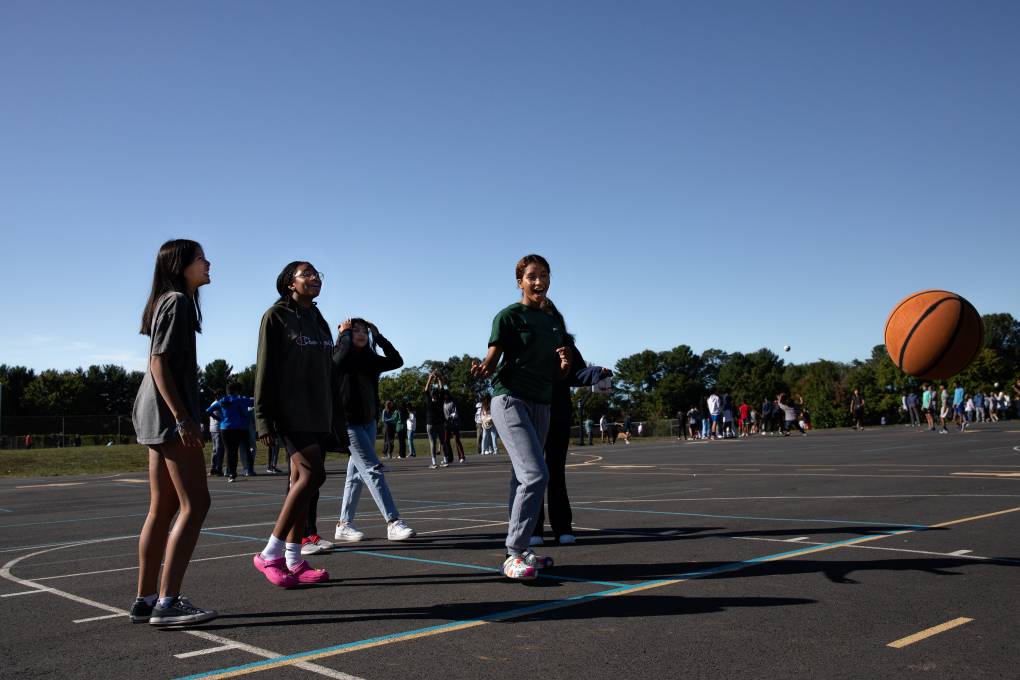
In the past generation, emphasis on play has shifted dramatically. For one thing, kids are rarely left unsupervised for a number of different reasons. Add to that the trend of cutting recess from school hours (only 26 minutes per day as of 2006), and the opportunity to learn how to play for kids has been really cut back.

Vialet is the founder of Playworks, a nonprofit organization that coaches schools, teachers, and playground supervisors on how to encourage good play practice. In some schools, Vialet says, recess is considered a nuisance — a time for kids to get into fights that go unresolved, resulting in tensions that are brought back into the classroom and spill over into instructional times.

“If you talk with some principals, they see recess as a time of day that has a negative impact on school climate,” she says. “There are more suspensions and discipline problems as a result.”

“Recess is meaner than it used to be,” one Oakland principal told New York Times writer David Bornstein.

Playworks steps in to help schools create a structure for play, and to familiarize both adults and kids with the tools of play. “It seems naïve to think that kids are going to figure out how to do it all on their own on the playground,” Vialet says. “We all had to learn from someone.”

Schools deploy Playworks in two ways: they can hire fulltime staff person, experts in play, from Monday through Friday for the school year, or they can hire Playworks to train teachers, yard monitors, and security guards.

“They take a generative approach,” Vialet says of the Playworks staff. “This is where we’re going to play kickball, these are the rules to this game. And they help create ideas that the kids will inevitably own instead of telling them what to do.”

And that’s the point — to create a scaffolding for play, and to encourage kids to come up with their own rules.

Vialet says in schools where the program has been institute, school staff say they love their jobs more, suspension rates have plummeted, there’s less violence, more peer social behavior, and more intermingling of different kinds groups.

According to a study published in Pediatrics, “school children who receive more recess behave better and are likely to learn more.”

Playworks is growing quickly. With an $18.7 million grant from the Robert Wood Johnson Foundation, the nonprofit will expand to 350 schools next year, and will serve more than 100,000 students. The organization is building a training business, as well.

Vialet was interviewed on KQED’s Forum program recently. You can listen to the program here.