Good Read: How to Teach Students Better Online Research Skills

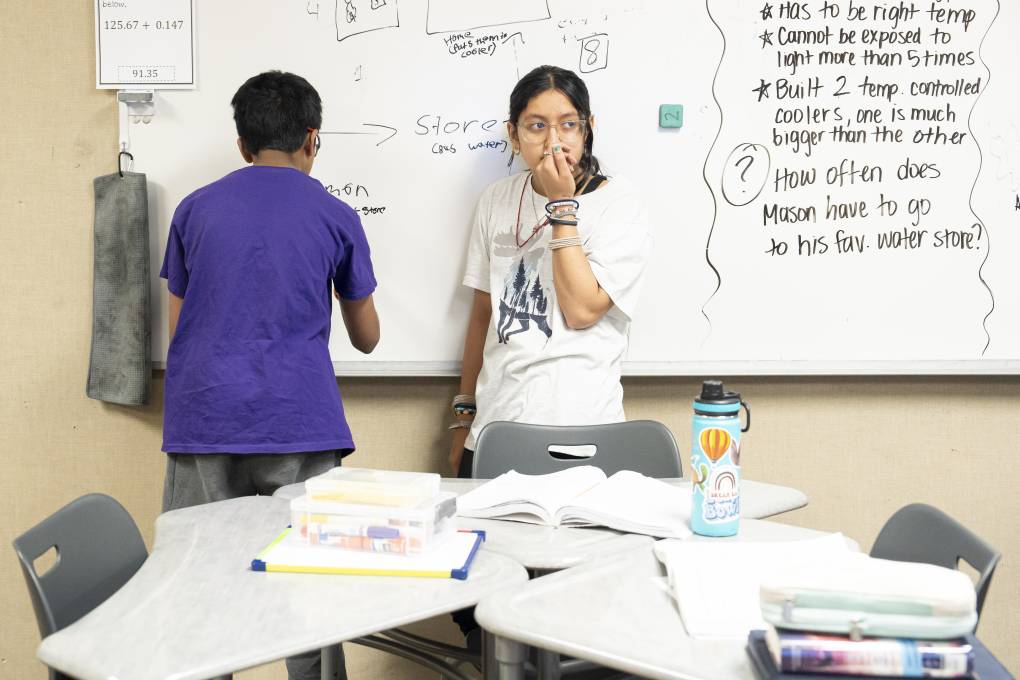
In a recent Pew study, most teachers surveyed said that courses and content focusing on digital literacy should be incorporated into the school curriculum. Whether or not it’s dictated officially into the curriculum, some teachers are taking the time to educate students on their own.
Lots of great tips in this EdWeek story. And for more, read 12 Ways To Be More Search Savvy.


Improving web research tactics is a priority Sara Shaw, an elementary school teacher in Avon, Mass., realized she needed to teach online research skills several years ago when her students kept turning in projects riddled with misinformation. The flawed material often came from websites the students used.

Read more at: www.edweek.org

What Teens Feel About Privacy and Social Media

christopherfrierbrown-300x3001

Flickr: Christopher Frier Brown

A new Pew Research study of 802 teenagers ages 12-17 and their parents reveals that teenagers are sharing more information on social networking sites than in the past, even as they carefully monitor and manage their profiles. And, while the number of social media sites and ways to share has grown, most teens aren’t concerned with third parties having access to their personal information.

Some highlights:

  • Today’s teens are sharing more personal information on social media sites: 91% share a photo of themselves with their profile (up from 79% in 2006), 92% use their real name on their most-used profile, and 20% include their cell phone number. And while older teens are more likely to share information like photos of themselves, school names and relationship status than younger teens, boys and girls “generally share personal information… at the same rates.” However, cell phone numbers are a key exception – boys are much more likely to share their cell phone numbers (26%) than girls (14%).
  • Twitter use has grown significantly among teens, rising in popularity from 16% in 2011 to 24% in 2012. African-American teens are more likely to use Twitter than white teens, 39% to 23%, respectively, and Twitter users are much more likely than Facebook users to make their posts public.
  • “The typical teen Facebook user has 300 friends, while the typical teen Twitter user has 79 followers.” Girls and older teens (ages 14-17) have larger networks on social media, and also have a larger variety of friends, drawing from different groups. Younger teens (ages 12-13) are less likely to friend people they don’t know, kids who attend different schools, or teachers and coaches. Girls are more likely than boys (37% to 23%) to be Facebook friends with teachers and coaches, and African-American teens are “twice as likely as whites” to be Facebook friends with celebrities, professional athletes and musicians (48% to 25%).

One of the most fascinating findings from the study’s focus groups was teens’ “waning enthusiasm for Facebook.” Reasons for the shift include increased adult presence on Facebook, friends’ need Continue reading

Flipped Classroom 2.0: Competency Learning With Videos

flipped-classroom

Jeremy Wilburn/Flickr

The flipped classroom model generated a lot of excitement initially, but more recently some educators — even those who were initial advocates — have expressed disillusionment with the idea of assigning students to watch instructional videos at home and work on problem solving and practice in class. Biggest criticisms: watching videos of lectures wasn’t all that revolutionary, that it perpetuated bad teaching and raised questions about equal access to digital technology.

Now flipped classroom may have reached equilibrium, neither loved nor hated, just another potential tool for teachers — if done well. “You never want to get stuck in a rut and keep doing the same thing over and over,” said Aaron Sams, a former high school chemistry teacher turned consultant who helped pioneer flipped classroom learning in an edWeb webinar. “The flipped classroom is not about the video,” said Jonathan Bergmann, Sams’ fellow teacher who helped fine tune and improve a flipped classroom strategy. “It’s about the active engaged stuff you can do in your class.”

“There is no place for them to hide. They had to converse with me and tell me when they were ready to be assessed on something.”

The two teachers admit when they started flipping their classrooms they put everything into video form. Now, they’ve taken a step back and realized some things shouldn’t be in lecture form, and Continue reading

Inquiry Learning Vs. Standardized Content: Can They Coexist?

497411105_60c65df8ba_z

Flickr: umjanedoean

By Thom Markham

As Common Core State Standards are incorporated from school to school across the country, educators are discussing their value. It may seem that educators are arguing over whether the CCSS will roll out as a substitute No Child Left Behind curriculum or as an innovative guide to encourage inquiry rather than rote learning. In reality, as time will prove, we’re arguing over whether content standards are still appropriate.

Everyday there is less standardization of information, making it nearly impossible to decide what a tenth-grader should know. Beyond the core literacies of reading, writing, computation, and research, the world-wide culture of innovation, discovery, multi-polarity, interdisciplinary thinking, and rapid change depends on the explosive potential of the human mind, not entombed truths from the past. Increasingly, any standards-based curriculum is at odds with the outside world.

There is only one resolution to the debate. Sooner or later, inquiry-standards will take precedence over content-based standards. Education’s core task is to prepare young people to generate new ideas, filter them through a net of critical analysis and reflection, and move the ideas through a design process to create a quality product, either as an idea or a material object. Students need information, facts, and specific knowledge for a successful outcome. But that information must be gathered during the process of creation, in a usable, just-in-time format not found in “subjects.”

If you’re a teacher in tune with the needs of your students, you sense the disconnect between the curriculum and reality. You’d like the freedom to respond more directly to student needs, but standardized information and testing remains a barrier to innovative teaching.

So how can you, as a teacher, help move the dialogue forward? First, you can focus on becoming a highly-effective project based learning (PBL) teacher. When done well, PBL is the most effective method education has at the moment to introduce and practice inquiry-based education. Continue reading

Can a Toy Spark Interest in Engineering for Girls?

DebbieSterlingPic

Katrina Schwartz

It’s a common refrain that there aren’t enough women in jobs that require math and science skills like engineering and computer science. Though more programs are cropping up geared towards girls involved in science through camps, rocketry clubs or with more focused courses on STEM subjects, the gender imbalance is still striking.

The discrepancy became all-too apparent to Debbie Sterling, a budding inventor who was one of the only girls in her engineering courses at Stanford. So she came up with an idea to encourage more girls in  is why she’s spent the last several years developing GoldieBlox, a toy focused on developing spatial skills in girls.

“I just think there need to be more options, more role models, more career paths for girls to see and that’s what I’m trying to do with GoldieBlox,” Sterling said.

Sterling discovered her interest in engineering almost by accident — a math teacher suggested she take a course when she got to college — and she wonders if girls would choose science careers if they were exposed to basic engineering and physics concepts earlier in life.

“Some modeling of a cool, young girl engineer could be useful if the girl playing can see a path from where she is to where the cool, functioning engineer is.”

Research shows that building toys like Legos or Erector Sets are good for building spatial skills, but those typically fall under the stereotype of toys for boys. After visiting the toy store and experiencing what she called “the pink explosion isle for girls” Sterling decided she needed to build an engineering toy that would appeal to girls.

GoldieBlox and the Spinning Machine is a construction kit with pieces that clip into a board to make a simple belt drive. The set comes with a story that tells of a girl engineer named Goldie who Continue reading

What It Takes to Become an All Project-Based School

New-Tech-students

New Tech Network

In many schools, project-based learning happens in isolated cases: in certain teachers’ classrooms here and there, or in the contexts of specific subjects. But for students to benefit from project-based learning, ideally it’s part of a school’s infrastructure — a way to approach learning holistically.

For one quickly growing network of schools, project-based learning is the crux of the entire ecosystem. New Tech Network, which was founded 15 years ago, is taking its school-wide project-based model to national scale. The organization, which offers a paid program for schools to use its model, began with a flagship school in Napa and has grown to 120 schools in 18 states, most of which are public schools.

The network has not only grown in size, but also in notoriety. President Obama visited Manor New Tech High School in Texas last week, as part of an effort to promote an education agenda focused on producing graduates that can compete in today’s global economy.

The nod from the president comes at a time when New Tech is attempting to position itself as a successful model to follow. But rather than relying on test scores and such quantifiable numbers to prove its value, New Tech’s own 2013 annual report frames success by focusing on deeper learning that can’t be measured by standardized test scores and their college readiness. Yet it’s that lack of emphasis on test scores, an all-consuming worry for many districts, that makes it more difficult for the organization to pin point numbers to tell its story.

“From where we stand, public school districts are as capable of innovative schools as charter schools.”

Here are a few of the statistics New Tech has gathered from their schools: students graduate at a rate six percent higher than the national average and enroll in college nine percent more than the average. They also persist in four-year universities at a 17 percent higher rate and 46 percent higher rate when it comes to two year colleges. Perhaps most importantly, they claim that Continue reading