• Bay Area Bites

  • Culinary Rants & Raves from Bay Area Foodies and Professionals

Posts Tagged ‘rabbit’


Bunny on the Table

Wednesday, April 6th, 2011

Here at Bay Area Bites, we believe in equal-opportunity coverage. So, while yesterday's post gave you tips on finding vegan marshmallow chicks and dairy-free chocolate bunnies, today we're going to tell you how get those rabbits out of the Easter basket and onto the table!

Yes, rabbits are cute. However, if you choose to eat meat, you should know that they're also lean, tasty, and take limited time & resources to reach market size, making them a practical and sustainable meat source.

When I was a restaurant critic, I always ordered rabbit when I found it on local menus. Why? First, because I liked it, and secondly, because it was very nice to have something different to write about for a change; there's only so many ways you can describe a steak, a chicken breast, or a piece of halibut. But, oh, the looks of pleading I got if I dared urge any of my dining companions to order it instead! Those Easter-bunny associations are strong.

There's no real reason to be squeamish about rabbit. Unlike, say, kidneys, brains, or blood sausage, there's nothing dramatic, weirdly textured, pungent or funky about rabbit. Yes, it does have a slight resemblance to chicken, but with a silky, meatier texture that's all its own.

In Italy, its mild flavor makes it a popular baby food; little jars of coniglio line the shelves at the supermercado and the farmacia. Rabbits were counted among the domesticated courtyard animals, like chickens and guinea fowl, that were one step closer to the house than livestock like cows, sheep, and goats.

A small but growing number of local gardeners are adding a few rabbits to their backyard mix of chickens and bees. However, if you're not quite up to raising (and dispatching) your own rabbit, you can still find local, humanely-raised rabbits in the Bay Area.

In the East Bay, you can find 3-lb Jones Farm rabbits from Santa Rosa for $10/lb at the Marin Sun Farms butcher shop in Rockridge Market Hall. At Avedano's Holly Park Market in San Francisco, rabbits from Devil's Gulch Ranch in West Marin arrive every Friday, where the 3-to-4 lb rabbits are $30 apiece. (They are also sold at the Marin Civic Center Farmers Market on Sundays from 9am-1pm)

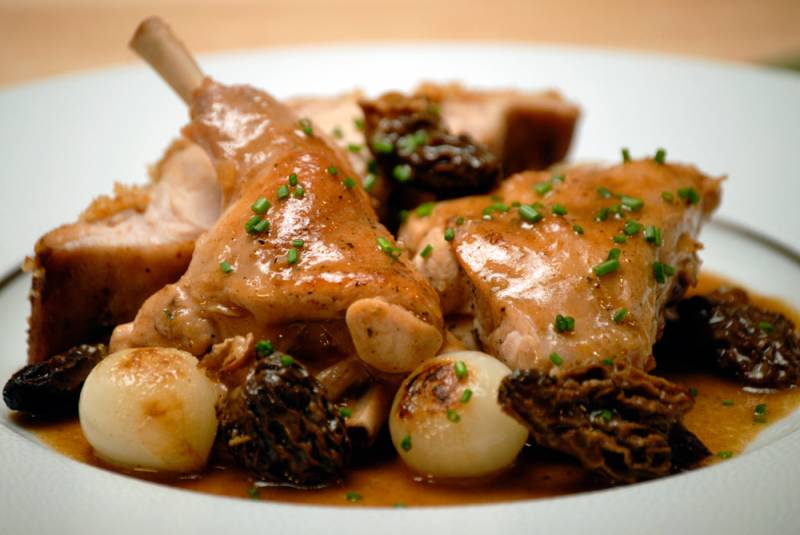
Being a lean meat, rabbit benefits from a little enrichment during the cooking process. You can go the Italian way, browning it in olive oil and then braising it with tomatoes and herbs, perhaps a splash of balsamic vinegar. The French prefer it lavished with mustard and cream, baked to a fragrant golden brown, and it's this version that I'm sharing with you today, adapted from a recipe in former Chez Panisse chef David Tanis's first book, A Platter of Figs and Other Recipes. It's rich but simple, a luscious amalgam of mustard, thyme, and cream, with bacon on top to add crispness and smoky depth.

Unless you have a sharp cleaver and a steady hand, it's wise to ask your butcher to divide your rabbit into serving pieces for you. At Marin Sun, the butcher tells me there are many, many ways to divvy up a bunny; we settle for separating out the legs (the meaty haunches and back legs, and the narrower front legs and shoulders), then chopping the rest of the body (the saddle) into 6 even pieces. Like a chicken, the more muscular legs take longer to cook; he advises putting the back legs in first, followed by the front legs 15 minutes later, and the saddle pieces 15 minutes after that. He also suggests, for my next rabbit, that I get the saddle boned out in one piece. Spread out, rubbed with fresh herbs and garlic, rolled and tied, then grilled or roasted, it becomes a kind of rabbit porchetta, easy to serve and eat.

What to accompany them? Why, carrots, of course. Tanis suggests simmering equal parts peeled potatoes and carrots in salted water, then draining and mashing them with a lump of butter, a generous pinch of saffron, and enough milk or creme fraiche to make it smooth and creamy.

Recipe: Mustardy Rabbit for Spring

Summary: Mustard and cream gives rabbit a savory, golden-brown coating in this lovely spring dish.

By Stephanie Rosenbaum
Adapted from A Platter of Figs and Other Recipes by David Tanis.

mustardy rabbit

Prep time: 2 hrs 20 min
Cook time: 1 hr
Total time: 3 hrs 20 min
Yield: 4 servings

Ingredients

  • 1 rabbit, approximately 3 lbs, cut into 8 pieces
  • salt to taste
  • freshly ground pepper to taste
  • 1/2 cup Dijon-style mustard
  • 1/4 cup grainy mustard or 2 tbsp whole mustard seeds, roughly crushed
  • 1 cup crème fraîche
  • 6 cloves garlic, minced
  • grated rind and juice of 1 lemon
  • several sprigs fresh thyme, leaves stripped from stems
  • 1/4 lb bacon (approximately 4-5 strips) or pancetta
  • 1/3 cup white wine or chicken broth

Instructions

  1. Pat rabbit dry, then rub with salt and pepper. In a large, shallow bowl, mix mustards, crème fraîche, lemon rind and juice, garlic, and thyme. Put rabbit pieces into the bowl and turn to coat. Let marinate for a couple of hours at room temperature, or refrigerate overnight.
  2. If rabbit's been chilled, let it come back to room temperature. Preheat oven to 400F. Put back legs into a shallow earthenware or ceramic baking dish. Drape a piece of bacon over legs. Pour in wine or broth.
  3. Bake for 15 minutes, then add forelegs, draping another piece of bacon over them. Bake for an additional 15 minutes, then add saddle pieces. Drape the remaining pieces of bacon over the pieces. Bake for approximately 30 minutes, turning occasionally as they brown, until juices are reduced and rabbit pieces are golden brown.

posted by | posted in cooking techniques and tips, food and drink, holidays and traditions, recipes | 3 Comments
tags: , , , ,

The Perennial Plate: Bunnies – The Farm and The Kitchen

Friday, February 4th, 2011

Daniel Klein holding a chicken. Photo: Lars Swanson

Daniel Klein holding a chicken. Photo: Lars Swanson

A little over a year and a half ago, I moved from New York City back to Minnesota -- the state where I was born (but only lived in until I was four years old). Upon my return, I had hoped to open my own restaurant, educating Midwesterners about good, local and creative food. I quickly came to realize that no educating was needed... except on my end. Taking stock of my skills and offerings, I decided to shift directions and combine my passions into one project. I've been making documentary films and cooking for the last six years, why not bring them together? Thus, The Perennial Plate was born.

For this new endeavor, I gave myself the challenge of creating a short documentary every week for a year about sustainable and adventurous food in Minnesota. The videos would be posted online for free, funding would come from the viewership and I would learn a lot about my home state. Forty-six episodes later, the project has been an inspiring and life changing experience. I've gained friends in the form of farmers, chefs, hunters and foragers and a new found appreciation for all of the work and love that goes into the food we eat.

I'll be heading through the Bay Area this summer to film, but before you get your own local video, I wanted to share a two-part episode that I made a couple weeks back in my home state. To view the whole series, visit theperennialplate.com

A warning to the squeamish viewer. These videos are about rabbits -- not just how cute they are, but how to raise them, how to kill them and how to eat them.

I visited Marshall Farm: a very small family operation that just started its first year of commercial rabbit farming. They are trying to popularize this climate-friendly protein option. As the only rabbit farm in Minnesota, most of their rabbits go to restaurants in the Twin Cities that feature local ingredients and charge a pretty penny.

Will rabbit break out of the fine dining mold and into the mainstream? With its white fur and Easter bunny association, maybe not. Because the rabbits aren't raised by the thousands, it also isn't the cheapest meat, and perhaps that's how it should stay -- as something special to be enjoyed from time to time.

WARNING: Includes graphic footage of a rabbit being slaughtered

At Marshall Farm we killed two bunnies. Scott Marshall butchered the first, and I did the second. From this bounty, I created a terrine. This elegant meatloaf is an easy crowd-pleaser, and a good way to make the most of every bit of the rabbit. Here's the recipe:

Rabbit Terrine Recipe

For this terrine I used rabbit as well as some pork fat, and some pork rillette that I had previously made. The rillette isn't necessary. I wouldn't make it just for this terrine, but if you want to give it a try, follow the example from Wrightfood.

Equipment:
Meat Grinder (eg KitchenAid with food grinder attachment)
Terrine mold or loaf pan

Ingredients:

2 rabbits de-boned
3/4 lb pork fat (or 1/3 of the quantity of rabbit)
2 cups pork rillette
1 egg
1 egg yolk
3 slices rye bread without crusts
1/2 cup of whole milk
2 rabbit livers (kidneys and hearts as well)
2 tablespoons of fresh thyme
1 Thai chili, seeds removed
2 tablespoons salt (to taste)
1 cup of dried cranberries
The addition of 2 tablespoons of a liqueur or fortified wine adds depth. I didn't have anything local, so I opted out
Canola oil to coat inside of terrine mold

Cut the rabbit and pork fat into pieces that will fit into your meat grinder. Combine the rabbit, pork, salt, and spice in a bowl. Mix and refrigerate for 2 hours (or more). Separately, put your meat grinder attachment in the freezer (for at least 1 hour).

Meanwhile, soak the bread in the milk and alcohol. Whisk the eggs until combined.

Remove the grinder from the freezer, and grind the salted-meat mixture as well as the soaked the bread. Add the whisked egg to the ground meat, lightly mix together, and then put the combined forcemeat through the grinder again.

Lightly poach or saute a spoonful of your forcemeat and taste for balanced seasoning. Adjust accordingly.

Lightly cover the inside of your terrine mold with canola oil, then press plastic wrap into the mold with plenty extra hanging over to cover the terrine at a later point.

Pour the cranberries into the bottom of the mold, distributing equally. Follow that with a layer of the forcemeat. If you are just using rabbit loins, place them in the center of the terrine and then fill the rest of the mold up with the remaining force meat. If you have the rillette: flatten the rillette onto plastic wrap, place the rabbit loins in the center and then roll the rillette around the loins, making as tight a cylinder as possible. Lay this tube (without the plastic) in the mold and cover with force meat, making sure some is on the sides as well. Use the excess plastic wrap to cover the forcemeat.

Cover the terrine with tinfoil, crimping at the edges to make a lid.
Fill a pan with hot water and set the mold in the water. Cook the terrine in the oven at 300 for an hour to an hour and a half or until the interior temperature reads 150 degrees.

Uncover the terrine and let sit out for 20 minutes. After 20 minutes create a press that can equally distribute weight onto the terrine (another terrine mold works best). Put the terrine in the fridge with weights on top and let it sit overnight.

I served the terrine with a green tomato vinaigrette and micro greens, but it can be served with anything a little sweet and sour. Pickles, mustard, and jams are all great options along with some crusty bread.

The Perennial Plate
Twitter: @perennialplate
Facebook: Perennial Plate

posted by | posted in DIY and urban homesteading, farmers and farms, recipes, tv, film, video, photography | 1 Comment
tags: , , , ,

Eating Cute

Friday, April 16th, 2010

Bunny Kiss. Photo by Nicky Dunbar.

Photo Credit: Nicky Dunbar

Where I work, we serve rabbit. It's a delightful dish, but when I describe it to guests, very often I am greeted with head-shaking, gasps of alarm, or-- sometimes-- the empathetic bunny-twitching of noses.

"Oh no, no, no," I've heard more than once,"I could never eat rabbit. They're so... adorable!"

Some people just can't stomach the thought of eating "cute." Of course quite often, these are the same people who ask me to describe for a second time the lamb special.

So when did lambs stop being cute? When their heads are removed? When they are slowly roasted over an open fire? When they are served with potatoes?

Why this aversion to rabbit, I ask?

For those folks who have kept rabbits as pets, the aversion is understandable, though why anyone would want one in their home is beyond me. They serve no practical domestic purpose of which I am aware. They don't do tricks (I stand corrected here. Some of them do do tricks). They are more than often pests-- just look at what happened to Australia.

Lambs are cute, too, and provide wool for sweaters and socks but we don't seem to have much of a problem eating them. Rabbits are turned into coats that only hookers seem to wear, so why do some people cry when they see them offered on a restaurant menu but don't seem to bat an eye when they read the word "lamb"?

Why would anyone else (apart from vegetarians) be averse to eating rabbit moreso than other animal flesh? Did they suffer through enough rabbit stews during the Great Depression and World War rationing? Is the Easter Bunny and his promises of candy to blame? Have we been brainwashed or bribed with enough sugar into believing the consumption of rabbit flesh is a crime against nature, but that somehow eating other adorable-looking animals is perfectly acceptable?

Or does it have something to do with Bugs Bunny? I've here people at my tables reference him (ad nauseum) and giggle after I mention our rabbit dish, but never do they mention Daffy Duck or Porky Pig or Foghorn Leghorn when they order their dishes of duck or pork or chicken, respectively.

Cute food, it seems, is wholly subjective.

The same people who profess horror at the thought of eating real rabbits do not seem to have a problem eating chocolate or marshmallow likenesses of them. Much thought is often given to which part of the delicacy should be eaten first-- the tail? the ears? It seems to me that it is one, short step from eating an effigy of something to eating the thing itself. (Okay, that's a bit of a stretch, but it's something else to think about. I mean, do vegetarians eat marshmallow peeps? It's just a question.)

I made that leap myself years ago. If you have no issues with consuming animal protein, I invite you now to join me in a little rabbit stew.

And while we're eating, perhaps you could next explain to me why it is that most people recoil in horror at the site of a rat minding its own business, yet squeal with delight whenever a squirrel rips a salted peanut out of their hand?

Oh, right. It's all about cute.

Hasenpfeffer with Bacon-Chive Spätzle

Hasenpfeffer

When researching Hasenpfeffer, I discovered that there seemed to be no two recipes that were alike. This doesn't surprise me given the fact that, for most of its history, Germany was little more than a patchwork of kingdoms, principalities, Margraves, and Palatinates. What on earth would lead me to think that Hanoverians, Prussians, Pomeranians, and Bavarians would ever unite over a rabbit dish?

Hasenpfeffer is a stew made from bits of rabbit or hare. Hasen is the German word for rabbit and, of course, explains why there is rabbit in the recipe. Pfeffer, which means "pepper" in the same language, refers to the little bits and pieces of rabbit which can be found in the stew and perhaps explains why there isn't a preponderance of actual pepper in the recipe. It's there alright, but not enough to merit a co-starring role.

I'll just chalk it up to my inability to grasp the nuances of the German language.

Serves 6 to 8 hungry people who are unafraid of eating cute creatures.

This is my own version-- a culling of others, with a few added touches of my own. I will never claim this recipe's authenticity as echt German but, being from Anaheim, which was (unsurprisingly) settled by Germans, I think it might be like some sort of birthright or something to lay claim to my own hasenpfeffer dish. It is a forgiving recipe, allowing for increases in amounts of the various ingredients, according to one's own tastes.

Ingredients:

Part One: The Marinade

2 rabbits (about 4 pounds), skinned and gutted and otherwise dressed.

1 1/4 cups dry red wine

3 cloves chopped garlic

about 1/2 cup shallots, thinly sliced

1 tablespoon dijon mustard

1 tablespoon kosher salt

Part Two: Stewing The Rabbit

1/3 cup all-purpose flour, for dusting the rabbit

1 to 1 1/4 cups water

1/2 pound bacon (I used Black Forest bacon because it just seemed to make sense.)

1 tablespoon red currant jelly

1/4 teaspoon dried rosemary, crushed

1/4 teaspoon dried thyme

1/4 teaspoon black peppercorns, crushed

1 bay leaf

A splash or two of apple cider vinegar to taste

Salt and more pepper to taste

A slurry of equal parts flour and water, in case the stew is not thick enough

Part Three: The Spätzle

1 cup all-purpose flour

1 teaspoon kosher salt

1/2 teaspoon ground pepper

1/2 teaspoon freshly ground nutmeg (pre-ground works well, too, but not quite as well)

2 large eggs, preferably at room temperature

1/4 cup milk

As much fresh chive as you like, or 2-to-3 tablespoons, chopped

Preparation:

1. In a bowl large enough to accommodate all your rabbit meat, combine red wine, salt, shallots, garlic, and mustard. Whisk to combine well. Rinse rabbit meat. Separate the legs-- hind and fore-- from the rabbits' bodies, then divide the carcasses into three or four pieces. Add rabbit to the wine mixture, cover and refrigerate. This can sit in your ice box for up to three days. I recommend letting it sit at least over night.

2. When you are ready to make your hasenpfeffer, fry up your bacon on a medium-high heat until crisp in the largest frying pan, Dutch Oven, or otherwise heavy-bottomed skillet you've got. Patience in bacon-frying rewards you with more rendered fat, so go gently. When bacon is done, remove, drain on paper towels, and chop into bits. Leave the bacon fat in the pan.

3. In a large plate or wide, shallow bowl, put your flour. Remove rabbit pieces from marinade, pat dry, and dredge in flour, shaking off any excess. Working in two batches, brown the rabbit. If you don't have enough bacon fat to evenly coat the bottom of your pan, simply add enough olive oil to do so (I told you this was a forgiving recipe.). Strain the marinade, so that you might temporarily liberate the shallots.

4. When all the rabbit has been browned, remove to a plate then add the shallots to the pan. Sauté for three to four minutes to deepen their flavor (they will have virtually disintegrated by the time your stew is finished, so don't worry about their looks). Add your wine marinate and water to the pan and bring to a boil. Now add your thyme, rosemary, crushed black pepper, and red currant preserves.

5. Add your rabbit pieces to the pan and one half of the chopped bacon. Return to a boil and then back down to a simmer. Cover and let simmer for about 1 1/2 hours, or until the meat looks as if it might start falling of the bone, which is pretty much what you want to happen. If you have no proper lid for your largest pan, as I do not, cover well with aluminum foil, or aluminium foil, if you are preparing this dish in Canada.

6. Now here comes the exciting part-- the spätzle, which means "little sparrow" in Swabian, in case you didn't know. In a large bowl, combine flour, salt, nutmeg, and pepper. In a separate bowl whisk together the milk and eggs. Make a well in the center of the dry ingredients and gently pour in the egg-milk mixture. Draw in flour from the sides of the well and combine until the dough is smooth and think. Let rest for 10 to fifteen minutes.

7. Bring about 3 quarts of lightly salted water to a boil in a large, wide pot. Reduce to a simmer. To form the spätzle (or, if you prefer, spaetzle), hold either a spoon or colander with large holes over the simmering water (of course, if you had a spätzle press, you'd be using that) and push the dough through the holes with a spatula. Best to do this in 4 to 5 batches-- noodles do not take well to over-crowding. Cook each batch for 3 to 4 minutes, or until they float to the surface, as though they were, in fact, little sparrows that had been forcibly drowned and had finally given up on life. Remove the dead sparrows to a colander and let drain.

8. When the stew is ready, remove the rabbit pieces to a warm platter, placing said platter in a warm oven. If the remaining sauce is not as thick as you would like (read: gravy-like consistency) at a little flour/water slurry to firm things up, cooking long enough, of course, to properly cook the flour.

9. At this point, you could either strain the sauce through a sieve to have a smooth sauce, or leave it as is. I vote as is-- why get rid of all that bacon and lumpy goodness? It is entirely up to you.

10. Now-- and finally-- in a separate pan, add your spätzle, and remaining bacon, along with about a half cup (or more to taste) of your rabbit sauce. Toss gently and heat through. Remove the spätzle to the center of a large serving platter and garnish liberally with chopped chives. Arrange the rabbit pieces around the spätzle, pour over as much of the sauce as you like and some more chives, should you find the need for more color.

Proudly serve your guests this platter of dead bunnies and little sparrows with a side of steamed, whole baby carrots. To young children. While they are watching Warner Bros. cartoons. One mights as well make as grand a statement as one can.

***And for those of you curious enough about the lead photo, it is the work of one Nicky Dunbar of Canada. He has spent the past several weeks photographing and otherwise giving life to a gold-wrapped chocolate bunny. It's a thing he does. I hope he gets around to eating it soon.

posted by | posted in food history and celebrities, recipes | 36 Comments
tags: , , , ,

What The Schmidt Is This? (At The Hop)
Monday, July 27th, 2009

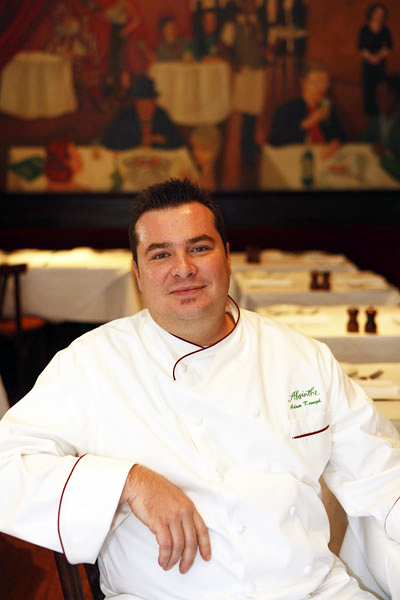
Outside of Schmidts looking in to the restaurant
Outside of Schmidt's looking into restaurant. Photo by Aimee Shapiro

One day last week, the lady and I had plans to visit Schmidt's for dinner. When we're deciding what to eat, we tend to favor collaboration and compromise, at least I do. Sometimes, rarely, our tastes don't intersect, and I always want to find dishes we both want, even if it means passing on something I'd really, really like to try. In the case of Schmidt's, a sleek, two month-old German eatery in the Mission District, I knew what I wanted, and would accept no proxies: hasenpfeffer, a red wine-soaked saddle and leg of rabbit with braised lingonberry-sweetened cabbage. In the hours leading up to our meals together, we typically examine menus online and discuss what appeals via texts and emails. Frequently, we have a pretty good idea of what we'll order before we walk through the restaurant's doors. On this occasion, I'd done my research, and knew, without question, that I had to hit that hop. The problem was, I wasn't so sure my lady would dance with me.

I positioned myself accordingly. At around 1:00 p.m., I sent off a quick text:

Was thinking about bunny. Now not so sure.

Her swift response, even more succinct, confirmed my fears:

I will not eat the bun.

Disappointed yet far from resigned, I honed a strategy. It was too early for negotiations. I ate lunch and crafted a diversionary text, giving the impression I was feeling flexible and perhaps willing to eat something else altogether:

Salad good. Still hungry. Tonight maybe fish if on special.

Rabbit is a polarizing meat. The world is full of people like my lady: hyper-carnivorous, adventurous gourmets who gleefully inhale piles of Korean barbecue, fried chicken dinners, and entire flocks in the form of steaming shawarmas, yet turn meek and wane at the prospect of the Easter Bunny, sauteed, on a plate. Rabbits are cute but surely no cuter than fuzzy sheep, baby chickens, and pink piglets -- cuddly creatures we're generally more comfortable cooing over and then, respectfully, consuming. Rabbits are also pets, but even those of us who have never fed and groomed one feel as if we know them. From folklore-steeped tricksters Bugs and Bre'er, to Thumper, Alice's elusive White, and the whole floppy-eared cast of Watership Down, the rabbit has an enduring and frequently anthropomorphized presence in popular culture, one that surpasses those of other commonly eaten animals. In whatever form, such familiar images, voices, stories, and carried connotations grip folks, and that, more than a real rabbit's bobbing tail, vacuous little eye-specks, and pink twitching nose, contributes to the skittishness diners display when there's hare to be had.

In many cultures, rabbits are a symbol of fertility and rebirth. They're associated with the season Spring and, of course, Easter. In real-life, they're viewed as gentle, vegetarian, harmless, and, despite their breeding proclivities, somehow suggestive of innocence. However, to gardeners like my mother in Louisville, Kentucky, they are far from innocent or harmless; they are a nuisance, a virulent menace fond of hopping, rustling and sniffing, through the backyard shrubbery every April to terrorize lettuce, cucumbers, squash, beans, herbs, and flowers. My mom doesn't hunt or even eat meat, but I doubt she'd mind if Elmer Fudd and Yosemite Sam showed up one year, shotguns at the ready, to declare war on her tormentors, and keep the neighborhood bistro stocked with lapin all summer long.

Back in San Francisco, it was 6:30 p.m. My lady and I rolled into Schmidt's, ravenous. As I'd suspected, there was no fish on special. My lady wanted a sausage, which was fine by me. We had to find another entree. I knew exactly what that had to be but I had to bide my time. If she sensed my profound resolve, she did not let on.

"I just don't think I can do it," she said, her eyes peering out, just barely visible above the menu held in front of her face.
"Do what?" I asked, feigning cluelessness.
"The bunny," she said, sighing. "I'm sure it's amazing, but I don't want to eat it."
"It's cool," I answered, sort of shrugging lightly and waving my hands as if I didn't care. "No bunny, no problem. I'll get a sausage too, maybe the duck one."
"Two sausages? They don't make the sausages here. If you're writing about this, we should get something they make here too," she said, ignoring my allusion.
"Well, I don't want blood sausage or the veal," I countered, gesturing towards the listing for an egg-topped schnitzel festooned with white anchovies, capers, and cauliflower. It was time to play hardball, to throw down cards, and make a final, decisive play. "I'm getting the rabbit," I said, folding my menu and reaching for the beer list. "Will you eat it?" I didn't look up as I spoke, trying to appear focused on selecting an appropriate brew.
There was a pause. "Hell yes."

And so, maneuvering ceased; we were eating rabbit.

In the classic 1949 cartoon Bowery Bugs, Bugs Bunny, pacing in circles around his den, carrot in mid-gnaw, makes, in that distinctive, chattering, Flatbush bark, his case for survival to a downtrodden New York City bookie in search of a good luck charm. "These rabbit's feet never brought me any luck," Bugs points out, pleading. "Look at the lives rabbits lead: Dogs, hunters, and hasenpfeffer."

rabbit
Hasenpfeffer, a red wine-soaked saddle and leg of rabbit with braised lingonberry-sweetened cabbage. Photo by Aimee Shapiro

Bugs could use some perspective. If the version at Schmidt's serves as any indication, hassenpfeffer is an unpretentious yet noble and exceedingly delicious way for a rabbit to end up. For a goofy, unintelligent, nervous wreck of a mammal, this beast sure tastes serious, deep, and soulful after a trip through chef Matt Shapiro's kitchen. Sweet shards of pale meat tumble off delicate bones rising up from a creamy, golden moat of rich sauce, a purple mountain of cabbage looming behind. The picture currently floating around the Internet (to be fair, in the company of a positive, well-crafted mention) unfortunately makes Shapiro's hassenpfeffer look like a symptom of an obscure, unsavory medical condition, or something from one of the Alien movies, a mound of extraterrestrial dung, perhaps. I sympathize. My first crack at pictures in the restaurant's dark dining room turned out so badly I had to outsource art to a real photographer.

Bean Salad
Bean Salad. Photo by Aimee Shapiro

The rabbit was the defining triumph but not so magnificent as to obscure the rest of the meal: an excellent Thuringer brat, snappy and juicy, best with a touch of an amazing sweet mustard (Schmidt's sells it, along with other German products such as mini-wieners, bottled, floating in water), a subtle, nutty, toothsome salad of green and waxed bean strips with hazelnuts, fried sage, and a citrus vinaigrette, and spaetzle, sans cheese, in fluffy, mild strands, like scrambled eggs colliding with a bowl of cereal -- in a good way. Far from the sort of heavily branded hot-spot designed to lure diners from around the city, Schmidt's is a new neighborhood gem the neighborhood can actually afford -- truly, simply, a very fine place to eat, much like Walzwerk, the owners' first restaurant, though more austere in appearance, with better food. We ordered some bread too, with the idea we'd use it to sop up every last bit of rabbit essence. This was unnecessary. The rabbit came with plenty of bread, the dense, heavy German sort. Unlike less refined purveyors of wurst, Schmidt's doesn't bludgeon you with excessive portions. Bread abuse in the line of duty -- respect for the rabbit's last luscious remnants -- caused me to walk at a 45 degree angle all the way home, stuffed, my body unable to conjure energy for any task beyond digestion. Yet even as I limped, 'kraut-addled, harebrained, breaded, and in need of a comfortable chair, part of me wanted to head back, to find a way to eat some more rabbit. To rock it, to roll it, slop it, and stroll it, once again -- at the hop.

Schmidt's
2400 Folsom St
(between 20th St & 21st St)
San Francisco, CA 94110
(415) 401-0200
*Cash only

posted by | posted in restaurants, bars, cafes, reviews, san francisco | 3 Comments
tags: , ,

Subscribe to BABrss posts

BAB Archives

  • Calendar

  • February 2012
    M T W T F S S
    « Jan    
     12345
    6789101112
    13141516171819
    20212223242526
    272829  
  • Sponsored by