personalized learning

RECENT POSTS

What It Takes to Become an All Project-Based School

New-Tech-students

New Tech Network

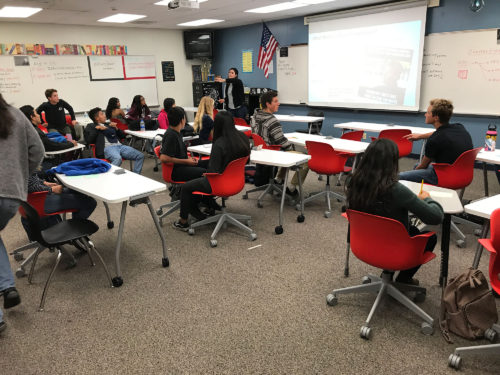
In many schools, project-based learning happens in isolated cases: in certain teachers’ classrooms here and there, or in the contexts of specific subjects. But for students to benefit from project-based learning, ideally it’s part of a school’s infrastructure — a way to approach learning holistically.

For one quickly growing network of schools, project-based learning is the crux of the entire ecosystem. New Tech Network, which was founded 15 years ago, is taking its school-wide project-based model to national scale. The organization, which offers a paid program for schools to use its model, began with a flagship school in Napa and has grown to 120 schools in 18 states, most of which are public schools.

The network has not only grown in size, but also in notoriety. President Obama visited Manor New Tech High School in Texas last week, as part of an effort to promote an education agenda focused on producing graduates that can compete in today’s global economy.

The nod from the president comes at a time when New Tech is attempting to position itself as a successful model to follow. But rather than relying on test scores and such quantifiable numbers to prove its value, New Tech’s own 2013 annual report frames success by focusing on deeper learning that can’t be measured by standardized test scores and their college readiness. Yet it’s that lack of emphasis on test scores, an all-consuming worry for many districts, that makes it more difficult for the organization to pin point numbers to tell its story.

“From where we stand, public school districts are as capable of innovative schools as charter schools.”

Here are a few of the statistics New Tech has gathered from their schools: students graduate at a rate six percent higher than the national average and enroll in college nine percent more than the average. They also persist in four-year universities at a 17 percent higher rate and 46 percent higher rate when it comes to two year colleges. Perhaps most importantly, they claim that Continue reading

In an Era of Global Competition, What Exactly Are We Testing For?

test-taking

Renato Ganoza/Flickr


In this era of global competition, test scores are used as the primary benchmark to call out which countries will produce “successful” students. Knowing that American students are competing against a global pool of the best and brightest has led education leaders to focus more on how they score on international tests compared to students from other countries.

But high test scores don’t provide a complete picture of students’ success, according to Yong Zhao, world-renown author, scholar, and professor of education at University of Oregon.

“Countries that score highly, have students with lower confidence,” Zhao said in his keynote address to educators gathered online for the 2013 Leadership Summit.

That seems counter-intuitive, and Zhao isn’t claiming a causal connection — he questions whether focusing on test scores might inadvertently lower confidence. Zhao has analyzed data from the Trends in International Mathematics and Science Study (TIMSS) and discovered a negative correlation between high math scores and confidence.

“Countries that score highly, have students with lower confidence.”

Similarly, in his analysis of the Program for International Student Assessment (PISA), a test that analyzes how countries score in reading, math and science, Zhao found a negative correlation between attitude and attainment. In other words, the countries with lower scores had students who reported higher interest in the subjects. Zhao analyzed media stories from high scoring countries like Korea and Japan, where students don’t show enough confidence or enthusiasm for subjects in which they excel.

He found the same results when he looked at students’ belief in their entrepreneurial capacity, their ability to start businesses or be self-starters. “Everybody is trying to perfect this system and make Continue reading

7 Essential Principles of Innovative Learning

kids in class

Flirck:WoodleyWonderworks

Every educator wants to create an environment that will foster students’ love of learning. Because the criteria are intangible, it’s difficult to define or pinpoint exactly what they are. But one group is giving it a try.

Researchers at the Organization for Economic Cooperation and Development (OECD) launched the Innovative Learning Environments project to turn an academic lens on the project of identifying concrete traits that mark innovative learning environments. They sifted through and categorized the research on learning science, documented case studies, and compiled policy recommendations they hope will transform the current system.

Their book, The Nature of Learning: Using Research to Inspire Practice and the accompanying practitioner’s guide, lay out the key principles for designing learning environments that will help students build skills useful in a world where jobs are increasingly information and knowledge-based. The principles are not job-specific – no one knows what the future economy will demand. Instead, the main goal is to develop self-directed learners, students with “adaptive expertise.”

“Adaptive expertise tries to push beyond the idea of mastery,” said Jennifer Groff, an educational engineer and co-founder of the Center for Curriculum Redesign. “You may be proficient, but without adaptive expertise you can get stuck very quickly as the world shifts.”

[RELATED READING: How Can Teachers Prepare Kids for a Connected World]

Groff doesn’t dispute that mastery is important and that students need to learn age-appropriate content, but she also argues it’s equally important to develop students’ ability to go beyond that, to question and apply learning in new situations.

To that end, these are their identified principles for innovative learning.

  1. 1.Learners have to be at the center of what happens in the classroom with activities focused on their cognition and growth. They have to actively engage in learning in order to become self-regulated learners who are able to control their emotions and motivations during the study process, set goals, and monitor their own learning process.
  2. 2. Learning is a social practice and can’t happen alone. “By our nature we are social beings and we learn by interacting,” Groff said. “We learn by pushing and pulling on concepts with Continue reading

Amidst a Mobile Revolution in Schools, Will Old Teaching Tactics Work?

Getty

Just a few years ago, the idea of using a mobile phone as a legitimate learning tool in school seemed far-fetched, if not downright blasphemous. Kids were either prohibited from bringing their phones to school, or at the very least told to shut it off during school hours.

But these days, it’s not unusual to hear a teacher say, “Class, turn on your cell. It’s time to work.”

Harvard professor Chris Dede has been working in the field of education technology for decades, and is astonished at how quickly mobile devices are penetrating in schools. “I’ve never seen technology moving faster than mobile learning,” said Dede, who teaches at the Harvard Graduate School of Education.

That’s not necessarily surprising, given that a staggering 80 percent of teens have cell phones. This penetration of mobile devices in the consumer market has also wrought what Dede describes as a “sea change” in the education landscape.

“People are talking about this being an inflection point,” said Elliot Soloway. Soloway is a professor at the School of Education at the University of Michigan, and a longtime proponent of mobile learning. “It feels like something major is about to happen. It went from a silly idea, to, ‘Of course it’s inevitable.”

“I’m petrified that we’ll apply new technology to old pedagogy.”

The most recent data available is from 2010, and indicates that 62 percent of schools allow cell phones to be used on school grounds, though not in classrooms. But both Dede and Solloway, who are closely involved in coaching schools on how to use mobile learning techniques, said a lot of progress has been made in just the past couple of years.

“What I’m hearing from schools more is that they’ve eliminated policies restricting using mobile devices for learning and they’re interested in developing mobile learning programs as fast as possible,” Dede said. “We’re going from districts fearing it and blocking it off to welcoming it and making it a major part of their technology plan. We’ll be surprised if a significant portion of districts aren’t using mobile learning inside and outside of schools soon.”

More than 1.5 million iPads have been deployed in schools. That’s not counting school-supplied non-Apple devices, or the most ubiquitous device of all — students’ own mobile phones.

Classroom uses for iPads and cell phones are vast and varied. Some schools are replacing print books for apps that feature videos and interactive quizzes. Kindergarteners are Continue reading

Can Apple Products Pave the Way to Personalized Learning?

Lenny Gonzalez

San Francisco middle school students watch instructional videos on their school-issued iPads.

Apple held a press event today at its Cupertino headquarters, unveiling a variety of improvements to its line of iPods and iPhones, including an update to its mobile operating system and a brand new version of its wildly popular iPhone. As always happens around these Apple announcements, there’s a flurry of excitement — before, during, and after — about what the company will reveal. Other tech companies hold similar press events, sure, but few seem to garner as much buzz as Apple’s.

Some of that allure came from its former CEO. When Steve Jobs announced in August that he was stepping down from his position as CEO, there was a massive outpouring of reflections and analyses by the technology press about the impact that he and his company have had on technology — on both hardware and software. Indeed, it’s hard to understate that impact when you look at the role that Apple played in the development and adoption of personal computers, portable music devices, mobile phones, and tablets. By extension, Apple’s influence has helped usher in new opportunities for digital content in the entertainment and publishing industries.

And, of course, the company has had a huge impact on education. Apple has had a long history of pushing its computers into the classrooms. For many years, a child’s first exposure to a computer had been at school, and often that computer was an Apple. The company made a push back in the Continue reading

Can a Smart Phone Program Really Close the Achievement Gap?

Students from different geographic regions communicate socially, but also to help each other achieve the common goal of succeeding at Algebra 1.

Flickr: from_ko

When asked what tech tools students would like to use in learning science and math, their reply was no surprise: “They said they wanted something that would utilize social networking technology — something portable. Overwhelmingly, they wanted to use a smart phone,” said Project K-Nect founder and director Shawn Gross about his interview with  Washington, D.C. area- kids five years ago.

“Students told us that the subject matter was too abstract, there wasn’t enough [real-world] application, that they were having difficulty with the instructional methods. They thought technology might be a way to change that,” says Gross.

With that directive in mind, Project K-Nect’s social-media-based curriculum combines project and collaborative learning with new media learning for the 3,000 high schoolers in three states who currently participate.

The initial goal of the nonprofit — launched in North Carolina in 2007 with the support of Qualcomm’s Wireless Reach Initiative and other organizations and now also in place in Ohio and Virginia — was to increase student performance in STEM subjects, particularly in low-income areas. The requirement, therefore, for Project K-Nect’s participating schools, is that at least 50 percent of the student body qualify for free or reduced lunch.

The majority of the students we started with in 2007-2008 school year went on to take an AP Calculus course or are currently enrolled in AP Statistics.”

Do smart phones help low-income, at-risk student populations learn math? Yes, most definitely, says Gross. The majority of participating students scored 20 percent higher on standardized tests than their peers in the same school and 30 to 40 percent higher than students in the district and state after a single year. (Click here to see a full research report on the program in Onslow County, North Carolina).

But for very high-risk students — such as those who are homeless or are attending school primarily for a free lunch — the technology-integrated math class is not as likely beneficial, Gross says. There is a lot more going on in that student’s life than academia, and curriculum alone won’t change that.

“It’s hard to just say ‘at-risk students,’ — there are different categories of at-risk students,” he says. “The bottom line is we see increased student achievement and engagement because this is a media that students feel comfortable utilizing. It’s an outlet to be able to express themselves in a totally different fashion.”

ON HOW IT WORKS:

“Initially, we partnered with Drexel University and Florida State University to create the curriculum. We built a comprehensive set of Algebra 1 resources: all the components related to instant messaging and blogging, assessment tools for teachers, supplemental activities, project-based learning components, problem sets, and cartoon animation. There are basically mini apps for every unit of instruction that get pushed out to a student’s device.

Teachers speak for 10 or 15 minutes about the fundamentals of the unit and give some instruction, then pass it to students who work in teams to create videos that describe the steps students need to take to arrive at proficiency [in Algebra 1]. Then, teachers ask the kids to apply the math to something. They post the videos up into the blogs [that all Project K-Nect's participating students share]. When they run into stumbling blocks they create a video and tag it with ‘SOS.’ One of the schools will pick up an SOS tag within a matter of minutes and will respond back, either using instant messaging or a video response.

[Visit Project K-Nect's blog to see example videos of what students are doing.]

WHY IT WORKS:

“Social networking is heavily questioned by adults, so at first, no one thought students were going to be using blogs to actually do math. It turned out that those adults were dead wrong. Students from different geographic regions were communicating socially, sure, but they were also communicating to help each other to achieve this common goal of succeeding at Algebra 1. They were taking control of the learning process and creating personalized learning communities.

And what has been really dramatic are the changes in instructional strategies in the classroom. Teachers have gone from lecture-style textbooks to a completely different approach: It’s project-based learning design that they’re doing, now.

What’s surprising — in a good way — is that the majority of the students we started with in 2007-2008 school year went on to take an AP Calculus course or are currently enrolled in AP Statistics. In this district [Jacksonville, North Carolina], typically only about 2 percent of Algebra 1 students will go on to take AP math course. Now, those students are sitting in an AP class in their senior year.”