inquiry learning

RECENT POSTS

Inquiry Learning Vs. Standardized Content: Can They Coexist?

497411105_60c65df8ba_z

Flickr: umjanedoean

By Thom Markham

As Common Core State Standards are incorporated from school to school across the country, educators are discussing their value. It may seem that educators are arguing over whether the CCSS will roll out as a substitute No Child Left Behind curriculum or as an innovative guide to encourage inquiry rather than rote learning. In reality, as time will prove, we’re arguing over whether content standards are still appropriate.

Everyday there is less standardization of information, making it nearly impossible to decide what a tenth-grader should know. Beyond the core literacies of reading, writing, computation, and research, the world-wide culture of innovation, discovery, multi-polarity, interdisciplinary thinking, and rapid change depends on the explosive potential of the human mind, not entombed truths from the past. Increasingly, any standards-based curriculum is at odds with the outside world.

There is only one resolution to the debate. Sooner or later, inquiry-standards will take precedence over content-based standards. Education’s core task is to prepare young people to generate new ideas, filter them through a net of critical analysis and reflection, and move the ideas through a design process to create a quality product, either as an idea or a material object. Students need information, facts, and specific knowledge for a successful outcome. But that information must be gathered during the process of creation, in a usable, just-in-time format not found in “subjects.”

If you’re a teacher in tune with the needs of your students, you sense the disconnect between the curriculum and reality. You’d like the freedom to respond more directly to student needs, but standardized information and testing remains a barrier to innovative teaching.

So how can you, as a teacher, help move the dialogue forward? First, you can focus on becoming a highly-effective project based learning (PBL) teacher. When done well, PBL is the most effective method education has at the moment to introduce and practice inquiry-based education. Continue reading

5 Tools to Help Students Learn How to Learn

idea-map-Jamie-Nast

Jamie Nast/Flickr

Helping students learn how to learn: That’s what most educators strive for, and that’s the goal of inquiry learning. That skill transfers to other academic subject areas and even to the workplace where employers have consistently said that they want creative, innovative and adaptive thinkers. Inquiry learning is an integrated approach that includes kinds of learning: content, literacy, information literacy, learning how to learn, and social or collaborative skills. Students think about the choices they make throughout the process and the way they feel as they learn. Those observations are as important as the content they learn or the projects they create.

“We want students thinking about their thinking,” said Leslie Maniotes a teacher effectiveness coach in the Denver Public Schools and one of the authors of Guided Inquiry: Learning in the 21st Century. “We want them reflecting on the process and the content.” Inquiry learning works best on longer, deep dive projects when students have to create something of their own out of what they’ve found.

“When they are able to see where they came from and where they got to it is very powerful for them.”

A good example is a long term research project. There are several common stages in longer projects and researchers have studied how students feel, think and act around the different stages. Students initiate the project, select a topic, explore it further, begin to formulate an approach, collect specific materials relevant to a focus and finally present on their findings.

During the process, students will go through different stages of emotions. They might feel Continue reading

How Emotional Connections Can Trigger Creativity and Learning

3113816327_9a3e7bdaff_z

Flickr: fhwrdh

Scientists are always uncovering new ways into how people learn best, and some of the most recent neuroscience research has shown connections between basic survival functions, social and emotional reactions to the world, and creative impulses.

Students’ social and emotional reactions to learning are imperative to feeling motivated to learn and to their ability to creatively solve problems, according to Mary Helen Immordino-Yang, who wrote Musings on the Neurobiological and Evolutionary Origins of Creativity via a Developmental Analysis of One Child’s Poetry [PDF]. Her research tries to understand why emotions are so important to learning by examining what happens to brain functions.

“Neuroimaging experiments show us that we use the very same neural systems to feel our bodies as to feel our relationships, our moral judgments, and our creative inspiration,” said Immordino-Yang, a professor at USC’s Rossier School of Education and an expert on the neuroscience of learning and creativity. Her whose work focuses on how neuroscience can help teachers understand the ways students learn best, and to that end, she’s created a free online curriculum for teachers.

“Help kids know how to make meaning and sense of what they are learning so they can see who they are.”

The neuromechanisms responsible for feeling and managing the body’s physical survival and consciousness have been co-opted to also manage social survival. “Survival in the savanna depends on a brain that is wired to make sense of the environment, and to play out the things it notices through patterns of bodily and mental reactions,” Immordino-Yang writes. “This same brain, the same logic, helps us make sense of and survive in the social world of today.” To make something relevant to a learner, it should inspire an emotional reaction in the person, triggering these survivalist parts of the brain that indicate something is important.

[RELATED: Teaching Social and Emotional Skills in School]

“The way that we make meaning out of situations, and the way that we feel and evaluate things, is plated on the same neural platforms as do the basic job of managing our viscera,” Immordino Yang said. When a topic strikes a chord with a student it feels meaningful because the part of his brain firing is the same part that keeps him conscious and alive. It’s also the part of the brain responsible for novel, creative or new ideas.

“Creativity is representing some kind of relevant problem in a new way and making people Continue reading

Creating Classrooms We Need: 8 Ways Into Inquiry Learning

7171535345_65369bbb0b_z

Flickr: Scratchpost

If kids can access information from sources other than school, and if school is no longer the only place where information lives, what, then happens to the role of this institution?

“Our whole reason for showing up for school has changed, but infrastructure has stayed behind,” said Diana Laufenberg, who taught history at the progressive public school Science Leadership Academy for many years. Laufenberg provided some insight into how she guided students to find their own learning paths at school, and enumerated some of these ideas at SXSWEdu last week.

1.   BE FLEXIBLE.
The less educators try to control what kids learn, the more students’ voices will be heard and, eventually, their ability to drive their own learning. But that requires a flexible mindset on the part of the teacher. “That’s a scary proposition for teachers,” Laufenberg said. “‘What do you mean I’m going to have 60 kids doing 60 different projects,’ teachers might say. But that’s exactly the way for kids to do interesting, high-end work that they’re invested in.”

Laufenberg recalled a group of tenacious students who continued to ask permission to focus their video project on the subject of drugs, despite her repeated objections. She finally relented — with the caveat that they not resort to cliches. In turn, the students turned in one of the best video projects she’d ever seen: a well-produced, polished video about Americans’ dependence on pharmaceutical drugs that was dense with facts backed up by students’ research. “And I almost killed this project,” she said. “There are vastly creative minds that are Continue reading

Alan November: How Teachers and Tech Can Let Students Take Control

IMG_8845

Erin Scott

For many educators, helping students direct their own learning is a priority. Educator and author Alan November, who has been talking about ways to get students to own their learning for years, draws on his experiences as a teacher, principal and education consultant to tell stories about some of the ideas he sees as integral to education.

November joined Steve Hargadon in a discussion of his new book Who Owns the Learning: Preparing Students for Success in the Digital Age, stressing the importance of global collaboration and the role of technology in making it all possible. Here are a few highlights from their discussion.

SCHOOL STRUCTURE CAN HOLD STUDENTS BACK

School often means rules and regulations that can seem unrelated to the broader goals of education. Students are told to sit down, be still, show up at specific times, and demonstrate knowledge in ways that have nothing to do with the real world. As a case in point, November talked about when he started his teaching career at a reform school for boys where the administration took rules seriously. He discovered that one of his students had been breaking into his classroom to practice coding at night. The student showed a rare passion for a subject that wasn’t even being taught at that time, stayed focused on the task and was self-directed – qualities normally valued by educators. At a time when few people knew even how to use a computer, this boy was teaching himself to code. But none of it mattered to an administration more concerned that he’d broken the rules.

“We might have robbed kids’ natural ability to take control of defining their own problems by spoon feeding them little tiny problems one at a time.”

November pointed out the similarities between learning to code and the movement toward instant feedback with some of the newest ed tech tools: engineers can test a string of code to see if it works, retrace steps to figure out where it went wrong if it doesn’t. In the same way, many blended learning methods provide the same kind of instant feedback into the classroom, allowing both the Continue reading

How to Fuel Students’ Learning Through Their Interests

IMG_8793

Erin Scott

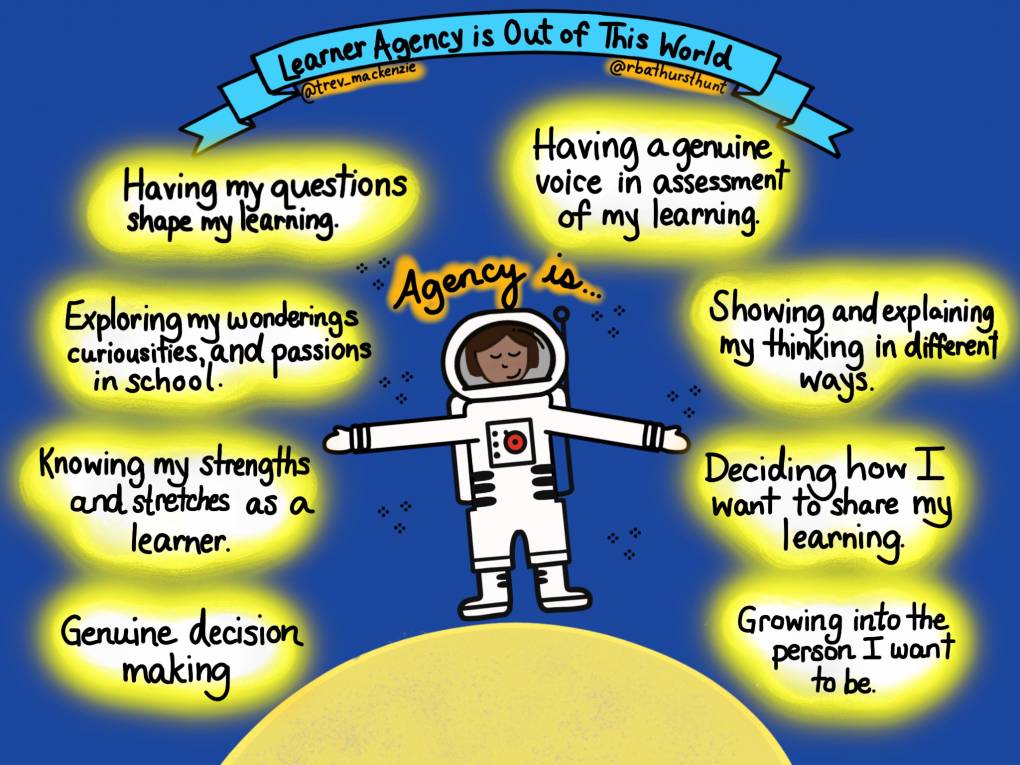
For David Preston, the term “open source learning” — a variation on inquiry learning or passion-based learning –  is about helping students choose their own learning path, an approach that already has some well-known champions among educators.

“When I think of ‘open source,’ it isn’t about software, but thermodynamic systems,” said Preston, who currently teaches at Ernest Righetti High School in Santa Maria, Calif. “You’re not just exchanging heat, but you’re switching environment and structure.”

Preston’s current classroom centers around the publication and maintenance of students’ personal blogs. The blogs themselves are a requirement, but the content and medium used in many student responses—be it text, video, audio, or some combination—are often the result of students’ own creative vision. Preston also pushes students to think critically about the implications of their digital actions through virtual discussions with collaborators, such as digital renaissance man Howard Rheingold, Canadian blogger, journalist, activist and author Cory Doctorow, and the National Institute for Technology in Liberal Education’s Bryan Alexander, among others.

“I still teach with standards in mind. I just teach inductively from the standards instead of using them as the ceiling.”

But when Preston began teaching at Los Angeles’ James Monroe High School in the pre-social-media world of 2005, he accomplished many of the same goals by assigning pen-and-paper, open-ended journal entries and holding class-wide debates driven by research from honest-to-goodness, hard-bound books. He also says there’s still room in open source teaching for academic standards, and that the common standards movement is important in terms of creating benchmarks for students nationwide.

“I still teach with standards in mind,” he said. “I just teach inductively from the standards instead of using them as the ceiling.”

What is the ceiling? That’s up to each individual teacher. But here’s a look inside the tools and Continue reading