Voice, Chat and DM: Remote Learning Tools That Make Sense In Person
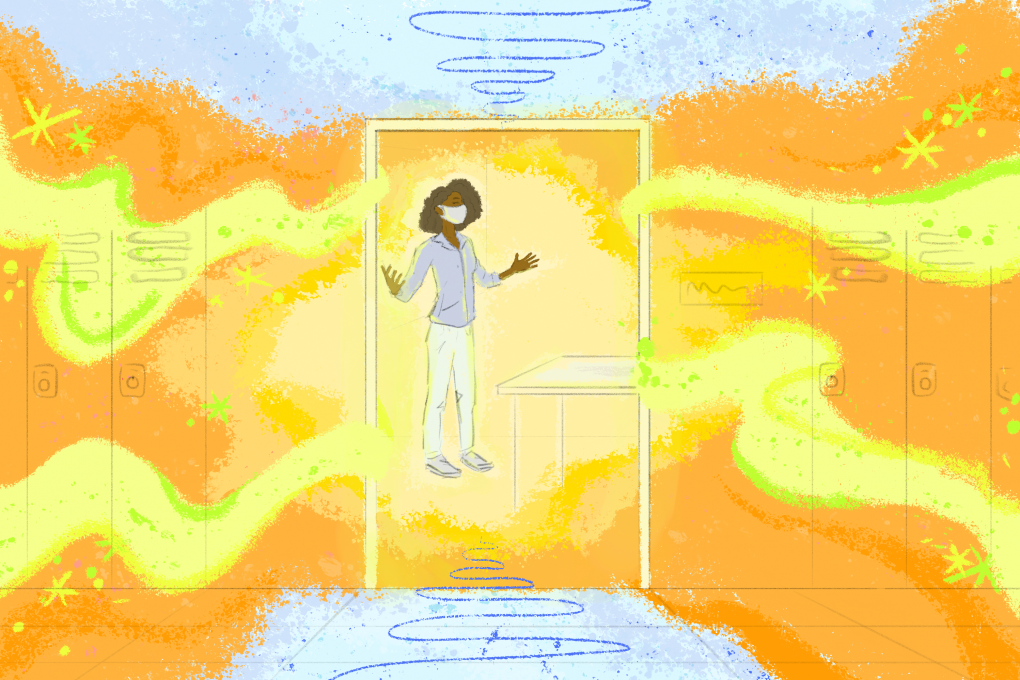
'We Need To Be Nurtured, Too': Many Teachers Say They're Reaching A Breaking Point
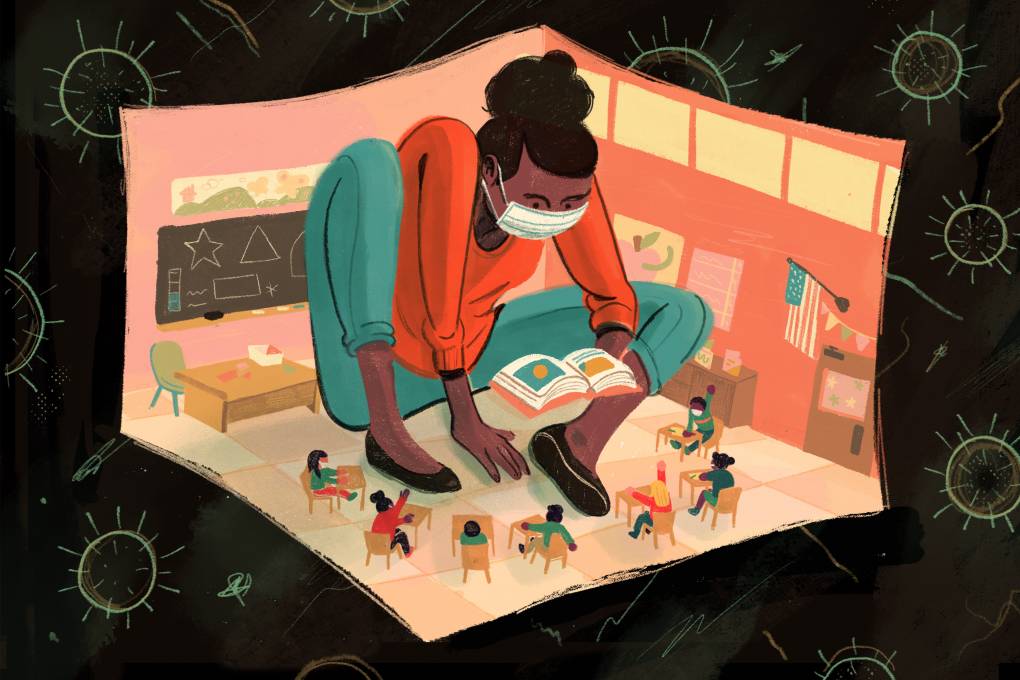
After A Year Of Remote Classes, Teachers Are Meeting Students For The First Time
New Data Highlight Disparities In Students Learning In Person vs. Remotely
CDC Says Schools Can Now Space Students 3 Feet Apart, Rather Than 6
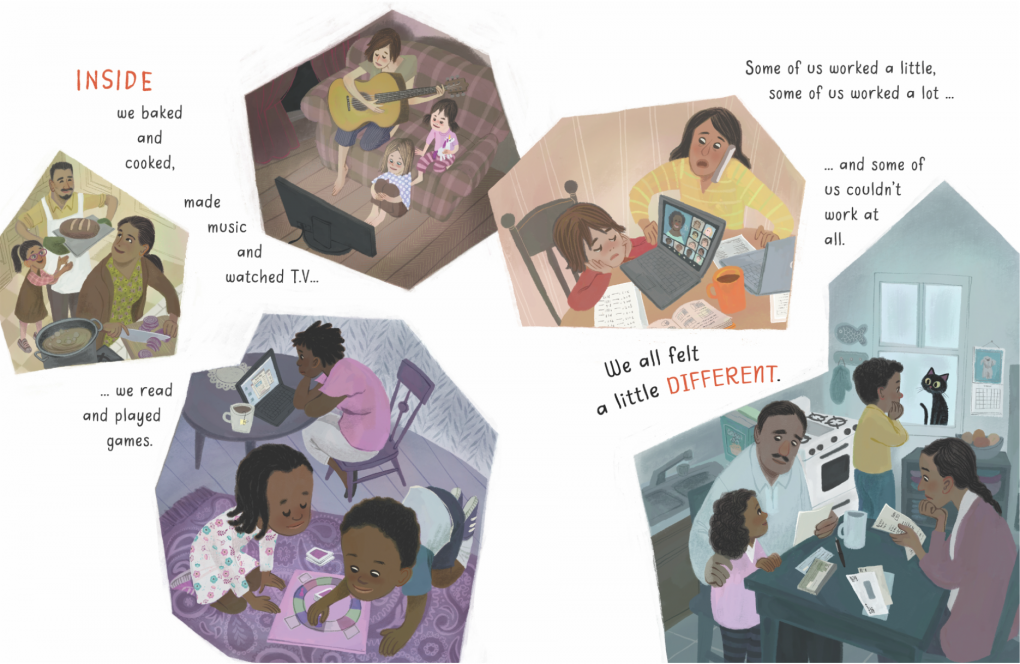
‘Outside, Inside’ Is a Time Capsule That Helps Kids and Adults Reflect on Pandemic Life
A Year Of School Like No Other: How A Teacher, A Student And A Parent Have Coped
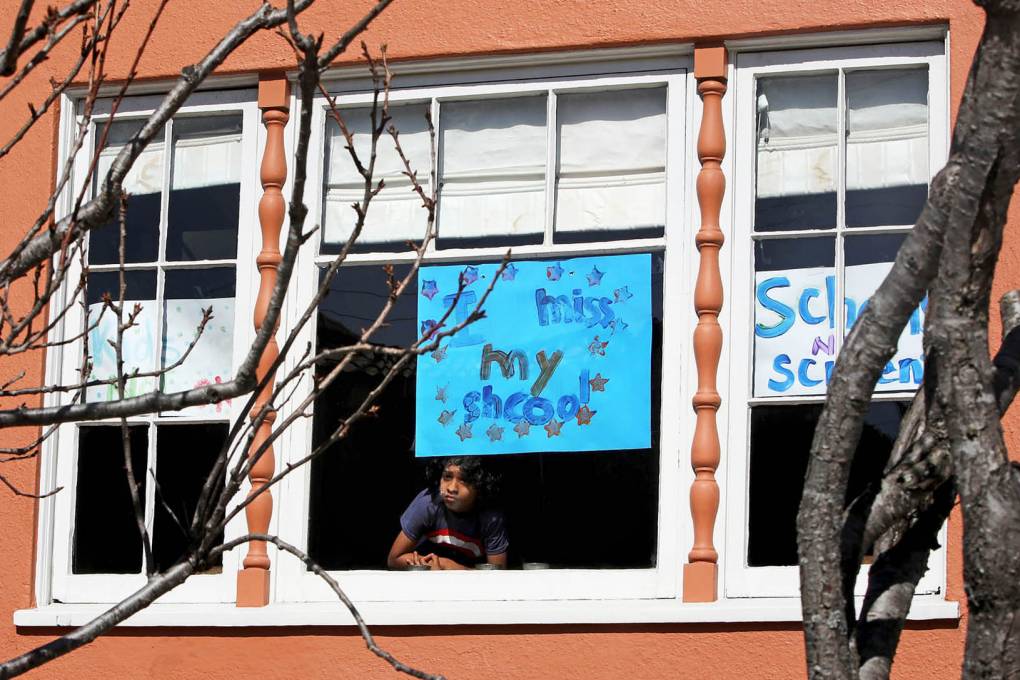
NPR/Ipsos Poll: Nearly One-Third Of Parents May Stick With Remote Learning
What the Research Says About School Reopening and COVID-19 Transmission
Sponsored
window.__IS_SSR__=true
window.__INITIAL_STATE__={"attachmentsReducer":{"audio_0":{"type":"attachments","id":"audio_0","imgSizes":{"kqedFullSize":{"file":"https://ww2.kqed.org/news/wp-content/themes/KQED-unified/img/audio_bgs/background0.jpg"}}},"audio_1":{"type":"attachments","id":"audio_1","imgSizes":{"kqedFullSize":{"file":"https://ww2.kqed.org/news/wp-content/themes/KQED-unified/img/audio_bgs/background1.jpg"}}},"audio_2":{"type":"attachments","id":"audio_2","imgSizes":{"kqedFullSize":{"file":"https://ww2.kqed.org/news/wp-content/themes/KQED-unified/img/audio_bgs/background2.jpg"}}},"audio_3":{"type":"attachments","id":"audio_3","imgSizes":{"kqedFullSize":{"file":"https://ww2.kqed.org/news/wp-content/themes/KQED-unified/img/audio_bgs/background3.jpg"}}},"audio_4":{"type":"attachments","id":"audio_4","imgSizes":{"kqedFullSize":{"file":"https://ww2.kqed.org/news/wp-content/themes/KQED-unified/img/audio_bgs/background4.jpg"}}},"placeholder":{"type":"attachments","id":"placeholder","imgSizes":{"thumbnail":{"file":"https://ww2.kqed.org/wp-content/uploads/sites/10/2018/01/GettyImages-896326950-160x96.jpg","width":160,"height":96,"mimeType":"image/jpeg"},"medium":{"file":"https://ww2.kqed.org/wp-content/uploads/sites/10/2018/01/GettyImages-896326950-800x478.jpg","width":800,"height":478,"mimeType":"image/jpeg"},"large":{"file":"https://ww2.kqed.org/wp-content/uploads/sites/10/2018/01/GettyImages-896326950-1020x610.jpg","width":1020,"height":610,"mimeType":"image/jpeg"},"fd-lrg":{"file":"https://ww2.kqed.org/wp-content/uploads/sites/10/2018/01/GettyImages-896326950-1920x1148.jpg","width":1920,"height":1148,"mimeType":"image/jpeg"},"fd-med":{"file":"https://ww2.kqed.org/wp-content/uploads/sites/10/2018/01/GettyImages-896326950-1180x705.jpg","width":1180,"height":705,"mimeType":"image/jpeg"},"fd-sm":{"file":"https://ww2.kqed.org/wp-content/uploads/sites/10/2018/01/GettyImages-896326950-960x574.jpg","width":960,"height":574,"mimeType":"image/jpeg"},"post-thumbnail":{"file":"https://ww2.kqed.org/wp-content/uploads/sites/10/2018/01/GettyImages-896326950-672x372.jpg","width":672,"height":372,"mimeType":"image/jpeg"},"twentyfourteen-full-width":{"file":"https://ww2.kqed.org/wp-content/uploads/sites/10/2018/01/GettyImages-896326950-1038x576.jpg","width":1038,"height":576,"mimeType":"image/jpeg"},"xxsmall":{"file":"https://ww2.kqed.org/wp-content/uploads/sites/10/2018/01/GettyImages-896326950-240x143.jpg","width":240,"height":143,"mimeType":"image/jpeg"},"xsmall":{"file":"https://ww2.kqed.org/wp-content/uploads/sites/10/2018/01/GettyImages-896326950-375x224.jpg","width":375,"height":224,"mimeType":"image/jpeg"},"small":{"file":"https://ww2.kqed.org/wp-content/uploads/sites/10/2018/01/GettyImages-896326950-520x311.jpg","width":520,"height":311,"mimeType":"image/jpeg"},"xlarge":{"file":"https://ww2.kqed.org/wp-content/uploads/sites/10/2018/01/GettyImages-896326950-1180x705.jpg","width":1180,"height":705,"mimeType":"image/jpeg"},"full-width":{"file":"https://ww2.kqed.org/wp-content/uploads/sites/10/2018/01/GettyImages-896326950-1920x1148.jpg","width":1920,"height":1148,"mimeType":"image/jpeg"},"guest-author-32":{"file":"https://ww2.kqed.org/wp-content/uploads/sites/10/2018/01/GettyImages-896326950-32x32.jpg","width":32,"height":32,"mimeType":"image/jpeg"},"guest-author-50":{"file":"https://ww2.kqed.org/wp-content/uploads/sites/10/2018/01/GettyImages-896326950-50x50.jpg","width":50,"height":50,"mimeType":"image/jpeg"},"guest-author-64":{"file":"https://ww2.kqed.org/wp-content/uploads/sites/10/2018/01/GettyImages-896326950-64x64.jpg","width":64,"height":64,"mimeType":"image/jpeg"},"guest-author-96":{"file":"https://ww2.kqed.org/wp-content/uploads/sites/10/2018/01/GettyImages-896326950-96x96.jpg","width":96,"height":96,"mimeType":"image/jpeg"},"guest-author-128":{"file":"https://ww2.kqed.org/wp-content/uploads/sites/10/2018/01/GettyImages-896326950-128x128.jpg","width":128,"height":128,"mimeType":"image/jpeg"},"detail":{"file":"https://ww2.kqed.org/wp-content/uploads/sites/10/2018/01/GettyImages-896326950-150x150.jpg","width":150,"height":150,"mimeType":"image/jpeg"},"kqedFullSize":{"file":"https://ww2.kqed.org/wp-content/uploads/sites/10/2018/01/GettyImages-896326950-e1514998105161.jpg","width":1920,"height":1148}}},"mindshift_57951":{"type":"attachments","id":"mindshift_57951","meta":{"index":"attachments_1591205162","site":"mindshift","id":"57951","found":true},"title":"iStock-1213537781","publishDate":1622793289,"status":"inherit","parent":57784,"modified":1622793321,"caption":null,"credit":"Olga Ignatova/iStock","altTag":null,"description":null,"imgSizes":{"medium":{"file":"https://ww2.kqed.org/app/uploads/sites/23/2021/06/iStock-1213537781-800x533.jpg","width":800,"height":533,"mimeType":"image/jpeg"},"large":{"file":"https://ww2.kqed.org/app/uploads/sites/23/2021/06/iStock-1213537781-1020x680.jpg","width":1020,"height":680,"mimeType":"image/jpeg"},"thumbnail":{"file":"https://ww2.kqed.org/app/uploads/sites/23/2021/06/iStock-1213537781-160x107.jpg","width":160,"height":107,"mimeType":"image/jpeg"},"medium_large":{"file":"https://ww2.kqed.org/app/uploads/sites/23/2021/06/iStock-1213537781-768x512.jpg","width":768,"height":512,"mimeType":"image/jpeg"},"1536x1536":{"file":"https://ww2.kqed.org/app/uploads/sites/23/2021/06/iStock-1213537781-1536x1024.jpg","width":1536,"height":1024,"mimeType":"image/jpeg"},"2048x2048":{"file":"https://ww2.kqed.org/app/uploads/sites/23/2021/06/iStock-1213537781-2048x1365.jpg","width":2048,"height":1365,"mimeType":"image/jpeg"},"post-thumbnail":{"file":"https://ww2.kqed.org/app/uploads/sites/23/2021/06/iStock-1213537781-672x372.jpg","width":672,"height":372,"mimeType":"image/jpeg"},"twentyfourteen-full-width":{"file":"https://ww2.kqed.org/app/uploads/sites/23/2021/06/iStock-1213537781-1038x576.jpg","width":1038,"height":576,"mimeType":"image/jpeg"},"full-width":{"file":"https://ww2.kqed.org/app/uploads/sites/23/2021/06/iStock-1213537781-1920x1280.jpg","width":1920,"height":1280,"mimeType":"image/jpeg"},"kqedFullSize":{"file":"https://ww2.kqed.org/app/uploads/sites/23/2021/06/iStock-1213537781-e1622793309859.jpg","width":1920,"height":1280}},"fetchFailed":false,"isLoading":false},"mindshift_57717":{"type":"attachments","id":"mindshift_57717","meta":{"index":"attachments_1591205162","site":"mindshift","id":"57717","found":true},"title":"A masked teacher sits squeezed in a classroom with her students.","publishDate":1619076557,"status":"inherit","parent":57716,"modified":1619076624,"caption":null,"credit":"Ryan Raphael for NPR","altTag":null,"description":null,"imgSizes":{"medium":{"file":"https://ww2.kqed.org/app/uploads/sites/23/2021/04/ryan-raphael_npr_teachers_slide-def39179ce36027a6c82ab9ce8e926d36a43f86d-800x533.jpg","width":800,"height":533,"mimeType":"image/jpeg"},"large":{"file":"https://ww2.kqed.org/app/uploads/sites/23/2021/04/ryan-raphael_npr_teachers_slide-def39179ce36027a6c82ab9ce8e926d36a43f86d-1020x680.jpg","width":1020,"height":680,"mimeType":"image/jpeg"},"thumbnail":{"file":"https://ww2.kqed.org/app/uploads/sites/23/2021/04/ryan-raphael_npr_teachers_slide-def39179ce36027a6c82ab9ce8e926d36a43f86d-160x107.jpg","width":160,"height":107,"mimeType":"image/jpeg"},"medium_large":{"file":"https://ww2.kqed.org/app/uploads/sites/23/2021/04/ryan-raphael_npr_teachers_slide-def39179ce36027a6c82ab9ce8e926d36a43f86d-768x512.jpg","width":768,"height":512,"mimeType":"image/jpeg"},"1536x1536":{"file":"https://ww2.kqed.org/app/uploads/sites/23/2021/04/ryan-raphael_npr_teachers_slide-def39179ce36027a6c82ab9ce8e926d36a43f86d-1536x1024.jpg","width":1536,"height":1024,"mimeType":"image/jpeg"},"2048x2048":{"file":"https://ww2.kqed.org/app/uploads/sites/23/2021/04/ryan-raphael_npr_teachers_slide-def39179ce36027a6c82ab9ce8e926d36a43f86d-2048x1365.jpg","width":2048,"height":1365,"mimeType":"image/jpeg"},"post-thumbnail":{"file":"https://ww2.kqed.org/app/uploads/sites/23/2021/04/ryan-raphael_npr_teachers_slide-def39179ce36027a6c82ab9ce8e926d36a43f86d-672x372.jpg","width":672,"height":372,"mimeType":"image/jpeg"},"twentyfourteen-full-width":{"file":"https://ww2.kqed.org/app/uploads/sites/23/2021/04/ryan-raphael_npr_teachers_slide-def39179ce36027a6c82ab9ce8e926d36a43f86d-1038x576.jpg","width":1038,"height":576,"mimeType":"image/jpeg"},"full-width":{"file":"https://ww2.kqed.org/app/uploads/sites/23/2021/04/ryan-raphael_npr_teachers_slide-def39179ce36027a6c82ab9ce8e926d36a43f86d-1920x1280.jpg","width":1920,"height":1280,"mimeType":"image/jpeg"},"kqedFullSize":{"file":"https://ww2.kqed.org/app/uploads/sites/23/2021/04/ryan-raphael_npr_teachers_slide-def39179ce36027a6c82ab9ce8e926d36a43f86d-scaled.jpg","width":2560,"height":1707}},"fetchFailed":false,"isLoading":false},"mindshift_57640":{"type":"attachments","id":"mindshift_57640","meta":{"index":"attachments_1591205162","site":"mindshift","id":"57640","found":true},"title":"Eda Uzunlar/NPR","publishDate":1617088950,"status":"inherit","parent":57639,"modified":1617089126,"caption":null,"credit":"Eda Uzunlar/NPR","altTag":null,"description":null,"imgSizes":{"medium":{"file":"https://ww2.kqed.org/app/uploads/sites/23/2021/03/teachernew_slide-149bf0393611eb75b19751585c934228661f0ae4-800x534.png","width":800,"height":534,"mimeType":"image/png"},"large":{"file":"https://ww2.kqed.org/app/uploads/sites/23/2021/03/teachernew_slide-149bf0393611eb75b19751585c934228661f0ae4-1020x680.png","width":1020,"height":680,"mimeType":"image/png"},"thumbnail":{"file":"https://ww2.kqed.org/app/uploads/sites/23/2021/03/teachernew_slide-149bf0393611eb75b19751585c934228661f0ae4-160x107.png","width":160,"height":107,"mimeType":"image/png"},"medium_large":{"file":"https://ww2.kqed.org/app/uploads/sites/23/2021/03/teachernew_slide-149bf0393611eb75b19751585c934228661f0ae4-768x512.png","width":768,"height":512,"mimeType":"image/png"},"1536x1536":{"file":"https://ww2.kqed.org/app/uploads/sites/23/2021/03/teachernew_slide-149bf0393611eb75b19751585c934228661f0ae4-1536x1025.png","width":1536,"height":1025,"mimeType":"image/png"},"2048x2048":{"file":"https://ww2.kqed.org/app/uploads/sites/23/2021/03/teachernew_slide-149bf0393611eb75b19751585c934228661f0ae4-2048x1366.png","width":2048,"height":1366,"mimeType":"image/png"},"post-thumbnail":{"file":"https://ww2.kqed.org/app/uploads/sites/23/2021/03/teachernew_slide-149bf0393611eb75b19751585c934228661f0ae4-672x372.png","width":672,"height":372,"mimeType":"image/png"},"twentyfourteen-full-width":{"file":"https://ww2.kqed.org/app/uploads/sites/23/2021/03/teachernew_slide-149bf0393611eb75b19751585c934228661f0ae4-1038x576.png","width":1038,"height":576,"mimeType":"image/png"},"full-width":{"file":"https://ww2.kqed.org/app/uploads/sites/23/2021/03/teachernew_slide-149bf0393611eb75b19751585c934228661f0ae4-1920x1281.png","width":1920,"height":1281,"mimeType":"image/png"},"kqedFullSize":{"file":"https://ww2.kqed.org/app/uploads/sites/23/2021/03/teachernew_slide-149bf0393611eb75b19751585c934228661f0ae4-e1617089103822.png","width":1920,"height":1281}},"fetchFailed":false,"isLoading":false},"mindshift_57596":{"type":"attachments","id":"mindshift_57596","meta":{"index":"attachments_1591205162","site":"mindshift","id":"57596","found":true},"title":"A new study reveals white students are being educated in person while students of color are mostly virtual.","publishDate":1616571839,"status":"inherit","parent":57595,"modified":1616571875,"caption":null,"credit":"LA Johnson/NPR","altTag":null,"description":"Coronavirus","imgSizes":{"medium":{"file":"https://ww2.kqed.org/app/uploads/sites/23/2021/03/hardtoteachonline-nprlajohnson_custom-4e8a1161a8376921cb50e74d201d0f8b891f46d6-800x416.jpg","width":800,"height":416,"mimeType":"image/jpeg"},"large":{"file":"https://ww2.kqed.org/app/uploads/sites/23/2021/03/hardtoteachonline-nprlajohnson_custom-4e8a1161a8376921cb50e74d201d0f8b891f46d6-1020x530.jpg","width":1020,"height":530,"mimeType":"image/jpeg"},"thumbnail":{"file":"https://ww2.kqed.org/app/uploads/sites/23/2021/03/hardtoteachonline-nprlajohnson_custom-4e8a1161a8376921cb50e74d201d0f8b891f46d6-160x83.jpg","width":160,"height":83,"mimeType":"image/jpeg"},"medium_large":{"file":"https://ww2.kqed.org/app/uploads/sites/23/2021/03/hardtoteachonline-nprlajohnson_custom-4e8a1161a8376921cb50e74d201d0f8b891f46d6-768x399.jpg","width":768,"height":399,"mimeType":"image/jpeg"},"1536x1536":{"file":"https://ww2.kqed.org/app/uploads/sites/23/2021/03/hardtoteachonline-nprlajohnson_custom-4e8a1161a8376921cb50e74d201d0f8b891f46d6-1536x798.jpg","width":1536,"height":798,"mimeType":"image/jpeg"},"2048x2048":{"file":"https://ww2.kqed.org/app/uploads/sites/23/2021/03/hardtoteachonline-nprlajohnson_custom-4e8a1161a8376921cb50e74d201d0f8b891f46d6-2048x1064.jpg","width":2048,"height":1064,"mimeType":"image/jpeg"},"post-thumbnail":{"file":"https://ww2.kqed.org/app/uploads/sites/23/2021/03/hardtoteachonline-nprlajohnson_custom-4e8a1161a8376921cb50e74d201d0f8b891f46d6-672x372.jpg","width":672,"height":372,"mimeType":"image/jpeg"},"twentyfourteen-full-width":{"file":"https://ww2.kqed.org/app/uploads/sites/23/2021/03/hardtoteachonline-nprlajohnson_custom-4e8a1161a8376921cb50e74d201d0f8b891f46d6-1038x576.jpg","width":1038,"height":576,"mimeType":"image/jpeg"},"full-width":{"file":"https://ww2.kqed.org/app/uploads/sites/23/2021/03/hardtoteachonline-nprlajohnson_custom-4e8a1161a8376921cb50e74d201d0f8b891f46d6-1920x998.jpg","width":1920,"height":998,"mimeType":"image/jpeg"},"kqedFullSize":{"file":"https://ww2.kqed.org/app/uploads/sites/23/2021/03/hardtoteachonline-nprlajohnson_custom-4e8a1161a8376921cb50e74d201d0f8b891f46d6-scaled-e1616571868371.jpg","width":1920,"height":998}},"fetchFailed":false,"isLoading":false},"mindshift_57575":{"type":"attachments","id":"mindshift_57575","meta":{"index":"attachments_1591205162","site":"mindshift","id":"57575","found":true},"title":"Jeevan Guha, 6, poses for a portrait near a homemade sign in San Francisco. His sign reads, \"I miss my school.\"","publishDate":1616170695,"status":"inherit","parent":57574,"modified":1616170766,"caption":"Jeevan Guha, 6, poses for a portrait near a homemade sign in San Francisco. His sign reads, \"I miss my school.\"\n","credit":"Yalonda M. James/San Francisco Chronicle via Getty Images","altTag":null,"description":"SAN FRANCISCO, CA - JAN. 26: Jeevan Guha, 6, poses for a portrait near his homemade sign following his Zoom class on Friday, January 26, 2021, in San Francisco, Calif. His sign reads, \"I miss my school.\" Guha is a first grade student at West Portal Elementary School. \"I hate Zoom because I like to see people in person. I don't wanna be stuck at home all day. I wanna go outside and see my friends at school,\" Guha said. However, Guha is happy that he's been able to spend more time with family during the coronavirus pandemic. (Yalonda M. James/The San Francisco Chronicle via Getty Images)","imgSizes":{"medium":{"file":"https://ww2.kqed.org/app/uploads/sites/23/2021/03/gettyimages-1306229038_slide-8f543e6d8796dcfadb4ed407f86ac52a8de39bb0-800x533.jpg","width":800,"height":533,"mimeType":"image/jpeg"},"large":{"file":"https://ww2.kqed.org/app/uploads/sites/23/2021/03/gettyimages-1306229038_slide-8f543e6d8796dcfadb4ed407f86ac52a8de39bb0-1020x680.jpg","width":1020,"height":680,"mimeType":"image/jpeg"},"thumbnail":{"file":"https://ww2.kqed.org/app/uploads/sites/23/2021/03/gettyimages-1306229038_slide-8f543e6d8796dcfadb4ed407f86ac52a8de39bb0-160x107.jpg","width":160,"height":107,"mimeType":"image/jpeg"},"medium_large":{"file":"https://ww2.kqed.org/app/uploads/sites/23/2021/03/gettyimages-1306229038_slide-8f543e6d8796dcfadb4ed407f86ac52a8de39bb0-768x512.jpg","width":768,"height":512,"mimeType":"image/jpeg"},"1536x1536":{"file":"https://ww2.kqed.org/app/uploads/sites/23/2021/03/gettyimages-1306229038_slide-8f543e6d8796dcfadb4ed407f86ac52a8de39bb0-1536x1024.jpg","width":1536,"height":1024,"mimeType":"image/jpeg"},"post-thumbnail":{"file":"https://ww2.kqed.org/app/uploads/sites/23/2021/03/gettyimages-1306229038_slide-8f543e6d8796dcfadb4ed407f86ac52a8de39bb0-672x372.jpg","width":672,"height":372,"mimeType":"image/jpeg"},"twentyfourteen-full-width":{"file":"https://ww2.kqed.org/app/uploads/sites/23/2021/03/gettyimages-1306229038_slide-8f543e6d8796dcfadb4ed407f86ac52a8de39bb0-1038x576.jpg","width":1038,"height":576,"mimeType":"image/jpeg"},"kqedFullSize":{"file":"https://ww2.kqed.org/app/uploads/sites/23/2021/03/gettyimages-1306229038_slide-8f543e6d8796dcfadb4ed407f86ac52a8de39bb0.jpg","width":1631,"height":1087}},"fetchFailed":false,"isLoading":false},"mindshift_57504":{"type":"attachments","id":"mindshift_57504","meta":{"index":"attachments_1591205162","site":"mindshift","id":"57504","found":true},"title":"From the book Outside, Inside by LeUyen Pham","publishDate":1615792905,"status":"inherit","parent":57503,"modified":1615792981,"caption":"A page from the children's book \"Outside, Inside\" by LeUyen Pham about life during the pandemic. ","credit":"Courtesy of LeUyen Pham","altTag":"A page from the children's book \"Outside, Inside\" by LeUyen Pham about life during the pandemic.","description":null,"imgSizes":{"medium":{"file":"https://ww2.kqed.org/app/uploads/sites/23/2021/03/From-the-book-Outside-Inside-by-LeUyen-Pham-800x521.png","width":800,"height":521,"mimeType":"image/png"},"large":{"file":"https://ww2.kqed.org/app/uploads/sites/23/2021/03/From-the-book-Outside-Inside-by-LeUyen-Pham-1020x664.png","width":1020,"height":664,"mimeType":"image/png"},"thumbnail":{"file":"https://ww2.kqed.org/app/uploads/sites/23/2021/03/From-the-book-Outside-Inside-by-LeUyen-Pham-160x104.png","width":160,"height":104,"mimeType":"image/png"},"medium_large":{"file":"https://ww2.kqed.org/app/uploads/sites/23/2021/03/From-the-book-Outside-Inside-by-LeUyen-Pham-768x500.png","width":768,"height":500,"mimeType":"image/png"},"1536x1536":{"file":"https://ww2.kqed.org/app/uploads/sites/23/2021/03/From-the-book-Outside-Inside-by-LeUyen-Pham-1536x1000.png","width":1536,"height":1000,"mimeType":"image/png"},"post-thumbnail":{"file":"https://ww2.kqed.org/app/uploads/sites/23/2021/03/From-the-book-Outside-Inside-by-LeUyen-Pham-672x372.png","width":672,"height":372,"mimeType":"image/png"},"twentyfourteen-full-width":{"file":"https://ww2.kqed.org/app/uploads/sites/23/2021/03/From-the-book-Outside-Inside-by-LeUyen-Pham-1038x576.png","width":1038,"height":576,"mimeType":"image/png"},"kqedFullSize":{"file":"https://ww2.kqed.org/app/uploads/sites/23/2021/03/From-the-book-Outside-Inside-by-LeUyen-Pham.png","width":1870,"height":1218}},"fetchFailed":false,"isLoading":false},"mindshift_57495":{"type":"attachments","id":"mindshift_57495","meta":{"index":"attachments_1591205162","site":"mindshift","id":"57495","found":true},"title":"Alexis Jones, a freshman at Cornell University.","publishDate":1615536684,"status":"inherit","parent":57493,"modified":1615536771,"caption":"Alexis Jones, a freshman at Cornell University.\n","credit":"Elissa Nadworny/NPR","altTag":null,"description":null,"imgSizes":{"medium":{"file":"https://ww2.kqed.org/app/uploads/sites/23/2021/03/alexis2_d7a9781_custom-17a6974fef6d7e55508d77caaf357e57c7aa1733-800x533.jpg","width":800,"height":533,"mimeType":"image/jpeg"},"large":{"file":"https://ww2.kqed.org/app/uploads/sites/23/2021/03/alexis2_d7a9781_custom-17a6974fef6d7e55508d77caaf357e57c7aa1733-1020x679.jpg","width":1020,"height":679,"mimeType":"image/jpeg"},"thumbnail":{"file":"https://ww2.kqed.org/app/uploads/sites/23/2021/03/alexis2_d7a9781_custom-17a6974fef6d7e55508d77caaf357e57c7aa1733-160x107.jpg","width":160,"height":107,"mimeType":"image/jpeg"},"medium_large":{"file":"https://ww2.kqed.org/app/uploads/sites/23/2021/03/alexis2_d7a9781_custom-17a6974fef6d7e55508d77caaf357e57c7aa1733-768x512.jpg","width":768,"height":512,"mimeType":"image/jpeg"},"1536x1536":{"file":"https://ww2.kqed.org/app/uploads/sites/23/2021/03/alexis2_d7a9781_custom-17a6974fef6d7e55508d77caaf357e57c7aa1733-1536x1023.jpg","width":1536,"height":1023,"mimeType":"image/jpeg"},"2048x2048":{"file":"https://ww2.kqed.org/app/uploads/sites/23/2021/03/alexis2_d7a9781_custom-17a6974fef6d7e55508d77caaf357e57c7aa1733-2048x1364.jpg","width":2048,"height":1364,"mimeType":"image/jpeg"},"post-thumbnail":{"file":"https://ww2.kqed.org/app/uploads/sites/23/2021/03/alexis2_d7a9781_custom-17a6974fef6d7e55508d77caaf357e57c7aa1733-672x372.jpg","width":672,"height":372,"mimeType":"image/jpeg"},"twentyfourteen-full-width":{"file":"https://ww2.kqed.org/app/uploads/sites/23/2021/03/alexis2_d7a9781_custom-17a6974fef6d7e55508d77caaf357e57c7aa1733-1038x576.jpg","width":1038,"height":576,"mimeType":"image/jpeg"},"full-width":{"file":"https://ww2.kqed.org/app/uploads/sites/23/2021/03/alexis2_d7a9781_custom-17a6974fef6d7e55508d77caaf357e57c7aa1733-1920x1279.jpg","width":1920,"height":1279,"mimeType":"image/jpeg"},"kqedFullSize":{"file":"https://ww2.kqed.org/app/uploads/sites/23/2021/03/alexis2_d7a9781_custom-17a6974fef6d7e55508d77caaf357e57c7aa1733-scaled-e1615536753985.jpg","width":1920,"height":1279}},"fetchFailed":false,"isLoading":false},"mindshift_57471":{"type":"attachments","id":"mindshift_57471","meta":{"index":"attachments_1591205162","site":"mindshift","id":"57471","found":true},"title":"Above view of mom working on the laptop computer while her daughter reading the e-learning resources on the digital tablet in the workspace at home.","publishDate":1614981453,"status":"inherit","parent":57470,"modified":1614981493,"caption":null,"credit":"Tang Ming Tung/Getty Images","altTag":null,"description":"Above view of mom working on the laptop computer while her daughter reading the e-learning resources on the digital tablet in the workspace at home","imgSizes":{"medium":{"file":"https://ww2.kqed.org/app/uploads/sites/23/2021/03/gettyimages-1216335753-1-_slide-557c046416db9f7bd5ac3e6cc5f7bea2f06c97ef-800x533.jpg","width":800,"height":533,"mimeType":"image/jpeg"},"large":{"file":"https://ww2.kqed.org/app/uploads/sites/23/2021/03/gettyimages-1216335753-1-_slide-557c046416db9f7bd5ac3e6cc5f7bea2f06c97ef-1020x680.jpg","width":1020,"height":680,"mimeType":"image/jpeg"},"thumbnail":{"file":"https://ww2.kqed.org/app/uploads/sites/23/2021/03/gettyimages-1216335753-1-_slide-557c046416db9f7bd5ac3e6cc5f7bea2f06c97ef-160x107.jpg","width":160,"height":107,"mimeType":"image/jpeg"},"medium_large":{"file":"https://ww2.kqed.org/app/uploads/sites/23/2021/03/gettyimages-1216335753-1-_slide-557c046416db9f7bd5ac3e6cc5f7bea2f06c97ef-768x512.jpg","width":768,"height":512,"mimeType":"image/jpeg"},"1536x1536":{"file":"https://ww2.kqed.org/app/uploads/sites/23/2021/03/gettyimages-1216335753-1-_slide-557c046416db9f7bd5ac3e6cc5f7bea2f06c97ef-1536x1024.jpg","width":1536,"height":1024,"mimeType":"image/jpeg"},"2048x2048":{"file":"https://ww2.kqed.org/app/uploads/sites/23/2021/03/gettyimages-1216335753-1-_slide-557c046416db9f7bd5ac3e6cc5f7bea2f06c97ef-2048x1365.jpg","width":2048,"height":1365,"mimeType":"image/jpeg"},"post-thumbnail":{"file":"https://ww2.kqed.org/app/uploads/sites/23/2021/03/gettyimages-1216335753-1-_slide-557c046416db9f7bd5ac3e6cc5f7bea2f06c97ef-672x372.jpg","width":672,"height":372,"mimeType":"image/jpeg"},"twentyfourteen-full-width":{"file":"https://ww2.kqed.org/app/uploads/sites/23/2021/03/gettyimages-1216335753-1-_slide-557c046416db9f7bd5ac3e6cc5f7bea2f06c97ef-1038x576.jpg","width":1038,"height":576,"mimeType":"image/jpeg"},"full-width":{"file":"https://ww2.kqed.org/app/uploads/sites/23/2021/03/gettyimages-1216335753-1-_slide-557c046416db9f7bd5ac3e6cc5f7bea2f06c97ef-1920x1280.jpg","width":1920,"height":1280,"mimeType":"image/jpeg"},"kqedFullSize":{"file":"https://ww2.kqed.org/app/uploads/sites/23/2021/03/gettyimages-1216335753-1-_slide-557c046416db9f7bd5ac3e6cc5f7bea2f06c97ef.jpg","width":2120,"height":1413}},"fetchFailed":false,"isLoading":false},"mindshift_56843":{"type":"attachments","id":"mindshift_56843","meta":{"index":"attachments_1591205162","site":"mindshift","id":"56843","found":true},"title":"Students attend the first day of school in the small town of Labastida, Spain, on Sept. 8. A recent study found no link between coronavirus spikes and school reopenings in the country.","publishDate":1603292822,"status":"inherit","parent":56842,"modified":1603293018,"caption":"A group of young student wearing face masks to prevent the spread of coronavirus, attend their first class, at the Labastida Ikastola school, in the small basque town of Labastida, northern Spain, Tuesday, Sept. 8, 2020. Spanish students return to class for the first time since the pandemic paralyzed Spain six months ago. (AP Photo/Alvaro Barrientos)","credit":null,"description":"A group of young student wearing face masks to prevent the spread of coronavirus, attend their first class, at the Labastida Ikastola school, in the small basque town of Labastida, northern Spain, Tuesday, Sept. 8, 2020. Spanish students return to class for the first time since the pandemic paralyzed Spain six months ago. (AP Photo/Alvaro Barrientos)","imgSizes":{"medium":{"file":"https://ww2.kqed.org/app/uploads/sites/23/2020/10/ap_20252329049519_wide-d8d356715372c2961617c3f3fe7f2668b17cfe2d-800x450.jpg","width":800,"height":450,"mimeType":"image/jpeg"},"large":{"file":"https://ww2.kqed.org/app/uploads/sites/23/2020/10/ap_20252329049519_wide-d8d356715372c2961617c3f3fe7f2668b17cfe2d-1020x574.jpg","width":1020,"height":574,"mimeType":"image/jpeg"},"thumbnail":{"file":"https://ww2.kqed.org/app/uploads/sites/23/2020/10/ap_20252329049519_wide-d8d356715372c2961617c3f3fe7f2668b17cfe2d-160x90.jpg","width":160,"height":90,"mimeType":"image/jpeg"},"medium_large":{"file":"https://ww2.kqed.org/app/uploads/sites/23/2020/10/ap_20252329049519_wide-d8d356715372c2961617c3f3fe7f2668b17cfe2d-768x432.jpg","width":768,"height":432,"mimeType":"image/jpeg"},"1536x1536":{"file":"https://ww2.kqed.org/app/uploads/sites/23/2020/10/ap_20252329049519_wide-d8d356715372c2961617c3f3fe7f2668b17cfe2d-1536x864.jpg","width":1536,"height":864,"mimeType":"image/jpeg"},"2048x2048":{"file":"https://ww2.kqed.org/app/uploads/sites/23/2020/10/ap_20252329049519_wide-d8d356715372c2961617c3f3fe7f2668b17cfe2d-2048x1152.jpg","width":2048,"height":1152,"mimeType":"image/jpeg"},"post-thumbnail":{"file":"https://ww2.kqed.org/app/uploads/sites/23/2020/10/ap_20252329049519_wide-d8d356715372c2961617c3f3fe7f2668b17cfe2d-672x372.jpg","width":672,"height":372,"mimeType":"image/jpeg"},"twentyfourteen-full-width":{"file":"https://ww2.kqed.org/app/uploads/sites/23/2020/10/ap_20252329049519_wide-d8d356715372c2961617c3f3fe7f2668b17cfe2d-1038x576.jpg","width":1038,"height":576,"mimeType":"image/jpeg"},"full-width":{"file":"https://ww2.kqed.org/app/uploads/sites/23/2020/10/ap_20252329049519_wide-d8d356715372c2961617c3f3fe7f2668b17cfe2d-1920x1080.jpg","width":1920,"height":1080,"mimeType":"image/jpeg"},"kqedFullSize":{"file":"https://ww2.kqed.org/app/uploads/sites/23/2020/10/ap_20252329049519_wide-d8d356715372c2961617c3f3fe7f2668b17cfe2d-scaled-e1603292990780.jpg","width":1920,"height":1080}},"fetchFailed":false,"isLoading":false}},"audioPlayerReducer":{"postId":"stream_live"},"authorsReducer":{"byline_mindshift_57716":{"type":"authors","id":"byline_mindshift_57716","meta":{"override":true},"slug":"byline_mindshift_57716","name":"Kavitha Cardoza","isLoading":false},"byline_mindshift_57639":{"type":"authors","id":"byline_mindshift_57639","meta":{"override":true},"slug":"byline_mindshift_57639","name":"Eda Uzunlar","isLoading":false},"byline_mindshift_57595":{"type":"authors","id":"byline_mindshift_57595","meta":{"override":true},"slug":"byline_mindshift_57595","name":"Anya Kamenetz","isLoading":false},"byline_mindshift_57574":{"type":"authors","id":"byline_mindshift_57574","meta":{"override":true},"slug":"byline_mindshift_57574","name":"Anya Kamenetz and Cory Turner","isLoading":false},"byline_mindshift_57493":{"type":"authors","id":"byline_mindshift_57493","meta":{"override":true},"slug":"byline_mindshift_57493","name":"Anya Kamenetz, Elissa Nadworny and Cory Turner","isLoading":false},"byline_mindshift_57470":{"type":"authors","id":"byline_mindshift_57470","meta":{"override":true},"slug":"byline_mindshift_57470","name":"Anya Kamenetz and Eda Uzunlar","isLoading":false},"byline_mindshift_56842":{"type":"authors","id":"byline_mindshift_56842","meta":{"override":true},"slug":"byline_mindshift_56842","name":"Anya Kamenetz","isLoading":false},"kdnewhouse":{"type":"authors","id":"11487","meta":{"index":"authors_1591205172","id":"11487","found":true},"name":"Kara Newhouse","firstName":"Kara","lastName":"Newhouse","slug":"kdnewhouse","email":"knewhouse@kqed.org","display_author_email":false,"staff_mastheads":["news"],"title":"MindShift Editor","bio":null,"avatar":"https://secure.gravatar.com/avatar/3dceed6fb271527113abfa9a8e9df34e?s=600&d=blank&r=g","twitter":null,"facebook":null,"instagram":null,"linkedin":null,"sites":[{"site":"","roles":["editor"]},{"site":"mindshift","roles":["editor"]}],"headData":{"title":"Kara Newhouse | KQED","description":"MindShift Editor","ogImgSrc":"https://secure.gravatar.com/avatar/3dceed6fb271527113abfa9a8e9df34e?s=600&d=blank&r=g","twImgSrc":"https://secure.gravatar.com/avatar/3dceed6fb271527113abfa9a8e9df34e?s=600&d=blank&r=g"},"isLoading":false,"link":"/author/kdnewhouse"},"csmith":{"type":"authors","id":"11603","meta":{"index":"authors_1591205172","id":"11603","found":true},"name":"Caroline Smith","firstName":"Caroline","lastName":"Smith","slug":"csmith","email":"csmith@kqed.org","display_author_email":true,"staff_mastheads":["news"],"title":"Producer, Forum","bio":"Caroline Smith is a producer for \u003cem>Forum\u003c/em>. Smith joined the team in 2019 as an intern and became an on-call producer later that year. From the Bay Area, Smith graduated with a B.A. in Rhetoric from UC Berkeley and is an alumnus of \u003cem>The Daily Californian.\u003c/em>","avatar":"https://secure.gravatar.com/avatar/36b81e5f708f5bf91084149f95da8754?s=600&d=blank&r=g","twitter":null,"facebook":null,"instagram":null,"linkedin":null,"sites":[{"site":"news","roles":["author"]},{"site":"mindshift","roles":["editor"]},{"site":"forum","roles":["editor"]},{"site":"perspectives","roles":["editor"]}],"headData":{"title":"Caroline Smith | KQED","description":"Producer, Forum","ogImgSrc":"https://secure.gravatar.com/avatar/36b81e5f708f5bf91084149f95da8754?s=600&d=blank&r=g","twImgSrc":"https://secure.gravatar.com/avatar/36b81e5f708f5bf91084149f95da8754?s=600&d=blank&r=g"},"isLoading":false,"link":"/author/csmith"}},"breakingNewsReducer":{},"campaignFinanceReducer":{},"firebase":{"requesting":{},"requested":{},"timestamps":{},"data":{},"ordered":{},"auth":{"isLoaded":false,"isEmpty":true},"authError":null,"profile":{"isLoaded":false,"isEmpty":true},"listeners":{"byId":{},"allIds":[]},"isInitializing":false,"errors":[]},"navBarReducer":{"navBarId":"home","fullView":true,"showPlayer":false},"navMenuReducer":{"menus":[{"key":"menu1","items":[{"name":"News","link":"/","type":"title"},{"name":"Politics","link":"/politics"},{"name":"Science","link":"/science"},{"name":"Education","link":"/educationnews"},{"name":"Housing","link":"/housing"},{"name":"Immigration","link":"/immigration"},{"name":"Criminal Justice","link":"/criminaljustice"},{"name":"Silicon Valley","link":"/siliconvalley"},{"name":"Forum","link":"/forum"},{"name":"The California Report","link":"/californiareport"}]},{"key":"menu2","items":[{"name":"Arts & Culture","link":"/arts","type":"title"},{"name":"Critics’ Picks","link":"/thedolist"},{"name":"Cultural Commentary","link":"/artscommentary"},{"name":"Food & Drink","link":"/food"},{"name":"Bay Area Hip-Hop","link":"/bayareahiphop"},{"name":"Rebel Girls","link":"/rebelgirls"},{"name":"Arts Video","link":"/artsvideos"}]},{"key":"menu3","items":[{"name":"Podcasts","link":"/podcasts","type":"title"},{"name":"Bay Curious","link":"/podcasts/baycurious"},{"name":"Rightnowish","link":"/podcasts/rightnowish"},{"name":"The Bay","link":"/podcasts/thebay"},{"name":"On Our Watch","link":"/podcasts/onourwatch"},{"name":"Mindshift","link":"/podcasts/mindshift"},{"name":"Consider This","link":"/podcasts/considerthis"},{"name":"Political Breakdown","link":"/podcasts/politicalbreakdown"}]},{"key":"menu4","items":[{"name":"Live Radio","link":"/radio","type":"title"},{"name":"TV","link":"/tv","type":"title"},{"name":"Events","link":"/events","type":"title"},{"name":"For Educators","link":"/education","type":"title"},{"name":"Support KQED","link":"/support","type":"title"},{"name":"About","link":"/about","type":"title"},{"name":"Help Center","link":"https://kqed-helpcenter.kqed.org/s","type":"title"}]}]},"pagesReducer":{},"postsReducer":{"stream_live":{"type":"live","id":"stream_live","audioUrl":"https://streams.kqed.org/kqedradio","title":"Live Stream","excerpt":"Live Stream information currently unavailable.","link":"/radio","featImg":"","label":{"name":"KQED Live","link":"/"}},"stream_kqedNewscast":{"type":"posts","id":"stream_kqedNewscast","audioUrl":"https://www.kqed.org/.stream/anon/radio/RDnews/newscast.mp3?_=1","title":"KQED Newscast","featImg":"","label":{"name":"88.5 FM","link":"/"}},"mindshift_57784":{"type":"posts","id":"mindshift_57784","meta":{"index":"posts_1591205157","site":"mindshift","id":"57784","score":null,"sort":[1622793637000]},"guestAuthors":[],"slug":"voice-chat-and-dm-remote-learning-tools-that-make-sense-in-person","title":"Voice, Chat and DM: Remote Learning Tools That Make Sense In Person","publishDate":1622793637,"format":"standard","headTitle":"Voice, Chat and DM: Remote Learning Tools That Make Sense In Person | KQED","labelTerm":{"site":"mindshift"},"content":"\u003cp>\u003cspan style=\"font-weight: 400;\">Understandably, many teachers were hesitant at the start of distance learning. Most saw only the new format’s deficiencies when compared to their physical classrooms. However, as educators adapted, many discovered new ways to teach literacy skills digitally. Some of these skills ended up being liberating, enlisting multi-modal forms of communication and connecting students in a uniquely online way. \u003c/span>\u003c/p>\n\u003cp>\u003cspan style=\"font-weight: 400;\">When the school year began online in fall 2020, Sylviane Cohn’s third grade class was just beginning to develop a skill of suddenly increased importance: typing. \u003c/span>\u003c/p>\n\u003cp>\u003cspan style=\"font-weight: 400;\">But Cohn discovered advantages to her students typing some of their assignments during virtual education. Watching her students’ writing appear on their respective Google Docs in real time meant she could provide simultaneous feedback. The process of editing on the computer — liberated from the messiness of revising on a piece of paper — made the process less burdensome and more enjoyable for her students.\u003c/span>\u003c/p>\n\u003cp>\u003cspan style=\"font-weight: 400;\">Early in the school year, Cohn had her students type two or three sentences of a story. One line at a time, they added dialogue, imagery or other embellishments. The process encouraged her students to try new strategies and freed them from the space constraints of a notebook page. “Over the course of a couple of weeks, they were able to create these much longer, more nuanced and detailed stories than they ever could have created in one fell swoop,” she said.\u003c/span>\u003c/p>\n\u003cp>\u003cimg loading=\"lazy\" decoding=\"async\" class=\"alignnone size-medium wp-image-57804\" src=\"https://ww2.kqed.org/app/uploads/sites/23/2021/05/Screen-Shot-2021-05-01-at-5.56.15-PM-800x455.jpg\" alt=\"\" width=\"800\" height=\"455\" srcset=\"https://cdn.kqed.org/wp-content/uploads/sites/23/2021/05/Screen-Shot-2021-05-01-at-5.56.15-PM-800x455.jpg 800w, https://cdn.kqed.org/wp-content/uploads/sites/23/2021/05/Screen-Shot-2021-05-01-at-5.56.15-PM-1020x580.jpg 1020w, https://cdn.kqed.org/wp-content/uploads/sites/23/2021/05/Screen-Shot-2021-05-01-at-5.56.15-PM-160x91.jpg 160w, https://cdn.kqed.org/wp-content/uploads/sites/23/2021/05/Screen-Shot-2021-05-01-at-5.56.15-PM-768x437.jpg 768w, https://cdn.kqed.org/wp-content/uploads/sites/23/2021/05/Screen-Shot-2021-05-01-at-5.56.15-PM-1536x874.jpg 1536w, https://cdn.kqed.org/wp-content/uploads/sites/23/2021/05/Screen-Shot-2021-05-01-at-5.56.15-PM-1920x1092.jpg 1920w, https://cdn.kqed.org/wp-content/uploads/sites/23/2021/05/Screen-Shot-2021-05-01-at-5.56.15-PM.jpg 1944w\" sizes=\"(max-width: 800px) 100vw, 800px\">\u003c/p>\n\u003ch2>\u003cstrong>Relieving Social Anxieties via Virtual Feedback \u003c/strong>\u003c/h2>\n\u003cp>\u003cspan style=\"font-weight: 400;\">Stacey Reeder, a sixth grade ELA teacher in Cincinnati, Ohio, observed that her sixth grade students suggested edits on each other’s papers more comfortably when separated by screens. \u003c/span>The asynchronous aspect of virtual feedback not only allowed students to take their time when giving feedback, but to do it at their convenience.\u003c/p>\n\u003cp>[ad fullwidth]\u003c/p>\n\u003cp>Virtual feedback also removed the social barriers that may prevent students from wanting peer feedback\u003cspan style=\"font-weight: 400;\">. The fear of watching a classmate’s eyebrows furrow as they read was removed from the equation. Some students may have felt less anxiety when they shared personal anecdotes and didn’t have to then look their editors in the eyes.\u003c/span>\u003c/p>\n\u003cp>\u003cspan style=\"font-weight: 400;\">“When it’s not face-to-face, kids can be a little more vulnerable and a little more specific about the feedback they give, because sometimes in sixth grade, it’s a social thing,” said Reeder.\u003c/span>\u003c/p>\n\u003cp>\u003cspan style=\"font-weight: 400;\">Much like how anonymity can embolden people on social media, Reeder claimed, there was a level of vulnerability that can be tapped into when writers and editors are separated by screens. Added was the security that students knew that their teacher would see all given feedback, ensuring students’ comments remained kind and helpful.\u003c/span>\u003c/p>\n\u003cp>\u003cspan style=\"font-weight: 400;\">After seeing the benefits, Reeder decided to keep asynchronous, online peer feedback as an option for the students who returned to her in-person classroom. \u003c/span>\u003c/p>\n\u003cp>\u003cb>Hearing a Human Voice \u003c/b>\u003c/p>\n\u003cp>\u003cspan style=\"font-weight: 400;\">For her own feedback to students, Reeder began attaching audio notes to assignments. Her students appreciated the ability to hear feedback rather than just read it. Audio feedback also provided students with the option to scroll through their work while listening and to replay feedback while writing. \u003c/span>\u003c/p>\n\u003cp>\u003cspan style=\"font-weight: 400;\">Given the shortened instruction time of online classes, there wasn’t enough time for every student to fully express their thoughts on the reading or participate in a class discussion. So Maribel Parenti, a third grade teacher in Redwood City, California, assigned students audio reflections between one and three minutes, depending on the depth of response necessary, on Google Classroom. Students were asked to reflect on a book’s chapter, provide summaries or explain characters’ actions.\u003c/span>\u003c/p>\n\u003cp>\u003cspan style=\"font-weight: 400;\">Much in the way students might participate in a classroom, Parenti’s students worked out their thinking by answering out loud. Parenti could check reading comprehension for every student through a metric designed to be less formal than a homework assignment or test. \u003c/span>\u003cspan style=\"font-weight: 400;\">She could then give students feedback by responding to their posts with her own voice recordings, which she found faster to make than writing a response. In her feedback, Parenti could agree with a student’s argument or ask them to expand on certain points — to which her students could then upload an audio reply.\u003c/span>\u003c/p>\n\u003cp>\u003cspan style=\"font-weight: 400;\">The assignment was specifically to check comprehension, centering thinking processes more than writing skills. Parenti prioritized verbal responses for her students who struggle with reading to increase their comfort with the activity. For her students at or above reading level, she would often write her responses to provide more reading practice.\u003c/span>\u003c/p>\n\u003cp>\u003cspan style=\"font-weight: 400;\">Early in distance learning, Parenti assigned students handwritten responses, which she struggled to read when held up to the screen. Typed submissions stressed her students struggling with typing and spelling skills.\u003c/span> \u003cspan style=\"font-weight: 400;\">She wanted to explore the different ways her class could have a conversation.\u003c/span>\u003c/p>\n\u003cp>\u003cspan style=\"font-weight: 400;\">Through audio, she could also hear the voices of her students who tended to not participate in her virtual classroom. Her more reserved and anxious students appreciated the chance to fully participate without observation from their peers. Their responses were given and received privately.\u003c/span>\u003c/p>\n\u003cp>\u003cspan style=\"font-weight: 400;\">“They’re just talking to themselves or to the computer and no one is seeing them,” she said.\u003c/span>\u003c/p>\n\u003cp>\u003cspan style=\"font-weight: 400;\">Parenti planned to still offer this participation option when her classroom becomes fully in-person: students who don’t feel comfortable sharing their thoughts in class could have the opportunity to upload them online later, privately and in their own time.\u003c/span>\u003c/p>\n\u003cp>\u003cspan style=\"font-weight: 400;\">Parenti also provided the option for students to upload video responses on \u003c/span>\u003ca href=\"https://info.flipgrid.com/\">\u003cspan style=\"font-weight: 400;\">Flipgrid\u003c/span>\u003c/a>\u003cspan style=\"font-weight: 400;\">. She called its features “Instagram for kids,” as students can add stickers, face effects and stock image backgrounds. Her students with humorous streaks appreciated the ability to sport virtual glasses and digitally change their hair colors. \u003c/span>\u003c/p>\n\u003cp>\u003cspan style=\"font-weight: 400;\">For one response, a student chose a newsroom background and delivered his answer with the formality of a nightly newscast anchor. Parenti shared his video with the class to provide inspiration. She watched as students shared ideas and tried out features or techniques their classmates used, receiving new insight into each student’s ingenuity. \u003c/span>\u003c/p>\n\u003cp>\u003cspan style=\"font-weight: 400;\">“Every single one of them is so different and they’re so creative that I’m just like, ‘Wow,’” she said.\u003c/span>\u003c/p>\n\u003ch2>The Upside of Zoom\u003c/h2>\n\u003cp>\u003cspan style=\"font-weight: 400;\">Aeriale Johnson, a third grade teacher in San Jose, California, helped her students express their creativity through the \u003c/span>\u003ca href=\"https://kinderbender.com/2020/08/21/all-because-i-trusted-them-to-use-the-chat-box/\">\u003cspan style=\"font-weight: 400;\">Zoom chat\u003c/span>\u003c/a>\u003cspan style=\"font-weight: 400;\">. This feature specifically allowed students to participate during times when they’d regularly be unable to speak, such as when watching videos or listening to a book. Rather than hold their questions and wait to be called on — running the risk of forgetting or running out of class time — students could type their thoughts, questions and reactions as they came to them, uninterrupted, in the Zoom chat. \u003c/span>\u003c/p>\n\u003cp>\u003cspan style=\"font-weight: 400;\">During storytime, students put crying emojis during the book’s sad moments and heart emojis during sweet ones. When the class watched videos, Johnson joined them in the chat as they wrote what they saw, thought and wanted to learn more about. Her students asked questions about environmental issues, racial justice and the year 2020. Johnson would pause class to catch up on the chatbox feed, responding to messages and answering questions.\u003c/span>\u003c/p>\n\u003cp>\u003cspan style=\"font-weight: 400;\">“That also shows you’re not just typing to a chat box for no reason, like, I value what you’re saying and I think that it’s important,” said Johnson.\u003c/span>\u003c/p>\n\u003cp>\u003cspan style=\"font-weight: 400;\">Zoom’s chat also includes a direct message feature, which Johnson’s students used to talk to her privately. While in-person, a student could come up to her and ask to speak one-on-one, their classmates could still observe that this took place, decreasing the situation’s privacy. With direct messaging, students could ask questions they might not feel comfortable vocalizing in front of the class or typing in the chat.\u003c/span>\u003c/p>\n\u003cp>\u003cspan style=\"font-weight: 400;\">\u003cimg loading=\"lazy\" decoding=\"async\" class=\"alignright size-thumbnail wp-image-57952\" src=\"https://ww2.kqed.org/app/uploads/sites/23/2021/06/Shyamsundar_Headshot-160x160.jpeg\" alt=\"\" width=\"160\" height=\"160\" srcset=\"https://cdn.kqed.org/wp-content/uploads/sites/23/2021/06/Shyamsundar_Headshot-160x160.jpeg 160w, https://cdn.kqed.org/wp-content/uploads/sites/23/2021/06/Shyamsundar_Headshot-768x768.jpeg 768w, https://cdn.kqed.org/wp-content/uploads/sites/23/2021/06/Shyamsundar_Headshot.jpeg 800w\" sizes=\"(max-width: 160px) 100vw, 160px\">Harini Shyamsundar, a secondary math teacher in San Pablo, California, shared that her students appreciated the chance to use the Zoom chat during the transitions and uncertainty of virtual learning. \u003c/span>\u003c/p>\n\u003cp>\u003cspan style=\"font-weight: 400;\">“[With] the newness of online learning and the kind of fear and uncertainty that students had around it, the ability to communicate using that chat tool, to privately communicate with the teacher to ask for help in this really not intimidating way, has been huge,” said Shyamsundar.\u003c/span>\u003c/p>\n\u003cp>\u003cspan style=\"font-weight: 400;\">Using the Zoom chat as a forum space, Shyamsundar encouraged her students to describe concepts and communicate to solve problems. Her students’ ability to privately chat with her to ask for help was something she wanted to keep when her class becomes fully in-person. \u003c/span>\u003c/p>\n\u003cp>\u003cspan style=\"font-weight: 400;\">“They can maybe put it into some sort of form and I’ll have it on my screen and I can answer it to the whole class,” she said. “I think it would be a really great adaptation to continue.”\u003c/span>\u003c/p>\n\u003cp>\u003cspan style=\"font-weight: 400;\">By March 2021, Johnson’s third grade class had started asking how to best replicate the chat box when moving back to in-person class. Her students proposed virtual tablets or whiteboards with dry-erase markers — anything that would allow them to respond quickly and occasionally use emojis.\u003c/span>\u003c/p>\n\u003ch2>\u003cb>Strategies for Thinking Visually \u003c/b>\u003c/h2>\n\u003cp>\u003cspan style=\"font-weight: 400;\">Kristin Tufo, a middle school science teacher in Portland, Oregon, thought her students might be tired of seeing their own faces after virtual education. So she decided to transform the annual seventh and eighth grade science fair into a podcast series. The episodes tackle questions posed by kindergarteners: Why is snow white? Why is cotton candy fluffy? Why do farts smell?\u003c/span>\u003c/p>\n\u003cp>\u003cspan style=\"font-weight: 400;\">Without video, her students must rely on their description skills to share their discoveries and relevant scientific processes — sharpening their writing skills.\u003c/span>\u003c/p>\n\u003cp>\u003cspan style=\"font-weight: 400;\">“It’s good for their writing skills to have to describe things in such a way that little kids can picture it,” said Tufo.\u003c/span>\u003c/p>\n\u003cp>\u003cspan style=\"font-weight: 400;\">While Tufo previously incorporated visuals into her teaching, her classes prior to virtual education prioritized discussion and demonstration. Wanting to provide visual aids to her lectures, she began taking notes on screen for her students to copy or use as inspiration. She included drawings, a practice known as \u003c/span>\u003ca href=\"https://www.kqed.org/mindshift/54655/why-teachers-are-so-excited-about-the-power-of-sketchnoting\">\u003cspan style=\"font-weight: 400;\">sketchnoting\u003c/span>\u003c/a>\u003cspan style=\"font-weight: 400;\">, to illustrate processes like fossilization or chemical reactions. \u003c/span>\u003c/p>\n\u003cp>\u003cspan style=\"font-weight: 400;\">“Rather than just watching a video of something, the act of actually writing or trying to draw something that represents it should give them a higher understanding of the idea,” Tufo said.\u003c/span>\u003c/p>\n\u003cp>\u003cimg loading=\"lazy\" decoding=\"async\" class=\"alignnone size-medium wp-image-57796\" src=\"https://ww2.kqed.org/app/uploads/sites/23/2021/05/Tufo-4-800x600.jpeg\" alt=\"\" width=\"800\" height=\"600\" srcset=\"https://cdn.kqed.org/wp-content/uploads/sites/23/2021/05/Tufo-4-800x600.jpeg 800w, https://cdn.kqed.org/wp-content/uploads/sites/23/2021/05/Tufo-4-1020x765.jpeg 1020w, https://cdn.kqed.org/wp-content/uploads/sites/23/2021/05/Tufo-4-160x120.jpeg 160w, https://cdn.kqed.org/wp-content/uploads/sites/23/2021/05/Tufo-4-768x576.jpeg 768w, https://cdn.kqed.org/wp-content/uploads/sites/23/2021/05/Tufo-4-1536x1152.jpeg 1536w, https://cdn.kqed.org/wp-content/uploads/sites/23/2021/05/Tufo-4-2048x1536.jpeg 2048w, https://cdn.kqed.org/wp-content/uploads/sites/23/2021/05/Tufo-4-1920x1440.jpeg 1920w\" sizes=\"(max-width: 800px) 100vw, 800px\">\u003c/p>\n\u003cp>\u003cspan style=\"font-weight: 400;\">Tufo turned to this process to convey her lessons and engage her students during decreased lecture times. Wanting to better imprint lessons in their minds, she encouraged her students to write their notes by hand. She cited scientific theories that visual aids and the act of physically writing assist with memory, as well as her training on the importance of the resistance of pen on paper in helping students with dyslexia.\u003c/span>\u003c/p>\n\u003cp>\u003cspan style=\"font-weight: 400;\">With practice, some of her students who initially lacked confidence in their artistry found they enjoyed incorporating drawings into their notes. Some began sketchnoting in their other classes, too, she said.\u003c/span>\u003c/p>\n\u003cp>\u003cimg loading=\"lazy\" decoding=\"async\" class=\"alignnone size-medium wp-image-57797\" src=\"https://ww2.kqed.org/app/uploads/sites/23/2021/05/Tufo-2-800x600.jpeg\" alt=\"\" width=\"800\" height=\"600\" srcset=\"https://cdn.kqed.org/wp-content/uploads/sites/23/2021/05/Tufo-2-800x600.jpeg 800w, https://cdn.kqed.org/wp-content/uploads/sites/23/2021/05/Tufo-2-1020x765.jpeg 1020w, https://cdn.kqed.org/wp-content/uploads/sites/23/2021/05/Tufo-2-160x120.jpeg 160w, https://cdn.kqed.org/wp-content/uploads/sites/23/2021/05/Tufo-2-768x576.jpeg 768w, https://cdn.kqed.org/wp-content/uploads/sites/23/2021/05/Tufo-2-1536x1152.jpeg 1536w, https://cdn.kqed.org/wp-content/uploads/sites/23/2021/05/Tufo-2-2048x1536.jpeg 2048w, https://cdn.kqed.org/wp-content/uploads/sites/23/2021/05/Tufo-2-1920x1440.jpeg 1920w\" sizes=\"(max-width: 800px) 100vw, 800px\">\u003c/p>\n\u003cp>\u003cspan style=\"font-weight: 400;\">Though she didn’t wish to dismiss the gravity of the pandemic, Parenti expressed gratitude that virtual education forced her and other teachers out of their comfort zones and encouraged experimentation with new technologies. These experiments, she expects, will influence education moving forward, like her own third grade class’ option for asynchronous participation.\u003c/span>\u003c/p>\n\u003cp>\u003cspan style=\"font-weight: 400;\">“Now I have more tools under my belt that I’m going to be able to use with my students once we go back in person,” Parenti said.\u003c/span>\u003c/p>\n\u003cp>[ad floatright]\u003c/p>\n\u003cp>\u003cem>MindShift is part of KQED, a non-profit NPR and PBS member station in San Francisco, CA. The text of this specific article is available to republish for noncommercial purposes under a Creative Commons \u003ca href=\"https://creativecommons.org/licenses/by-nc-nd/4.0/\">CC BY-NC-ND 4.0\u003c/a> license, thanks to support from the William and Flora Hewlett Foundation.\u003c/em>\u003c/p>\n\n","blocks":[],"excerpt":"Teachers learned on the fly to incorporate helpful digital tools during distance learning. Now that most are back to school in-person, they're looking for ways to hold on to what worked. ","status":"publish","parent":0,"modified":1713642338,"stats":{"hasAudio":false,"hasVideo":false,"hasChartOrMap":false,"iframeSrcs":[],"hasGoogleForm":false,"hasGallery":false,"hasHearkenModule":false,"hasPolis":false,"paragraphCount":45,"wordCount":2012},"headData":{"title":"Voice, Chat and DM: Remote Learning Tools That Make Sense In Person | KQED","description":"Teachers learned on the fly to incorporate helpful digital tools during distance learning. Now that most are back to school in-person, they're looking for ways to hold on to what worked. ","ogTitle":"","ogDescription":"","ogImgId":"","twTitle":"","twDescription":"","twImgId":"","schema":{"@context":"http://schema.org","@type":"Article","headline":"Voice, Chat and DM: Remote Learning Tools That Make Sense In Person","datePublished":"2021-06-04T08:00:37.000Z","dateModified":"2024-04-20T19:45:38.000Z","image":"https://cdn.kqed.org/wp-content/uploads/2020/02/KQED-OG-Image@1x.png"}},"sticky":false,"excludeFromSiteSearch":"Include","articleAge":"0","path":"/mindshift/57784/voice-chat-and-dm-remote-learning-tools-that-make-sense-in-person","audioTrackLength":null,"parsedContent":[{"type":"contentString","content":"\u003cdiv class=\"post-body\">\u003cp>\u003cp>\u003cspan style=\"font-weight: 400;\">Understandably, many teachers were hesitant at the start of distance learning. Most saw only the new format’s deficiencies when compared to their physical classrooms. However, as educators adapted, many discovered new ways to teach literacy skills digitally. Some of these skills ended up being liberating, enlisting multi-modal forms of communication and connecting students in a uniquely online way. \u003c/span>\u003c/p>\n\u003cp>\u003cspan style=\"font-weight: 400;\">When the school year began online in fall 2020, Sylviane Cohn’s third grade class was just beginning to develop a skill of suddenly increased importance: typing. \u003c/span>\u003c/p>\n\u003cp>\u003cspan style=\"font-weight: 400;\">But Cohn discovered advantages to her students typing some of their assignments during virtual education. Watching her students’ writing appear on their respective Google Docs in real time meant she could provide simultaneous feedback. The process of editing on the computer — liberated from the messiness of revising on a piece of paper — made the process less burdensome and more enjoyable for her students.\u003c/span>\u003c/p>\n\u003cp>\u003cspan style=\"font-weight: 400;\">Early in the school year, Cohn had her students type two or three sentences of a story. One line at a time, they added dialogue, imagery or other embellishments. The process encouraged her students to try new strategies and freed them from the space constraints of a notebook page. “Over the course of a couple of weeks, they were able to create these much longer, more nuanced and detailed stories than they ever could have created in one fell swoop,” she said.\u003c/span>\u003c/p>\n\u003cp>\u003cimg loading=\"lazy\" decoding=\"async\" class=\"alignnone size-medium wp-image-57804\" src=\"https://ww2.kqed.org/app/uploads/sites/23/2021/05/Screen-Shot-2021-05-01-at-5.56.15-PM-800x455.jpg\" alt=\"\" width=\"800\" height=\"455\" srcset=\"https://cdn.kqed.org/wp-content/uploads/sites/23/2021/05/Screen-Shot-2021-05-01-at-5.56.15-PM-800x455.jpg 800w, https://cdn.kqed.org/wp-content/uploads/sites/23/2021/05/Screen-Shot-2021-05-01-at-5.56.15-PM-1020x580.jpg 1020w, https://cdn.kqed.org/wp-content/uploads/sites/23/2021/05/Screen-Shot-2021-05-01-at-5.56.15-PM-160x91.jpg 160w, https://cdn.kqed.org/wp-content/uploads/sites/23/2021/05/Screen-Shot-2021-05-01-at-5.56.15-PM-768x437.jpg 768w, https://cdn.kqed.org/wp-content/uploads/sites/23/2021/05/Screen-Shot-2021-05-01-at-5.56.15-PM-1536x874.jpg 1536w, https://cdn.kqed.org/wp-content/uploads/sites/23/2021/05/Screen-Shot-2021-05-01-at-5.56.15-PM-1920x1092.jpg 1920w, https://cdn.kqed.org/wp-content/uploads/sites/23/2021/05/Screen-Shot-2021-05-01-at-5.56.15-PM.jpg 1944w\" sizes=\"(max-width: 800px) 100vw, 800px\">\u003c/p>\n\u003ch2>\u003cstrong>Relieving Social Anxieties via Virtual Feedback \u003c/strong>\u003c/h2>\n\u003cp>\u003cspan style=\"font-weight: 400;\">Stacey Reeder, a sixth grade ELA teacher in Cincinnati, Ohio, observed that her sixth grade students suggested edits on each other’s papers more comfortably when separated by screens. \u003c/span>The asynchronous aspect of virtual feedback not only allowed students to take their time when giving feedback, but to do it at their convenience.\u003c/p>\n\u003cp>\u003c/p>\u003c/div>","attributes":{"named":{},"numeric":[]}},{"type":"component","content":"","name":"ad","attributes":{"named":{"label":"fullwidth"},"numeric":["fullwidth"]}},{"type":"contentString","content":"\u003cdiv class=\"post-body\">\u003cp>\u003c/p>\n\u003cp>Virtual feedback also removed the social barriers that may prevent students from wanting peer feedback\u003cspan style=\"font-weight: 400;\">. The fear of watching a classmate’s eyebrows furrow as they read was removed from the equation. Some students may have felt less anxiety when they shared personal anecdotes and didn’t have to then look their editors in the eyes.\u003c/span>\u003c/p>\n\u003cp>\u003cspan style=\"font-weight: 400;\">“When it’s not face-to-face, kids can be a little more vulnerable and a little more specific about the feedback they give, because sometimes in sixth grade, it’s a social thing,” said Reeder.\u003c/span>\u003c/p>\n\u003cp>\u003cspan style=\"font-weight: 400;\">Much like how anonymity can embolden people on social media, Reeder claimed, there was a level of vulnerability that can be tapped into when writers and editors are separated by screens. Added was the security that students knew that their teacher would see all given feedback, ensuring students’ comments remained kind and helpful.\u003c/span>\u003c/p>\n\u003cp>\u003cspan style=\"font-weight: 400;\">After seeing the benefits, Reeder decided to keep asynchronous, online peer feedback as an option for the students who returned to her in-person classroom. \u003c/span>\u003c/p>\n\u003cp>\u003cb>Hearing a Human Voice \u003c/b>\u003c/p>\n\u003cp>\u003cspan style=\"font-weight: 400;\">For her own feedback to students, Reeder began attaching audio notes to assignments. Her students appreciated the ability to hear feedback rather than just read it. Audio feedback also provided students with the option to scroll through their work while listening and to replay feedback while writing. \u003c/span>\u003c/p>\n\u003cp>\u003cspan style=\"font-weight: 400;\">Given the shortened instruction time of online classes, there wasn’t enough time for every student to fully express their thoughts on the reading or participate in a class discussion. So Maribel Parenti, a third grade teacher in Redwood City, California, assigned students audio reflections between one and three minutes, depending on the depth of response necessary, on Google Classroom. Students were asked to reflect on a book’s chapter, provide summaries or explain characters’ actions.\u003c/span>\u003c/p>\n\u003cp>\u003cspan style=\"font-weight: 400;\">Much in the way students might participate in a classroom, Parenti’s students worked out their thinking by answering out loud. Parenti could check reading comprehension for every student through a metric designed to be less formal than a homework assignment or test. \u003c/span>\u003cspan style=\"font-weight: 400;\">She could then give students feedback by responding to their posts with her own voice recordings, which she found faster to make than writing a response. In her feedback, Parenti could agree with a student’s argument or ask them to expand on certain points — to which her students could then upload an audio reply.\u003c/span>\u003c/p>\n\u003cp>\u003cspan style=\"font-weight: 400;\">The assignment was specifically to check comprehension, centering thinking processes more than writing skills. Parenti prioritized verbal responses for her students who struggle with reading to increase their comfort with the activity. For her students at or above reading level, she would often write her responses to provide more reading practice.\u003c/span>\u003c/p>\n\u003cp>\u003cspan style=\"font-weight: 400;\">Early in distance learning, Parenti assigned students handwritten responses, which she struggled to read when held up to the screen. Typed submissions stressed her students struggling with typing and spelling skills.\u003c/span> \u003cspan style=\"font-weight: 400;\">She wanted to explore the different ways her class could have a conversation.\u003c/span>\u003c/p>\n\u003cp>\u003cspan style=\"font-weight: 400;\">Through audio, she could also hear the voices of her students who tended to not participate in her virtual classroom. Her more reserved and anxious students appreciated the chance to fully participate without observation from their peers. Their responses were given and received privately.\u003c/span>\u003c/p>\n\u003cp>\u003cspan style=\"font-weight: 400;\">“They’re just talking to themselves or to the computer and no one is seeing them,” she said.\u003c/span>\u003c/p>\n\u003cp>\u003cspan style=\"font-weight: 400;\">Parenti planned to still offer this participation option when her classroom becomes fully in-person: students who don’t feel comfortable sharing their thoughts in class could have the opportunity to upload them online later, privately and in their own time.\u003c/span>\u003c/p>\n\u003cp>\u003cspan style=\"font-weight: 400;\">Parenti also provided the option for students to upload video responses on \u003c/span>\u003ca href=\"https://info.flipgrid.com/\">\u003cspan style=\"font-weight: 400;\">Flipgrid\u003c/span>\u003c/a>\u003cspan style=\"font-weight: 400;\">. She called its features “Instagram for kids,” as students can add stickers, face effects and stock image backgrounds. Her students with humorous streaks appreciated the ability to sport virtual glasses and digitally change their hair colors. \u003c/span>\u003c/p>\n\u003cp>\u003cspan style=\"font-weight: 400;\">For one response, a student chose a newsroom background and delivered his answer with the formality of a nightly newscast anchor. Parenti shared his video with the class to provide inspiration. She watched as students shared ideas and tried out features or techniques their classmates used, receiving new insight into each student’s ingenuity. \u003c/span>\u003c/p>\n\u003cp>\u003cspan style=\"font-weight: 400;\">“Every single one of them is so different and they’re so creative that I’m just like, ‘Wow,’” she said.\u003c/span>\u003c/p>\n\u003ch2>The Upside of Zoom\u003c/h2>\n\u003cp>\u003cspan style=\"font-weight: 400;\">Aeriale Johnson, a third grade teacher in San Jose, California, helped her students express their creativity through the \u003c/span>\u003ca href=\"https://kinderbender.com/2020/08/21/all-because-i-trusted-them-to-use-the-chat-box/\">\u003cspan style=\"font-weight: 400;\">Zoom chat\u003c/span>\u003c/a>\u003cspan style=\"font-weight: 400;\">. This feature specifically allowed students to participate during times when they’d regularly be unable to speak, such as when watching videos or listening to a book. Rather than hold their questions and wait to be called on — running the risk of forgetting or running out of class time — students could type their thoughts, questions and reactions as they came to them, uninterrupted, in the Zoom chat. \u003c/span>\u003c/p>\n\u003cp>\u003cspan style=\"font-weight: 400;\">During storytime, students put crying emojis during the book’s sad moments and heart emojis during sweet ones. When the class watched videos, Johnson joined them in the chat as they wrote what they saw, thought and wanted to learn more about. Her students asked questions about environmental issues, racial justice and the year 2020. Johnson would pause class to catch up on the chatbox feed, responding to messages and answering questions.\u003c/span>\u003c/p>\n\u003cp>\u003cspan style=\"font-weight: 400;\">“That also shows you’re not just typing to a chat box for no reason, like, I value what you’re saying and I think that it’s important,” said Johnson.\u003c/span>\u003c/p>\n\u003cp>\u003cspan style=\"font-weight: 400;\">Zoom’s chat also includes a direct message feature, which Johnson’s students used to talk to her privately. While in-person, a student could come up to her and ask to speak one-on-one, their classmates could still observe that this took place, decreasing the situation’s privacy. With direct messaging, students could ask questions they might not feel comfortable vocalizing in front of the class or typing in the chat.\u003c/span>\u003c/p>\n\u003cp>\u003cspan style=\"font-weight: 400;\">\u003cimg loading=\"lazy\" decoding=\"async\" class=\"alignright size-thumbnail wp-image-57952\" src=\"https://ww2.kqed.org/app/uploads/sites/23/2021/06/Shyamsundar_Headshot-160x160.jpeg\" alt=\"\" width=\"160\" height=\"160\" srcset=\"https://cdn.kqed.org/wp-content/uploads/sites/23/2021/06/Shyamsundar_Headshot-160x160.jpeg 160w, https://cdn.kqed.org/wp-content/uploads/sites/23/2021/06/Shyamsundar_Headshot-768x768.jpeg 768w, https://cdn.kqed.org/wp-content/uploads/sites/23/2021/06/Shyamsundar_Headshot.jpeg 800w\" sizes=\"(max-width: 160px) 100vw, 160px\">Harini Shyamsundar, a secondary math teacher in San Pablo, California, shared that her students appreciated the chance to use the Zoom chat during the transitions and uncertainty of virtual learning. \u003c/span>\u003c/p>\n\u003cp>\u003cspan style=\"font-weight: 400;\">“[With] the newness of online learning and the kind of fear and uncertainty that students had around it, the ability to communicate using that chat tool, to privately communicate with the teacher to ask for help in this really not intimidating way, has been huge,” said Shyamsundar.\u003c/span>\u003c/p>\n\u003cp>\u003cspan style=\"font-weight: 400;\">Using the Zoom chat as a forum space, Shyamsundar encouraged her students to describe concepts and communicate to solve problems. Her students’ ability to privately chat with her to ask for help was something she wanted to keep when her class becomes fully in-person. \u003c/span>\u003c/p>\n\u003cp>\u003cspan style=\"font-weight: 400;\">“They can maybe put it into some sort of form and I’ll have it on my screen and I can answer it to the whole class,” she said. “I think it would be a really great adaptation to continue.”\u003c/span>\u003c/p>\n\u003cp>\u003cspan style=\"font-weight: 400;\">By March 2021, Johnson’s third grade class had started asking how to best replicate the chat box when moving back to in-person class. Her students proposed virtual tablets or whiteboards with dry-erase markers — anything that would allow them to respond quickly and occasionally use emojis.\u003c/span>\u003c/p>\n\u003ch2>\u003cb>Strategies for Thinking Visually \u003c/b>\u003c/h2>\n\u003cp>\u003cspan style=\"font-weight: 400;\">Kristin Tufo, a middle school science teacher in Portland, Oregon, thought her students might be tired of seeing their own faces after virtual education. So she decided to transform the annual seventh and eighth grade science fair into a podcast series. The episodes tackle questions posed by kindergarteners: Why is snow white? Why is cotton candy fluffy? Why do farts smell?\u003c/span>\u003c/p>\n\u003cp>\u003cspan style=\"font-weight: 400;\">Without video, her students must rely on their description skills to share their discoveries and relevant scientific processes — sharpening their writing skills.\u003c/span>\u003c/p>\n\u003cp>\u003cspan style=\"font-weight: 400;\">“It’s good for their writing skills to have to describe things in such a way that little kids can picture it,” said Tufo.\u003c/span>\u003c/p>\n\u003cp>\u003cspan style=\"font-weight: 400;\">While Tufo previously incorporated visuals into her teaching, her classes prior to virtual education prioritized discussion and demonstration. Wanting to provide visual aids to her lectures, she began taking notes on screen for her students to copy or use as inspiration. She included drawings, a practice known as \u003c/span>\u003ca href=\"https://www.kqed.org/mindshift/54655/why-teachers-are-so-excited-about-the-power-of-sketchnoting\">\u003cspan style=\"font-weight: 400;\">sketchnoting\u003c/span>\u003c/a>\u003cspan style=\"font-weight: 400;\">, to illustrate processes like fossilization or chemical reactions. \u003c/span>\u003c/p>\n\u003cp>\u003cspan style=\"font-weight: 400;\">“Rather than just watching a video of something, the act of actually writing or trying to draw something that represents it should give them a higher understanding of the idea,” Tufo said.\u003c/span>\u003c/p>\n\u003cp>\u003cimg loading=\"lazy\" decoding=\"async\" class=\"alignnone size-medium wp-image-57796\" src=\"https://ww2.kqed.org/app/uploads/sites/23/2021/05/Tufo-4-800x600.jpeg\" alt=\"\" width=\"800\" height=\"600\" srcset=\"https://cdn.kqed.org/wp-content/uploads/sites/23/2021/05/Tufo-4-800x600.jpeg 800w, https://cdn.kqed.org/wp-content/uploads/sites/23/2021/05/Tufo-4-1020x765.jpeg 1020w, https://cdn.kqed.org/wp-content/uploads/sites/23/2021/05/Tufo-4-160x120.jpeg 160w, https://cdn.kqed.org/wp-content/uploads/sites/23/2021/05/Tufo-4-768x576.jpeg 768w, https://cdn.kqed.org/wp-content/uploads/sites/23/2021/05/Tufo-4-1536x1152.jpeg 1536w, https://cdn.kqed.org/wp-content/uploads/sites/23/2021/05/Tufo-4-2048x1536.jpeg 2048w, https://cdn.kqed.org/wp-content/uploads/sites/23/2021/05/Tufo-4-1920x1440.jpeg 1920w\" sizes=\"(max-width: 800px) 100vw, 800px\">\u003c/p>\n\u003cp>\u003cspan style=\"font-weight: 400;\">Tufo turned to this process to convey her lessons and engage her students during decreased lecture times. Wanting to better imprint lessons in their minds, she encouraged her students to write their notes by hand. She cited scientific theories that visual aids and the act of physically writing assist with memory, as well as her training on the importance of the resistance of pen on paper in helping students with dyslexia.\u003c/span>\u003c/p>\n\u003cp>\u003cspan style=\"font-weight: 400;\">With practice, some of her students who initially lacked confidence in their artistry found they enjoyed incorporating drawings into their notes. Some began sketchnoting in their other classes, too, she said.\u003c/span>\u003c/p>\n\u003cp>\u003cimg loading=\"lazy\" decoding=\"async\" class=\"alignnone size-medium wp-image-57797\" src=\"https://ww2.kqed.org/app/uploads/sites/23/2021/05/Tufo-2-800x600.jpeg\" alt=\"\" width=\"800\" height=\"600\" srcset=\"https://cdn.kqed.org/wp-content/uploads/sites/23/2021/05/Tufo-2-800x600.jpeg 800w, https://cdn.kqed.org/wp-content/uploads/sites/23/2021/05/Tufo-2-1020x765.jpeg 1020w, https://cdn.kqed.org/wp-content/uploads/sites/23/2021/05/Tufo-2-160x120.jpeg 160w, https://cdn.kqed.org/wp-content/uploads/sites/23/2021/05/Tufo-2-768x576.jpeg 768w, https://cdn.kqed.org/wp-content/uploads/sites/23/2021/05/Tufo-2-1536x1152.jpeg 1536w, https://cdn.kqed.org/wp-content/uploads/sites/23/2021/05/Tufo-2-2048x1536.jpeg 2048w, https://cdn.kqed.org/wp-content/uploads/sites/23/2021/05/Tufo-2-1920x1440.jpeg 1920w\" sizes=\"(max-width: 800px) 100vw, 800px\">\u003c/p>\n\u003cp>\u003cspan style=\"font-weight: 400;\">Though she didn’t wish to dismiss the gravity of the pandemic, Parenti expressed gratitude that virtual education forced her and other teachers out of their comfort zones and encouraged experimentation with new technologies. These experiments, she expects, will influence education moving forward, like her own third grade class’ option for asynchronous participation.\u003c/span>\u003c/p>\n\u003cp>\u003cspan style=\"font-weight: 400;\">“Now I have more tools under my belt that I’m going to be able to use with my students once we go back in person,” Parenti said.\u003c/span>\u003c/p>\n\u003cp>\u003c/p>\u003c/div>","attributes":{"named":{},"numeric":[]}},{"type":"component","content":"","name":"ad","attributes":{"named":{"label":"floatright"},"numeric":["floatright"]}},{"type":"contentString","content":"\u003cdiv class=\"post-body\">\u003cp>\u003c/p>\n\u003cp>\u003cem>MindShift is part of KQED, a non-profit NPR and PBS member station in San Francisco, CA. The text of this specific article is available to republish for noncommercial purposes under a Creative Commons \u003ca href=\"https://creativecommons.org/licenses/by-nc-nd/4.0/\">CC BY-NC-ND 4.0\u003c/a> license, thanks to support from the William and Flora Hewlett Foundation.\u003c/em>\u003c/p>\n\n\u003c/div>\u003c/p>","attributes":{"named":{},"numeric":[]}}],"link":"/mindshift/57784/voice-chat-and-dm-remote-learning-tools-that-make-sense-in-person","authors":["11603"],"categories":["mindshift_193"],"tags":["mindshift_968","mindshift_358","mindshift_480","mindshift_21347","mindshift_21906"],"featImg":"mindshift_57951","label":"mindshift"},"mindshift_57716":{"type":"posts","id":"mindshift_57716","meta":{"index":"posts_1591205157","site":"mindshift","id":"57716","score":null,"sort":[1618903773000]},"guestAuthors":[],"slug":"we-need-to-be-nurtured-too-many-teachers-say-theyre-reaching-a-breaking-point","title":"'We Need To Be Nurtured, Too': Many Teachers Say They're Reaching A Breaking Point","publishDate":1618903773,"format":"standard","headTitle":"MindShift | KQED News","labelTerm":{"site":"mindshift"},"content":"\u003cp>To say Leah Juelke is an award-winning teacher is a bit of an understatement. She was a top 10 finalist for the Global Teacher Prize in 2020; she was North Dakota's Teacher of the Year in 2018; and she was awarded an NEA Foundation award for teaching excellence in 2019.\u003c/p>\n\u003cp>But Juelke, who teaches high school English learners in Fargo, N.D., says nothing prepared her for teaching during the coronavirus pandemic.\u003c/p>\n\u003cp>\"The level of stress is exponentially higher. It's like nothing I've experienced before.\"\u003c/p>\n\u003cp>It's a sentiment that NPR heard from teachers across the United States. After a year of uncertainty, long hours and juggling personal and work responsibilities, many told NPR they had reached a breaking point.\u003c/p>\n\u003cp>Heidi Crumrine, a high school English teacher in Concord, N.H., says this has been the most challenging year she has ever encountered in her two decades of teaching.\u003c/p>\n\u003cp>[ad fullwidth]\u003c/p>\n\u003cp>\"And I say [that] as someone who started her first day of teaching on 9/11 in the Bronx in New York City.\"\u003c/p>\n\u003cp>Teaching is one of the most stressful occupations in the U.S., tied only with nurses, a \u003ca href=\"https://www.gallup.com/education/269648/state-america-schools-report.aspx\">2013 Gallup poll found\u003c/a>. Jennifer Greif Green, an education professor at Boston University, says the additional stress that teachers are reporting during the pandemic is worrying because it doesn't affect only educators — it also affects students.\u003c/p>\n\u003cp>\"The mental health and well-being of teachers can have a really important impact on the mental health and well-being of the children who they're spending most of their days with,\" Green explains. \"Having teachers feel safe and supported in their school environments is essential to students learning and being successful.\"\u003c/p>\n\u003cp>Lisa Sanetti, a professor of educational psychology at the University of Connecticut, says, \"Chronically stressed teachers are just less effective in the classroom.\"\u003c/p>\n\u003cp>All that stress can also lead to burnout, which leads to teachers leaving the profession, Sanetti says. \"And we have a huge teacher turnover problem in our country.\"\u003c/p>\n\u003cp>Districts are trying to help — with yoga classes, counseling sessions and webinars on mental health. Some teachers have organized trivia nights or online happy hours where colleagues can just vent. Teachers told NPR they force themselves to take breaks, go for a bike ride or call a friend. Some have started therapy.\u003c/p>\n\u003cp>But most of the educators NPR spoke with say they're so exhausted that even self-care feels like one additional thing to do.\u003c/p>\n\u003cp>\"The reality is, when you're living it, you're just trying to get to the end of the day successfully and try again tomorrow,\" Crumrine says.\u003c/p>\n\u003cp>\u003cstrong>\"It feels like we're building the plane while we're flying it\"\u003c/strong>\u003c/p>\n\u003cp>In March 2020, when schools moved online, teachers across the U.S. had to completely reimagine their approach to education, often with no training or time to prepare. For many, it was a rough transition.\u003c/p>\n\u003cp>Teachers told NPR they've spent the past year experimenting with different methods of online and hybrid teaching, while also providing tech support for their students and families. Many say they routinely work 12-hour days and on weekends, yet struggle to form relationships with children virtually. Answering emails can take two hours a day.\u003c/p>\n\u003cp>Rashon Briggs, who teaches high school special education in Los Angeles, spent a lot of time worrying about his students during remote learning (his district only recently started offering in-person options). \"One of the biggest challenges is knowing that the kids were not getting the same level of service that they were getting in person,\" he says.\u003c/p>\n\u003cp>Teachers in districts that opened earlier for in-person learning say they have additional responsibilities now, such as sanitizing desks between classes, making sure children follow school safety protocols and keeping track of students who have had to quarantine.\u003c/p>\n\u003cp>\"I have a calendar, and it says who's quarantined, who is cleared to return on what day, who was absent,\" explains Rosamund Looney, who teaches first grade in Jefferson Parish, La. \"Then I follow up with those families to see 'Are you OK?' So there's just so much space taken up by that monitoring.\"\u003c/p>\n\u003cp>Looney also worries about her students' learning. Everyone in her district has to wear masks in class, which she says she completely agrees with. But those masks mean she can't see her first-graders' mouths as they learn phonics.\u003c/p>\n\u003cp>\"You are watching your teacher sound out words and then figuring out how to do that. And it's really hard for me to gauge what they are and aren't able to say.\" She says she's especially concerned about students who are more at risk of falling behind academically, like English learners.\u003c/p>\n\u003cp>In New Hampshire, Crumrine says quarantines and positive cases among school staff have led to a constant shifting between fully online and hybrid classes. The fluctuations have been exhausting for her. \"We started the year remote. Then we went back to school in October; then we were remote again in November, December. We went back to hybrid [in early February],\" she says. New Hampshire's governor has now \u003ca href=\"https://www.nhpr.org/post/sununu-says-all-nh-schools-must-reopen-later-month?nopop=1#stream/0\">ordered all schools to reopen\u003c/a> for full-time, in-person classes by this week.\u003c/p>\n\u003cp>\"It feels like we're building the plane while we're flying it and the destination keeps changing on us,\" Crumrine says.\u003c/p>\n\u003cp>\u003cstrong>Balancing work and home life\u003c/strong>\u003c/p>\n\u003cp>In addition to worrying about their students, many teachers are also concerned about their own children. Crumrine, whose husband is also a teacher, has three children and says she feels pulled by competing demands.\u003c/p>\n\u003cp>\"I feel this sense of guilt that I'm not a good enough teacher for my students and I'm not a good mother for my own kids. It just feels like a constant wave of never feeling like I can do what I know I'm good at.\"\u003c/p>\n\u003cp>Juelke, in North Dakota, is a single mom with a 9- and 3-year-old. \"I'm juggling the children and making sure my daughter is in her class and my 3-year-old is entertained. And that is definitely taking a toll.\"\u003c/p>\n\u003cp>Many teachers say they are eating and drinking more — and exercising and sleeping less.\u003c/p>\n\u003cp>Briggs, in LA, says his sleeping patterns are completely off. \"Being awake all hours of the night, going to bed at 2, 3 a.m., drinking coffee late at night and try to finish work so I can be more prepared the next day.\"\u003c/p>\n\u003cp>He's stressed, in part, because there are no clear work-life boundaries anymore. \"When you're waking up in the same space that you're on Zoom, that you're grading papers, that you're watching Netflix, those lines are blurred very easily.\"\u003c/p>\n\u003cp>Others say they're not as active at home and they're eating more junk food and putting on weight. The tight schedules mean they don't always move between classes or even remember to drink water.\u003c/p>\n\u003cp>\"There are a lot of dehydrated teachers out there,\" says Looney.\u003c/p>\n\u003cp>Many, like Juelke, say they miss having personal time. \"That time where I could sit in the car and drive to work and just kind of relax a little, or my prep time at school alone. That's gone now. And so I feel like my mental health has struggled in that way.\"\u003c/p>\n\u003cp>She says even though it breaks her heart, she has started looking for another profession.\u003c/p>\n\u003cp>Leonda Archer, a middle school math teacher in Arlington, Va., says she's usually a very upbeat person, but the pandemic — coupled with the racial turmoil in the country — has taken a toll. She's African American and says reports of Black men and women being killed by police make her fear for her husband's safety.\u003c/p>\n\u003cp>\"There were some points of lowness that I hadn't experienced before. There are some days where I feel like it's hard to keep going.\"\u003c/p>\n\u003cp>Archer says she has had difficulty sleeping and doesn't have an appetite. \"And right when I get into a groove, another traumatic experience happens.\"\u003c/p>\n\u003cp>Briggs says it was hard not being able to process events like \u003ca href=\"https://www.npr.org/sections/trial-over-killing-of-george-floyd/\">George Floyd's death\u003c/a> and the Black Lives Matter protests with his colleagues. In the past, those conversations informed what he would say in the classroom to help his own students make sense of the news.\u003c/p>\n\u003cp>\"The teachers were not able to talk to each other about 'How do you talk about this? How do you present that?' \" he says. \"There was a lack of ability for us to communicate a message about social justice and rights and the wrongs.\"\u003c/p>\n\u003cp>Crumrine says she misses the social aspect of being with her students, as well as other teachers. \"We're not eating lunch together. We're not popping into each other's classrooms. We're all in our little silos.\"\u003c/p>\n\u003cp>\u003cstrong>The school reopening divide\u003c/strong>\u003c/p>\n\u003cp>Teachers told NPR they feel a growing chasm in their communities: Parents want schools to open, but teachers first want to make sure it's safe. Many feel that they are not being included in these conversations and that their concerns aren't being taken seriously.\u003c/p>\n\u003cp>Crumrine says it has been devastating hearing elected officials and parents criticize teachers, insisting that schools need to open, even though teachers are concerned about their own health. She says some community members acted like online classes meant teachers weren't working at all. In fact, she says, they were working harder than ever. \"It just makes it feel so much worse when you read these horrible things that people say about us or these assumptions that they make about what we are or are not doing.\"\u003c/p>\n\u003cp>She says many states, \u003ca href=\"https://www.nhpr.org/post/you-dont-need-vaccine-reopen-schools-says-sununu#stream/0\">including her own\u003c/a>, didn't prioritize vaccines for teachers, which to her revealed just \"how deep that lack of value of educators is.\"\u003c/p>\n\u003cp>Sarahi Monterrey, who teaches English learners in Waukesha, Wis., says she has felt a \"huge divide\" in the community. \"It almost seems like us against them.\" She was in a Zoom school board meeting where parents and students were present, and a teacher testified that her husband had COVID-19. \"And a parent in the room said, 'Who cares?' And I was blown away. Just blown away.\"\u003c/p>\n\u003cp>In Virginia, Archer says that at the beginning of the pandemic, \"We were seen as angels. Like, 'Oh, my God, I've been home with my child for two months. How do teachers do it?' And now the narrative has totally flip-flopped.\"\u003c/p>\n\u003cp>She says she also misses \"the vibe of school, the energy, all of that. But I don't want people to be sick.\"\u003c/p>\n\u003cp>[ad floatright]\u003c/p>\n\u003cp>Archer works 12-hour days and says people need to remember that teachers are people too. \"Our profession is a nurturing one, but we also are humans that need to be poured into. We need to be nurtured, too.\"\u003c/p>\n\u003cdiv class=\"fullattribution\">Copyright 2021 NPR. To see more, visit https://www.npr.org.\u003cimg src=\"https://www.google-analytics.com/__utm.gif?utmac=UA-5828686-4&utmdt=%27We+Need+To+Be+Nurtured%2C+Too%27%3A+Many+Teachers+Say+They%27re+Reaching+A+Breaking+Point&utme=8(APIKey)9(MDAxOTAwOTE4MDEyMTkxMDAzNjczZDljZA004)\">\u003c/div>\n\n","blocks":[],"excerpt":"Educators tell NPR that the stress of teaching through the pandemic has affected their health and their personal lives. \"It's like nothing I've experienced before,\" one teachers says.","status":"publish","parent":0,"modified":1619076758,"stats":{"hasAudio":false,"hasVideo":false,"hasChartOrMap":false,"iframeSrcs":[],"hasGoogleForm":false,"hasGallery":false,"hasHearkenModule":false,"hasPolis":false,"paragraphCount":50,"wordCount":1835},"headData":{"title":"'We Need To Be Nurtured, Too': Many Teachers Say They're Reaching A Breaking Point - MindShift","description":"The stress of teaching through the pandemic has affected teachers' mental health and their personal lives.","ogTitle":"","ogDescription":"","ogImgId":"","twTitle":"","twDescription":"","twImgId":"","schema":{"@context":"http://schema.org","@type":"Article","headline":"'We Need To Be Nurtured, Too': Many Teachers Say They're Reaching A Breaking Point","datePublished":"2021-04-20T07:29:33.000Z","dateModified":"2021-04-22T07:32:38.000Z","image":"https://cdn.kqed.org/wp-content/uploads/2020/02/KQED-OG-Image@1x.png"}},"disqusIdentifier":"57716 https://ww2.kqed.org/mindshift/?p=57716","disqusUrl":"https://ww2.kqed.org/mindshift/2021/04/20/we-need-to-be-nurtured-too-many-teachers-say-theyre-reaching-a-breaking-point/","disqusTitle":"'We Need To Be Nurtured, Too': Many Teachers Say They're Reaching A Breaking Point","nprByline":"Kavitha Cardoza","nprImageAgency":"Ryan Raphael for NPR","nprStoryId":"988211478","nprApiLink":"http://api.npr.org/query?id=988211478&apiKey=MDAxOTAwOTE4MDEyMTkxMDAzNjczZDljZA004","nprHtmlLink":"https://www.npr.org/2021/04/19/988211478/we-need-to-be-nurtured-too-many-teachers-say-theyre-reaching-a-breaking-point?ft=nprml&f=988211478","nprRetrievedStory":"1","nprPubDate":"Mon, 19 Apr 2021 15:36:00 -0400","nprStoryDate":"Mon, 19 Apr 2021 12:00:00 -0400","nprLastModifiedDate":"Mon, 19 Apr 2021 15:36:49 -0400","path":"/mindshift/57716/we-need-to-be-nurtured-too-many-teachers-say-theyre-reaching-a-breaking-point","audioTrackLength":null,"parsedContent":[{"type":"contentString","content":"\u003cdiv class=\"post-body\">\u003cp>\u003cp>To say Leah Juelke is an award-winning teacher is a bit of an understatement. She was a top 10 finalist for the Global Teacher Prize in 2020; she was North Dakota's Teacher of the Year in 2018; and she was awarded an NEA Foundation award for teaching excellence in 2019.\u003c/p>\n\u003cp>But Juelke, who teaches high school English learners in Fargo, N.D., says nothing prepared her for teaching during the coronavirus pandemic.\u003c/p>\n\u003cp>\"The level of stress is exponentially higher. It's like nothing I've experienced before.\"\u003c/p>\n\u003cp>It's a sentiment that NPR heard from teachers across the United States. After a year of uncertainty, long hours and juggling personal and work responsibilities, many told NPR they had reached a breaking point.\u003c/p>\n\u003cp>Heidi Crumrine, a high school English teacher in Concord, N.H., says this has been the most challenging year she has ever encountered in her two decades of teaching.\u003c/p>\n\u003cp>\u003c/p>\u003c/div>","attributes":{"named":{},"numeric":[]}},{"type":"component","content":"","name":"ad","attributes":{"named":{"label":"fullwidth"},"numeric":["fullwidth"]}},{"type":"contentString","content":"\u003cdiv class=\"post-body\">\u003cp>\u003c/p>\n\u003cp>\"And I say [that] as someone who started her first day of teaching on 9/11 in the Bronx in New York City.\"\u003c/p>\n\u003cp>Teaching is one of the most stressful occupations in the U.S., tied only with nurses, a \u003ca href=\"https://www.gallup.com/education/269648/state-america-schools-report.aspx\">2013 Gallup poll found\u003c/a>. Jennifer Greif Green, an education professor at Boston University, says the additional stress that teachers are reporting during the pandemic is worrying because it doesn't affect only educators — it also affects students.\u003c/p>\n\u003cp>\"The mental health and well-being of teachers can have a really important impact on the mental health and well-being of the children who they're spending most of their days with,\" Green explains. \"Having teachers feel safe and supported in their school environments is essential to students learning and being successful.\"\u003c/p>\n\u003cp>Lisa Sanetti, a professor of educational psychology at the University of Connecticut, says, \"Chronically stressed teachers are just less effective in the classroom.\"\u003c/p>\n\u003cp>All that stress can also lead to burnout, which leads to teachers leaving the profession, Sanetti says. \"And we have a huge teacher turnover problem in our country.\"\u003c/p>\n\u003cp>Districts are trying to help — with yoga classes, counseling sessions and webinars on mental health. Some teachers have organized trivia nights or online happy hours where colleagues can just vent. Teachers told NPR they force themselves to take breaks, go for a bike ride or call a friend. Some have started therapy.\u003c/p>\n\u003cp>But most of the educators NPR spoke with say they're so exhausted that even self-care feels like one additional thing to do.\u003c/p>\n\u003cp>\"The reality is, when you're living it, you're just trying to get to the end of the day successfully and try again tomorrow,\" Crumrine says.\u003c/p>\n\u003cp>\u003cstrong>\"It feels like we're building the plane while we're flying it\"\u003c/strong>\u003c/p>\n\u003cp>In March 2020, when schools moved online, teachers across the U.S. had to completely reimagine their approach to education, often with no training or time to prepare. For many, it was a rough transition.\u003c/p>\n\u003cp>Teachers told NPR they've spent the past year experimenting with different methods of online and hybrid teaching, while also providing tech support for their students and families. Many say they routinely work 12-hour days and on weekends, yet struggle to form relationships with children virtually. Answering emails can take two hours a day.\u003c/p>\n\u003cp>Rashon Briggs, who teaches high school special education in Los Angeles, spent a lot of time worrying about his students during remote learning (his district only recently started offering in-person options). \"One of the biggest challenges is knowing that the kids were not getting the same level of service that they were getting in person,\" he says.\u003c/p>\n\u003cp>Teachers in districts that opened earlier for in-person learning say they have additional responsibilities now, such as sanitizing desks between classes, making sure children follow school safety protocols and keeping track of students who have had to quarantine.\u003c/p>\n\u003cp>\"I have a calendar, and it says who's quarantined, who is cleared to return on what day, who was absent,\" explains Rosamund Looney, who teaches first grade in Jefferson Parish, La. \"Then I follow up with those families to see 'Are you OK?' So there's just so much space taken up by that monitoring.\"\u003c/p>\n\u003cp>Looney also worries about her students' learning. Everyone in her district has to wear masks in class, which she says she completely agrees with. But those masks mean she can't see her first-graders' mouths as they learn phonics.\u003c/p>\n\u003cp>\"You are watching your teacher sound out words and then figuring out how to do that. And it's really hard for me to gauge what they are and aren't able to say.\" She says she's especially concerned about students who are more at risk of falling behind academically, like English learners.\u003c/p>\n\u003cp>In New Hampshire, Crumrine says quarantines and positive cases among school staff have led to a constant shifting between fully online and hybrid classes. The fluctuations have been exhausting for her. \"We started the year remote. Then we went back to school in October; then we were remote again in November, December. We went back to hybrid [in early February],\" she says. New Hampshire's governor has now \u003ca href=\"https://www.nhpr.org/post/sununu-says-all-nh-schools-must-reopen-later-month?nopop=1#stream/0\">ordered all schools to reopen\u003c/a> for full-time, in-person classes by this week.\u003c/p>\n\u003cp>\"It feels like we're building the plane while we're flying it and the destination keeps changing on us,\" Crumrine says.\u003c/p>\n\u003cp>\u003cstrong>Balancing work and home life\u003c/strong>\u003c/p>\n\u003cp>In addition to worrying about their students, many teachers are also concerned about their own children. Crumrine, whose husband is also a teacher, has three children and says she feels pulled by competing demands.\u003c/p>\n\u003cp>\"I feel this sense of guilt that I'm not a good enough teacher for my students and I'm not a good mother for my own kids. It just feels like a constant wave of never feeling like I can do what I know I'm good at.\"\u003c/p>\n\u003cp>Juelke, in North Dakota, is a single mom with a 9- and 3-year-old. \"I'm juggling the children and making sure my daughter is in her class and my 3-year-old is entertained. And that is definitely taking a toll.\"\u003c/p>\n\u003cp>Many teachers say they are eating and drinking more — and exercising and sleeping less.\u003c/p>\n\u003cp>Briggs, in LA, says his sleeping patterns are completely off. \"Being awake all hours of the night, going to bed at 2, 3 a.m., drinking coffee late at night and try to finish work so I can be more prepared the next day.\"\u003c/p>\n\u003cp>He's stressed, in part, because there are no clear work-life boundaries anymore. \"When you're waking up in the same space that you're on Zoom, that you're grading papers, that you're watching Netflix, those lines are blurred very easily.\"\u003c/p>\n\u003cp>Others say they're not as active at home and they're eating more junk food and putting on weight. The tight schedules mean they don't always move between classes or even remember to drink water.\u003c/p>\n\u003cp>\"There are a lot of dehydrated teachers out there,\" says Looney.\u003c/p>\n\u003cp>Many, like Juelke, say they miss having personal time. \"That time where I could sit in the car and drive to work and just kind of relax a little, or my prep time at school alone. That's gone now. And so I feel like my mental health has struggled in that way.\"\u003c/p>\n\u003cp>She says even though it breaks her heart, she has started looking for another profession.\u003c/p>\n\u003cp>Leonda Archer, a middle school math teacher in Arlington, Va., says she's usually a very upbeat person, but the pandemic — coupled with the racial turmoil in the country — has taken a toll. She's African American and says reports of Black men and women being killed by police make her fear for her husband's safety.\u003c/p>\n\u003cp>\"There were some points of lowness that I hadn't experienced before. There are some days where I feel like it's hard to keep going.\"\u003c/p>\n\u003cp>Archer says she has had difficulty sleeping and doesn't have an appetite. \"And right when I get into a groove, another traumatic experience happens.\"\u003c/p>\n\u003cp>Briggs says it was hard not being able to process events like \u003ca href=\"https://www.npr.org/sections/trial-over-killing-of-george-floyd/\">George Floyd's death\u003c/a> and the Black Lives Matter protests with his colleagues. In the past, those conversations informed what he would say in the classroom to help his own students make sense of the news.\u003c/p>\n\u003cp>\"The teachers were not able to talk to each other about 'How do you talk about this? How do you present that?' \" he says. \"There was a lack of ability for us to communicate a message about social justice and rights and the wrongs.\"\u003c/p>\n\u003cp>Crumrine says she misses the social aspect of being with her students, as well as other teachers. \"We're not eating lunch together. We're not popping into each other's classrooms. We're all in our little silos.\"\u003c/p>\n\u003cp>\u003cstrong>The school reopening divide\u003c/strong>\u003c/p>\n\u003cp>Teachers told NPR they feel a growing chasm in their communities: Parents want schools to open, but teachers first want to make sure it's safe. Many feel that they are not being included in these conversations and that their concerns aren't being taken seriously.\u003c/p>\n\u003cp>Crumrine says it has been devastating hearing elected officials and parents criticize teachers, insisting that schools need to open, even though teachers are concerned about their own health. She says some community members acted like online classes meant teachers weren't working at all. In fact, she says, they were working harder than ever. \"It just makes it feel so much worse when you read these horrible things that people say about us or these assumptions that they make about what we are or are not doing.\"\u003c/p>\n\u003cp>She says many states, \u003ca href=\"https://www.nhpr.org/post/you-dont-need-vaccine-reopen-schools-says-sununu#stream/0\">including her own\u003c/a>, didn't prioritize vaccines for teachers, which to her revealed just \"how deep that lack of value of educators is.\"\u003c/p>\n\u003cp>Sarahi Monterrey, who teaches English learners in Waukesha, Wis., says she has felt a \"huge divide\" in the community. \"It almost seems like us against them.\" She was in a Zoom school board meeting where parents and students were present, and a teacher testified that her husband had COVID-19. \"And a parent in the room said, 'Who cares?' And I was blown away. Just blown away.\"\u003c/p>\n\u003cp>In Virginia, Archer says that at the beginning of the pandemic, \"We were seen as angels. Like, 'Oh, my God, I've been home with my child for two months. How do teachers do it?' And now the narrative has totally flip-flopped.\"\u003c/p>\n\u003cp>She says she also misses \"the vibe of school, the energy, all of that. But I don't want people to be sick.\"\u003c/p>\n\u003cp>\u003c/p>\u003c/div>","attributes":{"named":{},"numeric":[]}},{"type":"component","content":"","name":"ad","attributes":{"named":{"label":"floatright"},"numeric":["floatright"]}},{"type":"contentString","content":"\u003cdiv class=\"post-body\">\u003cp>\u003c/p>\n\u003cp>Archer works 12-hour days and says people need to remember that teachers are people too. \"Our profession is a nurturing one, but we also are humans that need to be poured into. We need to be nurtured, too.\"\u003c/p>\n\u003cdiv class=\"fullattribution\">Copyright 2021 NPR. To see more, visit https://www.npr.org.\u003cimg src=\"https://www.google-analytics.com/__utm.gif?utmac=UA-5828686-4&utmdt=%27We+Need+To+Be+Nurtured%2C+Too%27%3A+Many+Teachers+Say+They%27re+Reaching+A+Breaking+Point&utme=8(APIKey)9(MDAxOTAwOTE4MDEyMTkxMDAzNjczZDljZA004)\">\u003c/div>\n\n\u003c/div>\u003c/p>","attributes":{"named":{},"numeric":[]}}],"link":"/mindshift/57716/we-need-to-be-nurtured-too-many-teachers-say-theyre-reaching-a-breaking-point","authors":["byline_mindshift_57716"],"categories":["mindshift_21280"],"tags":["mindshift_21344","mindshift_21343","mindshift_358","mindshift_480","mindshift_20865","mindshift_21398"],"featImg":"mindshift_57717","label":"mindshift"},"mindshift_57639":{"type":"posts","id":"mindshift_57639","meta":{"index":"posts_1591205157","site":"mindshift","id":"57639","score":null,"sort":[1617089377000]},"guestAuthors":[],"slug":"after-a-year-of-remote-classes-teachers-are-meeting-students-for-the-first-time","title":"After A Year Of Remote Classes, Teachers Are Meeting Students For The First Time","publishDate":1617089377,"format":"standard","headTitle":"MindShift | KQED News","labelTerm":{"site":"mindshift"},"content":"\u003cp>As students walked into Jahdai Jeffords' classroom for the first time, he greeted them with an assignment: \"Say something!\"\u003c/p>\n\u003cp>Jeffords, who teaches Spanish and Latin American studies at Carver High School in Winston-Salem, N.C., had been teaching remotely since March 2020. When school opened back up almost a year later on February 15th, he had never met, or in some cases, even seen many of the students he had been teaching.\u003c/p>\n\u003cp>To get over any first-day jitters, he rigged up a game: Don't introduce yourself by name.\u003c/p>\n\u003cp>\"I'd say, 'Wait! Don't tell me!' And try to guess their voices,\" Jeffords explains. \"Some of them had such unique voices [over Zoom] that I could tell, but others never really spoke, so it felt like having new students in front of me.\"\u003c/p>\n\u003cp>Similar reunions are playing out in classrooms across the country, where after months of seeing their students only on computer screens, teachers are finally getting their chance to meet — and teach — their students face-to-face.\u003c/p>\n\u003cp>[ad fullwidth]\u003c/p>\n\u003cp>Leslie Montufar, a sophomore in Jeffords' class, remembers her first day well; she was just as excited as her teacher to be back in class.\u003c/p>\n\u003cp>\"I walked in and he was standing on a high chair,\" she says with a grin. \"I was just like, 'Oh my gosh, Mr. Jeffords, like, here we go! I already know this is gonna be one of the best classes.' \"\u003c/p>\n\u003cp>Leslie was eager to get back to the familiar routines of school life. It was tough to stay motivated, she says, while learning virtually.\u003c/p>\n\u003cp>\"I'm a really social person,\" she explains. \"Once you get used to waking up and then logging into class, it gets really tiring just sitting all day in your pajamas not doing anything. But waking up, having something to get ready for, seeing old friends – \u003cem>oh my gosh\u003c/em>!' \"\u003c/p>\n\u003cp>Amy Barksdale, who teaches first grade in Silver Spring, Md., knew what her students \u003cem>looked\u003c/em> like, since most of them kept their cameras on. But there was one surprising difference when she actually met them in person.\u003c/p>\n\u003cp>\"When I saw the first kid walk in, I really forgot how \u003cem>small \u003c/em>they were,\" she says, laughing. Video classes, she learned, don't convey height very well. \"They were just so little. And they even looked at me and they were like, 'Wow! you're taller than I thought.' \"\u003c/p>\n\u003cp>When Arcola Elementary School reopened in person in mid-March, Barksdale's students had to adjust to a very different classroom. The reading corner was gone. The carpet squares the kids usually sat on? Packed away.\u003c/p>\n\u003cp>And for the first time, Barksdale had to encourage her first-graders \u003cem>not \u003c/em>to share. \"An aspect for social and emotional learning that they really need to gain is how to share and how to collaborate,\" she says. \"And right now, the safest thing for them is to \u003cem>not\u003c/em> share their materials.\"\u003c/p>\n\u003cp>But she says her students have adapted quickly. After all, as first-graders, almost all of their school experience has been colored by the pandemic.\u003c/p>\n\u003cp>\"It's just something that is their new normal,\" Barksdale explains. \"Because they are so young, it's not something that's so different for them.\"\u003c/p>\n\u003cp>\u003cstrong>On The Other Hand\u003c/strong>\u003c/p>\n\u003cp>Of course, not all students are back in class. According to a U.S. Education Department school survey \u003ca href=\"https://www.npr.org/2021/03/24/980592512/new-data-highlight-disparities-in-students-learning-in-person\">released last week,\u003c/a> 22% of elementary students and 26% percent of middle school students are still learning completely virtually.\u003c/p>\n\u003cp>And, looking ahead, it's unclear how traditional schooling will transform and expand after the pandemic.\u003c/p>\n\u003cp>A recent \u003ca href=\"https://www.npr.org/2021/03/05/973373489/npr-ipsos-poll-nearly-one-third-of-parents-may-stick-with-remote-learning\">NPR/IPSOS poll\u003c/a> shows that 29% of parents polled are considering keeping their kids in remote learning indefinitely. This could be for a myriad of reasons, such as home being a \u003ca href=\"https://www.npr.org/2021/03/08/971457441/as-many-parents-fret-over-remote-learning-some-find-their-kids-are-thriving\">better environment to focus\u003c/a> in, or not having to feel the impacts of an \u003ca href=\"https://www.npr.org/2021/03/01/963282430/for-some-black-students-remote-learning-has-offered-a-chance-to-thrive\">unsupportive education system.\u003c/a>\u003c/p>\n\u003cp>Neven Holland, who teaches fourth grade at Shelby County Schools in Memphis, Tenn., returned to the classroom for hybrid teaching in the beginning of March. Though he says seeing his students' faces again brings him joy, he doesn't know if teaching the students in front of him — as well as those online — is feasible for the long-term.\u003c/p>\n\u003cp>\"I've met a lot of challenging things in my life – graduate school, and climbed a mountain,\" says Holland. \"This definitely is the hardest thing I've ever done... trying to teach students virtually \u003cem>and\u003c/em> in person through a mask.\"\u003c/p>\n\u003cp>Holland says that after two weeks of this teaching model, he's exhausted. But, he recognizes the importance of building the student-teacher relationship, and knows he can maintain it both in-person and online.\u003c/p>\n\u003cp>\"Kids don't learn from someone they don't like,\" he explains. \"I've just learned to tap into their desires, how they want to see themselves, and their interests... and that works virtually or in person.\"\u003c/p>\n\u003cp>Rhonda Higgins, who, like Jeffords, teaches high school in Winston-Salem, N.C., is happy to have her students back. But, she adds quickly, it's not the same.\u003c/p>\n\u003cp>\"I feel like we've gone backwards in education,\" she says. \"Now the desks are in rows, you know, spaced out six feet apart – it's just really sterile. With this form of in-person learning, I don't know that they're getting a good education.\"\u003c/p>\n\u003cp>Nevertheless, Higgins believes that in-person learning is better than being completely virtual when it comes to the mental health and social development of her students. \"The social-emotional needs of our students, and staff – me, myself – it is critical. We need that connection,\" she says. \"These kids, they benefit from being back in the building.\"\u003c/p>\n\u003cp>Alice Letona began teaching her third-graders in-person last week at a dual-immersion school for English- and Spanish-speaking students in Santa Cruz, Calif. A week before she returned to the classroom, she shared a message for her future self:\u003c/p>\n\u003cp>[ad floatright]\u003c/p>\n\u003cp>\"If [there's] anything that this year has taught me, it's flexibility. These kids have been so resilient during this time. And resiliency is a big part of getting through life. Get through it, and just enjoy the time that you have with them.\"\u003c/p>\n\u003cdiv class=\"fullattribution\">Copyright 2021 NPR. To see more, visit https://www.npr.org.\u003cimg src=\"https://www.google-analytics.com/__utm.gif?utmac=UA-5828686-4&utmdt=After+A+Year+Of+Remote+Classes%2C+Teachers+Are+Meeting+Students+For+The+First+Time&utme=8(APIKey)9(MDAxOTAwOTE4MDEyMTkxMDAzNjczZDljZA004)\">\u003c/div>\n\n","blocks":[],"excerpt":"As schools reopen — either fully or for hybrid learning — teachers are getting the chance to meet their students face-to-face.","status":"publish","parent":0,"modified":1617089377,"stats":{"hasAudio":false,"hasVideo":false,"hasChartOrMap":false,"iframeSrcs":[],"hasGoogleForm":false,"hasGallery":false,"hasHearkenModule":false,"hasPolis":false,"paragraphCount":30,"wordCount":1058},"headData":{"title":"After A Year Of Remote Classes, Teachers Are Meeting Students For The First Time - MindShift","description":"As schools reopen — either fully or for hybrid learning — teachers are getting the chance to meet their students face-to-face.","ogTitle":"","ogDescription":"","ogImgId":"","twTitle":"","twDescription":"","twImgId":"","schema":{"@context":"http://schema.org","@type":"Article","headline":"After A Year Of Remote Classes, Teachers Are Meeting Students For The First Time","datePublished":"2021-03-30T07:29:37.000Z","dateModified":"2021-03-30T07:29:37.000Z","image":"https://cdn.kqed.org/wp-content/uploads/2020/02/KQED-OG-Image@1x.png"}},"disqusIdentifier":"57639 https://ww2.kqed.org/mindshift/?p=57639","disqusUrl":"https://ww2.kqed.org/mindshift/2021/03/30/after-a-year-of-remote-classes-teachers-are-meeting-students-for-the-first-time/","disqusTitle":"After A Year Of Remote Classes, Teachers Are Meeting Students For The First Time","nprImageCredit":"Eda Uzunlar","nprByline":"Eda Uzunlar","nprImageAgency":"NPR","nprStoryId":"981562837","nprApiLink":"http://api.npr.org/query?id=981562837&apiKey=MDAxOTAwOTE4MDEyMTkxMDAzNjczZDljZA004","nprHtmlLink":"https://www.npr.org/2021/03/27/981562837/after-a-year-of-remote-classes-teachers-are-meeting-students-for-the-first-time?ft=nprml&f=981562837","nprRetrievedStory":"1","nprPubDate":"Sat, 27 Mar 2021 06:02:00 -0400","nprStoryDate":"Sat, 27 Mar 2021 06:02:56 -0400","nprLastModifiedDate":"Sat, 27 Mar 2021 06:02:56 -0400","path":"/mindshift/57639/after-a-year-of-remote-classes-teachers-are-meeting-students-for-the-first-time","audioTrackLength":null,"parsedContent":[{"type":"contentString","content":"\u003cdiv class=\"post-body\">\u003cp>\u003cp>As students walked into Jahdai Jeffords' classroom for the first time, he greeted them with an assignment: \"Say something!\"\u003c/p>\n\u003cp>Jeffords, who teaches Spanish and Latin American studies at Carver High School in Winston-Salem, N.C., had been teaching remotely since March 2020. When school opened back up almost a year later on February 15th, he had never met, or in some cases, even seen many of the students he had been teaching.\u003c/p>\n\u003cp>To get over any first-day jitters, he rigged up a game: Don't introduce yourself by name.\u003c/p>\n\u003cp>\"I'd say, 'Wait! Don't tell me!' And try to guess their voices,\" Jeffords explains. \"Some of them had such unique voices [over Zoom] that I could tell, but others never really spoke, so it felt like having new students in front of me.\"\u003c/p>\n\u003cp>Similar reunions are playing out in classrooms across the country, where after months of seeing their students only on computer screens, teachers are finally getting their chance to meet — and teach — their students face-to-face.\u003c/p>\n\u003cp>\u003c/p>\u003c/div>","attributes":{"named":{},"numeric":[]}},{"type":"component","content":"","name":"ad","attributes":{"named":{"label":"fullwidth"},"numeric":["fullwidth"]}},{"type":"contentString","content":"\u003cdiv class=\"post-body\">\u003cp>\u003c/p>\n\u003cp>Leslie Montufar, a sophomore in Jeffords' class, remembers her first day well; she was just as excited as her teacher to be back in class.\u003c/p>\n\u003cp>\"I walked in and he was standing on a high chair,\" she says with a grin. \"I was just like, 'Oh my gosh, Mr. Jeffords, like, here we go! I already know this is gonna be one of the best classes.' \"\u003c/p>\n\u003cp>Leslie was eager to get back to the familiar routines of school life. It was tough to stay motivated, she says, while learning virtually.\u003c/p>\n\u003cp>\"I'm a really social person,\" she explains. \"Once you get used to waking up and then logging into class, it gets really tiring just sitting all day in your pajamas not doing anything. But waking up, having something to get ready for, seeing old friends – \u003cem>oh my gosh\u003c/em>!' \"\u003c/p>\n\u003cp>Amy Barksdale, who teaches first grade in Silver Spring, Md., knew what her students \u003cem>looked\u003c/em> like, since most of them kept their cameras on. But there was one surprising difference when she actually met them in person.\u003c/p>\n\u003cp>\"When I saw the first kid walk in, I really forgot how \u003cem>small \u003c/em>they were,\" she says, laughing. Video classes, she learned, don't convey height very well. \"They were just so little. And they even looked at me and they were like, 'Wow! you're taller than I thought.' \"\u003c/p>\n\u003cp>When Arcola Elementary School reopened in person in mid-March, Barksdale's students had to adjust to a very different classroom. The reading corner was gone. The carpet squares the kids usually sat on? Packed away.\u003c/p>\n\u003cp>And for the first time, Barksdale had to encourage her first-graders \u003cem>not \u003c/em>to share. \"An aspect for social and emotional learning that they really need to gain is how to share and how to collaborate,\" she says. \"And right now, the safest thing for them is to \u003cem>not\u003c/em> share their materials.\"\u003c/p>\n\u003cp>But she says her students have adapted quickly. After all, as first-graders, almost all of their school experience has been colored by the pandemic.\u003c/p>\n\u003cp>\"It's just something that is their new normal,\" Barksdale explains. \"Because they are so young, it's not something that's so different for them.\"\u003c/p>\n\u003cp>\u003cstrong>On The Other Hand\u003c/strong>\u003c/p>\n\u003cp>Of course, not all students are back in class. According to a U.S. Education Department school survey \u003ca href=\"https://www.npr.org/2021/03/24/980592512/new-data-highlight-disparities-in-students-learning-in-person\">released last week,\u003c/a> 22% of elementary students and 26% percent of middle school students are still learning completely virtually.\u003c/p>\n\u003cp>And, looking ahead, it's unclear how traditional schooling will transform and expand after the pandemic.\u003c/p>\n\u003cp>A recent \u003ca href=\"https://www.npr.org/2021/03/05/973373489/npr-ipsos-poll-nearly-one-third-of-parents-may-stick-with-remote-learning\">NPR/IPSOS poll\u003c/a> shows that 29% of parents polled are considering keeping their kids in remote learning indefinitely. This could be for a myriad of reasons, such as home being a \u003ca href=\"https://www.npr.org/2021/03/08/971457441/as-many-parents-fret-over-remote-learning-some-find-their-kids-are-thriving\">better environment to focus\u003c/a> in, or not having to feel the impacts of an \u003ca href=\"https://www.npr.org/2021/03/01/963282430/for-some-black-students-remote-learning-has-offered-a-chance-to-thrive\">unsupportive education system.\u003c/a>\u003c/p>\n\u003cp>Neven Holland, who teaches fourth grade at Shelby County Schools in Memphis, Tenn., returned to the classroom for hybrid teaching in the beginning of March. Though he says seeing his students' faces again brings him joy, he doesn't know if teaching the students in front of him — as well as those online — is feasible for the long-term.\u003c/p>\n\u003cp>\"I've met a lot of challenging things in my life – graduate school, and climbed a mountain,\" says Holland. \"This definitely is the hardest thing I've ever done... trying to teach students virtually \u003cem>and\u003c/em> in person through a mask.\"\u003c/p>\n\u003cp>Holland says that after two weeks of this teaching model, he's exhausted. But, he recognizes the importance of building the student-teacher relationship, and knows he can maintain it both in-person and online.\u003c/p>\n\u003cp>\"Kids don't learn from someone they don't like,\" he explains. \"I've just learned to tap into their desires, how they want to see themselves, and their interests... and that works virtually or in person.\"\u003c/p>\n\u003cp>Rhonda Higgins, who, like Jeffords, teaches high school in Winston-Salem, N.C., is happy to have her students back. But, she adds quickly, it's not the same.\u003c/p>\n\u003cp>\"I feel like we've gone backwards in education,\" she says. \"Now the desks are in rows, you know, spaced out six feet apart – it's just really sterile. With this form of in-person learning, I don't know that they're getting a good education.\"\u003c/p>\n\u003cp>Nevertheless, Higgins believes that in-person learning is better than being completely virtual when it comes to the mental health and social development of her students. \"The social-emotional needs of our students, and staff – me, myself – it is critical. We need that connection,\" she says. \"These kids, they benefit from being back in the building.\"\u003c/p>\n\u003cp>Alice Letona began teaching her third-graders in-person last week at a dual-immersion school for English- and Spanish-speaking students in Santa Cruz, Calif. A week before she returned to the classroom, she shared a message for her future self:\u003c/p>\n\u003cp>\u003c/p>\u003c/div>","attributes":{"named":{},"numeric":[]}},{"type":"component","content":"","name":"ad","attributes":{"named":{"label":"floatright"},"numeric":["floatright"]}},{"type":"contentString","content":"\u003cdiv class=\"post-body\">\u003cp>\u003c/p>\n\u003cp>\"If [there's] anything that this year has taught me, it's flexibility. These kids have been so resilient during this time. And resiliency is a big part of getting through life. Get through it, and just enjoy the time that you have with them.\"\u003c/p>\n\u003cdiv class=\"fullattribution\">Copyright 2021 NPR. To see more, visit https://www.npr.org.\u003cimg src=\"https://www.google-analytics.com/__utm.gif?utmac=UA-5828686-4&utmdt=After+A+Year+Of+Remote+Classes%2C+Teachers+Are+Meeting+Students+For+The+First+Time&utme=8(APIKey)9(MDAxOTAwOTE4MDEyMTkxMDAzNjczZDljZA004)\">\u003c/div>\n\n\u003c/div>\u003c/p>","attributes":{"named":{},"numeric":[]}}],"link":"/mindshift/57639/after-a-year-of-remote-classes-teachers-are-meeting-students-for-the-first-time","authors":["byline_mindshift_57639"],"categories":["mindshift_21345"],"tags":["mindshift_21344","mindshift_21343","mindshift_358","mindshift_480","mindshift_21359"],"featImg":"mindshift_57640","label":"mindshift"},"mindshift_57595":{"type":"posts","id":"mindshift_57595","meta":{"index":"posts_1591205157","site":"mindshift","id":"57595","score":null,"sort":[1616572426000]},"guestAuthors":[],"slug":"new-data-highlight-disparities-in-students-learning-in-person-vs-remotely","title":"New Data Highlight Disparities In Students Learning In Person vs. Remotely","publishDate":1616572426,"format":"standard","headTitle":"MindShift | KQED News","labelTerm":{"site":"mindshift"},"content":"\u003cp>The U.S. Education Department has\u003ca href=\"https://nces.ed.gov/\"> released the first\u003c/a> in a series of school surveys intended to provide a national view of learning during the pandemic. It reveals that the percentage of students who are still attending school virtually may be higher than previously understood.\u003c/p>\n\u003cp>As of January and early February of this year, 44% of elementary students and 48% of middle school students in the survey remained fully remote. And the survey found large differences by race: 69% of Asian, 58% of Black and 57% of Hispanic fourth graders were learning entirely remotely, while just 27% of White students were.\u003c/p>\n\u003cp>Conversely, nearly half of white fourth-graders were learning full-time in person, compared with just 15% of Asian, 28% of Black and 33% of Hispanic fourth-graders. The remainder had hybrid schedules.\u003c/p>\n\u003cp>This disparity may be partly driven by where students live. City schools, the survey found, are less likely than rural schools to offer full-time, in-person classes. Full-time, in-person schooling dominated in the South and the Midwest, and was much less common in the West and Northeast.\u003c/p>\n\u003cp>The racial and ethnic gaps may also be driven in part by which families are choosing to stay remote, even where some in-person learning is offered. Three out of 4 districts around the country were offering some in-person learning as of January, the report says, with full-time, in person learning more common than hybrid schedules.\u003c/p>\n\u003cp>[ad fullwidth]\u003c/p>\n\u003cp>The Education Department created the survey in response to an \u003ca href=\"https://www.npr.org/sections/president-biden-takes-office/2021/01/21/959162019/biden-announces-executive-actions-meant-to-help-reopen-schools\">executive action \u003c/a>signed by President Biden on his first full day in office. To obtain results quickly, researchers used the existing infrastructure of the National Assessment of Educational Progress, the testing program also known as \"The Nation's Report Card.\"\u003c/p>\n\u003cp>More than a year after schools around the country first switched to virtual learning, this is the first attempt at federal data collection on the progress of school reopening. Although the Trump administration pushed for school reopening, it made no such efforts. \"I'm not sure there's a role at the department to collect and compile that research,\" former Education Secretary Betsy DeVos \u003ca href=\"https://www.usnews.com/news/education-news/articles/2020-10-20/betsy-devos-not-my-job-to-track-schools-coronavirus-reopening-plans\">said last October\u003c/a>.\u003c/p>\n\u003cp>This survey covers a nationally representative sample of around 7,000 schools, half of which were educating fourth-graders and the other half educating eighth-graders (those being grades included in The Nation's Report Card testing).\u003c/p>\n\u003cp>New results will be reported monthly through at least July. The results are intended to provide context for The Nation's Report Card in 2022, and state tests, which the\u003ca href=\"https://www.npr.org/sections/coronavirus-live-updates/2021/02/23/970520559/states-must-test-student-learning-this-spring-biden-administration-says\"> Biden administration is requiring\u003c/a> this year.\u003c/p>\n\u003cp>The survey is also intended to pinpoint inequities. For example, among the other key findings: More than 4 in 10 districts said they were giving priority to students with disabilities for in-person instruction. Yet in practice, 39% of elementary students with disabilities remained remote, compared with 44% overall. Many families of students with disabilities \u003ca href=\"https://www.npr.org/2020/08/20/904195408/students-with-disabilities-struggle-to-learn-remotely\">have said\u003c/a> that their children receive limited benefit from virtual learning.\u003c/p>\n\u003cp>Finally, this pilot survey asked how many hours of live video instruction students were receiving when learning remotely. The majority of schools said they are offering more than three hours per day. But 10% of eighth-graders, and 5% of fourth-graders, are getting no live instruction at all when learning remotely. They may be working on other activities such as homework packets, or software, or watching pre-recorded lessons.\u003c/p>\n\u003cp>The response rate to this nationally representative survey varied around the country and was lowest in the Northeast. Notably, out of 27 large urban districts targeted in the survey, 16 declined to participate.\u003c/p>\n\u003cp>\u003c/p>\n\u003cp>Previously, NPR has been citing school reopening data provided by an organization called Burbio. Burbio scrapes school district websites to find out whether school is being offered hybrid, full-time or all-virtual. Their data set — 1,200 school districts representing 35,000 schools and nearly half of the U.S. school population, is larger than that covered in this federal survey.\u003c/p>\n\u003cdiv class=\"fullattribution\">Copyright 2021 NPR. To see more, visit https://www.npr.org.\u003cimg src=\"https://www.google-analytics.com/__utm.gif?utmac=UA-5828686-4&utmdt=New+Data+Highlight+Disparities+In+Students+Learning+In+Person&utme=8(APIKey)9(MDAxOTAwOTE4MDEyMTkxMDAzNjczZDljZA004)\">\u003c/div>\n\n","blocks":[],"excerpt":"The first federal survey on school reopening shows racial and geographic differences in participation in full-time, in person learning. ","status":"publish","parent":0,"modified":1616572426,"stats":{"hasAudio":false,"hasVideo":false,"hasChartOrMap":false,"iframeSrcs":[],"hasGoogleForm":false,"hasGallery":false,"hasHearkenModule":false,"hasPolis":false,"paragraphCount":15,"wordCount":677},"headData":{"title":"New Data Highlight Disparities In Students Learning In Person vs. Remotely - MindShift","description":"The first federal survey on school reopening shows racial and geographic differences in participation in full-time, in person learning. ","ogTitle":"","ogDescription":"","ogImgId":"","twTitle":"","twDescription":"","twImgId":"","schema":{"@context":"http://schema.org","@type":"Article","headline":"New Data Highlight Disparities In Students Learning In Person vs. Remotely","datePublished":"2021-03-24T07:53:46.000Z","dateModified":"2021-03-24T07:53:46.000Z","image":"https://cdn.kqed.org/wp-content/uploads/2020/02/KQED-OG-Image@1x.png"}},"disqusIdentifier":"57595 https://ww2.kqed.org/mindshift/?p=57595","disqusUrl":"https://ww2.kqed.org/mindshift/2021/03/24/new-data-highlight-disparities-in-students-learning-in-person-vs-remotely/","disqusTitle":"New Data Highlight Disparities In Students Learning In Person vs. Remotely","nprImageCredit":"LA Johnson","nprByline":"Anya Kamenetz","nprImageAgency":"NPR","nprStoryId":"980592512","nprApiLink":"http://api.npr.org/query?id=980592512&apiKey=MDAxOTAwOTE4MDEyMTkxMDAzNjczZDljZA004","nprHtmlLink":"https://www.npr.org/2021/03/24/980592512/new-data-highlight-disparities-in-students-learning-in-person?ft=nprml&f=980592512","nprRetrievedStory":"1","nprPubDate":"Wed, 24 Mar 2021 01:00:00 -0400","nprStoryDate":"Wed, 24 Mar 2021 01:00:54 -0400","nprLastModifiedDate":"Wed, 24 Mar 2021 01:00:54 -0400","path":"/mindshift/57595/new-data-highlight-disparities-in-students-learning-in-person-vs-remotely","audioTrackLength":null,"parsedContent":[{"type":"contentString","content":"\u003cdiv class=\"post-body\">\u003cp>\u003cp>The U.S. Education Department has\u003ca href=\"https://nces.ed.gov/\"> released the first\u003c/a> in a series of school surveys intended to provide a national view of learning during the pandemic. It reveals that the percentage of students who are still attending school virtually may be higher than previously understood.\u003c/p>\n\u003cp>As of January and early February of this year, 44% of elementary students and 48% of middle school students in the survey remained fully remote. And the survey found large differences by race: 69% of Asian, 58% of Black and 57% of Hispanic fourth graders were learning entirely remotely, while just 27% of White students were.\u003c/p>\n\u003cp>Conversely, nearly half of white fourth-graders were learning full-time in person, compared with just 15% of Asian, 28% of Black and 33% of Hispanic fourth-graders. The remainder had hybrid schedules.\u003c/p>\n\u003cp>This disparity may be partly driven by where students live. City schools, the survey found, are less likely than rural schools to offer full-time, in-person classes. Full-time, in-person schooling dominated in the South and the Midwest, and was much less common in the West and Northeast.\u003c/p>\n\u003cp>The racial and ethnic gaps may also be driven in part by which families are choosing to stay remote, even where some in-person learning is offered. Three out of 4 districts around the country were offering some in-person learning as of January, the report says, with full-time, in person learning more common than hybrid schedules.\u003c/p>\n\u003cp>\u003c/p>\u003c/div>","attributes":{"named":{},"numeric":[]}},{"type":"component","content":"","name":"ad","attributes":{"named":{"label":"fullwidth"},"numeric":["fullwidth"]}},{"type":"contentString","content":"\u003cdiv class=\"post-body\">\u003cp>\u003c/p>\n\u003cp>The Education Department created the survey in response to an \u003ca href=\"https://www.npr.org/sections/president-biden-takes-office/2021/01/21/959162019/biden-announces-executive-actions-meant-to-help-reopen-schools\">executive action \u003c/a>signed by President Biden on his first full day in office. To obtain results quickly, researchers used the existing infrastructure of the National Assessment of Educational Progress, the testing program also known as \"The Nation's Report Card.\"\u003c/p>\n\u003cp>More than a year after schools around the country first switched to virtual learning, this is the first attempt at federal data collection on the progress of school reopening. Although the Trump administration pushed for school reopening, it made no such efforts. \"I'm not sure there's a role at the department to collect and compile that research,\" former Education Secretary Betsy DeVos \u003ca href=\"https://www.usnews.com/news/education-news/articles/2020-10-20/betsy-devos-not-my-job-to-track-schools-coronavirus-reopening-plans\">said last October\u003c/a>.\u003c/p>\n\u003cp>This survey covers a nationally representative sample of around 7,000 schools, half of which were educating fourth-graders and the other half educating eighth-graders (those being grades included in The Nation's Report Card testing).\u003c/p>\n\u003cp>New results will be reported monthly through at least July. The results are intended to provide context for The Nation's Report Card in 2022, and state tests, which the\u003ca href=\"https://www.npr.org/sections/coronavirus-live-updates/2021/02/23/970520559/states-must-test-student-learning-this-spring-biden-administration-says\"> Biden administration is requiring\u003c/a> this year.\u003c/p>\n\u003cp>The survey is also intended to pinpoint inequities. For example, among the other key findings: More than 4 in 10 districts said they were giving priority to students with disabilities for in-person instruction. Yet in practice, 39% of elementary students with disabilities remained remote, compared with 44% overall. Many families of students with disabilities \u003ca href=\"https://www.npr.org/2020/08/20/904195408/students-with-disabilities-struggle-to-learn-remotely\">have said\u003c/a> that their children receive limited benefit from virtual learning.\u003c/p>\n\u003cp>Finally, this pilot survey asked how many hours of live video instruction students were receiving when learning remotely. The majority of schools said they are offering more than three hours per day. But 10% of eighth-graders, and 5% of fourth-graders, are getting no live instruction at all when learning remotely. They may be working on other activities such as homework packets, or software, or watching pre-recorded lessons.\u003c/p>\n\u003cp>The response rate to this nationally representative survey varied around the country and was lowest in the Northeast. Notably, out of 27 large urban districts targeted in the survey, 16 declined to participate.\u003c/p>\n\u003cp>\u003c/p>\n\u003cp>Previously, NPR has been citing school reopening data provided by an organization called Burbio. Burbio scrapes school district websites to find out whether school is being offered hybrid, full-time or all-virtual. Their data set — 1,200 school districts representing 35,000 schools and nearly half of the U.S. school population, is larger than that covered in this federal survey.\u003c/p>\n\u003cdiv class=\"fullattribution\">Copyright 2021 NPR. To see more, visit https://www.npr.org.\u003cimg src=\"https://www.google-analytics.com/__utm.gif?utmac=UA-5828686-4&utmdt=New+Data+Highlight+Disparities+In+Students+Learning+In+Person&utme=8(APIKey)9(MDAxOTAwOTE4MDEyMTkxMDAzNjczZDljZA004)\">\u003c/div>\n\n\u003c/div>\u003c/p>","attributes":{"named":{},"numeric":[]}}],"link":"/mindshift/57595/new-data-highlight-disparities-in-students-learning-in-person-vs-remotely","authors":["byline_mindshift_57595"],"categories":["mindshift_21358"],"tags":["mindshift_21344","mindshift_358","mindshift_20701","mindshift_480","mindshift_21347"],"featImg":"mindshift_57596","label":"mindshift"},"mindshift_57574":{"type":"posts","id":"mindshift_57574","meta":{"index":"posts_1591205157","site":"mindshift","id":"57574","score":null,"sort":[1616170802000]},"guestAuthors":[],"slug":"cdc-says-schools-can-now-space-students-3-feet-apart-rather-than-6","title":"CDC Says Schools Can Now Space Students 3 Feet Apart, Rather Than 6","publishDate":1616170802,"format":"standard","headTitle":"MindShift | KQED News","labelTerm":{"site":"mindshift"},"content":"\u003cdiv class=\"storyMajorUpdateDate\">\u003cstrong>Updated March 19, 2021 at 11:33 AM ET\u003c/strong>\u003c/div>\n\u003cp>The Centers for Disease Control and Prevention has updated its guidance for schools. On Friday, the agency announced it \"now recommends that, with universal masking, students should maintain a distance of at least 3 feet in classroom settings.\"\u003c/p>\n\u003cp>Previously the guidance stated, \"Physical distancing (at least 6 feet) should be maximized to the greatest extent possible.\" The new guidelines still call for 6 feet of distance between adults and students as well as in common areas, such as auditoriums, and when masks are off, such as while eating. And the 6-foot distancing rule still applies for the general public in settings such as grocery stores.\u003c/p>\n\u003cp>The change is momentous because in many places around the country, the 6-foot guidance has been interpreted as requiring schools to operate on part-time or hybrid schedules to reduce class sizes. A 3-foot rule would allow many more schools to open in person full time.\u003c/p>\n\u003cp>The revision was spurred by some new research, including a study published in the\u003ca href=\"https://academic.oup.com/cid/advance-article/doi/10.1093/cid/ciab230/6167856?searchresult=1\"> journal \u003cem>Clinical Infectious Diseases\u003c/em>\u003c/a> on March 10,which looked at schools in Massachusetts, where districts were given a choice of distancing students either 6 or 3 feet apart. The study included more than half a million students who attended school in-person last fall.\u003c/p>\n\u003cp>\"We didn't see any substantial difference in cases among students or staff in districts with 3 feet versus 6 feet, suggesting that we can open the schools safely at 3 feet, provided that some of the mitigation measures that were present here in Massachusetts are in place,\" says Westyn Branch-Elliman, a co-author of the study and an infectious diseases specialist at Beth Israel Deaconess Medical Center. \"Our study adds to a growing body of worldwide data about the safety of 3 feet in school settings.\"\u003c/p>\n\u003cp>[ad fullwidth]\u003c/p>\n\u003cp>The World Health Organization \u003ca href=\"https://www.who.int/news-room/q-a-detail/coronavirus-disease-covid-19-schools\">already recommended\u003c/a> that schools distance children 1 meter apart (3.3 feet). The American Academy of Pediatrics, meanwhile, \u003ca href=\"https://services.aap.org/en/pages/2019-novel-coronavirus-covid-19-infections/clinical-guidance/covid-19-planning-considerations-return-to-in-person-education-in-schools/\">has been warning\u003c/a> that \"in many school settings, 6 feet between students is not feasible without drastically limiting the number of students.\" As a result, the AAP has advised flexibility, telling school leaders to \"weigh the benefits of strict adherence to a 6-feet spacing rule between students with the potential downside if remote learning is the only alternative.\"\u003c/p>\n\u003cp>About 30% of U.S. students attend schools that have adopted hybrid schedules, \u003ca href=\"https://info.burbio.com/school-tracker-update-mar-15/\">according to\u003c/a> the organization Burbio. These schedules can have children attending in-person for as few as five days every three weeks. While at home, depending on school staffing, they may be joining in-person classes by video, or they may be completing packets of homework or online assignments without live support.\u003c/p>\n\u003cp>In Dallas, Superintendent Michael Hinojosa says his high schools' hybrid schedule has reduced student engagement. \"They're in school Monday, Tuesday. Then nobody's there on Wednesday, then another group's there on Thursday and Friday. And so our participation level has been very low,\" says Hinojosa. \"Hopefully, with the new CDC guidelines of 3 feet, we can get more kids in there.\"\u003c/p>\n\u003cp>Parent surveys suggest hybrid models can be the worst of both worlds. In a recent \u003ca href=\"https://www.npr.org/2021/03/05/973373489/npr-ipsos-poll-nearly-one-third-of-parents-may-stick-with-remote-learning\">NPR/Ipsos poll of parents\u003c/a>, those with children enrolled in hybrid learning were the most likely to feel worried that their child will be behind when the pandemic is over (62% agreed, versus 50% of those attending remote, and 37% attending fully in-person). They were also most likely, by a wide margin, to believe that the pandemic has disrupted their child's education.\u003c/p>\n\u003cp>Similarly, a new national survey of parents from the group ParentsTogether found that, compared to parents of students attending either fully remote or full-time in-person, \"Parents of kids doing blended learning are more concerned about their kids' mental health, more concerned about them falling behind, more concerned about them not getting enough instructional support, more concerned about them getting bad grades, failing, or not finishing,\" says ParentsTogether co-founder Justin Ruben. For example, in the survey, 62% of respondents with students in the hybrid model said their child's mental health had gotten worse since the pandemic started, compared to about half of parents with students in the other two models.\u003c/p>\n\u003cp>On Friday, the CDC also released the results of \u003ca href=\"https://www.cdc.gov/mmwr/volumes/70/wr/mm7011a1.htm?s_cid=mm7011a1_w\">a parent survey\u003c/a> showing that, when children were in blended models, parents reported their children had less physical activity, less time outside, less time with their friends, and worse mental and emotional health, compared to students attending school five days a week.\u003c/p>\n\u003cp>\u003c/p>\n\u003cp>And teachers, too,\u003ca href=\"https://www.npr.org/2020/12/04/938050723/5-things-weve-learned-about-virtual-school-in-2020\"> report lots of stress\u003c/a> with hybrid models. In December, Randi Weingarten, president of the American Federation of Teachers, called for the model to be phased out. \"Hybrid doesn't work,\" she said. \"You can't livestream and teach in person at the same time.\"\u003c/p>\n\u003cdiv class=\"fullattribution\">Copyright 2021 NPR. To see more, visit https://www.npr.org.\u003cimg src=\"https://www.google-analytics.com/__utm.gif?utmac=UA-5828686-4&utmdt=CDC+Says+Schools+Can+Now+Space+Students+3+Feet+Apart%2C+Rather+Than+6&utme=8(APIKey)9(MDAxOTAwOTE4MDEyMTkxMDAzNjczZDljZA004)\">\u003c/div>\n\n","blocks":[],"excerpt":"In many places, the 6-foot guidance was interpreted as requiring schools to operate on part-time schedules in order to reduce class sizes. A 3-foot rule would allow many more schools to reopen fully.","status":"publish","parent":0,"modified":1616170802,"stats":{"hasAudio":false,"hasVideo":false,"hasChartOrMap":false,"iframeSrcs":[],"hasGoogleForm":false,"hasGallery":false,"hasHearkenModule":false,"hasPolis":false,"paragraphCount":14,"wordCount":821},"headData":{"title":"CDC Says Schools Can Now Space Students 3 Feet Apart, Rather Than 6 - MindShift","description":"In many places, the 6-foot guidance was interpreted as requiring schools to operate on part-time schedules in order to reduce class sizes. A 3-foot rule would allow many more schools to reopen fully.","ogTitle":"","ogDescription":"","ogImgId":"","twTitle":"","twDescription":"","twImgId":"","schema":{"@context":"http://schema.org","@type":"Article","headline":"CDC Says Schools Can Now Space Students 3 Feet Apart, Rather Than 6","datePublished":"2021-03-19T16:20:02.000Z","dateModified":"2021-03-19T16:20:02.000Z","image":"https://cdn.kqed.org/wp-content/uploads/2020/02/KQED-OG-Image@1x.png"}},"disqusIdentifier":"57574 https://ww2.kqed.org/mindshift/?p=57574","disqusUrl":"https://ww2.kqed.org/mindshift/2021/03/19/cdc-says-schools-can-now-space-students-3-feet-apart-rather-than-6/","disqusTitle":"CDC Says Schools Can Now Space Students 3 Feet Apart, Rather Than 6","nprImageCredit":"Yalonda M. James","nprByline":"Anya Kamenetz and Cory Turner","nprImageAgency":"San Francisco Chronicle via Getty Images","nprStoryId":"978608714","nprApiLink":"http://api.npr.org/query?id=978608714&apiKey=MDAxOTAwOTE4MDEyMTkxMDAzNjczZDljZA004","nprHtmlLink":"https://www.npr.org/2021/03/19/978608714/cdc-says-schools-can-now-space-students-3-feet-apart-rather-than-6?ft=nprml&f=978608714","nprRetrievedStory":"1","nprPubDate":"Fri, 19 Mar 2021 11:45:00 -0400","nprStoryDate":"Fri, 19 Mar 2021 10:45:01 -0400","nprLastModifiedDate":"Fri, 19 Mar 2021 11:45:16 -0400","path":"/mindshift/57574/cdc-says-schools-can-now-space-students-3-feet-apart-rather-than-6","audioTrackLength":null,"parsedContent":[{"type":"contentString","content":"\u003cdiv class=\"post-body\">\u003cp>\u003cdiv class=\"storyMajorUpdateDate\">\u003cstrong>Updated March 19, 2021 at 11:33 AM ET\u003c/strong>\u003c/div>\n\u003cp>The Centers for Disease Control and Prevention has updated its guidance for schools. On Friday, the agency announced it \"now recommends that, with universal masking, students should maintain a distance of at least 3 feet in classroom settings.\"\u003c/p>\n\u003cp>Previously the guidance stated, \"Physical distancing (at least 6 feet) should be maximized to the greatest extent possible.\" The new guidelines still call for 6 feet of distance between adults and students as well as in common areas, such as auditoriums, and when masks are off, such as while eating. And the 6-foot distancing rule still applies for the general public in settings such as grocery stores.\u003c/p>\n\u003cp>The change is momentous because in many places around the country, the 6-foot guidance has been interpreted as requiring schools to operate on part-time or hybrid schedules to reduce class sizes. A 3-foot rule would allow many more schools to open in person full time.\u003c/p>\n\u003cp>The revision was spurred by some new research, including a study published in the\u003ca href=\"https://academic.oup.com/cid/advance-article/doi/10.1093/cid/ciab230/6167856?searchresult=1\"> journal \u003cem>Clinical Infectious Diseases\u003c/em>\u003c/a> on March 10,which looked at schools in Massachusetts, where districts were given a choice of distancing students either 6 or 3 feet apart. The study included more than half a million students who attended school in-person last fall.\u003c/p>\n\u003cp>\"We didn't see any substantial difference in cases among students or staff in districts with 3 feet versus 6 feet, suggesting that we can open the schools safely at 3 feet, provided that some of the mitigation measures that were present here in Massachusetts are in place,\" says Westyn Branch-Elliman, a co-author of the study and an infectious diseases specialist at Beth Israel Deaconess Medical Center. \"Our study adds to a growing body of worldwide data about the safety of 3 feet in school settings.\"\u003c/p>\n\u003cp>\u003c/p>\u003c/div>","attributes":{"named":{},"numeric":[]}},{"type":"component","content":"","name":"ad","attributes":{"named":{"label":"fullwidth"},"numeric":["fullwidth"]}},{"type":"contentString","content":"\u003cdiv class=\"post-body\">\u003cp>\u003c/p>\n\u003cp>The World Health Organization \u003ca href=\"https://www.who.int/news-room/q-a-detail/coronavirus-disease-covid-19-schools\">already recommended\u003c/a> that schools distance children 1 meter apart (3.3 feet). The American Academy of Pediatrics, meanwhile, \u003ca href=\"https://services.aap.org/en/pages/2019-novel-coronavirus-covid-19-infections/clinical-guidance/covid-19-planning-considerations-return-to-in-person-education-in-schools/\">has been warning\u003c/a> that \"in many school settings, 6 feet between students is not feasible without drastically limiting the number of students.\" As a result, the AAP has advised flexibility, telling school leaders to \"weigh the benefits of strict adherence to a 6-feet spacing rule between students with the potential downside if remote learning is the only alternative.\"\u003c/p>\n\u003cp>About 30% of U.S. students attend schools that have adopted hybrid schedules, \u003ca href=\"https://info.burbio.com/school-tracker-update-mar-15/\">according to\u003c/a> the organization Burbio. These schedules can have children attending in-person for as few as five days every three weeks. While at home, depending on school staffing, they may be joining in-person classes by video, or they may be completing packets of homework or online assignments without live support.\u003c/p>\n\u003cp>In Dallas, Superintendent Michael Hinojosa says his high schools' hybrid schedule has reduced student engagement. \"They're in school Monday, Tuesday. Then nobody's there on Wednesday, then another group's there on Thursday and Friday. And so our participation level has been very low,\" says Hinojosa. \"Hopefully, with the new CDC guidelines of 3 feet, we can get more kids in there.\"\u003c/p>\n\u003cp>Parent surveys suggest hybrid models can be the worst of both worlds. In a recent \u003ca href=\"https://www.npr.org/2021/03/05/973373489/npr-ipsos-poll-nearly-one-third-of-parents-may-stick-with-remote-learning\">NPR/Ipsos poll of parents\u003c/a>, those with children enrolled in hybrid learning were the most likely to feel worried that their child will be behind when the pandemic is over (62% agreed, versus 50% of those attending remote, and 37% attending fully in-person). They were also most likely, by a wide margin, to believe that the pandemic has disrupted their child's education.\u003c/p>\n\u003cp>Similarly, a new national survey of parents from the group ParentsTogether found that, compared to parents of students attending either fully remote or full-time in-person, \"Parents of kids doing blended learning are more concerned about their kids' mental health, more concerned about them falling behind, more concerned about them not getting enough instructional support, more concerned about them getting bad grades, failing, or not finishing,\" says ParentsTogether co-founder Justin Ruben. For example, in the survey, 62% of respondents with students in the hybrid model said their child's mental health had gotten worse since the pandemic started, compared to about half of parents with students in the other two models.\u003c/p>\n\u003cp>On Friday, the CDC also released the results of \u003ca href=\"https://www.cdc.gov/mmwr/volumes/70/wr/mm7011a1.htm?s_cid=mm7011a1_w\">a parent survey\u003c/a> showing that, when children were in blended models, parents reported their children had less physical activity, less time outside, less time with their friends, and worse mental and emotional health, compared to students attending school five days a week.\u003c/p>\n\u003cp>\u003c/p>\n\u003cp>And teachers, too,\u003ca href=\"https://www.npr.org/2020/12/04/938050723/5-things-weve-learned-about-virtual-school-in-2020\"> report lots of stress\u003c/a> with hybrid models. In December, Randi Weingarten, president of the American Federation of Teachers, called for the model to be phased out. \"Hybrid doesn't work,\" she said. \"You can't livestream and teach in person at the same time.\"\u003c/p>\n\u003cdiv class=\"fullattribution\">Copyright 2021 NPR. To see more, visit https://www.npr.org.\u003cimg src=\"https://www.google-analytics.com/__utm.gif?utmac=UA-5828686-4&utmdt=CDC+Says+Schools+Can+Now+Space+Students+3+Feet+Apart%2C+Rather+Than+6&utme=8(APIKey)9(MDAxOTAwOTE4MDEyMTkxMDAzNjczZDljZA004)\">\u003c/div>\n\n\u003c/div>\u003c/p>","attributes":{"named":{},"numeric":[]}}],"link":"/mindshift/57574/cdc-says-schools-can-now-space-students-3-feet-apart-rather-than-6","authors":["byline_mindshift_57574"],"categories":["mindshift_21345"],"tags":["mindshift_21344","mindshift_358","mindshift_480","mindshift_21361"],"featImg":"mindshift_57575","label":"mindshift"},"mindshift_57503":{"type":"posts","id":"mindshift_57503","meta":{"index":"posts_1591205157","site":"mindshift","id":"57503","score":null,"sort":[1615797059000]},"guestAuthors":[],"slug":"outside-inside-is-a-time-capsule-that-helps-kids-and-adults-reflect-on-pandemic-life","title":"‘Outside, Inside’ Is a Time Capsule That Helps Kids and Adults Reflect on Pandemic Life","publishDate":1615797059,"format":"standard","headTitle":"MindShift | KQED News","labelTerm":{"site":"mindshift"},"content":"\u003cp>\u003cspan style=\"font-weight: 400\">Children’s book creator \u003c/span>\u003ca href=\"https://leuyenpham.com/\">\u003cspan style=\"font-weight: 400\">LeUyen Pham\u003c/span>\u003c/a>\u003cspan style=\"font-weight: 400\"> remembers the early days of the COVID-19 pandemic as a time of contrasts and confusion.\u003c/span>\u003c/p>\n\u003cp>\u003cspan style=\"font-weight: 400\">With her husband and kids at home, the house was suddenly loud all the time, while Los Angeles was abnormally quiet. Unanswerable questions swirled everywhere. “We were all walking around in a weird fog,” said Pham. “We were all nervous. We were all scared. Was it just the flu? Was it something bigger than the flu? Were we all going to die? We just didn’t know.”\u003c/span>\u003c/p>\n\u003cp>\u003cspan style=\"font-weight: 400\">So Pham did what authors do. She wrote.\u003c/span>\u003c/p>\n\u003cp>\u003cspan style=\"font-weight: 400\">At first she wrote without a plan, observing what she saw in her neighborhood and in the world. Soon, a pattern emerged. A juxtaposition between what was happening outside and inside, both literally and figuratively. It was almost like a nursery rhyme, said Pham, who has illustrated more than 100 books and was a \u003c/span>\u003ca href=\"https://www.youtube.com/watch?v=xAOTeGFo2zs\">\u003cspan style=\"font-weight: 400\">2020 Caldecott honoree\u003c/span>\u003c/a>\u003cspan style=\"font-weight: 400\">.\u003c/span>\u003c/p>\n\u003cp>\u003cspan style=\"font-weight: 400\">Within months, she turned her jotted-down ideas into the text and art for \u003c/span>\u003ca href=\"https://us.macmillan.com/books/9781250798350\">\u003ci>\u003cspan style=\"font-weight: 400\">Outside, Inside\u003c/span>\u003c/i>\u003c/a>\u003cspan style=\"font-weight: 400\">, a picture book published in January. The book never says words like “coronavirus” or “quarantine,” yet through digitally illustrated scenes of families, workers and neighborhoods pulled from real life in 2020, it’s a literary time capsule that can help kids and adults reflect on their experiences during the pandemic.\u003c/span>\u003c/p>\n\u003cfigure id=\"attachment_57506\" class=\"wp-caption alignnone\" style=\"max-width: 1920px\">\u003cimg class=\"size-full wp-image-57506\" src=\"https://ww2.kqed.org/app/uploads/sites/23/2021/03/Pages-from-Outside-Inside-by-LeUyen-Pham.png\" alt=\"Pages from the children's book "Outside, Inside" by LeUyen Pham about life during the pandemic.\" width=\"1920\" height=\"625\" srcset=\"https://ww2.kqed.org/app/uploads/sites/23/2021/03/Pages-from-Outside-Inside-by-LeUyen-Pham.png 1920w, https://ww2.kqed.org/app/uploads/sites/23/2021/03/Pages-from-Outside-Inside-by-LeUyen-Pham-800x260.png 800w, https://ww2.kqed.org/app/uploads/sites/23/2021/03/Pages-from-Outside-Inside-by-LeUyen-Pham-1020x332.png 1020w, https://ww2.kqed.org/app/uploads/sites/23/2021/03/Pages-from-Outside-Inside-by-LeUyen-Pham-160x52.png 160w, https://ww2.kqed.org/app/uploads/sites/23/2021/03/Pages-from-Outside-Inside-by-LeUyen-Pham-768x250.png 768w, https://ww2.kqed.org/app/uploads/sites/23/2021/03/Pages-from-Outside-Inside-by-LeUyen-Pham-1536x500.png 1536w\" sizes=\"(max-width: 1920px) 100vw, 1920px\">\u003cfigcaption class=\"wp-caption-text\">Pages from the children's book \"Outside, Inside\" by LeUyen Pham about life during the pandemic. \u003ccite>(Courtesy of LeUyen Pham)\u003c/cite>\u003c/figcaption>\u003c/figure>\n\u003cp>\u003cspan style=\"font-weight: 400\">That’s something sorely needed right now, according \u003c/span>\u003ca href=\"https://twitter.com/MsKass1\">\u003cspan style=\"font-weight: 400\">Kass Minor\u003c/span>\u003c/a>\u003cspan style=\"font-weight: 400\">, a former special education teacher who works with districts around the country to improve teaching and learning. Minor said she worries that the ongoing task of keeping people safe from COVID-19 has edged out space for meaningful conversations about the past year.\u003c/span>\u003c/p>\n\u003cp>[ad fullwidth]\u003c/p>\n\u003cp>\u003cspan style=\"font-weight: 400\">“I’m worried because I feel like we are teaching children to hold it in and to ignore what happened,” Minor said. “500,000 people died. That's real, and we’ve got to talk about it.”\u003c/span>\u003c/p>\n\u003cp>\u003cspan style=\"font-weight: 400\">To help teachers open those conversations, Minor teamed up with Pham to create a \u003c/span>\u003ca href=\"https://drive.google.com/file/d/1CLk2MY853cjKJDZVXu-81jTAkRp-QjF3/view\">\u003cspan style=\"font-weight: 400\">“teaching bundle”\u003c/span>\u003c/a>\u003cspan style=\"font-weight: 400\"> with a read-aloud guide and hands-on activities to accompany \u003c/span>\u003ci>\u003cspan style=\"font-weight: 400\">Outside, Inside\u003c/span>\u003c/i>\u003cspan style=\"font-weight: 400\">. The pair also will discuss the picture book and how to connect it to curriculum during \u003c/span>\u003ca href=\"https://www.crowdcast.io/e/57ie1tfv/register\">\u003cspan style=\"font-weight: 400\">a webinar hosted by the Author Village\u003c/span>\u003c/a>\u003cspan style=\"font-weight: 400\">.\u003c/span>\u003c/p>\n\u003cp>\u003ci>\u003cspan style=\"font-weight: 400\">Outside, Inside\u003c/span>\u003c/i>\u003cspan style=\"font-weight: 400\"> does not follow one main character but weaves a collective narrative of a period when everyone all over the world “just went inside, shut their doors, and waited.” At the same time, it reflects \u003c/span>\u003ca href=\"https://www.kqed.org/mindshift/57493/a-year-of-school-like-no-other-how-a-teacher-a-student-and-a-parent-have-coped\">\u003cspan style=\"font-weight: 400\">how differently people experienced the pandemic\u003c/span>\u003c/a>\u003cspan style=\"font-weight: 400\"> based on their jobs, locations and other circumstances. Its pages present a mosaic of towns, windows, kitchen and homes through which a reader can glimpse these varied lives.\u003c/span>\u003c/p>\n\u003cfigure id=\"attachment_57507\" class=\"wp-caption alignnone\" style=\"max-width: 1868px\">\u003cimg class=\"size-full wp-image-57507\" src=\"https://ww2.kqed.org/app/uploads/sites/23/2021/03/Pham4.png\" alt=\"Pages from the children's book "Outside, Inside" by LeUyen Pham about life during the pandemic. \" width=\"1868\" height=\"1216\" srcset=\"https://ww2.kqed.org/app/uploads/sites/23/2021/03/Pham4.png 1868w, https://ww2.kqed.org/app/uploads/sites/23/2021/03/Pham4-800x521.png 800w, https://ww2.kqed.org/app/uploads/sites/23/2021/03/Pham4-1020x664.png 1020w, https://ww2.kqed.org/app/uploads/sites/23/2021/03/Pham4-160x104.png 160w, https://ww2.kqed.org/app/uploads/sites/23/2021/03/Pham4-768x500.png 768w, https://ww2.kqed.org/app/uploads/sites/23/2021/03/Pham4-1536x1000.png 1536w\" sizes=\"(max-width: 1868px) 100vw, 1868px\">\u003cfigcaption class=\"wp-caption-text\">A page from the children's book \"Outside, Inside\" by LeUyen Pham about life during the pandemic. \u003ccite>(Courtesy of LeUyen Pham)\u003c/cite>\u003c/figcaption>\u003c/figure>\n\u003cp>\u003cspan style=\"font-weight: 400\">One \u003ca href=\"https://ww2.kqed.org/app/uploads/sites/23/2021/03/From-the-book-Outside-Inside-by-LeUyen-Pham.png\">spread\u003c/a>, for example, shows a family baking bread, another family stressing over bills, a pair of smiling children playing a board game, and another a child looking bored in a virtual class. The book also acknowledges that not everyone got to stay home through an outside scene of frontline and essential workers in action and an indoor scene full of hospital rooms.\u003c/span>\u003c/p>\n\u003cp>\u003cspan style=\"font-weight: 400\">In Minor’s teaching bundle, educators can find prompts for “think aloud” and “turn and talk” moments to use with specific pages. The prompts encourage children to \u003c/span>\u003ca href=\"https://www.kqed.org/mindshift/55882/how-keeping-a-pandemic-journal-builds-students-historical-thinking-skills-and-helps-them-cope\">\u003cspan style=\"font-weight: 400\">share memories from quarantine\u003c/span>\u003c/a>\u003cspan style=\"font-weight: 400\"> through writing, drawing and talking.\u003c/span>\u003c/p>\n\u003cp>\u003cspan style=\"font-weight: 400\">After the \u003c/span>\u003ca href=\"https://www.kqed.org/mindshift/55694/how-online-book-read-alouds-can-help-students-literacy-and-connection-during-social-distancing\">\u003cspan style=\"font-weight: 400\">read aloud\u003c/span>\u003c/a>\u003cspan style=\"font-weight: 400\">, teachers can build on the discussion by asking students to create an Outside, Inside \u003c/span>\u003ca href=\"https://drive.google.com/file/d/1pWtPaRg4ahe6JzfJkR61UCjVJPiG5dge/view\">\u003cspan style=\"font-weight: 400\">house\u003c/span>\u003c/a>\u003cspan style=\"font-weight: 400\"> or a time capsule. Minor said that these multimodal activities kids invite “to think of themselves as illustrators and writers and creators of their own story.” With the Outside, Inside house, children engage with different perspectives by seeing two views of a home and making a window to link them. In the time capsule project, students photograph memorabilia from the past year and discuss themes among items chosen by their peers.\u003c/span>\u003c/p>\n\u003cp>\u003cspan style=\"font-weight: 400\">Minor’s guide connects both activities to specific Common Core literacy standards related to developing and organizing ideas, writing sequences and participating in collaborative conversations.\u003c/span>\u003c/p>\n\u003cp>\u003cspan style=\"font-weight: 400\">Pham has seen those skills on display during virtual school visits for \u003c/span>\u003ci>\u003cspan style=\"font-weight: 400\">Outside, Inside\u003c/span>\u003c/i>\u003cspan style=\"font-weight: 400\">. She said her recent classroom interactions have differed from when she toured for previous books. Before, children often wanted to see her illustration skills in action. Now, “it's not about what can I draw, it’s about what can you remember?” she said. “Somehow that empowers the kids to turn it onto themselves.”\u003c/span>\u003c/p>\n\u003cfigure id=\"attachment_57505\" class=\"wp-caption alignnone\" style=\"max-width: 1866px\">\u003cimg class=\"size-full wp-image-57505\" src=\"https://ww2.kqed.org/app/uploads/sites/23/2021/03/Page-from-the-book-Outside-Inside-by-LeUyen-Pham.png\" alt=\"A page from the children's book "Outside, Inside" by LeUyen Pham about life during the pandemic. \" width=\"1866\" height=\"1215\" srcset=\"https://ww2.kqed.org/app/uploads/sites/23/2021/03/Page-from-the-book-Outside-Inside-by-LeUyen-Pham.png 1866w, https://ww2.kqed.org/app/uploads/sites/23/2021/03/Page-from-the-book-Outside-Inside-by-LeUyen-Pham-800x521.png 800w, https://ww2.kqed.org/app/uploads/sites/23/2021/03/Page-from-the-book-Outside-Inside-by-LeUyen-Pham-1020x664.png 1020w, https://ww2.kqed.org/app/uploads/sites/23/2021/03/Page-from-the-book-Outside-Inside-by-LeUyen-Pham-160x104.png 160w, https://ww2.kqed.org/app/uploads/sites/23/2021/03/Page-from-the-book-Outside-Inside-by-LeUyen-Pham-768x500.png 768w, https://ww2.kqed.org/app/uploads/sites/23/2021/03/Page-from-the-book-Outside-Inside-by-LeUyen-Pham-1536x1000.png 1536w\" sizes=\"(max-width: 1866px) 100vw, 1866px\">\u003cfigcaption class=\"wp-caption-text\">A page from the children's book \"Outside, Inside\" by LeUyen Pham about life during the pandemic. \u003ccite>(Courtesy of LeUyen Pham)\u003c/cite>\u003c/figcaption>\u003c/figure>\n\u003cp>\u003cspan style=\"font-weight: 400\">Grown-ups’ reactions have surprised Pham, too. She said teachers, who have faced \u003c/span>\u003ca href=\"https://www.kqed.org/mindshift/56836/how-teachers-are-leaning-on-each-other-to-stay-resilient-during-covid-19\">\u003cspan style=\"font-weight: 400\">their own host of challenges\u003c/span>\u003c/a>\u003cspan style=\"font-weight: 400\"> during the pandemic, tear up while reading more often than children. And she’s heard from parents and educators whose children or students have hooked onto particular images that connected to their lives. Those adults have expressed gratitude that the book opened a dialogue when they didn’t know how to. \u003c/span>\u003c/p>\n\u003cp>\u003c/p>\n\u003cp>\u003ci>\u003cspan style=\"font-weight: 400\">Outside, Inside\u003c/span>\u003c/i>\u003cspan style=\"font-weight: 400\"> ends on a hopeful note, with the arrival of spring, families embracing and children playing outdoors. Though we can’t write “The End” on the pandemic just yet, Pham and Minor hope that the picture book and accompanying lesson plans can be part of the healing process.\u003c/span>\u003c/p>\n\n","blocks":[],"excerpt":"The book \"Outside, Inside\" captures the various experiences children had during the coronavirus pandemic. A teaching bundle helps educators find ways to apply pandemic experiences in the classroom. ","status":"publish","parent":0,"modified":1615797059,"stats":{"hasAudio":false,"hasVideo":false,"hasChartOrMap":false,"iframeSrcs":[],"hasGoogleForm":false,"hasGallery":false,"hasHearkenModule":false,"hasPolis":false,"paragraphCount":18,"wordCount":938},"headData":{"title":"‘Outside, Inside’ Is a Time Capsule That Helps Kids and Adults Reflect on Pandemic Life - MindShift","description":"The book "Outside, Inside" captures the various experiences children had during the coronavirus pandemic. A teaching bundle helps educators find ways to apply pandemic experiences in the classroom. ","ogTitle":"","ogDescription":"","ogImgId":"","twTitle":"","twDescription":"","twImgId":"","schema":{"@context":"http://schema.org","@type":"Article","headline":"‘Outside, Inside’ Is a Time Capsule That Helps Kids and Adults Reflect on Pandemic Life","datePublished":"2021-03-15T08:30:59.000Z","dateModified":"2021-03-15T08:30:59.000Z","image":"https://cdn.kqed.org/wp-content/uploads/2020/02/KQED-OG-Image@1x.png"}},"disqusIdentifier":"57503 https://ww2.kqed.org/mindshift/?p=57503","disqusUrl":"https://ww2.kqed.org/mindshift/2021/03/15/outside-inside-is-a-time-capsule-that-helps-kids-and-adults-reflect-on-pandemic-life/","disqusTitle":"‘Outside, Inside’ Is a Time Capsule That Helps Kids and Adults Reflect on Pandemic Life","path":"/mindshift/57503/outside-inside-is-a-time-capsule-that-helps-kids-and-adults-reflect-on-pandemic-life","audioTrackLength":null,"parsedContent":[{"type":"contentString","content":"\u003cdiv class=\"post-body\">\u003cp>\u003cp>\u003cspan style=\"font-weight: 400\">Children’s book creator \u003c/span>\u003ca href=\"https://leuyenpham.com/\">\u003cspan style=\"font-weight: 400\">LeUyen Pham\u003c/span>\u003c/a>\u003cspan style=\"font-weight: 400\"> remembers the early days of the COVID-19 pandemic as a time of contrasts and confusion.\u003c/span>\u003c/p>\n\u003cp>\u003cspan style=\"font-weight: 400\">With her husband and kids at home, the house was suddenly loud all the time, while Los Angeles was abnormally quiet. Unanswerable questions swirled everywhere. “We were all walking around in a weird fog,” said Pham. “We were all nervous. We were all scared. Was it just the flu? Was it something bigger than the flu? Were we all going to die? We just didn’t know.”\u003c/span>\u003c/p>\n\u003cp>\u003cspan style=\"font-weight: 400\">So Pham did what authors do. She wrote.\u003c/span>\u003c/p>\n\u003cp>\u003cspan style=\"font-weight: 400\">At first she wrote without a plan, observing what she saw in her neighborhood and in the world. Soon, a pattern emerged. A juxtaposition between what was happening outside and inside, both literally and figuratively. It was almost like a nursery rhyme, said Pham, who has illustrated more than 100 books and was a \u003c/span>\u003ca href=\"https://www.youtube.com/watch?v=xAOTeGFo2zs\">\u003cspan style=\"font-weight: 400\">2020 Caldecott honoree\u003c/span>\u003c/a>\u003cspan style=\"font-weight: 400\">.\u003c/span>\u003c/p>\n\u003cp>\u003cspan style=\"font-weight: 400\">Within months, she turned her jotted-down ideas into the text and art for \u003c/span>\u003ca href=\"https://us.macmillan.com/books/9781250798350\">\u003ci>\u003cspan style=\"font-weight: 400\">Outside, Inside\u003c/span>\u003c/i>\u003c/a>\u003cspan style=\"font-weight: 400\">, a picture book published in January. The book never says words like “coronavirus” or “quarantine,” yet through digitally illustrated scenes of families, workers and neighborhoods pulled from real life in 2020, it’s a literary time capsule that can help kids and adults reflect on their experiences during the pandemic.\u003c/span>\u003c/p>\n\u003cfigure id=\"attachment_57506\" class=\"wp-caption alignnone\" style=\"max-width: 1920px\">\u003cimg class=\"size-full wp-image-57506\" src=\"https://ww2.kqed.org/app/uploads/sites/23/2021/03/Pages-from-Outside-Inside-by-LeUyen-Pham.png\" alt=\"Pages from the children's book "Outside, Inside" by LeUyen Pham about life during the pandemic.\" width=\"1920\" height=\"625\" srcset=\"https://ww2.kqed.org/app/uploads/sites/23/2021/03/Pages-from-Outside-Inside-by-LeUyen-Pham.png 1920w, https://ww2.kqed.org/app/uploads/sites/23/2021/03/Pages-from-Outside-Inside-by-LeUyen-Pham-800x260.png 800w, https://ww2.kqed.org/app/uploads/sites/23/2021/03/Pages-from-Outside-Inside-by-LeUyen-Pham-1020x332.png 1020w, https://ww2.kqed.org/app/uploads/sites/23/2021/03/Pages-from-Outside-Inside-by-LeUyen-Pham-160x52.png 160w, https://ww2.kqed.org/app/uploads/sites/23/2021/03/Pages-from-Outside-Inside-by-LeUyen-Pham-768x250.png 768w, https://ww2.kqed.org/app/uploads/sites/23/2021/03/Pages-from-Outside-Inside-by-LeUyen-Pham-1536x500.png 1536w\" sizes=\"(max-width: 1920px) 100vw, 1920px\">\u003cfigcaption class=\"wp-caption-text\">Pages from the children's book \"Outside, Inside\" by LeUyen Pham about life during the pandemic. \u003ccite>(Courtesy of LeUyen Pham)\u003c/cite>\u003c/figcaption>\u003c/figure>\n\u003cp>\u003cspan style=\"font-weight: 400\">That’s something sorely needed right now, according \u003c/span>\u003ca href=\"https://twitter.com/MsKass1\">\u003cspan style=\"font-weight: 400\">Kass Minor\u003c/span>\u003c/a>\u003cspan style=\"font-weight: 400\">, a former special education teacher who works with districts around the country to improve teaching and learning. Minor said she worries that the ongoing task of keeping people safe from COVID-19 has edged out space for meaningful conversations about the past year.\u003c/span>\u003c/p>\n\u003cp>\u003c/p>\u003c/div>","attributes":{"named":{},"numeric":[]}},{"type":"component","content":"","name":"ad","attributes":{"named":{"label":"fullwidth"},"numeric":["fullwidth"]}},{"type":"contentString","content":"\u003cdiv class=\"post-body\">\u003cp>\u003c/p>\n\u003cp>\u003cspan style=\"font-weight: 400\">“I’m worried because I feel like we are teaching children to hold it in and to ignore what happened,” Minor said. “500,000 people died. That's real, and we’ve got to talk about it.”\u003c/span>\u003c/p>\n\u003cp>\u003cspan style=\"font-weight: 400\">To help teachers open those conversations, Minor teamed up with Pham to create a \u003c/span>\u003ca href=\"https://drive.google.com/file/d/1CLk2MY853cjKJDZVXu-81jTAkRp-QjF3/view\">\u003cspan style=\"font-weight: 400\">“teaching bundle”\u003c/span>\u003c/a>\u003cspan style=\"font-weight: 400\"> with a read-aloud guide and hands-on activities to accompany \u003c/span>\u003ci>\u003cspan style=\"font-weight: 400\">Outside, Inside\u003c/span>\u003c/i>\u003cspan style=\"font-weight: 400\">. The pair also will discuss the picture book and how to connect it to curriculum during \u003c/span>\u003ca href=\"https://www.crowdcast.io/e/57ie1tfv/register\">\u003cspan style=\"font-weight: 400\">a webinar hosted by the Author Village\u003c/span>\u003c/a>\u003cspan style=\"font-weight: 400\">.\u003c/span>\u003c/p>\n\u003cp>\u003ci>\u003cspan style=\"font-weight: 400\">Outside, Inside\u003c/span>\u003c/i>\u003cspan style=\"font-weight: 400\"> does not follow one main character but weaves a collective narrative of a period when everyone all over the world “just went inside, shut their doors, and waited.” At the same time, it reflects \u003c/span>\u003ca href=\"https://www.kqed.org/mindshift/57493/a-year-of-school-like-no-other-how-a-teacher-a-student-and-a-parent-have-coped\">\u003cspan style=\"font-weight: 400\">how differently people experienced the pandemic\u003c/span>\u003c/a>\u003cspan style=\"font-weight: 400\"> based on their jobs, locations and other circumstances. Its pages present a mosaic of towns, windows, kitchen and homes through which a reader can glimpse these varied lives.\u003c/span>\u003c/p>\n\u003cfigure id=\"attachment_57507\" class=\"wp-caption alignnone\" style=\"max-width: 1868px\">\u003cimg class=\"size-full wp-image-57507\" src=\"https://ww2.kqed.org/app/uploads/sites/23/2021/03/Pham4.png\" alt=\"Pages from the children's book "Outside, Inside" by LeUyen Pham about life during the pandemic. \" width=\"1868\" height=\"1216\" srcset=\"https://ww2.kqed.org/app/uploads/sites/23/2021/03/Pham4.png 1868w, https://ww2.kqed.org/app/uploads/sites/23/2021/03/Pham4-800x521.png 800w, https://ww2.kqed.org/app/uploads/sites/23/2021/03/Pham4-1020x664.png 1020w, https://ww2.kqed.org/app/uploads/sites/23/2021/03/Pham4-160x104.png 160w, https://ww2.kqed.org/app/uploads/sites/23/2021/03/Pham4-768x500.png 768w, https://ww2.kqed.org/app/uploads/sites/23/2021/03/Pham4-1536x1000.png 1536w\" sizes=\"(max-width: 1868px) 100vw, 1868px\">\u003cfigcaption class=\"wp-caption-text\">A page from the children's book \"Outside, Inside\" by LeUyen Pham about life during the pandemic. \u003ccite>(Courtesy of LeUyen Pham)\u003c/cite>\u003c/figcaption>\u003c/figure>\n\u003cp>\u003cspan style=\"font-weight: 400\">One \u003ca href=\"https://ww2.kqed.org/app/uploads/sites/23/2021/03/From-the-book-Outside-Inside-by-LeUyen-Pham.png\">spread\u003c/a>, for example, shows a family baking bread, another family stressing over bills, a pair of smiling children playing a board game, and another a child looking bored in a virtual class. The book also acknowledges that not everyone got to stay home through an outside scene of frontline and essential workers in action and an indoor scene full of hospital rooms.\u003c/span>\u003c/p>\n\u003cp>\u003cspan style=\"font-weight: 400\">In Minor’s teaching bundle, educators can find prompts for “think aloud” and “turn and talk” moments to use with specific pages. The prompts encourage children to \u003c/span>\u003ca href=\"https://www.kqed.org/mindshift/55882/how-keeping-a-pandemic-journal-builds-students-historical-thinking-skills-and-helps-them-cope\">\u003cspan style=\"font-weight: 400\">share memories from quarantine\u003c/span>\u003c/a>\u003cspan style=\"font-weight: 400\"> through writing, drawing and talking.\u003c/span>\u003c/p>\n\u003cp>\u003cspan style=\"font-weight: 400\">After the \u003c/span>\u003ca href=\"https://www.kqed.org/mindshift/55694/how-online-book-read-alouds-can-help-students-literacy-and-connection-during-social-distancing\">\u003cspan style=\"font-weight: 400\">read aloud\u003c/span>\u003c/a>\u003cspan style=\"font-weight: 400\">, teachers can build on the discussion by asking students to create an Outside, Inside \u003c/span>\u003ca href=\"https://drive.google.com/file/d/1pWtPaRg4ahe6JzfJkR61UCjVJPiG5dge/view\">\u003cspan style=\"font-weight: 400\">house\u003c/span>\u003c/a>\u003cspan style=\"font-weight: 400\"> or a time capsule. Minor said that these multimodal activities kids invite “to think of themselves as illustrators and writers and creators of their own story.” With the Outside, Inside house, children engage with different perspectives by seeing two views of a home and making a window to link them. In the time capsule project, students photograph memorabilia from the past year and discuss themes among items chosen by their peers.\u003c/span>\u003c/p>\n\u003cp>\u003cspan style=\"font-weight: 400\">Minor’s guide connects both activities to specific Common Core literacy standards related to developing and organizing ideas, writing sequences and participating in collaborative conversations.\u003c/span>\u003c/p>\n\u003cp>\u003cspan style=\"font-weight: 400\">Pham has seen those skills on display during virtual school visits for \u003c/span>\u003ci>\u003cspan style=\"font-weight: 400\">Outside, Inside\u003c/span>\u003c/i>\u003cspan style=\"font-weight: 400\">. She said her recent classroom interactions have differed from when she toured for previous books. Before, children often wanted to see her illustration skills in action. Now, “it's not about what can I draw, it’s about what can you remember?” she said. “Somehow that empowers the kids to turn it onto themselves.”\u003c/span>\u003c/p>\n\u003cfigure id=\"attachment_57505\" class=\"wp-caption alignnone\" style=\"max-width: 1866px\">\u003cimg class=\"size-full wp-image-57505\" src=\"https://ww2.kqed.org/app/uploads/sites/23/2021/03/Page-from-the-book-Outside-Inside-by-LeUyen-Pham.png\" alt=\"A page from the children's book "Outside, Inside" by LeUyen Pham about life during the pandemic. \" width=\"1866\" height=\"1215\" srcset=\"https://ww2.kqed.org/app/uploads/sites/23/2021/03/Page-from-the-book-Outside-Inside-by-LeUyen-Pham.png 1866w, https://ww2.kqed.org/app/uploads/sites/23/2021/03/Page-from-the-book-Outside-Inside-by-LeUyen-Pham-800x521.png 800w, https://ww2.kqed.org/app/uploads/sites/23/2021/03/Page-from-the-book-Outside-Inside-by-LeUyen-Pham-1020x664.png 1020w, https://ww2.kqed.org/app/uploads/sites/23/2021/03/Page-from-the-book-Outside-Inside-by-LeUyen-Pham-160x104.png 160w, https://ww2.kqed.org/app/uploads/sites/23/2021/03/Page-from-the-book-Outside-Inside-by-LeUyen-Pham-768x500.png 768w, https://ww2.kqed.org/app/uploads/sites/23/2021/03/Page-from-the-book-Outside-Inside-by-LeUyen-Pham-1536x1000.png 1536w\" sizes=\"(max-width: 1866px) 100vw, 1866px\">\u003cfigcaption class=\"wp-caption-text\">A page from the children's book \"Outside, Inside\" by LeUyen Pham about life during the pandemic. \u003ccite>(Courtesy of LeUyen Pham)\u003c/cite>\u003c/figcaption>\u003c/figure>\n\u003cp>\u003cspan style=\"font-weight: 400\">Grown-ups’ reactions have surprised Pham, too. She said teachers, who have faced \u003c/span>\u003ca href=\"https://www.kqed.org/mindshift/56836/how-teachers-are-leaning-on-each-other-to-stay-resilient-during-covid-19\">\u003cspan style=\"font-weight: 400\">their own host of challenges\u003c/span>\u003c/a>\u003cspan style=\"font-weight: 400\"> during the pandemic, tear up while reading more often than children. And she’s heard from parents and educators whose children or students have hooked onto particular images that connected to their lives. Those adults have expressed gratitude that the book opened a dialogue when they didn’t know how to. \u003c/span>\u003c/p>\n\u003cp>\u003c/p>\n\u003cp>\u003ci>\u003cspan style=\"font-weight: 400\">Outside, Inside\u003c/span>\u003c/i>\u003cspan style=\"font-weight: 400\"> ends on a hopeful note, with the arrival of spring, families embracing and children playing outdoors. Though we can’t write “The End” on the pandemic just yet, Pham and Minor hope that the picture book and accompanying lesson plans can be part of the healing process.\u003c/span>\u003c/p>\n\n\u003c/div>\u003c/p>","attributes":{"named":{},"numeric":[]}}],"link":"/mindshift/57503/outside-inside-is-a-time-capsule-that-helps-kids-and-adults-reflect-on-pandemic-life","authors":["11487"],"categories":["mindshift_21358"],"tags":["mindshift_20997","mindshift_21344","mindshift_358","mindshift_20701","mindshift_480","mindshift_20865","mindshift_21359","mindshift_943"],"featImg":"mindshift_57504","label":"mindshift"},"mindshift_57493":{"type":"posts","id":"mindshift_57493","meta":{"index":"posts_1591205157","site":"mindshift","id":"57493","score":null,"sort":[1615536938000]},"guestAuthors":[],"slug":"a-year-of-school-like-no-other-how-a-teacher-a-student-and-a-parent-have-coped","title":"A Year Of School Like No Other: How A Teacher, A Student And A Parent Have Coped","publishDate":1615536938,"format":"standard","headTitle":"MindShift | KQED News","labelTerm":{"site":"mindshift"},"content":"\u003cp>Almost exactly one year ago, the pandemic caused a cascade of school and university closures, sending 9 out of 10 students home as the coronavirus raced through the United States and the rest of the world.\u003c/p>\n\u003cp>By Labor Day, 62% of U.S. students were still learning virtually, according to the organization Burbio. That number dropped significantly during the fall and rose in the winter as COVID-19 surged. And today, just under 1 in 4 public school students attends a district that still hasn't held a single day of in-person learning.\u003c/p>\n\u003cp>Colleges have seen widespread disruption, too: In the fall, only about 20% of four-year colleges offered any classes in person. And while that number has come up a bit for the spring semester, most college students — even if they live on campus — are taking classes virtually.\u003c/p>\n\u003cp>It may take years to understand what has been lost this year, and if history is any guide, it may take years to recover. There are mounting concerns about lost learning, social and emotional scars, and declining enrollment.\u003c/p>\n\u003cp>In our reporting over the past year, we've talked with hundreds of students and professors and parents and teachers about the massive disruption to their learning, their careers and their lives. This week, we checked back in with three of them — a teacher, a student and a parent — to find out what they are thinking and what they need now. Here are their stories:\u003c/p>\n\u003ch2>\u003cstrong>The teacher\u003c/strong>\u003c/h2>\n\u003cp>Robin Nelson is a first-grade teacher in Jacksonville, Fla. In March 2020, right after school shut down, she broke down in tears as she told us how much she missed her students: \"I had one little girl and her family that live in the neighborhood drive by, and she left little, you know, love notes and pictures on my doorstep.\"\u003c/p>\n\u003cp>[ad fullwidth]\u003c/p>\n\u003cp>For Nelson, the separation was heartbreaking: \"You're not a teacher if you can't be with your kids. Computers are not kids. They're not your teacher.\"\u003c/p>\n\u003cp>Florida has been one of the most aggressive large states when it comes to reopening in-person school. By Oct. 1, Nelson was back in the classroom at Ortega Elementary School.\u003c/p>\n\u003cp>Since reopening, the school does its best to follow CDC guidelines: Her students, all in masks, are spaced with an empty desk between them. Lunch takes place in the classroom, with students watching a Disney movie to prevent too much conversation. Everyone coming in the door gets a pump of hand sanitizer and a choice of COVID-safe greeting — like toe-tapping or hip-bumping.\u003c/p>\n\u003cp>Even with the social distancing, Nelson says, \"I'm just so happy to have my hands on 'em. Computer teaching is not the same. It's just not.\"\u003c/p>\n\u003cp>Her school is small and close-knit, and there have been no outbreaks. But not everything is back to normal. Some of her students have missed weeks at a time for quarantine because their families are front-line workers.\u003c/p>\n\u003cp>The lost learning time adds up. Especially, she says, with students who are still struggling to catch up from the year before. \"They didn't learn what they needed to learn to enter first grade. And then if they were more behind, they're more behind even still. So there's definitely that loss of learning.\"\u003c/p>\n\u003cp>She says that, despite the disruption, her district hasn't officially changed its student achievement targets from previous years; the state is going ahead with testing next month, as the Biden administration is requiring states to do. Nelson says teachers need to strike a balance when it comes to catch-up expectations.\u003c/p>\n\u003cp>\"If you push too hard, the kids are going to shut down because they can't make it happen. But if then if you act wishy-washy, they're not going to try to rise to any occasion.\"\u003c/p>\n\u003cp>Despite these tensions, on the day we talk there is one big bright spot: She has just gotten her first dose of a coronavirus vaccine.\u003c/p>\n\u003ch2>\u003cstrong>The college freshman\u003c/strong>\u003c/h2>\n\u003cp>The end of senior year of high school didn't go exactly as Alexis Jones had planned. Everything was online — including her AP exams. And instead of a spacious school surrounded by friends and teachers, she found herself studying and taking classes in her father's cramped two-bedroom apartment in Washington, D.C.\u003c/p>\n\u003cp>Alexis is a top student, with a passion for art and social justice. But even dreaming about college, which usually brought solace and joy, was nerve-wracking: \"It's weird to think about college when other stuff is going on that's threatening the health of people,\" she told us last March. \"Maybe I'll have to rethink my plans, or I hate to say, not go to college next year. But I'll just have to play it by ear. I guess.\"\u003c/p>\n\u003cp>When we spoke with her again in late April, she had some big news: She had committed to Cornell University in Ithaca, N.Y. She'd been dreaming about California, but with the pandemic, she wanted a location her dad could drive to, in case he needed to come pick her up in an emergency.\u003c/p>\n\u003cp>By May, the delight of getting into an Ivy League school was overshadowed by the uncertainty of the pandemic: \"I don't know how to feel because I don't know if I'm going to be going immediately in the fall, but I guess I'm still excited.\"\u003c/p>\n\u003cp>But Cornell was among the roughly 20% of colleges that opened up in-person, with regular weekly testing. Jones had never visited the school before, and says she'll always remember the first thing she did when she finally arrived: take a COVID-19 test.\u003c/p>\n\u003cp>\"I got tested. I got my I.D. I got my [dorm] key,\" she said. Because of pandemic protocols that limited building access, she carried all her belongings to her room by herself. She decorated her new home — a double room all to herself — and settled in.\u003c/p>\n\u003cp>In the fall she had some in-person classes. Although everyone was six feet apart and wearing masks, she said it really did feel like college, with discussions and interactions. This semester, her classes are all online, which means she doesn't even have to leave her room, except to get food.\u003c/p>\n\u003cp>It's not ideal, but it's what she's got — and she says she's thriving. This week started with a meeting on Zoom with her Japanese language professor.\u003c/p>\n\u003cp>\"\u003cem>Konnichiwa\u003c/em>,\" Jones says into her computer. \"\u003cem>Konnichiwa, Jones-san\u003c/em>\", her professor says back. \"\u003cem>Nihongo wa taihen desu ka?\u003c/em>\" (Japanese is tough, right?) her professor asks. \"Yes, it is hard,\" Jones replies, laughing.\u003c/p>\n\u003cp>Jones says that in high school she would spend her free time making art or reading books. So the stunted social life on campus hasn't really been a problem. \"I'm not like a social, social, social person,\" she says.\u003c/p>\n\u003cp>She's made a few friends through social media — and study groups. She has yet to go to a college party (which even though she's not a \"party girl,\" she \u003cem>was \u003c/em>looking forward to experiencing).\u003c/p>\n\u003cp>Instead, social highlights include having a few people over to her room. But even that comes with COVID stress.\u003c/p>\n\u003cp>\"I still think that is a risk,\" she says. \"You know, I am letting my friends, new friends into my room. Like I don't know these people. I don't know where they've been.\"\u003c/p>\n\u003cp>Looking back, she's glad she landed on a campus that invested in testing to make being in-person possible.\u003c/p>\n\u003cp>And she's hopeful she'll get to go to that big college party someday. \"I know I haven't gotten the typical freshman experience,\" she says, \"but luckily I am a freshman, so I still have three more years before I'm graduating to see what college is actually like.\"\u003c/p>\n\u003cp>And while she's looking forward to the social stuff, she says she's really here to learn, to grow and to graduate.\u003c/p>\n\u003ch2>\u003cstrong>The parent \u003c/strong>\u003c/h2>\n\u003cp>Kendra Mendoza lives in Providence, R.I., with her two kids, both teenagers. She's a single parent and works long hours as a home health care provider.\u003c/p>\n\u003cfigure id=\"attachment_57496\" class=\"wp-caption alignnone\" style=\"max-width: 1920px\">\u003cimg class=\"size-full wp-image-57496\" src=\"https://ww2.kqed.org/app/uploads/sites/23/2021/03/kendra-and-josh-providence-august-20-2020-1_enl-5ad250ea2b0883078d042e5e6d850cee185d0d3e-scaled.jpg\" alt=\"\" width=\"1920\" height=\"2560\" srcset=\"https://ww2.kqed.org/app/uploads/sites/23/2021/03/kendra-and-josh-providence-august-20-2020-1_enl-5ad250ea2b0883078d042e5e6d850cee185d0d3e-scaled.jpg 1920w, https://ww2.kqed.org/app/uploads/sites/23/2021/03/kendra-and-josh-providence-august-20-2020-1_enl-5ad250ea2b0883078d042e5e6d850cee185d0d3e-800x1067.jpg 800w, https://ww2.kqed.org/app/uploads/sites/23/2021/03/kendra-and-josh-providence-august-20-2020-1_enl-5ad250ea2b0883078d042e5e6d850cee185d0d3e-1020x1360.jpg 1020w, https://ww2.kqed.org/app/uploads/sites/23/2021/03/kendra-and-josh-providence-august-20-2020-1_enl-5ad250ea2b0883078d042e5e6d850cee185d0d3e-160x213.jpg 160w, https://ww2.kqed.org/app/uploads/sites/23/2021/03/kendra-and-josh-providence-august-20-2020-1_enl-5ad250ea2b0883078d042e5e6d850cee185d0d3e-768x1024.jpg 768w, https://ww2.kqed.org/app/uploads/sites/23/2021/03/kendra-and-josh-providence-august-20-2020-1_enl-5ad250ea2b0883078d042e5e6d850cee185d0d3e-1152x1536.jpg 1152w, https://ww2.kqed.org/app/uploads/sites/23/2021/03/kendra-and-josh-providence-august-20-2020-1_enl-5ad250ea2b0883078d042e5e6d850cee185d0d3e-1536x2048.jpg 1536w\" sizes=\"(max-width: 1920px) 100vw, 1920px\">\u003cfigcaption class=\"wp-caption-text\">Kendra Mendoza's son, Joshua, has cerebral palsy. Remote learning has been a big challenge. \u003ccite>(Scott Alario for NPR)\u003c/cite>\u003c/figcaption>\u003c/figure>\n\u003cp>During our first interview, back in August, she was very frank about the challenges she was facing in the pandemic, even laughing about it: \"I have a lot to say, a lot of opinions, and I don't got any answers.\"\u003c/p>\n\u003cp>Mendoza's 17-year-old son, Joshua, has cerebral palsy and a cluster of conditions that put him in a wheel chair and fragile health.\u003c/p>\n\u003cp>Mendoza said back in August that all of Joshua's therapies had stopped because of the pandemic, but she had recently been told he could go back to school in the fall. At the time, she was wrestling with whether to send him. She worried then that because of her son's physical challenges, if he got COVID-19, he could die.\u003c/p>\n\u003cp>It's now six months later, and we recently caught up with Kendra Mendoza on a Saturday morning Zoom call. The laugh was still there, but Mendoza said life has gotten harder.\u003c/p>\n\u003cp>Her rent has gone up and, even though she pays her bills on time, her water got shut off for two weeks in December. Her focus, though, is on Joshua. After we spoke in August, she decided to keep him home. Coronavirus was just too scary.\u003c/p>\n\u003cp>But it's not quite working anymore. Normally, her son is very social, \"making all kinds of jokes and noises and trying to bring up conversation. He's just so sociable and happy. He loves music.\"\u003c/p>\n\u003cp>But he's been out of school now now for a full year, she says, and Joshua has become increasingly lonely.\u003c/p>\n\u003cp>He misses his best friend, Kobe, who also has special needs. So, Mendoza was thinking recently, maybe it's time for Joshua to go back to school.\u003c/p>\n\u003cp>But, when she asked him: What do you want?\u003c/p>\n\u003cp>To her surprise, he said, he wants to stay home. Like so many parents, Mendoza has fought hard for a sense of control in this pandemic.\u003c/p>\n\u003cp>One year in, though, she's realizing, she can't control everything, and she's trying to be OK with that. \"I'm working on it, I'm working on it.\"\u003c/p>\n\u003cp>[ad floatright]\u003c/p>\n\u003cp>It's time, she says, for Joshua to be able \"to choose his happiness\" — and for her to worry less.\u003c/p>\n\u003cdiv class=\"fullattribution\">Copyright 2021 NPR. To see more, visit https://www.npr.org.\u003cimg src=\"https://www.google-analytics.com/__utm.gif?utmac=UA-5828686-4&utmdt=A+Year+Of+School+Like+No+Other%3A+How+A+Teacher%2C+A+Student+And+A+Parent+Have+Coped+&utme=8(APIKey)9(MDAxOTAwOTE4MDEyMTkxMDAzNjczZDljZA004)\">\u003c/div>\n\n","blocks":[],"excerpt":"We've talked with hundreds of people since the pandemic shut down schools and colleges a year ago. We checked back back in with three of them about how their lives have changed.","status":"publish","parent":0,"modified":1615536938,"stats":{"hasAudio":false,"hasVideo":false,"hasChartOrMap":false,"iframeSrcs":[],"hasGoogleForm":false,"hasGallery":false,"hasHearkenModule":false,"hasPolis":false,"paragraphCount":46,"wordCount":1796},"headData":{"title":"A Year Of School Like No Other: How A Teacher, A Student And A Parent Have Coped - MindShift","description":"We've talked with hundreds of people since the pandemic shut down schools and colleges a year ago. We checked back back in with three of them about how their lives have changed.","ogTitle":"","ogDescription":"","ogImgId":"","twTitle":"","twDescription":"","twImgId":"","schema":{"@context":"http://schema.org","@type":"Article","headline":"A Year Of School Like No Other: How A Teacher, A Student And A Parent Have Coped","datePublished":"2021-03-12T08:15:38.000Z","dateModified":"2021-03-12T08:15:38.000Z","image":"https://cdn.kqed.org/wp-content/uploads/2020/02/KQED-OG-Image@1x.png"}},"disqusIdentifier":"57493 https://ww2.kqed.org/mindshift/?p=57493","disqusUrl":"https://ww2.kqed.org/mindshift/2021/03/12/a-year-of-school-like-no-other-how-a-teacher-a-student-and-a-parent-have-coped/","disqusTitle":"A Year Of School Like No Other: How A Teacher, A Student And A Parent Have Coped","nprByline":"Anya Kamenetz, Elissa Nadworny and Cory Turner","nprImageAgency":"Scott Alario for NPR","nprStoryId":"975587578","nprApiLink":"http://api.npr.org/query?id=975587578&apiKey=MDAxOTAwOTE4MDEyMTkxMDAzNjczZDljZA004","nprHtmlLink":"https://www.npr.org/2021/03/11/975587578/a-year-of-school-like-no-other-how-a-teacher-a-student-and-a-parent-have-coped?ft=nprml&f=975587578","nprRetrievedStory":"1","nprPubDate":"Thu, 11 Mar 2021 06:00:00 -0500","nprStoryDate":"Thu, 11 Mar 2021 06:00:24 -0500","nprLastModifiedDate":"Thu, 11 Mar 2021 06:53:35 -0500","path":"/mindshift/57493/a-year-of-school-like-no-other-how-a-teacher-a-student-and-a-parent-have-coped","audioTrackLength":null,"parsedContent":[{"type":"contentString","content":"\u003cdiv class=\"post-body\">\u003cp>\u003cp>Almost exactly one year ago, the pandemic caused a cascade of school and university closures, sending 9 out of 10 students home as the coronavirus raced through the United States and the rest of the world.\u003c/p>\n\u003cp>By Labor Day, 62% of U.S. students were still learning virtually, according to the organization Burbio. That number dropped significantly during the fall and rose in the winter as COVID-19 surged. And today, just under 1 in 4 public school students attends a district that still hasn't held a single day of in-person learning.\u003c/p>\n\u003cp>Colleges have seen widespread disruption, too: In the fall, only about 20% of four-year colleges offered any classes in person. And while that number has come up a bit for the spring semester, most college students — even if they live on campus — are taking classes virtually.\u003c/p>\n\u003cp>It may take years to understand what has been lost this year, and if history is any guide, it may take years to recover. There are mounting concerns about lost learning, social and emotional scars, and declining enrollment.\u003c/p>\n\u003cp>In our reporting over the past year, we've talked with hundreds of students and professors and parents and teachers about the massive disruption to their learning, their careers and their lives. This week, we checked back in with three of them — a teacher, a student and a parent — to find out what they are thinking and what they need now. Here are their stories:\u003c/p>\n\u003ch2>\u003cstrong>The teacher\u003c/strong>\u003c/h2>\n\u003cp>Robin Nelson is a first-grade teacher in Jacksonville, Fla. In March 2020, right after school shut down, she broke down in tears as she told us how much she missed her students: \"I had one little girl and her family that live in the neighborhood drive by, and she left little, you know, love notes and pictures on my doorstep.\"\u003c/p>\n\u003cp>\u003c/p>\u003c/div>","attributes":{"named":{},"numeric":[]}},{"type":"component","content":"","name":"ad","attributes":{"named":{"label":"fullwidth"},"numeric":["fullwidth"]}},{"type":"contentString","content":"\u003cdiv class=\"post-body\">\u003cp>\u003c/p>\n\u003cp>For Nelson, the separation was heartbreaking: \"You're not a teacher if you can't be with your kids. Computers are not kids. They're not your teacher.\"\u003c/p>\n\u003cp>Florida has been one of the most aggressive large states when it comes to reopening in-person school. By Oct. 1, Nelson was back in the classroom at Ortega Elementary School.\u003c/p>\n\u003cp>Since reopening, the school does its best to follow CDC guidelines: Her students, all in masks, are spaced with an empty desk between them. Lunch takes place in the classroom, with students watching a Disney movie to prevent too much conversation. Everyone coming in the door gets a pump of hand sanitizer and a choice of COVID-safe greeting — like toe-tapping or hip-bumping.\u003c/p>\n\u003cp>Even with the social distancing, Nelson says, \"I'm just so happy to have my hands on 'em. Computer teaching is not the same. It's just not.\"\u003c/p>\n\u003cp>Her school is small and close-knit, and there have been no outbreaks. But not everything is back to normal. Some of her students have missed weeks at a time for quarantine because their families are front-line workers.\u003c/p>\n\u003cp>The lost learning time adds up. Especially, she says, with students who are still struggling to catch up from the year before. \"They didn't learn what they needed to learn to enter first grade. And then if they were more behind, they're more behind even still. So there's definitely that loss of learning.\"\u003c/p>\n\u003cp>She says that, despite the disruption, her district hasn't officially changed its student achievement targets from previous years; the state is going ahead with testing next month, as the Biden administration is requiring states to do. Nelson says teachers need to strike a balance when it comes to catch-up expectations.\u003c/p>\n\u003cp>\"If you push too hard, the kids are going to shut down because they can't make it happen. But if then if you act wishy-washy, they're not going to try to rise to any occasion.\"\u003c/p>\n\u003cp>Despite these tensions, on the day we talk there is one big bright spot: She has just gotten her first dose of a coronavirus vaccine.\u003c/p>\n\u003ch2>\u003cstrong>The college freshman\u003c/strong>\u003c/h2>\n\u003cp>The end of senior year of high school didn't go exactly as Alexis Jones had planned. Everything was online — including her AP exams. And instead of a spacious school surrounded by friends and teachers, she found herself studying and taking classes in her father's cramped two-bedroom apartment in Washington, D.C.\u003c/p>\n\u003cp>Alexis is a top student, with a passion for art and social justice. But even dreaming about college, which usually brought solace and joy, was nerve-wracking: \"It's weird to think about college when other stuff is going on that's threatening the health of people,\" she told us last March. \"Maybe I'll have to rethink my plans, or I hate to say, not go to college next year. But I'll just have to play it by ear. I guess.\"\u003c/p>\n\u003cp>When we spoke with her again in late April, she had some big news: She had committed to Cornell University in Ithaca, N.Y. She'd been dreaming about California, but with the pandemic, she wanted a location her dad could drive to, in case he needed to come pick her up in an emergency.\u003c/p>\n\u003cp>By May, the delight of getting into an Ivy League school was overshadowed by the uncertainty of the pandemic: \"I don't know how to feel because I don't know if I'm going to be going immediately in the fall, but I guess I'm still excited.\"\u003c/p>\n\u003cp>But Cornell was among the roughly 20% of colleges that opened up in-person, with regular weekly testing. Jones had never visited the school before, and says she'll always remember the first thing she did when she finally arrived: take a COVID-19 test.\u003c/p>\n\u003cp>\"I got tested. I got my I.D. I got my [dorm] key,\" she said. Because of pandemic protocols that limited building access, she carried all her belongings to her room by herself. She decorated her new home — a double room all to herself — and settled in.\u003c/p>\n\u003cp>In the fall she had some in-person classes. Although everyone was six feet apart and wearing masks, she said it really did feel like college, with discussions and interactions. This semester, her classes are all online, which means she doesn't even have to leave her room, except to get food.\u003c/p>\n\u003cp>It's not ideal, but it's what she's got — and she says she's thriving. This week started with a meeting on Zoom with her Japanese language professor.\u003c/p>\n\u003cp>\"\u003cem>Konnichiwa\u003c/em>,\" Jones says into her computer. \"\u003cem>Konnichiwa, Jones-san\u003c/em>\", her professor says back. \"\u003cem>Nihongo wa taihen desu ka?\u003c/em>\" (Japanese is tough, right?) her professor asks. \"Yes, it is hard,\" Jones replies, laughing.\u003c/p>\n\u003cp>Jones says that in high school she would spend her free time making art or reading books. So the stunted social life on campus hasn't really been a problem. \"I'm not like a social, social, social person,\" she says.\u003c/p>\n\u003cp>She's made a few friends through social media — and study groups. She has yet to go to a college party (which even though she's not a \"party girl,\" she \u003cem>was \u003c/em>looking forward to experiencing).\u003c/p>\n\u003cp>Instead, social highlights include having a few people over to her room. But even that comes with COVID stress.\u003c/p>\n\u003cp>\"I still think that is a risk,\" she says. \"You know, I am letting my friends, new friends into my room. Like I don't know these people. I don't know where they've been.\"\u003c/p>\n\u003cp>Looking back, she's glad she landed on a campus that invested in testing to make being in-person possible.\u003c/p>\n\u003cp>And she's hopeful she'll get to go to that big college party someday. \"I know I haven't gotten the typical freshman experience,\" she says, \"but luckily I am a freshman, so I still have three more years before I'm graduating to see what college is actually like.\"\u003c/p>\n\u003cp>And while she's looking forward to the social stuff, she says she's really here to learn, to grow and to graduate.\u003c/p>\n\u003ch2>\u003cstrong>The parent \u003c/strong>\u003c/h2>\n\u003cp>Kendra Mendoza lives in Providence, R.I., with her two kids, both teenagers. She's a single parent and works long hours as a home health care provider.\u003c/p>\n\u003cfigure id=\"attachment_57496\" class=\"wp-caption alignnone\" style=\"max-width: 1920px\">\u003cimg class=\"size-full wp-image-57496\" src=\"https://ww2.kqed.org/app/uploads/sites/23/2021/03/kendra-and-josh-providence-august-20-2020-1_enl-5ad250ea2b0883078d042e5e6d850cee185d0d3e-scaled.jpg\" alt=\"\" width=\"1920\" height=\"2560\" srcset=\"https://ww2.kqed.org/app/uploads/sites/23/2021/03/kendra-and-josh-providence-august-20-2020-1_enl-5ad250ea2b0883078d042e5e6d850cee185d0d3e-scaled.jpg 1920w, https://ww2.kqed.org/app/uploads/sites/23/2021/03/kendra-and-josh-providence-august-20-2020-1_enl-5ad250ea2b0883078d042e5e6d850cee185d0d3e-800x1067.jpg 800w, https://ww2.kqed.org/app/uploads/sites/23/2021/03/kendra-and-josh-providence-august-20-2020-1_enl-5ad250ea2b0883078d042e5e6d850cee185d0d3e-1020x1360.jpg 1020w, https://ww2.kqed.org/app/uploads/sites/23/2021/03/kendra-and-josh-providence-august-20-2020-1_enl-5ad250ea2b0883078d042e5e6d850cee185d0d3e-160x213.jpg 160w, https://ww2.kqed.org/app/uploads/sites/23/2021/03/kendra-and-josh-providence-august-20-2020-1_enl-5ad250ea2b0883078d042e5e6d850cee185d0d3e-768x1024.jpg 768w, https://ww2.kqed.org/app/uploads/sites/23/2021/03/kendra-and-josh-providence-august-20-2020-1_enl-5ad250ea2b0883078d042e5e6d850cee185d0d3e-1152x1536.jpg 1152w, https://ww2.kqed.org/app/uploads/sites/23/2021/03/kendra-and-josh-providence-august-20-2020-1_enl-5ad250ea2b0883078d042e5e6d850cee185d0d3e-1536x2048.jpg 1536w\" sizes=\"(max-width: 1920px) 100vw, 1920px\">\u003cfigcaption class=\"wp-caption-text\">Kendra Mendoza's son, Joshua, has cerebral palsy. Remote learning has been a big challenge. \u003ccite>(Scott Alario for NPR)\u003c/cite>\u003c/figcaption>\u003c/figure>\n\u003cp>During our first interview, back in August, she was very frank about the challenges she was facing in the pandemic, even laughing about it: \"I have a lot to say, a lot of opinions, and I don't got any answers.\"\u003c/p>\n\u003cp>Mendoza's 17-year-old son, Joshua, has cerebral palsy and a cluster of conditions that put him in a wheel chair and fragile health.\u003c/p>\n\u003cp>Mendoza said back in August that all of Joshua's therapies had stopped because of the pandemic, but she had recently been told he could go back to school in the fall. At the time, she was wrestling with whether to send him. She worried then that because of her son's physical challenges, if he got COVID-19, he could die.\u003c/p>\n\u003cp>It's now six months later, and we recently caught up with Kendra Mendoza on a Saturday morning Zoom call. The laugh was still there, but Mendoza said life has gotten harder.\u003c/p>\n\u003cp>Her rent has gone up and, even though she pays her bills on time, her water got shut off for two weeks in December. Her focus, though, is on Joshua. After we spoke in August, she decided to keep him home. Coronavirus was just too scary.\u003c/p>\n\u003cp>But it's not quite working anymore. Normally, her son is very social, \"making all kinds of jokes and noises and trying to bring up conversation. He's just so sociable and happy. He loves music.\"\u003c/p>\n\u003cp>But he's been out of school now now for a full year, she says, and Joshua has become increasingly lonely.\u003c/p>\n\u003cp>He misses his best friend, Kobe, who also has special needs. So, Mendoza was thinking recently, maybe it's time for Joshua to go back to school.\u003c/p>\n\u003cp>But, when she asked him: What do you want?\u003c/p>\n\u003cp>To her surprise, he said, he wants to stay home. Like so many parents, Mendoza has fought hard for a sense of control in this pandemic.\u003c/p>\n\u003cp>One year in, though, she's realizing, she can't control everything, and she's trying to be OK with that. \"I'm working on it, I'm working on it.\"\u003c/p>\n\u003cp>\u003c/p>\u003c/div>","attributes":{"named":{},"numeric":[]}},{"type":"component","content":"","name":"ad","attributes":{"named":{"label":"floatright"},"numeric":["floatright"]}},{"type":"contentString","content":"\u003cdiv class=\"post-body\">\u003cp>\u003c/p>\n\u003cp>It's time, she says, for Joshua to be able \"to choose his happiness\" — and for her to worry less.\u003c/p>\n\u003cdiv class=\"fullattribution\">Copyright 2021 NPR. To see more, visit https://www.npr.org.\u003cimg src=\"https://www.google-analytics.com/__utm.gif?utmac=UA-5828686-4&utmdt=A+Year+Of+School+Like+No+Other%3A+How+A+Teacher%2C+A+Student+And+A+Parent+Have+Coped+&utme=8(APIKey)9(MDAxOTAwOTE4MDEyMTkxMDAzNjczZDljZA004)\">\u003c/div>\n\n\u003c/div>\u003c/p>","attributes":{"named":{},"numeric":[]}}],"link":"/mindshift/57493/a-year-of-school-like-no-other-how-a-teacher-a-student-and-a-parent-have-coped","authors":["byline_mindshift_57493"],"categories":["mindshift_21345"],"tags":["mindshift_21344","mindshift_21343","mindshift_358","mindshift_480","mindshift_21347"],"featImg":"mindshift_57495","label":"mindshift"},"mindshift_57470":{"type":"posts","id":"mindshift_57470","meta":{"index":"posts_1591205157","site":"mindshift","id":"57470","score":null,"sort":[1614981556000]},"guestAuthors":[],"slug":"npr-ipsos-poll-nearly-one-third-of-parents-may-stick-with-remote-learning","title":"NPR/Ipsos Poll: Nearly One-Third Of Parents May Stick With Remote Learning","publishDate":1614981556,"format":"standard","headTitle":"MindShift | KQED News","labelTerm":{"site":"mindshift"},"content":"\u003cp>One year after the coronavirus pandemic shuttered classrooms around the country and the world, U.S. parents are guardedly optimistic about the academic and social development of their children, \u003ca href=\"https://www.ipsos.com/en-us/news-polls/parents-welcome-educational-support\">an NPR/Ipsos poll\u003c/a> finds.\u003c/p>\n\u003cp>But 62% of parents say their child's education has been disrupted. And more than 4 out of 5 would like to see schools provide targeted extra services to help their kids catch up. This includes just over half of parents who support the idea of summer school.\u003c/p>\n\u003cp>The nation has lacked solid national data on precisely where classrooms are open to students. In our survey, half of parents said their children were learning virtually, a third were attending in person full time, and the remainder were in person part time. As other\u003ca href=\"https://www.washingtonpost.com/context/july-24-31-2020-washington-post-schar-school-poll-of-parents/f7552bde-6f87-4e1a-83a2-268953720ff5/?itid=lk_inline_manual_1\"> polls have found\u003c/a>, Black and Hispanic parents were far more likely than white parents to say their children were all remote — 65% for Black parents, 57% for Hispanic parents and 38% for white parents.\u003c/p>\n\u003cp>In a sign of the disruptions that have become routine this school year, 43% of parents said that they had switched among virtual, in-person or hybrid since the previous fall.\u003c/p>\n\u003cp>It has been \"a bit of a journey, to put it mildly,\" said Nick Ehrenberg, a father of two in Minneapolis who was one of the parents polled. School for his children has shifted back and forth between virtual, hybrid, and virtual again due to closures and quarantine. It has been full time, in person for just the past few weeks.\u003c/p>\n\u003cp>[ad fullwidth]\u003c/p>\n\u003cp>\u003cstrong>My kid is doing fine, but we want help \u003c/strong>\u003c/p>\n\u003cp>However their children were attending school, 48% of parents agreed that \"I am worried that my child will be behind when the pandemic is over.\" (In this question, as with others in the poll, there were not significant differences in the responses by race or ethnicity).\u003c/p>\n\u003cp>Yet when asked to pinpoint their areas of concern, robust majorities of parents actually judged their kids to be on track, or even ahead of schedule: in math and science, reading and writing, mental health and emotional well-being, and socialization and communication skills.\u003c/p>\n\u003cp>Considering their relatively positive outlook on children's development across these areas, it may not be surprising that parents give high marks overall to their kids' schools — 79% said \"My child's school has handled the pandemic well,\" and 82% said their schools had clearly communicated during the year.\u003c/p>\n\u003cp>When it came to specific concerns, slightly more parents were concerned about socialization and communication skills (22%) vs. academic skills (17% worried about reading and writing and 19% about math).\u003c/p>\n\u003cp>Susan Hom has a teenage son who is attending school online and lives in Poughkeepsie, N.Y., where he socializes with a neighbor outside and with friends online over video games. She says she's concerned about the \"lack of peer social interaction and also, peer learning. I think they could learn a lot from their peers if they're in the same classroom together.\"\u003c/p>\n\u003cp>The biggest area of concern among those NPR/Ipsos asked about was \"time management,\" and even there, just 1 in 4 parents say kids are behind.\u003c/p>\n\u003cp>\"There was some procrastination at times going on, where some things just didn't get done right away, and we had to kind of catch up,\" said Nick Ehrenberg in Minneapolis. He said his second-grader and kindergartner were learning from home, with himself usually supervising while also working from home.\u003c/p>\n\u003cp>Still, he said he was not too concerned about his children's progress. \"I consider myself privileged and lucky for that.\"\u003c/p>\n\u003cp>\u003cstrong>Full time, in person — or remote indefinitely\u003c/strong>\u003c/p>\n\u003cp>Looking ahead, precisely three-quarters of parents polled expect their children's schools to open full time in person next fall. And about half of those whose children now attend hybrid or remotely expect those schools to open full time in person as soon as teachers are fully vaccinated. President Biden has talked frequently about teacher vaccination and recently directed all states to \u003ca href=\"https://www.npr.org/sections/coronavirus-live-updates/2021/03/02/973030394/biden-says-u-s-will-have-vaccine-supply-for-all-adults-by-may-prioritizes-teache\">prioritize educators \u003c/a>for the shots this month.\u003c/p>\n\u003cp>However, full-time learning might prove a difficult milestone to reach unless Centers for Disease Control and Prevention guidelines are altered, cases plummet, or schools receive a large infusion of money. Current \u003ca href=\"https://www.npr.org/2021/02/19/969467560/if-schools-follow-cdc-guidance-bidens-reopening-goals-could-be-hard-to-reach?live=1\">CDC guidelines recommend\u003c/a> 6 feet of distance between students, which is only possible with hybrid scheduling, given the size of most classrooms today.\u003c/p>\n\u003cp>On the other hand, fully 29% of parents told us they were likely to stick with remote learning indefinitely. That included about half of the parents who are currently enrolled in remote learning.\u003c/p>\n\u003cp>Perhaps in response to this interest, many schools, states and districts are looking at continuing to offer a remote public school option, districtwide or even statewide to make it more efficient. School districts as diverse as \u003ca href=\"https://www.wccusd.net/site/default.aspx?PageType=3&DomainID=1&ModuleInstanceID=26537&ViewID=6446EE88-D30C-497E-9316-3F8874B3E108&RenderLoc=0&FlexDataID=88474&PageID=1\">West Contra\u003c/a> \u003ca href=\"https://www.wccusd.net/site/default.aspx?PageType=3&DomainID=1&ModuleInstanceID=26537&ViewID=6446EE88-D30C-497E-9316-3F8874B3E108&RenderLoc=0&FlexDataID=88474&PageID=1\">Costa Unified\u003c/a> and \u003ca href=\"https://www.cnusd.k12.ca.us/c_n_u_s_d_c_o_n_n_e_c_t_i_o_n/connection_newsletter_1-22-2021\">Riverside \u003c/a>in California,\u003ca href=\"https://www.parkwayschools.net/site/default.aspx?PageType=3&DomainID=4&ModuleInstanceID=63&ViewID=6446EE88-D30C-497E-9316-3F8874B3E108&RenderLoc=0&FlexDataID=73038&PageID=1\"> suburban St. Louis\u003c/a> and \u003ca href=\"https://rlp.lps.org/\">Lincoln, Neb., \u003c/a>all say they're offering districtwide virtual schools next year. A Rand Corp. survey found that about \u003ca href=\"https://www.rand.org/pubs/research_reports/RRA956-1.html\">1 in 5 district\u003c/a>s are considering it. This could end up being the most significant change in education to extend beyond the pandemic.\u003c/p>\n\u003cp>America Velez, a mother of five in St. Cloud, Fla., says a virtual school is her preferred option for her daughter. \"It's a charter school within Florida, they pretty much stick to the state guidelines. So their teachers, again, have been phenomenal,\" she said. \"But then again, it's been a program that's been around for many years. So very different than ... something that pretty much was thrown together because of COVID.\"\u003c/p>\n\u003cp>\u003cstrong>Personalize my learning, and maybe summer school? \u003c/strong>\u003c/p>\n\u003cp>We asked parents about some of the \u003ca href=\"https://www.npr.org/2021/02/08/964524688/keep-schools-open-all-summer-and-other-bold-ideas-to-help-kids-catch-up\">various recovery ideas\u003c/a> that education leaders have proposed as a way of addressing the disrupted learning, as well as the emotional hardships of the pandemic itself. Most were fans.\u003c/p>\n\u003cp>Around 4 in 5 expected their own children would benefit from each of the following: \"individualized, detailed assessment,\" \"social and emotional wellness programs,\" \"one-on-one tutoring\" and \"better software-based practice programs.\" Across the board, Black and Hispanic parents saw even more potential benefits from these interventions.\u003c/p>\n\u003cp>\"It would be nice if the school would offer some after-school tutoring ... but we may not get informed about it because their grades are fine,\" said Travis Hall, father to a 10-year-old and 13-year-old in Brownstown, Mich.\u003c/p>\n\u003cp>And more than 4 in 5 parents support additional help for students in special education.\u003c/p>\n\u003cp>Kevin LaJuan Godley in San Antonio, Texas, has a 16-year-old daughter with some special needs. Though he says that remote learning has helped her stay focused in school, she has less consistent access to an aide. \"Out of class, when she's learning from home, sometimes she gets it, sometimes she doesn't. She doesn't get [support] when she needs it.\"\u003c/p>\n\u003cp>Extra learning time was the least popular option presented. When we asked if their children would benefit from \"additional school days or extended-day programs,\" 43% said they expected a \"large\" or \"moderate\" benefit.\u003c/p>\n\u003cp>[ad floatright]\u003c/p>\n\u003cp>Just over half said they were in support of summer school as a policy. Travis Hall said he'd support some kind of summer program, but he'd prefer it be an enrichment program, such as building a robot or writing a graphic novel. \"Just something else that was more entertaining than just, 'here's the book we're going to study.' When it's 75 degrees and sunny outside, that's not going to work.\"\u003c/p>\n\u003cdiv class=\"fullattribution\">Copyright 2021 NPR. To see more, visit https://www.npr.org.\u003cimg src=\"https://www.google-analytics.com/__utm.gif?utmac=UA-5828686-4&utmdt=NPR%2FIpsos+Poll%3A+Nearly+One-Third+Of+Parents+May+Stick+With+Remote+Learning&utme=8(APIKey)9(MDAxOTAwOTE4MDEyMTkxMDAzNjczZDljZA004)\">\u003c/div>\n\n","blocks":[],"excerpt":"Four out of 5 parents told us they support targeted interventions by schools that would help students recover academic, social and emotional skills.","status":"publish","parent":0,"modified":1614981556,"stats":{"hasAudio":false,"hasVideo":false,"hasChartOrMap":false,"iframeSrcs":[],"hasGoogleForm":false,"hasGallery":false,"hasHearkenModule":false,"hasPolis":false,"paragraphCount":30,"wordCount":1263},"headData":{"title":"NPR/Ipsos Poll: Nearly One-Third Of Parents May Stick With Remote Learning - MindShift","description":"Four out of 5 parents told us they support targeted interventions by schools that would help students recover academic, social and emotional skills.","ogTitle":"","ogDescription":"","ogImgId":"","twTitle":"","twDescription":"","twImgId":"","schema":{"@context":"http://schema.org","@type":"Article","headline":"NPR/Ipsos Poll: Nearly One-Third Of Parents May Stick With Remote Learning","datePublished":"2021-03-05T21:59:16.000Z","dateModified":"2021-03-05T21:59:16.000Z","image":"https://cdn.kqed.org/wp-content/uploads/2020/02/KQED-OG-Image@1x.png"}},"disqusIdentifier":"57470 https://ww2.kqed.org/mindshift/?p=57470","disqusUrl":"https://ww2.kqed.org/mindshift/2021/03/05/npr-ipsos-poll-nearly-one-third-of-parents-may-stick-with-remote-learning/","disqusTitle":"NPR/Ipsos Poll: Nearly One-Third Of Parents May Stick With Remote Learning","nprImageCredit":"Tang Ming Tung","nprByline":"Anya Kamenetz and Eda Uzunlar","nprImageAgency":"Getty Images","nprStoryId":"973373489","nprApiLink":"http://api.npr.org/query?id=973373489&apiKey=MDAxOTAwOTE4MDEyMTkxMDAzNjczZDljZA004","nprHtmlLink":"https://www.npr.org/2021/03/05/973373489/npr-ipsos-poll-nearly-one-third-of-parents-may-stick-with-remote-learning?ft=nprml&f=973373489","nprRetrievedStory":"1","nprPubDate":"Fri, 05 Mar 2021 11:26:00 -0500","nprStoryDate":"Fri, 05 Mar 2021 05:02:00 -0500","nprLastModifiedDate":"Fri, 05 Mar 2021 11:26:34 -0500","nprAudio":"https://ondemand.npr.org/anon.npr-mp3/npr/me/2021/03/20210305_me_npripsos_poll_nearly_one_third_of_parents_may_stick_with_remote_learning.mp3?orgId=1&topicId=1013&aggIds=812054919&d=240&p=3&story=973373489&ft=nprml&f=973373489","nprAudioM3u":"http://api.npr.org/m3u/1973929615-e48588.m3u?orgId=1&topicId=1013&aggIds=812054919&d=240&p=3&story=973373489&ft=nprml&f=973373489","path":"/mindshift/57470/npr-ipsos-poll-nearly-one-third-of-parents-may-stick-with-remote-learning","audioUrl":"https://ondemand.npr.org/anon.npr-mp3/npr/me/2021/03/20210305_me_npripsos_poll_nearly_one_third_of_parents_may_stick_with_remote_learning.mp3?orgId=1&topicId=1013&aggIds=812054919&d=240&p=3&story=973373489&ft=nprml&f=973373489","audioTrackLength":null,"parsedContent":[{"type":"contentString","content":"\u003cdiv class=\"post-body\">\u003cp>\u003cp>One year after the coronavirus pandemic shuttered classrooms around the country and the world, U.S. parents are guardedly optimistic about the academic and social development of their children, \u003ca href=\"https://www.ipsos.com/en-us/news-polls/parents-welcome-educational-support\">an NPR/Ipsos poll\u003c/a> finds.\u003c/p>\n\u003cp>But 62% of parents say their child's education has been disrupted. And more than 4 out of 5 would like to see schools provide targeted extra services to help their kids catch up. This includes just over half of parents who support the idea of summer school.\u003c/p>\n\u003cp>The nation has lacked solid national data on precisely where classrooms are open to students. In our survey, half of parents said their children were learning virtually, a third were attending in person full time, and the remainder were in person part time. As other\u003ca href=\"https://www.washingtonpost.com/context/july-24-31-2020-washington-post-schar-school-poll-of-parents/f7552bde-6f87-4e1a-83a2-268953720ff5/?itid=lk_inline_manual_1\"> polls have found\u003c/a>, Black and Hispanic parents were far more likely than white parents to say their children were all remote — 65% for Black parents, 57% for Hispanic parents and 38% for white parents.\u003c/p>\n\u003cp>In a sign of the disruptions that have become routine this school year, 43% of parents said that they had switched among virtual, in-person or hybrid since the previous fall.\u003c/p>\n\u003cp>It has been \"a bit of a journey, to put it mildly,\" said Nick Ehrenberg, a father of two in Minneapolis who was one of the parents polled. School for his children has shifted back and forth between virtual, hybrid, and virtual again due to closures and quarantine. It has been full time, in person for just the past few weeks.\u003c/p>\n\u003cp>\u003c/p>\u003c/div>","attributes":{"named":{},"numeric":[]}},{"type":"component","content":"","name":"ad","attributes":{"named":{"label":"fullwidth"},"numeric":["fullwidth"]}},{"type":"contentString","content":"\u003cdiv class=\"post-body\">\u003cp>\u003c/p>\n\u003cp>\u003cstrong>My kid is doing fine, but we want help \u003c/strong>\u003c/p>\n\u003cp>However their children were attending school, 48% of parents agreed that \"I am worried that my child will be behind when the pandemic is over.\" (In this question, as with others in the poll, there were not significant differences in the responses by race or ethnicity).\u003c/p>\n\u003cp>Yet when asked to pinpoint their areas of concern, robust majorities of parents actually judged their kids to be on track, or even ahead of schedule: in math and science, reading and writing, mental health and emotional well-being, and socialization and communication skills.\u003c/p>\n\u003cp>Considering their relatively positive outlook on children's development across these areas, it may not be surprising that parents give high marks overall to their kids' schools — 79% said \"My child's school has handled the pandemic well,\" and 82% said their schools had clearly communicated during the year.\u003c/p>\n\u003cp>When it came to specific concerns, slightly more parents were concerned about socialization and communication skills (22%) vs. academic skills (17% worried about reading and writing and 19% about math).\u003c/p>\n\u003cp>Susan Hom has a teenage son who is attending school online and lives in Poughkeepsie, N.Y., where he socializes with a neighbor outside and with friends online over video games. She says she's concerned about the \"lack of peer social interaction and also, peer learning. I think they could learn a lot from their peers if they're in the same classroom together.\"\u003c/p>\n\u003cp>The biggest area of concern among those NPR/Ipsos asked about was \"time management,\" and even there, just 1 in 4 parents say kids are behind.\u003c/p>\n\u003cp>\"There was some procrastination at times going on, where some things just didn't get done right away, and we had to kind of catch up,\" said Nick Ehrenberg in Minneapolis. He said his second-grader and kindergartner were learning from home, with himself usually supervising while also working from home.\u003c/p>\n\u003cp>Still, he said he was not too concerned about his children's progress. \"I consider myself privileged and lucky for that.\"\u003c/p>\n\u003cp>\u003cstrong>Full time, in person — or remote indefinitely\u003c/strong>\u003c/p>\n\u003cp>Looking ahead, precisely three-quarters of parents polled expect their children's schools to open full time in person next fall. And about half of those whose children now attend hybrid or remotely expect those schools to open full time in person as soon as teachers are fully vaccinated. President Biden has talked frequently about teacher vaccination and recently directed all states to \u003ca href=\"https://www.npr.org/sections/coronavirus-live-updates/2021/03/02/973030394/biden-says-u-s-will-have-vaccine-supply-for-all-adults-by-may-prioritizes-teache\">prioritize educators \u003c/a>for the shots this month.\u003c/p>\n\u003cp>However, full-time learning might prove a difficult milestone to reach unless Centers for Disease Control and Prevention guidelines are altered, cases plummet, or schools receive a large infusion of money. Current \u003ca href=\"https://www.npr.org/2021/02/19/969467560/if-schools-follow-cdc-guidance-bidens-reopening-goals-could-be-hard-to-reach?live=1\">CDC guidelines recommend\u003c/a> 6 feet of distance between students, which is only possible with hybrid scheduling, given the size of most classrooms today.\u003c/p>\n\u003cp>On the other hand, fully 29% of parents told us they were likely to stick with remote learning indefinitely. That included about half of the parents who are currently enrolled in remote learning.\u003c/p>\n\u003cp>Perhaps in response to this interest, many schools, states and districts are looking at continuing to offer a remote public school option, districtwide or even statewide to make it more efficient. School districts as diverse as \u003ca href=\"https://www.wccusd.net/site/default.aspx?PageType=3&DomainID=1&ModuleInstanceID=26537&ViewID=6446EE88-D30C-497E-9316-3F8874B3E108&RenderLoc=0&FlexDataID=88474&PageID=1\">West Contra\u003c/a> \u003ca href=\"https://www.wccusd.net/site/default.aspx?PageType=3&DomainID=1&ModuleInstanceID=26537&ViewID=6446EE88-D30C-497E-9316-3F8874B3E108&RenderLoc=0&FlexDataID=88474&PageID=1\">Costa Unified\u003c/a> and \u003ca href=\"https://www.cnusd.k12.ca.us/c_n_u_s_d_c_o_n_n_e_c_t_i_o_n/connection_newsletter_1-22-2021\">Riverside \u003c/a>in California,\u003ca href=\"https://www.parkwayschools.net/site/default.aspx?PageType=3&DomainID=4&ModuleInstanceID=63&ViewID=6446EE88-D30C-497E-9316-3F8874B3E108&RenderLoc=0&FlexDataID=73038&PageID=1\"> suburban St. Louis\u003c/a> and \u003ca href=\"https://rlp.lps.org/\">Lincoln, Neb., \u003c/a>all say they're offering districtwide virtual schools next year. A Rand Corp. survey found that about \u003ca href=\"https://www.rand.org/pubs/research_reports/RRA956-1.html\">1 in 5 district\u003c/a>s are considering it. This could end up being the most significant change in education to extend beyond the pandemic.\u003c/p>\n\u003cp>America Velez, a mother of five in St. Cloud, Fla., says a virtual school is her preferred option for her daughter. \"It's a charter school within Florida, they pretty much stick to the state guidelines. So their teachers, again, have been phenomenal,\" she said. \"But then again, it's been a program that's been around for many years. So very different than ... something that pretty much was thrown together because of COVID.\"\u003c/p>\n\u003cp>\u003cstrong>Personalize my learning, and maybe summer school? \u003c/strong>\u003c/p>\n\u003cp>We asked parents about some of the \u003ca href=\"https://www.npr.org/2021/02/08/964524688/keep-schools-open-all-summer-and-other-bold-ideas-to-help-kids-catch-up\">various recovery ideas\u003c/a> that education leaders have proposed as a way of addressing the disrupted learning, as well as the emotional hardships of the pandemic itself. Most were fans.\u003c/p>\n\u003cp>Around 4 in 5 expected their own children would benefit from each of the following: \"individualized, detailed assessment,\" \"social and emotional wellness programs,\" \"one-on-one tutoring\" and \"better software-based practice programs.\" Across the board, Black and Hispanic parents saw even more potential benefits from these interventions.\u003c/p>\n\u003cp>\"It would be nice if the school would offer some after-school tutoring ... but we may not get informed about it because their grades are fine,\" said Travis Hall, father to a 10-year-old and 13-year-old in Brownstown, Mich.\u003c/p>\n\u003cp>And more than 4 in 5 parents support additional help for students in special education.\u003c/p>\n\u003cp>Kevin LaJuan Godley in San Antonio, Texas, has a 16-year-old daughter with some special needs. Though he says that remote learning has helped her stay focused in school, she has less consistent access to an aide. \"Out of class, when she's learning from home, sometimes she gets it, sometimes she doesn't. She doesn't get [support] when she needs it.\"\u003c/p>\n\u003cp>Extra learning time was the least popular option presented. When we asked if their children would benefit from \"additional school days or extended-day programs,\" 43% said they expected a \"large\" or \"moderate\" benefit.\u003c/p>\n\u003cp>\u003c/p>\u003c/div>","attributes":{"named":{},"numeric":[]}},{"type":"component","content":"","name":"ad","attributes":{"named":{"label":"floatright"},"numeric":["floatright"]}},{"type":"contentString","content":"\u003cdiv class=\"post-body\">\u003cp>\u003c/p>\n\u003cp>Just over half said they were in support of summer school as a policy. Travis Hall said he'd support some kind of summer program, but he'd prefer it be an enrichment program, such as building a robot or writing a graphic novel. \"Just something else that was more entertaining than just, 'here's the book we're going to study.' When it's 75 degrees and sunny outside, that's not going to work.\"\u003c/p>\n\u003cdiv class=\"fullattribution\">Copyright 2021 NPR. To see more, visit https://www.npr.org.\u003cimg src=\"https://www.google-analytics.com/__utm.gif?utmac=UA-5828686-4&utmdt=NPR%2FIpsos+Poll%3A+Nearly+One-Third+Of+Parents+May+Stick+With+Remote+Learning&utme=8(APIKey)9(MDAxOTAwOTE4MDEyMTkxMDAzNjczZDljZA004)\">\u003c/div>\n\n\u003c/div>\u003c/p>","attributes":{"named":{},"numeric":[]}}],"link":"/mindshift/57470/npr-ipsos-poll-nearly-one-third-of-parents-may-stick-with-remote-learning","authors":["byline_mindshift_57470"],"categories":["mindshift_21358"],"tags":["mindshift_21343","mindshift_358","mindshift_480","mindshift_21347","mindshift_21359"],"featImg":"mindshift_57471","label":"mindshift"},"mindshift_56842":{"type":"posts","id":"mindshift_56842","meta":{"index":"posts_1591205157","site":"mindshift","id":"56842","score":null,"sort":[1603293479000]},"guestAuthors":[],"slug":"what-the-research-says-about-school-reopening-and-covid-19-transmission","title":"What the Research Says About School Reopening and COVID-19 Transmission","publishDate":1603293479,"format":"standard","headTitle":"MindShift | KQED News","labelTerm":{"site":"mindshift"},"content":"\u003cp>Despite widespread concerns, two new international studies show no consistent relationship between in-person K-12 schooling and the spread of the coronavirus. And a third study from the United States shows no elevated risk to childcare workers who stayed on the job.\u003c/p>\n\u003cp>Combined with anecdotal reports from \u003ca href=\"https://www.stltoday.com/news/local/education/early-success-in-containing-virus-prompts-more-st-louis-area-schools-to-bring-students-back/article_f51a746a-4da2-5383-bb87-0fe995dfdf27.html\">a number\u003c/a> of \u003ca href=\"https://www.usatoday.com/story/news/investigations/2020/09/28/florida-schools-reopened-en-mass-feared-covid-surge-hasnt-followed/3557417001/\">U.S. states\u003c/a> where schools are open, as well as a \u003ca href=\"https://statsiq.co1.qualtrics.com/public-dashboard/v0/dashboard/5f62eaee4451ae001535c839#/dashboard/5f62eaee4451ae001535c839?pageId=Page_1ac6a6bc-92b6-423e-9f7a-259a18648318\">crowdsourced dashboard\u003c/a> of around 2,000 U.S. schools, some medical experts are saying it's time to shift the discussion from the risks of opening K-12 schools to the risks of keeping them closed.\u003c/p>\n\u003cp>\"As a pediatrician, I am really seeing the \u003ca href=\"https://jamanetwork.com/journals/jamapediatrics/fullarticle/2766115\">negative impacts\u003c/a> of these school closures on children,\" Dr. Danielle Dooley, a medical director at Children's National Hospital in Washington, D.C., told NPR. She ticked off mental health problems, \u003ca href=\"https://www.npr.org/2020/09/08/908442609/children-are-going-hungry-why-schools-are-struggling-to-feed-students\">hunger\u003c/a>, obesity due to inactivity, missing routine medical care and the risk of child abuse — on top of the loss of education. \"Going to school is really vital for children. They get their meals in school, their physical activity, their health care, their education, of course.\"\u003c/p>\n\u003cp>While agreeing that emerging data is encouraging, other experts said the United States as a whole has made little progress toward practices that would allow schools to make reopening safer — from rapid and regular testing, to contact tracing to identify the source of outbreaks, to reporting school-associated cases publicly, regularly and consistently.\u003c/p>\n\u003cp>\"We are driving with the headlights off, and we've got kids in the car,\" said Melinda Buntin, chair of the Department of Health Policy at Vanderbilt School of Medicine, who \u003ca href=\"https://jamanetwork.com/channels/health-forum/fullarticle/2769782\">has argued\u003c/a> for reopening schools with precautions.\u003c/p>\n\u003cp>[ad fullwidth]\u003c/p>\n\u003cp>\u003cstrong>Emerging evidence\u003c/strong>\u003c/p>\n\u003cp>Enric Álvarez at the Universitat Politècnica de Catalunya looked at different regions within Spain for his \u003ca href=\"https://biocomsc.upc.edu/en/shared/20201002_report_136.pdf\">recent co-authored working paper\u003c/a>. Spain's \u003ca href=\"https://www.nytimes.com/2020/08/31/world/europe/coronavirus-covid-spain-second-wave.html\">second wave\u003c/a> of coronavirus cases started before the school year began in September. Still, cases in one region dropped three weeks after schools reopened, while others continued rising at the same rate as before, and one stayed flat.\u003c/p>\n\u003cp>Nowhere, the research found, was there a spike that coincided with reopening: \"What we found is that the school [being opened] makes absolutely no difference,\" Álvarez told NPR.\u003c/p>\n\u003cp>Spain does extensive contact tracing, so Álvarez was also able to analyze how much schools are contributing to the spread of the coronavirus. Álvarez said his research suggests the answer is: not much. He found that, for all the students and staff who tested positive, 87% of them did not infect anyone else at the school. They were single cases.\u003c/p>\n\u003cp>\"We are not sure that the environments of the schools may not have a small and systematic effect,\" said Álvarez, \"But it's pretty clear that they don't have very major epidemic-changing effects, at least in Spain, with the measures that are being taken in Spain.\"\u003c/p>\n\u003cp>These safety measures include \u003ca href=\"https://www.reuters.com/article/us-health-coronavirus-spain-schools/spain-to-make-children-over-six-wear-masks-at-school-idUSKBN25N27U\">mask-wearing for all children older than 6,\u003c/a> ventilation, keeping students in small groups or \"bubbles,\" and social distancing of 1.5 meters — slightly less than the recommended 6 feet in the United States. When a case is detected, the entire \"bubble\" is sent home for quarantine.\u003c/p>\n\u003cp>Insights for Education is a foundation that advises education ministries around the globe. For their\u003ca href=\"https://education.org/facts-and-insights#f09a6e46-8c5f-4d01-8297-d2a3f6c8f873\"> report\u003c/a>, which was not peer reviewed, they analyzed school reopening dates and coronavirus trends from February through the end of September across 191 countries.\u003c/p>\n\u003cp>\"There is no consistent pattern,\" said Dr. Randa Grob-Zakhary, who heads the organization. \"It's not that closing schools leads to a decrease in cases, or that opening schools leads to a surge in cases.\"\u003c/p>\n\u003cp>Some countries, such as Thailand and South Africa, fully opened when cases were low, with no apparent impact on transmission. Others, such as Vietnam and Gambia, had cases rising during summer break, yet those rates actually dropped after schools reopened. Japan, too, saw cases rise, and then fall again, all while schools were fully reopened. But the United Kingdom saw a strong upward trend that started around the time of reopening schools.\u003c/p>\n\u003cp>\"We're not saying at all that schools have nothing to do with cases,\" Grob-Zakhary said. What the data suggests instead is that opening schools does not inevitably lead to increased case numbers.\u003c/p>\n\u003cp>\u003cstrong>What about the U.S.? \u003c/strong>\u003c/p>\n\u003cp>On Oct. 14, the Infectious Diseases Society of America gave a briefing on safe school reopenings. Bottom line? \"The data so far are not indicating that schools are a superspreader site,\" said Dr. Preeti Malani, an infectious disease specialist at the University of Michigan's medical school.\u003c/p>\n\u003cp>One place in the U.S. where systematic data gathering is happening — Utah — seems to echo the conclusions drawn by the new international studies. Utah's \u003ca href=\"https://coronavirus.utah.gov/case-counts/\">state COVID database\u003c/a> clearly reports school-associated cases by district. And while coronavirus spread is relatively high in the state, State Superintendent of Public Instruction Sydnee Dickson believes that schools are not, for the most part, driving spread.\u003c/p>\n\u003cp>\"Where you see cases on the rise in a neighborhood, in a county, we see that tend to be reflected in a school,\" Dickson said. \"[But] we're not seeing spread by virtue of being in school together.\"\u003c/p>\n\u003cp>Tom Hudachko of the state's health department said that after both colleges and schools reopened in early September, there was a rise in cases among the 15-24 age group. But with targeted public health messaging those cases have started to come down.\u003c/p>\n\u003cp>For the most part, Hudachko said, K-12 school clusters have been concentrated at high schools. \"We have had some outbreaks in middle schools. They've been far less frequent. And elementary school numbers seem to be one-offs here and there.\"\u003c/p>\n\u003cp>And these clusters — including \u003ca href=\"https://www.nytimes.com/2020/10/18/us/coronavirus-schools-reopening-outbreak.html\">one large reported outbreak\u003c/a> with at least 90 cases — have largely been traced to informal social gatherings in homes, not to classrooms. (Álvarez, in Spain, also said that clusters among young people there have been traced to social gatherings, including rooftop and beach parties).\u003c/p>\n\u003cp>Few states are reporting school-related data as clearly as Utah. And that's a shame, said Buntin at Vanderbilt. \"One might argue that we're running really a massive national experiment right now in schools,\" Buntin said, \"and we're not collecting uniform data.\"\u003c/p>\n\u003cp>The \u003ca href=\"https://www.npr.org/2020/09/23/915738935/new-dashboard-tracks-coronavirus-cases-in-schools-across-47-states\">largest centralized effort\u003c/a> at such data collection in the United States — the unofficial, crowdsourced \u003ca href=\"https://statsiq.co1.qualtrics.com/public-dashboard/v0/dashboard/5f62eaee4451ae001535c839#/dashboard/5f62eaee4451ae001535c839?pageId=Page_1ac6a6bc-92b6-423e-9f7a-259a18648318\">COVID-19 School Response Dashboard\u003c/a> — has gotten a lot of publicity. But it is self-reported, not a representative sample of schools.\u003c/p>\n\u003cp>Buntin and other experts said it's likely that the dashboard is biased toward schools that are doing an exemplary job of following safety precautions and are organized enough to share their results. Also, the dashboard doesn't yet offer the ability to compare coronavirus cases reported at schools with local case rates.\u003c/p>\n\u003cp>In the absence of data, there are scary and tragic anecdotes of \u003ca href=\"https://www.ky3.com/2020/10/02/arkansas-elementary-school-teacher-dies-from-covid-19/\">teachers\u003c/a> \u003ca href=\"https://www.beaumontenterprise.com/news/article/Evadale-Elementary-teacher-dies-of-coronavirus-15612718.php\">around\u003c/a> the \u003ca href=\"https://www.lansingstatejournal.com/story/news/local/2020/10/01/we-need-take-seriously-health-official-says-after-teacher-dies-covid-19/5887514002/\">country\u003c/a> \u003ca href=\"https://www.thesnaponline.com/2020/10/04/norwood-teacher-dies-after-contracting-covid-19/\">dying\u003c/a> of COVID-19. But it's hard to extrapolate from these incidents. It's not immediately clear whether the educators contracted the virus at school, whether they are part of school-based clusters, or what safety precautions were or were not followed by the schools in question.\u003c/p>\n\u003cp>A \u003ca href=\"https://news.yale.edu/2020/10/16/child-care-not-associated-spread-covid-19-yale-study-finds\">recent study\u003c/a> from Yale University could potentially shed some light on these questions. It tracked 57,000 childcare workers, located in all 50 states, Washington, D.C., and Puerto Rico, for the first three months of the pandemic in the United States. About half continued caring for very young children, such as the children of essential workers, while the other half stayed home. The study found no difference in the rate of coronavirus infections between the two groups, after accounting for demographic factors.\u003c/p>\n\u003cp>Walter Gilliam, lead author of the study and a professor of psychology at the Yale Child Study Center, cautioned that it's difficult to generalize this report to a K-12 schools setting, because the children were mostly under the age of 6 and kept in very small groups — and, he said, the childcare workers were trained in health and safety and reported following strict protocols around disinfection. However, he said, \"I think it would be great to do this study with school teachers and see what we can find out.\"\u003c/p>\n\u003cp>\u003cstrong>Risk and benefit\u003c/strong>\u003c/p>\n\u003cp>When you add up what we know and even what we still don't know, some doctors and public health advocates said there are powerful arguments for in-person schooling wherever possible, particularly for younger students and those with special needs.\u003c/p>\n\u003cp>\"Children under the age of 10 generally are at quite low risk of acquiring symptomatic disease,\" from the coronavirus, said Dr. Rainu Kaushal of Weill Cornell Medical Center. And they \u003ca href=\"https://jamanetwork.com/channels/health-forum/fullarticle/2767982\">rarely transmit it either\u003c/a>. It's a happy coincidence, Kaushal and others said, that the youngest children face lower risk and are also the ones who have the hardest time with virtual learning.\u003c/p>\n\u003cp>\"I would like to see the students, especially the younger students, get back,\" said Malani at the University of Michigan. \"I feel more encouraged that that can happen in a safe and thoughtful way.\"\u003c/p>\n\u003cp>Chicago Public Schools, one of the largest districts in the country, seemed to take that guidance into consideration when it \u003ca href=\"https://chicago.suntimes.com/education/2020/10/16/21519167/cps-reopening-public-schools-remote-learning-ctu-union\">announced recently\u003c/a> a phased reopening starting with pre-K and special education.\u003c/p>\n\u003cp>Kaushal said it's important to keep in mind that Black, Latinx and Native American communities are much more severely affected by COVID-19. And that many of the \"children that are at the severest risk of disease, are also at the severest risk of not having a school open, whether it be for food security, adult time, security, losing the time to learn or losing the skills that they have acquired over the last year or so.\"\u003c/p>\n\u003cp>[ad floatright]\u003c/p>\n\u003cp>Any decision made on school reopening, she said, has to focus on equity as well as safety. There are no easy trade-offs here.\u003c/p>\n\u003cdiv class=\"fullattribution\">Copyright 2020 NPR. To see more, visit https://www.npr.org.\u003cimg src=\"https://www.google-analytics.com/__utm.gif?utmac=UA-5828686-4&utmdt=Are+The+Risks+Of+Reopening+Schools+Exaggerated%3F&utme=8(APIKey)9(MDAxOTAwOTE4MDEyMTkxMDAzNjczZDljZA004)\">\u003c/div>\n\n","blocks":[],"excerpt":"New research has found few links between in-person K-12 schooling and COVID-19 case rates. \"There is no consistent pattern,\" one study author said.","status":"publish","parent":0,"modified":1603293479,"stats":{"hasAudio":false,"hasVideo":false,"hasChartOrMap":false,"iframeSrcs":[],"hasGoogleForm":false,"hasGallery":false,"hasHearkenModule":false,"hasPolis":false,"paragraphCount":37,"wordCount":1675},"headData":{"title":"What the Research Says About School Reopening and COVID-19 Transmission - MindShift","description":"New research has found few links between in-person K-12 schooling and COVID-19 case rates. "There is no consistent pattern," one study author said.","ogTitle":"","ogDescription":"","ogImgId":"","twTitle":"","twDescription":"","twImgId":"","schema":{"@context":"http://schema.org","@type":"Article","headline":"What the Research Says About School Reopening and COVID-19 Transmission","datePublished":"2020-10-21T15:17:59.000Z","dateModified":"2020-10-21T15:17:59.000Z","image":"https://cdn.kqed.org/wp-content/uploads/2020/02/KQED-OG-Image@1x.png"}},"disqusIdentifier":"56842 https://ww2.kqed.org/mindshift/?p=56842","disqusUrl":"https://ww2.kqed.org/mindshift/2020/10/21/what-the-research-says-about-school-reopening-and-covid-19-transmission/","disqusTitle":"What the Research Says About School Reopening and COVID-19 Transmission","nprImageCredit":"Alvaro Barrientos","nprByline":"Anya Kamenetz","nprImageAgency":"AP","nprStoryId":"925794511","nprApiLink":"http://api.npr.org/query?id=925794511&apiKey=MDAxOTAwOTE4MDEyMTkxMDAzNjczZDljZA004","nprHtmlLink":"https://www.npr.org/2020/10/21/925794511/were-the-risks-of-reopening-schools-exaggerated?ft=nprml&f=925794511","nprRetrievedStory":"1","nprPubDate":"Wed, 21 Oct 2020 10:54:00 -0400","nprStoryDate":"Wed, 21 Oct 2020 07:05:51 -0400","nprLastModifiedDate":"Wed, 21 Oct 2020 10:54:52 -0400","subhead":"Opening schools does not inevitably lead to increased case numbers","path":"/mindshift/56842/what-the-research-says-about-school-reopening-and-covid-19-transmission","audioTrackLength":null,"parsedContent":[{"type":"contentString","content":"\u003cdiv class=\"post-body\">\u003cp>\u003cp>Despite widespread concerns, two new international studies show no consistent relationship between in-person K-12 schooling and the spread of the coronavirus. And a third study from the United States shows no elevated risk to childcare workers who stayed on the job.\u003c/p>\n\u003cp>Combined with anecdotal reports from \u003ca href=\"https://www.stltoday.com/news/local/education/early-success-in-containing-virus-prompts-more-st-louis-area-schools-to-bring-students-back/article_f51a746a-4da2-5383-bb87-0fe995dfdf27.html\">a number\u003c/a> of \u003ca href=\"https://www.usatoday.com/story/news/investigations/2020/09/28/florida-schools-reopened-en-mass-feared-covid-surge-hasnt-followed/3557417001/\">U.S. states\u003c/a> where schools are open, as well as a \u003ca href=\"https://statsiq.co1.qualtrics.com/public-dashboard/v0/dashboard/5f62eaee4451ae001535c839#/dashboard/5f62eaee4451ae001535c839?pageId=Page_1ac6a6bc-92b6-423e-9f7a-259a18648318\">crowdsourced dashboard\u003c/a> of around 2,000 U.S. schools, some medical experts are saying it's time to shift the discussion from the risks of opening K-12 schools to the risks of keeping them closed.\u003c/p>\n\u003cp>\"As a pediatrician, I am really seeing the \u003ca href=\"https://jamanetwork.com/journals/jamapediatrics/fullarticle/2766115\">negative impacts\u003c/a> of these school closures on children,\" Dr. Danielle Dooley, a medical director at Children's National Hospital in Washington, D.C., told NPR. She ticked off mental health problems, \u003ca href=\"https://www.npr.org/2020/09/08/908442609/children-are-going-hungry-why-schools-are-struggling-to-feed-students\">hunger\u003c/a>, obesity due to inactivity, missing routine medical care and the risk of child abuse — on top of the loss of education. \"Going to school is really vital for children. They get their meals in school, their physical activity, their health care, their education, of course.\"\u003c/p>\n\u003cp>While agreeing that emerging data is encouraging, other experts said the United States as a whole has made little progress toward practices that would allow schools to make reopening safer — from rapid and regular testing, to contact tracing to identify the source of outbreaks, to reporting school-associated cases publicly, regularly and consistently.\u003c/p>\n\u003cp>\"We are driving with the headlights off, and we've got kids in the car,\" said Melinda Buntin, chair of the Department of Health Policy at Vanderbilt School of Medicine, who \u003ca href=\"https://jamanetwork.com/channels/health-forum/fullarticle/2769782\">has argued\u003c/a> for reopening schools with precautions.\u003c/p>\n\u003cp>\u003c/p>\u003c/div>","attributes":{"named":{},"numeric":[]}},{"type":"component","content":"","name":"ad","attributes":{"named":{"label":"fullwidth"},"numeric":["fullwidth"]}},{"type":"contentString","content":"\u003cdiv class=\"post-body\">\u003cp>\u003c/p>\n\u003cp>\u003cstrong>Emerging evidence\u003c/strong>\u003c/p>\n\u003cp>Enric Álvarez at the Universitat Politècnica de Catalunya looked at different regions within Spain for his \u003ca href=\"https://biocomsc.upc.edu/en/shared/20201002_report_136.pdf\">recent co-authored working paper\u003c/a>. Spain's \u003ca href=\"https://www.nytimes.com/2020/08/31/world/europe/coronavirus-covid-spain-second-wave.html\">second wave\u003c/a> of coronavirus cases started before the school year began in September. Still, cases in one region dropped three weeks after schools reopened, while others continued rising at the same rate as before, and one stayed flat.\u003c/p>\n\u003cp>Nowhere, the research found, was there a spike that coincided with reopening: \"What we found is that the school [being opened] makes absolutely no difference,\" Álvarez told NPR.\u003c/p>\n\u003cp>Spain does extensive contact tracing, so Álvarez was also able to analyze how much schools are contributing to the spread of the coronavirus. Álvarez said his research suggests the answer is: not much. He found that, for all the students and staff who tested positive, 87% of them did not infect anyone else at the school. They were single cases.\u003c/p>\n\u003cp>\"We are not sure that the environments of the schools may not have a small and systematic effect,\" said Álvarez, \"But it's pretty clear that they don't have very major epidemic-changing effects, at least in Spain, with the measures that are being taken in Spain.\"\u003c/p>\n\u003cp>These safety measures include \u003ca href=\"https://www.reuters.com/article/us-health-coronavirus-spain-schools/spain-to-make-children-over-six-wear-masks-at-school-idUSKBN25N27U\">mask-wearing for all children older than 6,\u003c/a> ventilation, keeping students in small groups or \"bubbles,\" and social distancing of 1.5 meters — slightly less than the recommended 6 feet in the United States. When a case is detected, the entire \"bubble\" is sent home for quarantine.\u003c/p>\n\u003cp>Insights for Education is a foundation that advises education ministries around the globe. For their\u003ca href=\"https://education.org/facts-and-insights#f09a6e46-8c5f-4d01-8297-d2a3f6c8f873\"> report\u003c/a>, which was not peer reviewed, they analyzed school reopening dates and coronavirus trends from February through the end of September across 191 countries.\u003c/p>\n\u003cp>\"There is no consistent pattern,\" said Dr. Randa Grob-Zakhary, who heads the organization. \"It's not that closing schools leads to a decrease in cases, or that opening schools leads to a surge in cases.\"\u003c/p>\n\u003cp>Some countries, such as Thailand and South Africa, fully opened when cases were low, with no apparent impact on transmission. Others, such as Vietnam and Gambia, had cases rising during summer break, yet those rates actually dropped after schools reopened. Japan, too, saw cases rise, and then fall again, all while schools were fully reopened. But the United Kingdom saw a strong upward trend that started around the time of reopening schools.\u003c/p>\n\u003cp>\"We're not saying at all that schools have nothing to do with cases,\" Grob-Zakhary said. What the data suggests instead is that opening schools does not inevitably lead to increased case numbers.\u003c/p>\n\u003cp>\u003cstrong>What about the U.S.? \u003c/strong>\u003c/p>\n\u003cp>On Oct. 14, the Infectious Diseases Society of America gave a briefing on safe school reopenings. Bottom line? \"The data so far are not indicating that schools are a superspreader site,\" said Dr. Preeti Malani, an infectious disease specialist at the University of Michigan's medical school.\u003c/p>\n\u003cp>One place in the U.S. where systematic data gathering is happening — Utah — seems to echo the conclusions drawn by the new international studies. Utah's \u003ca href=\"https://coronavirus.utah.gov/case-counts/\">state COVID database\u003c/a> clearly reports school-associated cases by district. And while coronavirus spread is relatively high in the state, State Superintendent of Public Instruction Sydnee Dickson believes that schools are not, for the most part, driving spread.\u003c/p>\n\u003cp>\"Where you see cases on the rise in a neighborhood, in a county, we see that tend to be reflected in a school,\" Dickson said. \"[But] we're not seeing spread by virtue of being in school together.\"\u003c/p>\n\u003cp>Tom Hudachko of the state's health department said that after both colleges and schools reopened in early September, there was a rise in cases among the 15-24 age group. But with targeted public health messaging those cases have started to come down.\u003c/p>\n\u003cp>For the most part, Hudachko said, K-12 school clusters have been concentrated at high schools. \"We have had some outbreaks in middle schools. They've been far less frequent. And elementary school numbers seem to be one-offs here and there.\"\u003c/p>\n\u003cp>And these clusters — including \u003ca href=\"https://www.nytimes.com/2020/10/18/us/coronavirus-schools-reopening-outbreak.html\">one large reported outbreak\u003c/a> with at least 90 cases — have largely been traced to informal social gatherings in homes, not to classrooms. (Álvarez, in Spain, also said that clusters among young people there have been traced to social gatherings, including rooftop and beach parties).\u003c/p>\n\u003cp>Few states are reporting school-related data as clearly as Utah. And that's a shame, said Buntin at Vanderbilt. \"One might argue that we're running really a massive national experiment right now in schools,\" Buntin said, \"and we're not collecting uniform data.\"\u003c/p>\n\u003cp>The \u003ca href=\"https://www.npr.org/2020/09/23/915738935/new-dashboard-tracks-coronavirus-cases-in-schools-across-47-states\">largest centralized effort\u003c/a> at such data collection in the United States — the unofficial, crowdsourced \u003ca href=\"https://statsiq.co1.qualtrics.com/public-dashboard/v0/dashboard/5f62eaee4451ae001535c839#/dashboard/5f62eaee4451ae001535c839?pageId=Page_1ac6a6bc-92b6-423e-9f7a-259a18648318\">COVID-19 School Response Dashboard\u003c/a> — has gotten a lot of publicity. But it is self-reported, not a representative sample of schools.\u003c/p>\n\u003cp>Buntin and other experts said it's likely that the dashboard is biased toward schools that are doing an exemplary job of following safety precautions and are organized enough to share their results. Also, the dashboard doesn't yet offer the ability to compare coronavirus cases reported at schools with local case rates.\u003c/p>\n\u003cp>In the absence of data, there are scary and tragic anecdotes of \u003ca href=\"https://www.ky3.com/2020/10/02/arkansas-elementary-school-teacher-dies-from-covid-19/\">teachers\u003c/a> \u003ca href=\"https://www.beaumontenterprise.com/news/article/Evadale-Elementary-teacher-dies-of-coronavirus-15612718.php\">around\u003c/a> the \u003ca href=\"https://www.lansingstatejournal.com/story/news/local/2020/10/01/we-need-take-seriously-health-official-says-after-teacher-dies-covid-19/5887514002/\">country\u003c/a> \u003ca href=\"https://www.thesnaponline.com/2020/10/04/norwood-teacher-dies-after-contracting-covid-19/\">dying\u003c/a> of COVID-19. But it's hard to extrapolate from these incidents. It's not immediately clear whether the educators contracted the virus at school, whether they are part of school-based clusters, or what safety precautions were or were not followed by the schools in question.\u003c/p>\n\u003cp>A \u003ca href=\"https://news.yale.edu/2020/10/16/child-care-not-associated-spread-covid-19-yale-study-finds\">recent study\u003c/a> from Yale University could potentially shed some light on these questions. It tracked 57,000 childcare workers, located in all 50 states, Washington, D.C., and Puerto Rico, for the first three months of the pandemic in the United States. About half continued caring for very young children, such as the children of essential workers, while the other half stayed home. The study found no difference in the rate of coronavirus infections between the two groups, after accounting for demographic factors.\u003c/p>\n\u003cp>Walter Gilliam, lead author of the study and a professor of psychology at the Yale Child Study Center, cautioned that it's difficult to generalize this report to a K-12 schools setting, because the children were mostly under the age of 6 and kept in very small groups — and, he said, the childcare workers were trained in health and safety and reported following strict protocols around disinfection. However, he said, \"I think it would be great to do this study with school teachers and see what we can find out.\"\u003c/p>\n\u003cp>\u003cstrong>Risk and benefit\u003c/strong>\u003c/p>\n\u003cp>When you add up what we know and even what we still don't know, some doctors and public health advocates said there are powerful arguments for in-person schooling wherever possible, particularly for younger students and those with special needs.\u003c/p>\n\u003cp>\"Children under the age of 10 generally are at quite low risk of acquiring symptomatic disease,\" from the coronavirus, said Dr. Rainu Kaushal of Weill Cornell Medical Center. And they \u003ca href=\"https://jamanetwork.com/channels/health-forum/fullarticle/2767982\">rarely transmit it either\u003c/a>. It's a happy coincidence, Kaushal and others said, that the youngest children face lower risk and are also the ones who have the hardest time with virtual learning.\u003c/p>\n\u003cp>\"I would like to see the students, especially the younger students, get back,\" said Malani at the University of Michigan. \"I feel more encouraged that that can happen in a safe and thoughtful way.\"\u003c/p>\n\u003cp>Chicago Public Schools, one of the largest districts in the country, seemed to take that guidance into consideration when it \u003ca href=\"https://chicago.suntimes.com/education/2020/10/16/21519167/cps-reopening-public-schools-remote-learning-ctu-union\">announced recently\u003c/a> a phased reopening starting with pre-K and special education.\u003c/p>\n\u003cp>Kaushal said it's important to keep in mind that Black, Latinx and Native American communities are much more severely affected by COVID-19. And that many of the \"children that are at the severest risk of disease, are also at the severest risk of not having a school open, whether it be for food security, adult time, security, losing the time to learn or losing the skills that they have acquired over the last year or so.\"\u003c/p>\n\u003cp>\u003c/p>\u003c/div>","attributes":{"named":{},"numeric":[]}},{"type":"component","content":"","name":"ad","attributes":{"named":{"label":"floatright"},"numeric":["floatright"]}},{"type":"contentString","content":"\u003cdiv class=\"post-body\">\u003cp>\u003c/p>\n\u003cp>Any decision made on school reopening, she said, has to focus on equity as well as safety. There are no easy trade-offs here.\u003c/p>\n\u003cdiv class=\"fullattribution\">Copyright 2020 NPR. To see more, visit https://www.npr.org.\u003cimg src=\"https://www.google-analytics.com/__utm.gif?utmac=UA-5828686-4&utmdt=Are+The+Risks+Of+Reopening+Schools+Exaggerated%3F&utme=8(APIKey)9(MDAxOTAwOTE4MDEyMTkxMDAzNjczZDljZA004)\">\u003c/div>\n\n\u003c/div>\u003c/p>","attributes":{"named":{},"numeric":[]}}],"link":"/mindshift/56842/what-the-research-says-about-school-reopening-and-covid-19-transmission","authors":["byline_mindshift_56842"],"categories":["mindshift_21345"],"tags":["mindshift_21344","mindshift_21343","mindshift_480","mindshift_20865","mindshift_21361"],"featImg":"mindshift_56843","label":"mindshift"}},"programsReducer":{"possible":{"id":"possible","title":"Possible","info":"Possible is hosted by entrepreneur Reid Hoffman and writer Aria Finger. Together in Possible, Hoffman and Finger lead enlightening discussions about building a brighter collective future. The show features interviews with visionary guests like Trevor Noah, Sam Altman and Janette Sadik-Khan. Possible paints an optimistic portrait of the world we can create through science, policy, business, art and our shared humanity. It asks: What if everything goes right for once? How can we get there? Each episode also includes a short fiction story generated by advanced AI GPT-4, serving as a thought-provoking springboard to speculate how humanity could leverage technology for good.","airtime":"SUN 2pm","imageSrc":"https://cdn.kqed.org/wp-content/uploads/2024/04/Possible-Podcast-Tile-360x360-1.jpg","officialWebsiteLink":"https://www.possible.fm/","meta":{"site":"news","source":"Possible"},"link":"/radio/program/possible","subscribe":{"apple":"https://podcasts.apple.com/us/podcast/possible/id1677184070","spotify":"https://open.spotify.com/show/730YpdUSNlMyPQwNnyjp4k"}},"1a":{"id":"1a","title":"1A","info":"1A is home to the national conversation. 1A brings on great guests and frames the best debate in ways that make you think, share and engage.","airtime":"MON-THU 11pm-12am","imageSrc":"https://ww2.kqed.org/radio/wp-content/uploads/sites/50/2018/04/1a.jpg","officialWebsiteLink":"https://the1a.org/","meta":{"site":"news","source":"npr"},"link":"/radio/program/1a","subscribe":{"npr":"https://rpb3r.app.goo.gl/RBrW","apple":"https://itunes.apple.com/WebObjects/MZStore.woa/wa/viewPodcast?s=143441&mt=2&id=1188724250&at=11l79Y&ct=nprdirectory","tuneIn":"https://tunein.com/radio/1A-p947376/","rss":"https://feeds.npr.org/510316/podcast.xml"}},"all-things-considered":{"id":"all-things-considered","title":"All Things Considered","info":"Every weekday, \u003cem>All Things Considered\u003c/em> hosts Robert Siegel, Audie Cornish, Ari Shapiro, and Kelly McEvers present the program's trademark mix of news, interviews, commentaries, reviews, and offbeat features. Michel Martin hosts on the weekends.","airtime":"MON-FRI 1pm-2pm, 4:30pm-6:30pm\u003cbr />SAT-SUN 5pm-6pm","imageSrc":"https://cdn.kqed.org/wp-content/uploads/2024/04/All-Things-Considered-Podcast-Tile-360x360-1.jpg","officialWebsiteLink":"https://www.npr.org/programs/all-things-considered/","meta":{"site":"news","source":"npr"},"link":"/radio/program/all-things-considered"},"american-suburb-podcast":{"id":"american-suburb-podcast","title":"American Suburb: The Podcast","tagline":"The flip side of gentrification, told through one town","info":"Gentrification is changing cities across America, forcing people from neighborhoods they have long called home. Call them the displaced. Now those priced out of the Bay Area are looking for a better life in an unlikely place. American Suburb follows this migration to one California town along the Delta, 45 miles from San Francisco. But is this once sleepy suburb ready for them?","imageSrc":"https://cdn.kqed.org/wp-content/uploads/2024/04/American-Suburb-Podcast-Tile-703x703-1.jpg","officialWebsiteLink":"/news/series/american-suburb-podcast","meta":{"site":"news","source":"kqed","order":"13"},"link":"/news/series/american-suburb-podcast/","subscribe":{"npr":"https://rpb3r.app.goo.gl/RBrW","apple":"https://itunes.apple.com/WebObjects/MZStore.woa/wa/viewPodcast?mt=2&id=1287748328","tuneIn":"https://tunein.com/radio/American-Suburb-p1086805/","rss":"https://ww2.kqed.org/news/series/american-suburb-podcast/feed/podcast","google":"https://podcasts.google.com/feed/aHR0cHM6Ly9mZWVkcy5tZWdhcGhvbmUuZm0vS1FJTkMzMDExODgxNjA5"}},"baycurious":{"id":"baycurious","title":"Bay Curious","tagline":"Exploring the Bay Area, one question at a time","info":"KQED’s new podcast, Bay Curious, gets to the bottom of the mysteries — both profound and peculiar — that give the Bay Area its unique identity. And we’ll do it with your help! You ask the questions. You decide what Bay Curious investigates. And you join us on the journey to find the answers.","imageSrc":"https://cdn.kqed.org/wp-content/uploads/2024/04/Bay-Curious-Podcast-Tile-703x703-1.jpg","imageAlt":"\"KQED Bay Curious","officialWebsiteLink":"/news/series/baycurious","meta":{"site":"news","source":"kqed","order":"4"},"link":"/podcasts/baycurious","subscribe":{"apple":"https://podcasts.apple.com/us/podcast/bay-curious/id1172473406","npr":"https://www.npr.org/podcasts/500557090/bay-curious","rss":"https://ww2.kqed.org/news/category/bay-curious-podcast/feed/podcast","google":"https://podcasts.google.com/feed/aHR0cHM6Ly93dzIua3FlZC5vcmcvbmV3cy9jYXRlZ29yeS9iYXktY3VyaW91cy1wb2RjYXN0L2ZlZWQvcG9kY2FzdA","stitcher":"https://www.stitcher.com/podcast/kqed/bay-curious","spotify":"https://open.spotify.com/show/6O76IdmhixfijmhTZLIJ8k"}},"bbc-world-service":{"id":"bbc-world-service","title":"BBC World Service","info":"The day's top stories from BBC News compiled twice daily in the week, once at weekends.","airtime":"MON-FRI 9pm-10pm, TUE-FRI 1am-2am","imageSrc":"https://cdn.kqed.org/wp-content/uploads/2024/04/BBC-World-Service-Podcast-Tile-360x360-1.jpg","officialWebsiteLink":"https://www.bbc.co.uk/sounds/play/live:bbc_world_service","meta":{"site":"news","source":"BBC World Service"},"link":"/radio/program/bbc-world-service","subscribe":{"apple":"https://itunes.apple.com/us/podcast/global-news-podcast/id135067274?mt=2","tuneIn":"https://tunein.com/radio/BBC-World-Service-p455581/","rss":"https://podcasts.files.bbci.co.uk/p02nq0gn.rss"}},"code-switch-life-kit":{"id":"code-switch-life-kit","title":"Code Switch / Life Kit","info":"\u003cem>Code Switch\u003c/em>, which listeners will hear in the first part of the hour, has fearless and much-needed conversations about race. Hosted by journalists of color, the show tackles the subject of race head-on, exploring how it impacts every part of society — from politics and pop culture to history, sports and more.\u003cbr />\u003cbr />\u003cem>Life Kit\u003c/em>, which will be in the second part of the hour, guides you through spaces and feelings no one prepares you for — from finances to mental health, from workplace microaggressions to imposter syndrome, from relationships to parenting. The show features experts with real world experience and shares their knowledge. Because everyone needs a little help being human.\u003cbr />\u003cbr />\u003ca href=\"https://www.npr.org/podcasts/510312/codeswitch\">\u003cem>Code Switch\u003c/em> offical site and podcast\u003c/a>\u003cbr />\u003ca href=\"https://www.npr.org/lifekit\">\u003cem>Life Kit\u003c/em> offical site and podcast\u003c/a>\u003cbr />","airtime":"SUN 9pm-10pm","imageSrc":"https://cdn.kqed.org/wp-content/uploads/2024/04/Code-Switch-Life-Kit-Podcast-Tile-360x360-1.jpg","meta":{"site":"radio","source":"npr"},"link":"/radio/program/code-switch-life-kit","subscribe":{"apple":"https://podcasts.apple.com/podcast/1112190608?mt=2&at=11l79Y&ct=nprdirectory","google":"https://podcasts.google.com/feed/aHR0cHM6Ly93d3cubnByLm9yZy9yc3MvcG9kY2FzdC5waHA_aWQ9NTEwMzEy","spotify":"https://open.spotify.com/show/3bExJ9JQpkwNhoHvaIIuyV","rss":"https://feeds.npr.org/510312/podcast.xml"}},"commonwealth-club":{"id":"commonwealth-club","title":"Commonwealth Club of California Podcast","info":"The Commonwealth Club of California is the nation's oldest and largest public affairs forum. As a non-partisan forum, The Club brings to the public airwaves diverse viewpoints on important topics. The Club's weekly radio broadcast - the oldest in the U.S., dating back to 1924 - is carried across the nation on public radio stations and is now podcasting. Our website archive features audio of our recent programs, as well as selected speeches from our long and distinguished history. This podcast feed is usually updated twice a week and is always un-edited.","airtime":"THU 10pm, FRI 1am","imageSrc":"https://cdn.kqed.org/wp-content/uploads/2024/04/Commonwealth-Club-Podcast-Tile-360x360-1.jpg","officialWebsiteLink":"https://www.commonwealthclub.org/podcasts","meta":{"site":"news","source":"Commonwealth Club of California"},"link":"/radio/program/commonwealth-club","subscribe":{"apple":"https://itunes.apple.com/us/podcast/commonwealth-club-of-california-podcast/id976334034?mt=2","google":"https://podcasts.google.com/feed/aHR0cDovL3d3dy5jb21tb253ZWFsdGhjbHViLm9yZy9hdWRpby9wb2RjYXN0L3dlZWtseS54bWw","tuneIn":"https://tunein.com/radio/Commonwealth-Club-of-California-p1060/"}},"considerthis":{"id":"considerthis","title":"Consider This","tagline":"Make sense of the day","info":"Make sense of the day. Every weekday afternoon, Consider This helps you consider the major stories of the day in less than 15 minutes, featuring the reporting and storytelling resources of NPR. Plus, KQED’s Bianca Taylor brings you the local KQED news you need to know.","imageSrc":"https://cdn.kqed.org/wp-content/uploads/2024/04/Consider-This-Podcast-Tile-703x703-1.jpg","imageAlt":"Consider This from NPR and KQED","officialWebsiteLink":"/podcasts/considerthis","meta":{"site":"news","source":"kqed","order":"7"},"link":"/podcasts/considerthis","subscribe":{"apple":"https://podcasts.apple.com/podcast/id1503226625?mt=2&at=11l79Y&ct=nprdirectory","npr":"https://rpb3r.app.goo.gl/coronavirusdaily","google":"https://podcasts.google.com/feed/aHR0cHM6Ly9mZWVkcy5ucHIub3JnLzUxMDM1NS9wb2RjYXN0LnhtbA","spotify":"https://open.spotify.com/show/3Z6JdCS2d0eFEpXHKI6WqH"}},"forum":{"id":"forum","title":"Forum","tagline":"The conversation starts here","info":"KQED’s live call-in program discussing local, state, national and international issues, as well as in-depth interviews.","airtime":"MON-FRI 9am-11am, 10pm-11pm","imageSrc":"https://cdn.kqed.org/wp-content/uploads/2024/04/Forum-Podcast-Tile-703x703-1.jpg","imageAlt":"KQED Forum with Mina Kim and Alexis Madrigal","officialWebsiteLink":"/forum","meta":{"site":"news","source":"kqed","order":"8"},"link":"/forum","subscribe":{"apple":"https://podcasts.apple.com/us/podcast/kqeds-forum/id73329719","google":"https://podcasts.google.com/feed/aHR0cHM6Ly9mZWVkcy5tZWdhcGhvbmUuZm0vS1FJTkM5NTU3MzgxNjMz","npr":"https://www.npr.org/podcasts/432307980/forum","stitcher":"https://www.stitcher.com/podcast/kqedfm-kqeds-forum-podcast","rss":"https://feeds.megaphone.fm/KQINC9557381633"}},"freakonomics-radio":{"id":"freakonomics-radio","title":"Freakonomics Radio","info":"Freakonomics Radio is a one-hour award-winning podcast and public-radio project hosted by Stephen Dubner, with co-author Steve Levitt as a regular guest. It is produced in partnership with WNYC.","imageSrc":"https://ww2.kqed.org/news/wp-content/uploads/sites/10/2018/05/freakonomicsRadio.png","officialWebsiteLink":"http://freakonomics.com/","airtime":"SUN 1am-2am, SAT 3pm-4pm","meta":{"site":"radio","source":"WNYC"},"link":"/radio/program/freakonomics-radio","subscribe":{"npr":"https://rpb3r.app.goo.gl/4s8b","apple":"https://itunes.apple.com/us/podcast/freakonomics-radio/id354668519","tuneIn":"https://tunein.com/podcasts/WNYC-Podcasts/Freakonomics-Radio-p272293/","rss":"https://feeds.feedburner.com/freakonomicsradio"}},"fresh-air":{"id":"fresh-air","title":"Fresh Air","info":"Hosted by Terry Gross, \u003cem>Fresh Air from WHYY\u003c/em> is the Peabody Award-winning weekday magazine of contemporary arts and issues. One of public radio's most popular programs, Fresh Air features intimate conversations with today's biggest luminaries.","airtime":"MON-FRI 7pm-8pm","imageSrc":"https://cdn.kqed.org/wp-content/uploads/2024/04/Fresh-Air-Podcast-Tile-360x360-1.jpg","officialWebsiteLink":"https://www.npr.org/programs/fresh-air/","meta":{"site":"radio","source":"npr"},"link":"/radio/program/fresh-air","subscribe":{"npr":"https://rpb3r.app.goo.gl/4s8b","apple":"https://itunes.apple.com/WebObjects/MZStore.woa/wa/viewPodcast?s=143441&mt=2&id=214089682&at=11l79Y&ct=nprdirectory","tuneIn":"https://tunein.com/radio/Fresh-Air-p17/","rss":"https://feeds.npr.org/381444908/podcast.xml"}},"here-and-now":{"id":"here-and-now","title":"Here & Now","info":"A live production of NPR and WBUR Boston, in collaboration with stations across the country, Here & Now reflects the fluid world of news as it's happening in the middle of the day, with timely, in-depth news, interviews and conversation. Hosted by Robin Young, Jeremy Hobson and Tonya Mosley.","airtime":"MON-THU 11am-12pm","imageSrc":"https://cdn.kqed.org/wp-content/uploads/2024/04/Here-And-Now-Podcast-Tile-360x360-1.jpg","officialWebsiteLink":"http://www.wbur.org/hereandnow","meta":{"site":"news","source":"npr"},"link":"/radio/program/here-and-now","subsdcribe":{"apple":"https://itunes.apple.com/WebObjects/MZStore.woa/wa/viewPodcast?mt=2&id=426698661","tuneIn":"https://tunein.com/radio/Here--Now-p211/","rss":"https://feeds.npr.org/510051/podcast.xml"}},"how-i-built-this":{"id":"how-i-built-this","title":"How I Built This with Guy Raz","info":"Guy Raz dives into the stories behind some of the world's best known companies. How I Built This weaves a narrative journey about innovators, entrepreneurs and idealists—and the movements they built.","imageSrc":"https://ww2.kqed.org/news/wp-content/uploads/sites/10/2018/05/howIBuiltThis.png","officialWebsiteLink":"https://www.npr.org/podcasts/510313/how-i-built-this","airtime":"SUN 7:30pm-8pm","meta":{"site":"news","source":"npr"},"link":"/radio/program/how-i-built-this","subscribe":{"npr":"https://rpb3r.app.goo.gl/3zxy","apple":"https://itunes.apple.com/us/podcast/how-i-built-this-with-guy-raz/id1150510297?mt=2","tuneIn":"https://tunein.com/podcasts/Arts--Culture-Podcasts/How-I-Built-This-p910896/","rss":"https://feeds.npr.org/510313/podcast.xml"}},"inside-europe":{"id":"inside-europe","title":"Inside Europe","info":"Inside Europe, a one-hour weekly news magazine hosted by Helen Seeney and Keith Walker, explores the topical issues shaping the continent. No other part of the globe has experienced such dynamic political and social change in recent years.","airtime":"SAT 3am-4am","imageSrc":"https://cdn.kqed.org/wp-content/uploads/2024/04/Inside-Europe-Podcast-Tile-300x300-1.jpg","meta":{"site":"news","source":"Deutsche Welle"},"link":"/radio/program/inside-europe","subscribe":{"apple":"https://itunes.apple.com/us/podcast/inside-europe/id80106806?mt=2","tuneIn":"https://tunein.com/radio/Inside-Europe-p731/","rss":"https://partner.dw.com/xml/podcast_inside-europe"}},"latino-usa":{"id":"latino-usa","title":"Latino USA","airtime":"MON 1am-2am, SUN 6pm-7pm","info":"Latino USA, the radio journal of news and culture, is the only national, English-language radio program produced from a Latino perspective.","imageSrc":"https://ww2.kqed.org/radio/wp-content/uploads/sites/50/2018/04/latinoUsa.jpg","officialWebsiteLink":"http://latinousa.org/","meta":{"site":"news","source":"npr"},"link":"/radio/program/latino-usa","subscribe":{"npr":"https://rpb3r.app.goo.gl/xtTd","apple":"https://itunes.apple.com/WebObjects/MZStore.woa/wa/viewPodcast?s=143441&mt=2&id=79681317&at=11l79Y&ct=nprdirectory","tuneIn":"https://tunein.com/radio/Latino-USA-p621/","rss":"https://feeds.npr.org/510016/podcast.xml"}},"live-from-here-highlights":{"id":"live-from-here-highlights","title":"Live from Here Highlights","info":"Chris Thile steps to the mic as the host of Live from Here (formerly A Prairie Home Companion), a live public radio variety show. Download Chris’s Song of the Week plus other highlights from the broadcast. Produced by American Public Media.","airtime":"SAT 6pm-8pm, SUN 11am-1pm","imageSrc":"https://cdn.kqed.org/wp-content/uploads/2024/04/Live-From-Here-Podcast-Tile-360x360-1.jpg","officialWebsiteLink":"https://www.livefromhere.org/","meta":{"site":"arts","source":"american public media"},"link":"/radio/program/live-from-here-highlights","subscribe":{"apple":"https://itunes.apple.com/us/podcast/id1167173941","tuneIn":"https://tunein.com/radio/Live-from-Here-Highlights-p921744/","rss":"https://feeds.publicradio.org/public_feeds/a-prairie-home-companion-highlights/rss/rss"}},"marketplace":{"id":"marketplace","title":"Marketplace","info":"Our flagship program, helmed by Kai Ryssdal, examines what the day in money delivered, through stories, conversations, newsworthy numbers and more. Updated Monday through Friday at about 3:30 p.m. PT.","airtime":"MON-FRI 4pm-4:30pm, MON-WED 6:30pm-7pm","imageSrc":"https://cdn.kqed.org/wp-content/uploads/2024/04/Marketplace-Podcast-Tile-360x360-1.jpg","officialWebsiteLink":"https://www.marketplace.org/","meta":{"site":"news","source":"American Public Media"},"link":"/radio/program/marketplace","subscribe":{"apple":"https://itunes.apple.com/WebObjects/MZStore.woa/wa/viewPodcast?s=143441&mt=2&id=201853034&at=11l79Y&ct=nprdirectory","tuneIn":"https://tunein.com/radio/APM-Marketplace-p88/","rss":"https://feeds.publicradio.org/public_feeds/marketplace-pm/rss/rss"}},"mindshift":{"id":"mindshift","title":"MindShift","tagline":"A podcast about the future of learning and how we raise our kids","info":"The MindShift podcast explores the innovations in education that are shaping how kids learn. Hosts Ki Sung and Katrina Schwartz introduce listeners to educators, researchers, parents and students who are developing effective ways to improve how kids learn. We cover topics like how fed-up administrators are developing surprising tactics to deal with classroom disruptions; how listening to podcasts are helping kids develop reading skills; the consequences of overparenting; and why interdisciplinary learning can engage students on all ends of the traditional achievement spectrum. This podcast is part of the MindShift education site, a division of KQED News. KQED is an NPR/PBS member station based in San Francisco. You can also visit the MindShift website for episodes and supplemental blog posts or tweet us \u003ca href=\"https://twitter.com/MindShiftKQED\">@MindShiftKQED\u003c/a> or visit us at \u003ca href=\"/mindshift\">MindShift.KQED.org\u003c/a>","imageSrc":"https://cdn.kqed.org/wp-content/uploads/2024/04/Mindshift-Podcast-Tile-703x703-1.jpg","imageAlt":"KQED MindShift: How We Will Learn","officialWebsiteLink":"/mindshift/","meta":{"site":"news","source":"kqed","order":"2"},"link":"/podcasts/mindshift","subscribe":{"apple":"https://podcasts.apple.com/us/podcast/mindshift-podcast/id1078765985","google":"https://podcasts.google.com/feed/aHR0cHM6Ly9mZWVkcy5tZWdhcGhvbmUuZm0vS1FJTkM1NzY0NjAwNDI5","npr":"https://www.npr.org/podcasts/464615685/mind-shift-podcast","stitcher":"https://www.stitcher.com/podcast/kqed/stories-teachers-share","spotify":"https://open.spotify.com/show/0MxSpNYZKNprFLCl7eEtyx"}},"morning-edition":{"id":"morning-edition","title":"Morning Edition","info":"\u003cem>Morning Edition\u003c/em> takes listeners around the country and the world with multi-faceted stories and commentaries every weekday. Hosts Steve Inskeep, David Greene and Rachel Martin bring you the latest breaking news and features to prepare you for the day.","airtime":"MON-FRI 3am-9am","imageSrc":"https://cdn.kqed.org/wp-content/uploads/2024/04/Morning-Edition-Podcast-Tile-360x360-1.jpg","officialWebsiteLink":"https://www.npr.org/programs/morning-edition/","meta":{"site":"news","source":"npr"},"link":"/radio/program/morning-edition"},"onourwatch":{"id":"onourwatch","title":"On Our Watch","tagline":"Police secrets, unsealed","info":"For decades, the process for how police police themselves has been inconsistent – if not opaque. In some states, like California, these proceedings were completely hidden. After a new police transparency law unsealed scores of internal affairs files, our reporters set out to examine these cases and the shadow world of police discipline. On Our Watch brings listeners into the rooms where officers are questioned and witnesses are interrogated to find out who this system is really protecting. Is it the officers, or the public they've sworn to serve?","imageSrc":"https://cdn.kqed.org/wp-content/uploads/2024/04/On-Our-Watch-Podcast-Tile-703x703-1.jpg","imageAlt":"On Our Watch from NPR and KQED","officialWebsiteLink":"/podcasts/onourwatch","meta":{"site":"news","source":"kqed","order":"1"},"link":"/podcasts/onourwatch","subscribe":{"apple":"https://podcasts.apple.com/podcast/id1567098962","google":"https://podcasts.google.com/feed/aHR0cHM6Ly9mZWVkcy5ucHIub3JnLzUxMDM2MC9wb2RjYXN0LnhtbD9zYz1nb29nbGVwb2RjYXN0cw","npr":"https://rpb3r.app.goo.gl/onourwatch","spotify":"https://open.spotify.com/show/0OLWoyizopu6tY1XiuX70x","tuneIn":"https://tunein.com/radio/On-Our-Watch-p1436229/","stitcher":"https://www.stitcher.com/show/on-our-watch","rss":"https://feeds.npr.org/510360/podcast.xml"}},"on-the-media":{"id":"on-the-media","title":"On The Media","info":"Our weekly podcast explores how the media 'sausage' is made, casts an incisive eye on fluctuations in the marketplace of ideas, and examines threats to the freedom of information and expression in America and abroad. For one hour a week, the show tries to lift the veil from the process of \"making media,\" especially news media, because it's through that lens that we see the world and the world sees us","airtime":"SUN 2pm-3pm, MON 12am-1am","imageSrc":"https://ww2.kqed.org/radio/wp-content/uploads/sites/50/2018/04/onTheMedia.png","officialWebsiteLink":"https://www.wnycstudios.org/shows/otm","meta":{"site":"news","source":"wnyc"},"link":"/radio/program/on-the-media","subscribe":{"apple":"https://itunes.apple.com/us/podcast/on-the-media/id73330715?mt=2","tuneIn":"https://tunein.com/radio/On-the-Media-p69/","rss":"http://feeds.wnyc.org/onthemedia"}},"our-body-politic":{"id":"our-body-politic","title":"Our Body Politic","info":"Presented by KQED, KCRW and KPCC, and created and hosted by award-winning journalist Farai Chideya, Our Body Politic is unapologetically centered on reporting on not just how women of color experience the major political events of today, but how they’re impacting those very issues.","airtime":"SAT 6pm-7pm, SUN 1am-2am","imageSrc":"https://cdn.kqed.org/wp-content/uploads/2024/04/Our-Body-Politic-Podcast-Tile-360x360-1.jpg","officialWebsiteLink":"https://our-body-politic.simplecast.com/","meta":{"site":"news","source":"kcrw"},"link":"/radio/program/our-body-politic","subscribe":{"apple":"https://podcasts.apple.com/us/podcast/our-body-politic/id1533069868","google":"https://podcasts.google.com/feed/aHR0cHM6Ly9mZWVkcy5zaW1wbGVjYXN0LmNvbS9feGFQaHMxcw","spotify":"https://open.spotify.com/show/4ApAiLT1kV153TttWAmqmc","rss":"https://feeds.simplecast.com/_xaPhs1s","tuneIn":"https://tunein.com/podcasts/News--Politics-Podcasts/Our-Body-Politic-p1369211/"}},"pbs-newshour":{"id":"pbs-newshour","title":"PBS NewsHour","info":"Analysis, background reports and updates from the PBS NewsHour putting today's news in context.","airtime":"MON-FRI 3pm-4pm","imageSrc":"https://cdn.kqed.org/wp-content/uploads/2024/04/PBS-News-Hour-Podcast-Tile-360x360-1.jpg","officialWebsiteLink":"https://www.pbs.org/newshour/","meta":{"site":"news","source":"pbs"},"link":"/radio/program/pbs-newshour","subscribe":{"apple":"https://itunes.apple.com/us/podcast/pbs-newshour-full-show/id394432287?mt=2","tuneIn":"https://tunein.com/radio/PBS-NewsHour---Full-Show-p425698/","rss":"https://www.pbs.org/newshour/feeds/rss/podcasts/show"}},"perspectives":{"id":"perspectives","title":"Perspectives","tagline":"KQED's series of of daily listener commentaries since 1991","info":"KQED's series of of daily listener commentaries since 1991.","imageSrc":"https://cdn.kqed.org/wp-content/uploads/2024/04/Perspectives-Podcast-Tile-703x703-1.jpg","officialWebsiteLink":"/perspectives/","meta":{"site":"radio","source":"kqed","order":"15"},"link":"/perspectives","subscribe":{"apple":"https://podcasts.apple.com/us/podcast/id73801135","npr":"https://www.npr.org/podcasts/432309616/perspectives","rss":"https://ww2.kqed.org/perspectives/category/perspectives/feed/","google":"https://podcasts.google.com/feed/aHR0cHM6Ly93dzIua3FlZC5vcmcvcGVyc3BlY3RpdmVzL2NhdGVnb3J5L3BlcnNwZWN0aXZlcy9mZWVkLw"}},"planet-money":{"id":"planet-money","title":"Planet Money","info":"The economy explained. Imagine you could call up a friend and say, Meet me at the bar and tell me what's going on with the economy. Now imagine that's actually a fun evening.","airtime":"SUN 3pm-4pm","imageSrc":"https://ww2.kqed.org/radio/wp-content/uploads/sites/50/2018/04/planetmoney.jpg","officialWebsiteLink":"https://www.npr.org/sections/money/","meta":{"site":"news","source":"npr"},"link":"/radio/program/planet-money","subscribe":{"npr":"https://rpb3r.app.goo.gl/M4f5","apple":"https://itunes.apple.com/us/podcast/planet-money/id290783428?mt=2","tuneIn":"https://tunein.com/podcasts/Business--Economics-Podcasts/Planet-Money-p164680/","rss":"https://feeds.npr.org/510289/podcast.xml"}},"politicalbreakdown":{"id":"politicalbreakdown","title":"Political Breakdown","tagline":"Politics from a personal perspective","info":"Political Breakdown is a new series that explores the political intersection of California and the nation. Each week hosts Scott Shafer and Marisa Lagos are joined with a new special guest to unpack politics -- with personality — and offer an insider’s glimpse at how politics happens.","airtime":"THU 6:30pm-7pm","imageSrc":"https://cdn.kqed.org/wp-content/uploads/2024/04/Political-Breakdown-2024-Podcast-Tile-703x703-1.jpg","imageAlt":"KQED Political Breakdown","officialWebsiteLink":"/podcasts/politicalbreakdown","meta":{"site":"radio","source":"kqed","order":"11"},"link":"/podcasts/politicalbreakdown","subscribe":{"apple":"https://podcasts.apple.com/us/podcast/political-breakdown/id1327641087","google":"https://podcasts.google.com/feed/aHR0cHM6Ly9mZWVkcy5tZWdhcGhvbmUuZm0vS1FJTkM5Nzk2MzI2MTEx","npr":"https://www.npr.org/podcasts/572155894/political-breakdown","stitcher":"https://www.stitcher.com/podcast/kqed/political-breakdown","spotify":"https://open.spotify.com/show/07RVyIjIdk2WDuVehvBMoN","rss":"https://ww2.kqed.org/news/tag/political-breakdown/feed/podcast"}},"pri-the-world":{"id":"pri-the-world","title":"PRI's The World: Latest Edition","info":"Each weekday, host Marco Werman and his team of producers bring you the world's most interesting stories in an hour of radio that reminds us just how small our planet really is.","airtime":"MON-FRI 2pm-3pm","imageSrc":"https://cdn.kqed.org/wp-content/uploads/2024/04/The-World-Podcast-Tile-360x360-1.jpg","officialWebsiteLink":"https://www.pri.org/programs/the-world","meta":{"site":"news","source":"PRI"},"link":"/radio/program/pri-the-world","subscribe":{"apple":"https://itunes.apple.com/us/podcast/pris-the-world-latest-edition/id278196007?mt=2","tuneIn":"https://tunein.com/podcasts/News--Politics-Podcasts/PRIs-The-World-p24/","rss":"http://feeds.feedburner.com/pri/theworld"}},"radiolab":{"id":"radiolab","title":"Radiolab","info":"A two-time Peabody Award-winner, Radiolab is an investigation told through sounds and stories, and centered around one big idea. In the Radiolab world, information sounds like music and science and culture collide. Hosted by Jad Abumrad and Robert Krulwich, the show is designed for listeners who demand skepticism, but appreciate wonder. WNYC Studios is the producer of other leading podcasts including Freakonomics Radio, Death, Sex & Money, On the Media and many more.","airtime":"SUN 12am-1am, SAT 2pm-3pm","imageSrc":"https://ww2.kqed.org/radio/wp-content/uploads/sites/50/2018/04/radiolab1400.png","officialWebsiteLink":"https://www.wnycstudios.org/shows/radiolab/","meta":{"site":"science","source":"WNYC"},"link":"/radio/program/radiolab","subscribe":{"apple":"https://itunes.apple.com/us/podcast/radiolab/id152249110?mt=2","tuneIn":"https://tunein.com/radio/RadioLab-p68032/","rss":"https://feeds.wnyc.org/radiolab"}},"reveal":{"id":"reveal","title":"Reveal","info":"Created by The Center for Investigative Reporting and PRX, Reveal is public radios first one-hour weekly radio show and podcast dedicated to investigative reporting. Credible, fact based and without a partisan agenda, Reveal combines the power and artistry of driveway moment storytelling with data-rich reporting on critically important issues. The result is stories that inform and inspire, arming our listeners with information to right injustices, hold the powerful accountable and improve lives.Reveal is hosted by Al Letson and showcases the award-winning work of CIR and newsrooms large and small across the nation. In a radio and podcast market crowded with choices, Reveal focuses on important and often surprising stories that illuminate the world for our listeners.","airtime":"SAT 4pm-5pm","imageSrc":"https://ww2.kqed.org/radio/wp-content/uploads/sites/50/2018/04/reveal300px.png","officialWebsiteLink":"https://www.revealnews.org/episodes/","meta":{"site":"news","source":"npr"},"link":"/radio/program/reveal","subscribe":{"apple":"https://itunes.apple.com/us/podcast/reveal/id886009669","tuneIn":"https://tunein.com/radio/Reveal-p679597/","rss":"http://feeds.revealradio.org/revealpodcast"}},"says-you":{"id":"says-you","title":"Says You!","info":"Public radio's game show of bluff and bluster, words and whimsy. The warmest, wittiest cocktail party - it's spirited and civil, brainy and boisterous, peppered with musical interludes. Fast paced and playful, it's the most fun you can have with language without getting your mouth washed out with soap. Our motto: It's not important to know the answers, it's important to like the answers!","airtime":"SUN 4pm-5pm","imageSrc":"https://cdn.kqed.org/wp-content/uploads/2024/04/Says-You-Podcast-Tile-360x360-1.jpg","officialWebsiteLink":"http://www.saysyouradio.com/","meta":{"site":"comedy","source":"Pipit and Finch"},"link":"/radio/program/says-you","subscribe":{"apple":"https://itunes.apple.com/us/podcast/says-you!/id1050199826","tuneIn":"https://tunein.com/radio/Says-You-p480/","rss":"https://saysyou.libsyn.com/rss"}},"science-friday":{"id":"science-friday","title":"Science Friday","info":"Science Friday is a weekly science talk show, broadcast live over public radio stations nationwide. Each week, the show focuses on science topics that are in the news and tries to bring an educated, balanced discussion to bear on the scientific issues at hand. Panels of expert guests join host Ira Flatow, a veteran science journalist, to discuss science and to take questions from listeners during the call-in portion of the program.","airtime":"FRI 11am-1pm","imageSrc":"https://cdn.kqed.org/wp-content/uploads/2024/04/Science-Friday-Podcast-Tile-360x360-1.jpg","officialWebsiteLink":"https://www.wnycstudios.org/shows/science-friday","meta":{"site":"news","source":"npr"},"link":"/radio/program/science-friday","subscribe":{"apple":"https://itunes.apple.com/WebObjects/MZStore.woa/wa/viewPodcast?s=143441&mt=2&id=73329284&at=11l79Y&ct=nprdirectory","tuneIn":"https://tunein.com/radio/Science-Friday-p394/","rss":"http://feeds.wnyc.org/science-friday"}},"science-podcast":{"id":"science-podcast","title":"KQED Science News","tagline":"From the lab, to your ears","info":"KQED Science explores science and environment news, trends, and events from the Bay Area and beyond.","imageSrc":"https://cdn.kqed.org/wp-content/uploads/2024/04/Science-News-Podcast-Tile-703x703-1.jpg","officialWebsiteLink":"https://ww2.kqed.org/science/category/science-podcast/","meta":{"site":"science","source":"kqed","order":"17"},"link":"/science/category/science-podcast","subscribe":{"apple":"https://podcasts.apple.com/us/podcast/kqed-science-news/id214663465","google":"https://podcasts.google.com/feed/aHR0cDovL2Jsb2dzLmtxZWQub3JnL3NjaWVuY2UvZmVlZC8","stitcher":"https://www.stitcher.com/podcast/kqed-science-news","rss":"https://ww2.kqed.org/science/category/science-podcast/feed/podcast"}},"selected-shorts":{"id":"selected-shorts","title":"Selected Shorts","info":"Spellbinding short stories by established and emerging writers take on a new life when they are performed by stars of the stage and screen.","airtime":"SAT 8pm-9pm","imageSrc":"https://cdn.kqed.org/wp-content/uploads/2024/04/Selected-Shorts-Podcast-Tile-360x360-1.jpg","officialWebsiteLink":"https://www.pri.org/programs/selected-shorts","meta":{"site":"arts","source":"pri"},"link":"/radio/program/selected-shorts","subscribe":{"apple":"https://itunes.apple.com/WebObjects/MZStore.woa/wa/viewPodcast?s=143441&mt=2&id=253191824&at=11l79Y&ct=nprdirectory","tuneIn":"https://tunein.com/radio/Selected-Shorts-p31792/","rss":"https://feeds.megaphone.fm/selectedshorts"}},"snap-judgment":{"id":"snap-judgment","title":"Snap Judgment","info":"Snap Judgment (Storytelling, with a BEAT) mixes real stories with killer beats to produce cinematic, dramatic, kick-ass radio. Snap’s raw, musical brand of storytelling dares listeners to see the world through the eyes of another. WNYC studios is the producer of leading podcasts including Radiolab, Freakonomics Radio, Note To Self, Here’s The Thing With Alec Baldwin, and more.","airtime":"SAT 1pm-2pm, 9pm-10pm","imageSrc":"https://ww2.kqed.org/radio/wp-content/uploads/sites/50/2018/04/snapJudgement.jpg","officialWebsiteLink":"https://snapjudgment.org","meta":{"site":"arts","source":"WNYC"},"link":"/radio/program/snap-judgment","subscribe":{"apple":"https://itunes.apple.com/WebObjects/MZStore.woa/wa/viewPodcast?s=143441&mt=2&id=283657561&at=11l79Y&ct=nprdirectory","tuneIn":"https://tunein.com/radio/Snap-Judgment-p243817/","rss":"https://feeds.feedburner.com/snapjudgment-wnyc"}},"soldout":{"id":"soldout","title":"SOLD OUT: Rethinking Housing in America","tagline":"A new future for housing","info":"Sold Out: Rethinking Housing in America","imageSrc":"https://cdn.kqed.org/wp-content/uploads/2024/04/Sold-Out-Podcast-Tile-703x703-1.jpg","imageAlt":"KQED Sold Out: Rethinking Housing in America","officialWebsiteLink":"/podcasts/soldout","meta":{"site":"news","source":"kqed","order":3},"link":"/podcasts/soldout","subscribe":{"npr":"https://www.npr.org/podcasts/911586047/s-o-l-d-o-u-t-a-new-future-for-housing","apple":"https://podcasts.apple.com/us/podcast/introducing-sold-out-rethinking-housing-in-america/id1531354937","rss":"https://feeds.megaphone.fm/soldout","spotify":"https://open.spotify.com/show/38dTBSk2ISFoPiyYNoKn1X","stitcher":"https://www.stitcher.com/podcast/kqed/sold-out-rethinking-housing-in-america","tunein":"https://tunein.com/radio/SOLD-OUT-Rethinking-Housing-in-America-p1365871/","google":"https://podcasts.google.com/feed/aHR0cHM6Ly9mZWVkcy5tZWdhcGhvbmUuZm0vc29sZG91dA"}},"ted-radio-hour":{"id":"ted-radio-hour","title":"TED Radio Hour","info":"The TED Radio Hour is a journey through fascinating ideas, astonishing inventions, fresh approaches to old problems, and new ways to think and create.","airtime":"SUN 3pm-4pm, SAT 10pm-11pm","imageSrc":"https://ww2.kqed.org/radio/wp-content/uploads/sites/50/2018/04/tedRadioHour.jpg","officialWebsiteLink":"https://www.npr.org/programs/ted-radio-hour/?showDate=2018-06-22","meta":{"site":"news","source":"npr"},"link":"/radio/program/ted-radio-hour","subscribe":{"npr":"https://rpb3r.app.goo.gl/8vsS","apple":"https://itunes.apple.com/WebObjects/MZStore.woa/wa/viewPodcast?s=143441&mt=2&id=523121474&at=11l79Y&ct=nprdirectory","tuneIn":"https://tunein.com/radio/TED-Radio-Hour-p418021/","rss":"https://feeds.npr.org/510298/podcast.xml"}},"tech-nation":{"id":"tech-nation","title":"Tech Nation Radio Podcast","info":"Tech Nation is a weekly public radio program, hosted by Dr. Moira Gunn. Founded in 1993, it has grown from a simple interview show to a multi-faceted production, featuring conversations with noted technology and science leaders, and a weekly science and technology-related commentary.","airtime":"FRI 10pm","imageSrc":"https://cdn.kqed.org/wp-content/uploads/2024/04/Tech-Nation-Radio-Podcast-Tile-360x360-1.jpg","officialWebsiteLink":"http://technation.podomatic.com/","meta":{"site":"science","source":"Tech Nation Media"},"link":"/radio/program/tech-nation","subscribe":{"rss":"https://technation.podomatic.com/rss2.xml"}},"thebay":{"id":"thebay","title":"The Bay","tagline":"Local news to keep you rooted","info":"Host Devin Katayama walks you through the biggest story of the day with reporters and newsmakers.","imageSrc":"https://cdn.kqed.org/wp-content/uploads/2024/04/The-Bay-Podcast-Tile-703x703-1.jpg","imageAlt":"\"KQED The Bay","officialWebsiteLink":"/podcasts/thebay","meta":{"site":"radio","source":"kqed","order":"6"},"link":"/podcasts/thebay","subscribe":{"apple":"https://podcasts.apple.com/us/podcast/the-bay/id1350043452","google":"https://podcasts.google.com/feed/aHR0cHM6Ly9mZWVkcy5tZWdhcGhvbmUuZm0vS1FJTkM4MjU5Nzg2MzI3","npr":"https://www.npr.org/podcasts/586725995/the-bay","stitcher":"https://www.stitcher.com/podcast/kqed/the-bay","spotify":"https://open.spotify.com/show/4BIKBKIujizLHlIlBNaAqQ","rss":"https://feeds.megaphone.fm/KQINC8259786327"}},"californiareport":{"id":"californiareport","title":"The California Report","tagline":"California, day by day","info":"KQED’s statewide radio news program providing daily coverage of issues, trends and public policy decisions.","imageSrc":"https://cdn.kqed.org/wp-content/uploads/2024/04/The-California-Report-Podcast-Tile-703x703-1.jpg","imageAlt":"KQED The California Report","officialWebsiteLink":"/californiareport","meta":{"site":"news","source":"kqed","order":"9"},"link":"/californiareport","subscribe":{"apple":"https://podcasts.apple.com/us/podcast/kqeds-the-california-report/id79681292","google":"https://podcasts.google.com/feed/aHR0cHM6Ly9mZWVkcy5tZWdhcGhvbmUuZm0vS1FJTkM1MDAyODE4NTgz","npr":"https://www.npr.org/podcasts/432285393/the-california-report","stitcher":"https://www.stitcher.com/podcast/kqedfm-kqeds-the-california-report-podcast-8838","rss":"https://ww2.kqed.org/news/tag/tcram/feed/podcast"}},"californiareportmagazine":{"id":"californiareportmagazine","title":"The California Report Magazine","tagline":"Your state, your stories","info":"Every week, The California Report Magazine takes you on a road trip for the ears: to visit the places and meet the people who make California unique. The in-depth storytelling podcast from the California Report.","airtime":"FRI 4:30pm-5pm, 6:30pm-7pm, 11pm-11:30pm","imageSrc":"https://cdn.kqed.org/wp-content/uploads/2024/04/The-California-Report-Magazine-Podcast-Tile-703x703-1.jpg","officialWebsiteLink":"/californiareportmagazine","meta":{"site":"news","source":"kqed","order":"10"},"link":"/californiareportmagazine","subscribe":{"apple":"https://podcasts.apple.com/us/podcast/the-california-report-magazine/id1314750545","google":"https://podcasts.google.com/feed/aHR0cHM6Ly9mZWVkcy5tZWdhcGhvbmUuZm0vS1FJTkM3NjkwNjk1OTAz","npr":"https://www.npr.org/podcasts/564733126/the-california-report-magazine","stitcher":"https://www.stitcher.com/podcast/kqed/the-california-report-magazine","rss":"https://ww2.kqed.org/news/tag/tcrmag/feed/podcast"}},"theleap":{"id":"theleap","title":"The Leap","tagline":"What if you closed your eyes, and jumped?","info":"Stories about people making dramatic, risky changes, told by award-winning public radio reporter Judy Campbell.","imageSrc":"https://cdn.kqed.org/wp-content/uploads/2024/04/The-Leap-Podcast-Tile-703x703-1.jpg","imageAlt":"KQED The Leap","officialWebsiteLink":"/podcasts/theleap","meta":{"site":"news","source":"kqed","order":"14"},"link":"/podcasts/theleap","subscribe":{"apple":"https://podcasts.apple.com/us/podcast/the-leap/id1046668171","google":"https://podcasts.google.com/feed/aHR0cHM6Ly9mZWVkcy5tZWdhcGhvbmUuZm0vS1FJTkM0NTcwODQ2MjY2","npr":"https://www.npr.org/podcasts/447248267/the-leap","stitcher":"https://www.stitcher.com/podcast/kqed/the-leap","spotify":"https://open.spotify.com/show/3sSlVHHzU0ytLwuGs1SD1U","rss":"https://ww2.kqed.org/news/programs/the-leap/feed/podcast"}},"masters-of-scale":{"id":"masters-of-scale","title":"Masters of Scale","info":"Masters of Scale is an original podcast in which LinkedIn co-founder and Greylock Partner Reid Hoffman sets out to describe and prove theories that explain how great entrepreneurs take their companies from zero to a gazillion in ingenious fashion.","airtime":"Every other Wednesday June 12 through October 16 at 8pm (repeats Thursdays at 2am)","imageSrc":"https://cdn.kqed.org/wp-content/uploads/2024/04/Masters-of-Scale-Podcast-Tile-360x360-1.jpg","officialWebsiteLink":"https://mastersofscale.com/","meta":{"site":"radio","source":"WaitWhat"},"link":"/radio/program/masters-of-scale","subscribe":{"apple":"http://mastersofscale.app.link/","rss":"https://rss.art19.com/masters-of-scale"}},"the-moth-radio-hour":{"id":"the-moth-radio-hour","title":"The Moth Radio Hour","info":"Since its launch in 1997, The Moth has presented thousands of true stories, told live and without notes, to standing-room-only crowds worldwide. Moth storytellers stand alone, under a spotlight, with only a microphone and a roomful of strangers. The storyteller and the audience embark on a high-wire act of shared experience which is both terrifying and exhilarating. Since 2008, The Moth podcast has featured many of our favorite stories told live on Moth stages around the country. For information on all of our programs and live events, visit themoth.org.","airtime":"SAT 8pm-9pm and SUN 11am-12pm","imageSrc":"https://ww2.kqed.org/radio/wp-content/uploads/sites/50/2018/04/theMoth.jpg","officialWebsiteLink":"https://themoth.org/","meta":{"site":"arts","source":"prx"},"link":"/radio/program/the-moth-radio-hour","subscribe":{"apple":"https://itunes.apple.com/us/podcast/the-moth-podcast/id275699983?mt=2","tuneIn":"https://tunein.com/radio/The-Moth-p273888/","rss":"http://feeds.themoth.org/themothpodcast"}},"the-new-yorker-radio-hour":{"id":"the-new-yorker-radio-hour","title":"The New Yorker Radio Hour","info":"The New Yorker Radio Hour is a weekly program presented by the magazine's editor, David Remnick, and produced by WNYC Studios and The New Yorker. Each episode features a diverse mix of interviews, profiles, storytelling, and an occasional burst of humor inspired by the magazine, and shaped by its writers, artists, and editors. This isn't a radio version of a magazine, but something all its own, reflecting the rich possibilities of audio storytelling and conversation. Theme music for the show was composed and performed by Merrill Garbus of tUnE-YArDs.","airtime":"SAT 10am-11am","imageSrc":"https://cdn.kqed.org/wp-content/uploads/2024/04/The-New-Yorker-Podcast-Tile-360x360-1.jpg","officialWebsiteLink":"https://www.wnycstudios.org/shows/tnyradiohour","meta":{"site":"arts","source":"WNYC"},"link":"/radio/program/the-new-yorker-radio-hour","subscribe":{"apple":"https://itunes.apple.com/us/podcast/id1050430296","tuneIn":"https://tunein.com/podcasts/WNYC-Podcasts/New-Yorker-Radio-Hour-p803804/","rss":"https://feeds.feedburner.com/newyorkerradiohour"}},"the-takeaway":{"id":"the-takeaway","title":"The Takeaway","info":"The Takeaway is produced in partnership with its national audience. It delivers perspective and analysis to help us better understand the day’s news. Be a part of the American conversation on-air and online.","airtime":"MON-THU 12pm-1pm","imageSrc":"https://cdn.kqed.org/wp-content/uploads/2024/04/The-Takeaway-Podcast-Tile-360x360-1.jpg","officialWebsiteLink":"https://www.wnycstudios.org/shows/takeaway","meta":{"site":"news","source":"WNYC"},"link":"/radio/program/the-takeaway","subscribe":{"apple":"https://itunes.apple.com/us/podcast/the-takeaway/id363143310?mt=2","tuneIn":"http://tunein.com/radio/The-Takeaway-p150731/","rss":"https://feeds.feedburner.com/takeawaypodcast"}},"this-american-life":{"id":"this-american-life","title":"This American Life","info":"This American Life is a weekly public radio show, heard by 2.2 million people on more than 500 stations. Another 2.5 million people download the weekly podcast. It is hosted by Ira Glass, produced in collaboration with Chicago Public Media, delivered to stations by PRX The Public Radio Exchange, and has won all of the major broadcasting awards.","airtime":"SAT 12pm-1pm, 7pm-8pm","imageSrc":"https://ww2.kqed.org/radio/wp-content/uploads/sites/50/2018/04/thisAmericanLife.png","officialWebsiteLink":"https://www.thisamericanlife.org/","meta":{"site":"news","source":"wbez"},"link":"/radio/program/this-american-life","subscribe":{"apple":"https://itunes.apple.com/WebObjects/MZStore.woa/wa/viewPodcast?s=143441&mt=2&id=201671138&at=11l79Y&ct=nprdirectory","rss":"https://www.thisamericanlife.org/podcast/rss.xml"}},"truthbetold":{"id":"truthbetold","title":"Truth Be Told","tagline":"Advice by and for people of color","info":"We’re the friend you call after a long day, the one who gets it. Through wisdom from some of the greatest thinkers of our time, host Tonya Mosley explores what it means to grow and thrive as a Black person in America, while discovering new ways of being that serve as a portal to more love, more healing, and more joy.","airtime":"","imageSrc":"https://cdn.kqed.org/wp-content/uploads/2024/04/Truth-Be-Told-Podcast-Tile-360x360-1.jpg","imageAlt":"KQED Truth Be Told with Tonya Mosley","officialWebsiteLink":"https://www.kqed.ord/podcasts/truthbetold","meta":{"site":"news","source":"npr","order":"12"},"link":"/podcasts/truthbetold","subscribe":{"apple":"https://podcasts.apple.com/us/podcast/truth-be-told/id1462216572","google":"https://podcasts.google.com/feed/aHR0cHM6Ly93dzIua3FlZC5vcmcvbmV3cy9jYXRlZ29yeS90cnV0aC1iZS10b2xkLXBvZGNhc3QvZmVlZA","npr":"https://www.npr.org/podcasts/719210818/truth-be-told","stitcher":"https://www.stitcher.com/s?fid=398170&refid=stpr","spotify":"https://open.spotify.com/show/587DhwTBxke6uvfwDfaV5N"}},"wait-wait-dont-tell-me":{"id":"wait-wait-dont-tell-me","title":"Wait Wait... Don't Tell Me!","info":"Peter Sagal and Bill Kurtis host the weekly NPR News quiz show alongside some of the best and brightest news and entertainment personalities.","airtime":"SUN 10am-11am, SAT 11am-12pm, SAT 6pm-7pm","imageSrc":"https://cdn.kqed.org/wp-content/uploads/2024/04/Wait-Wait-Podcast-Tile-300x300-1.jpg","officialWebsiteLink":"https://www.npr.org/programs/wait-wait-dont-tell-me/","meta":{"site":"news","source":"npr"},"link":"/radio/program/wait-wait-dont-tell-me","subscribe":{"npr":"https://rpb3r.app.goo.gl/Xogv","apple":"https://itunes.apple.com/WebObjects/MZStore.woa/wa/viewPodcast?s=143441&mt=2&id=121493804&at=11l79Y&ct=nprdirectory","tuneIn":"https://tunein.com/radio/Wait-Wait-Dont-Tell-Me-p46/","rss":"https://feeds.npr.org/344098539/podcast.xml"}},"washington-week":{"id":"washington-week","title":"Washington Week","info":"For 50 years, Washington Week has been the most intelligent and up to date conversation about the most important news stories of the week. Washington Week is the longest-running news and public affairs program on PBS and features journalists -- not pundits -- lending insight and perspective to the week's important news stories.","airtime":"SAT 1:30am-2am","imageSrc":"https://ww2.kqed.org/radio/wp-content/uploads/sites/50/2018/04/washington-week.jpg","officialWebsiteLink":"http://www.pbs.org/weta/washingtonweek/","meta":{"site":"news","source":"pbs"},"link":"/radio/program/washington-week","subscribe":{"apple":"https://itunes.apple.com/us/podcast/washington-week-audio-pbs/id83324702?mt=2","tuneIn":"https://tunein.com/podcasts/Current-Affairs/Washington-Week-p693/","rss":"http://feeds.pbs.org/pbs/weta/washingtonweek-audio"}},"weekend-edition-saturday":{"id":"weekend-edition-saturday","title":"Weekend Edition Saturday","info":"Weekend Edition Saturday wraps up the week's news and offers a mix of analysis and features on a wide range of topics, including arts, sports, entertainment, and human interest stories. The two-hour program is hosted by NPR's Peabody Award-winning Scott Simon.","airtime":"SAT 5am-10am","imageSrc":"https://cdn.kqed.org/wp-content/uploads/2024/04/Weekend-Edition-Podcast-Tile-360x360-1.jpg","officialWebsiteLink":"https://www.npr.org/programs/weekend-edition-saturday/","meta":{"site":"news","source":"npr"},"link":"/radio/program/weekend-edition-saturday"},"weekend-edition-sunday":{"id":"weekend-edition-sunday","title":"Weekend Edition Sunday","info":"Weekend Edition Sunday features interviews with newsmakers, artists, scientists, politicians, musicians, writers, theologians and historians. The program has covered news events from Nelson Mandela's 1990 release from a South African prison to the capture of Saddam Hussein.","airtime":"SUN 5am-10am","imageSrc":"https://cdn.kqed.org/wp-content/uploads/2024/04/Weekend-Edition-Podcast-Tile-360x360-1.jpg","officialWebsiteLink":"https://www.npr.org/programs/weekend-edition-sunday/","meta":{"site":"news","source":"npr"},"link":"/radio/program/weekend-edition-sunday"},"world-affairs":{"id":"world-affairs","title":"World Affairs","info":"The world as we knew it is undergoing a rapid transformation…so what's next? Welcome to WorldAffairs, your guide to a changing world. We give you the context you need to navigate across borders and ideologies. Through sound-rich stories and in-depth interviews, we break down what it means to be a global citizen on a hot, crowded planet. Our hosts, Ray Suarez, Teresa Cotsirilos and Philip Yun help you make sense of an uncertain world, one story at a time.","airtime":"MON 10pm, TUE 1am, SAT 3am","imageSrc":"https://cdn.kqed.org/wp-content/uploads/2024/04/World-Affairs-Podcast-Tile-360x360-1.jpg ","officialWebsiteLink":"https://www.worldaffairs.org/","meta":{"site":"news","source":"World Affairs"},"link":"/radio/program/world-affairs","subscribe":{"apple":"https://itunes.apple.com/us/podcast/world-affairs/id101215657?mt=2","tuneIn":"https://tunein.com/radio/WorldAffairs-p1665/","rss":"https://worldaffairs.libsyn.com/rss"}},"on-shifting-ground":{"id":"on-shifting-ground","title":"On Shifting Ground with Ray Suarez","info":"Geopolitical turmoil. A warming planet. Authoritarians on the rise. We live in a chaotic world that’s rapidly shifting around us. “On Shifting Ground with Ray Suarez” explores international fault lines and how they impact us all. Each week, NPR veteran Ray Suarez hosts conversations with journalists, leaders and policy experts to help us read between the headlines – and give us hope for human resilience.","airtime":"MON 10pm, TUE 1am, SAT 3am","imageSrc":"https://ww2.kqed.org/app/uploads/2022/12/onshiftingground-600x600-1.png","officialWebsiteLink":"https://worldaffairs.org/radio-podcast/","meta":{"site":"news","source":"On Shifting Ground"},"link":"/radio/program/on-shifting-ground","subscribe":{"apple":"https://podcasts.apple.com/ie/podcast/on-shifting-ground/id101215657","rss":"https://feeds.libsyn.com/36668/rss"}},"hidden-brain":{"id":"hidden-brain","title":"Hidden Brain","info":"Shankar Vedantam uses science and storytelling to reveal the unconscious patterns that drive human behavior, shape our choices and direct our relationships.","imageSrc":"https://ww2.kqed.org/radio/wp-content/uploads/sites/50/2018/05/hiddenbrain.jpg","officialWebsiteLink":"https://www.npr.org/series/423302056/hidden-brain","airtime":"SUN 7pm-8pm","meta":{"site":"news","source":"NPR"},"link":"/radio/program/hidden-brain","subscribe":{"apple":"https://itunes.apple.com/us/podcast/hidden-brain/id1028908750?mt=2","tuneIn":"https://tunein.com/podcasts/Science-Podcasts/Hidden-Brain-p787503/","rss":"https://feeds.npr.org/510308/podcast.xml"}},"city-arts":{"id":"city-arts","title":"City Arts & Lectures","info":"A one-hour radio program to hear celebrated writers, artists and thinkers address contemporary ideas and values, often discussing the creative process. Please note: tapes or transcripts are not available","imageSrc":"https://ww2.kqed.org/radio/wp-content/uploads/sites/50/2018/05/cityartsandlecture-300x300.jpg","officialWebsiteLink":"https://www.cityarts.net/","airtime":"SUN 1pm-2pm, TUE 10pm, WED 1am","meta":{"site":"news","source":"City Arts & Lectures"},"link":"https://www.cityarts.net","subscribe":{"tuneIn":"https://tunein.com/radio/City-Arts-and-Lectures-p692/","rss":"https://www.cityarts.net/feed/"}},"white-lies":{"id":"white-lies","title":"White Lies","info":"In 1965, Rev. James Reeb was murdered in Selma, Alabama. Three men were tried and acquitted, but no one was ever held to account. Fifty years later, two journalists from Alabama return to the city where it happened, expose the lies that kept the murder from being solved and uncover a story about guilt and memory that says as much about America today as it does about the past.","imageSrc":"https://cdn.kqed.org/wp-content/uploads/2024/04/White-Lies-Podcast-Tile-360x360-1.jpg","officialWebsiteLink":"https://www.npr.org/podcasts/510343/white-lies","meta":{"site":"news","source":"npr"},"link":"/radio/program/white-lies","subscribe":{"npr":"https://rpb3r.app.goo.gl/whitelies","apple":"https://podcasts.apple.com/podcast/id1462650519?mt=2&at=11l79Y&ct=nprdirectory","google":"https://podcasts.google.com/feed/aHR0cHM6Ly9mZWVkcy5ucHIub3JnLzUxMDM0My9wb2RjYXN0LnhtbA","spotify":"https://open.spotify.com/show/12yZ2j8vxqhc0QZyRES3ft?si=LfWYEK6URA63hueKVxRLAw","rss":"https://feeds.npr.org/510343/podcast.xml"}},"rightnowish":{"id":"rightnowish","title":"Rightnowish","tagline":"Art is where you find it","info":"Rightnowish digs into life in the Bay Area right now… ish. Journalist Pendarvis Harshaw takes us to galleries painted on the sides of liquor stores in West Oakland. We'll dance in warehouses in the Bayview, make smoothies with kids in South Berkeley, and listen to classical music in a 1984 Cutlass Supreme in Richmond. Every week, Pen talks to movers and shakers about how the Bay Area shapes what they create, and how they shape the place we call home.","imageSrc":"https://cdn.kqed.org/wp-content/uploads/2024/04/Rightnowish-Podcast-Tile-500x500-1.jpg","imageAlt":"KQED Rightnowish with Pendarvis Harshaw","officialWebsiteLink":"/podcasts/rightnowish","meta":{"site":"arts","source":"kqed","order":"5"},"link":"/podcasts/rightnowish","subscribe":{"npr":"https://www.npr.org/podcasts/721590300/rightnowish","rss":"https://ww2.kqed.org/arts/programs/rightnowish/feed/podcast","apple":"https://podcasts.apple.com/us/podcast/rightnowish/id1482187648","stitcher":"https://www.stitcher.com/podcast/kqed/rightnowish","google":"https://podcasts.google.com/feed/aHR0cHM6Ly9mZWVkcy5tZWdhcGhvbmUuZm0vS1FJTkMxMjU5MTY3NDc4","spotify":"https://open.spotify.com/show/7kEJuafTzTVan7B78ttz1I"}},"jerrybrown":{"id":"jerrybrown","title":"The Political Mind of Jerry Brown","tagline":"Lessons from a lifetime in politics","info":"The Political Mind of Jerry Brown brings listeners the wisdom of the former Governor, Mayor, and presidential candidate. Scott Shafer interviewed Brown for more than 40 hours, covering the former governor's life and half-century in the political game – and Brown has some lessons he'd like to share. ","imageSrc":"https://cdn.kqed.org/wp-content/uploads/2024/04/The-Political-Mind-of-Jerry-Brown-Podcast-Tile-703x703-1.jpg","imageAlt":"KQED The Political Mind of Jerry Brown","officialWebsiteLink":"/podcasts/jerrybrown","meta":{"site":"news","source":"kqed","order":"16"},"link":"/podcasts/jerrybrown","subscribe":{"npr":"https://www.npr.org/podcasts/790253322/the-political-mind-of-jerry-brown","apple":"https://itunes.apple.com/us/podcast/id1492194549","rss":"https://ww2.kqed.org/news/series/jerrybrown/feed/podcast/","tuneIn":"http://tun.in/pjGcK","stitcher":"https://www.stitcher.com/podcast/kqed/the-political-mind-of-jerry-brown","spotify":"https://open.spotify.com/show/54C1dmuyFyKMFttY6X2j6r?si=K8SgRCoISNK6ZbjpXrX5-w","google":"https://podcasts.google.com/feed/aHR0cHM6Ly93dzIua3FlZC5vcmcvbmV3cy9zZXJpZXMvamVycnlicm93bi9mZWVkL3BvZGNhc3Qv"}},"the-splendid-table":{"id":"the-splendid-table","title":"The Splendid Table","info":"\u003cem>The Splendid Table\u003c/em> hosts our nation's conversations about cooking, sustainability and food culture.","imageSrc":"https://cdn.kqed.org/wp-content/uploads/2024/04/The-Splendid-Table-Podcast-Tile-360x360-1.jpg","officialWebsiteLink":"https://www.splendidtable.org/","airtime":"SUN 10-11 pm","meta":{"site":"radio","source":"npr"},"link":"/radio/program/the-splendid-table"}},"racesReducer":{"5921":{"id":"5921","type":"apRace","location":"State of California","raceName":"U.S. House of Representatives, District 7","raceDescription":"Top candidate wins seat.","raceType":"top2","totalVotes":158422,"precinctsReportPercentage":98.97,"eevp":99,"tabulationStatus":"Tabulation Paused","dateUpdated":"March 22, 2024","timeUpdated":"4:48 PM","source":"AP","candidates":[{"candidateName":"Doris Matsui","candidateIncumbent":true,"candidateParty":"D","voteCount":89456,"isWinner":true},{"candidateName":"Tom Silva","candidateIncumbent":false,"candidateParty":"R","voteCount":48920,"isWinner":true},{"candidateName":"David Mandel","candidateIncumbent":false,"candidateParty":"D","voteCount":20046,"isWinner":false}],"winnerDateTime":"2024-03-09T01:00:38.194Z"},"5922":{"id":"5922","type":"apRace","location":"State of California","raceName":"U.S. House of Representatives, District 8","raceDescription":"Top candidate wins seat.","raceType":"top2","totalVotes":0,"uncontested":true,"precinctsReportPercentage":0,"eevp":0,"tabulationStatus":"Tabulation Paused","dateUpdated":"March 22, 2024","timeUpdated":"4:20 PM","source":"AP","candidates":[{"candidateName":"Rudy Recile","candidateIncumbent":false,"candidateParty":"R","voteCount":0,"isWinner":true},{"candidateName":"John Garamendi","candidateIncumbent":true,"candidateParty":"D","voteCount":0,"isWinner":true}],"winnerDateTime":"2024-03-06T04:00:30.000Z"},"5924":{"id":"5924","type":"apRace","location":"State of California","raceName":"U.S. House of Representatives, District 10","raceDescription":"Top candidate wins seat.","raceType":"top2","totalVotes":185034,"precinctsReportPercentage":99.07,"eevp":99,"tabulationStatus":"Tabulation Paused","dateUpdated":"March 22, 2024","timeUpdated":"4:48 PM","source":"AP","candidates":[{"candidateName":"Mark DeSaulnier","candidateIncumbent":true,"candidateParty":"D","voteCount":121265,"isWinner":true},{"candidateName":"Katherine Piccinini","candidateIncumbent":false,"candidateParty":"R","voteCount":34883,"isWinner":true},{"candidateName":"Nolan Chen","candidateIncumbent":false,"candidateParty":"R","voteCount":19459,"isWinner":false},{"candidateName":"Joe Sweeney","candidateIncumbent":false,"candidateParty":"NPP","voteCount":7606,"isWinner":false},{"candidateName":"Mohamed Elsherbini","candidateIncumbent":false,"candidateParty":"NPP","voteCount":1821,"isWinner":false}],"winnerDateTime":"2024-03-09T01:02:32.415Z"},"5926":{"id":"5926","type":"apRace","location":"State of California","raceName":"U.S. House of Representatives, District 12","raceDescription":"Top candidate wins seat.","raceType":"top2","totalVotes":153801,"precinctsReportPercentage":98.88,"eevp":99,"tabulationStatus":"Tabulation Paused","dateUpdated":"March 20, 2024","timeUpdated":"4:41 PM","source":"AP","candidates":[{"candidateName":"Lateefah Simon","candidateIncumbent":false,"candidateParty":"D","voteCount":85905,"isWinner":true},{"candidateName":"Jennifer Tran","candidateIncumbent":false,"candidateParty":"D","voteCount":22964,"isWinner":true},{"candidateName":"Tony Daysog","candidateIncumbent":false,"candidateParty":"D","voteCount":17197,"isWinner":false},{"candidateName":"Stephen Slauson","candidateIncumbent":false,"candidateParty":"R","voteCount":9699,"isWinner":false},{"candidateName":"Glenn Kaplan","candidateIncumbent":false,"candidateParty":"D","voteCount":6785,"isWinner":false},{"candidateName":"Eric Wilson","candidateIncumbent":false,"candidateParty":"D","voteCount":4243,"isWinner":false},{"candidateName":"Abdur Sikder","candidateIncumbent":false,"candidateParty":"D","voteCount":2847,"isWinner":false},{"candidateName":"Ned Nuerge","candidateIncumbent":false,"candidateParty":"R","voteCount":2532,"isWinner":false},{"candidateName":"Andre Todd","candidateIncumbent":false,"candidateParty":"D","voteCount":1629,"isWinner":false}],"winnerDateTime":"2024-03-16T00:22:36.062Z"},"5928":{"id":"5928","type":"apRace","location":"State of California","raceName":"U.S. House of Representatives, District 14","raceDescription":"Top candidate wins seat.","raceType":"top2","totalVotes":125831,"precinctsReportPercentage":99.14,"eevp":99,"tabulationStatus":"Tabulation Paused","dateUpdated":"March 20, 2024","timeUpdated":"4:41 PM","source":"AP","candidates":[{"candidateName":"Eric Swalwell","candidateIncumbent":true,"candidateParty":"D","voteCount":83989,"isWinner":true},{"candidateName":"Vin Kruttiventi","candidateIncumbent":false,"candidateParty":"R","voteCount":22106,"isWinner":true},{"candidateName":"Alison Hayden","candidateIncumbent":false,"candidateParty":"R","voteCount":11928,"isWinner":false},{"candidateName":"Luis Reynoso","candidateIncumbent":false,"candidateParty":"R","voteCount":7808,"isWinner":false}],"winnerDateTime":"2024-03-12T00:51:36.366Z"},"5930":{"id":"5930","type":"apRace","location":"State of California","raceName":"U.S. House of Representatives, District 16","raceDescription":"Top candidate wins seat.","raceType":"top2","totalVotes":182135,"precinctsReportPercentage":98.91,"eevp":99,"tabulationStatus":"Tabulation Paused","dateUpdated":"April 3, 2024","timeUpdated":"3:04 PM","source":"AP","candidates":[{"candidateName":"Sam Liccardo","candidateIncumbent":false,"candidateParty":"D","voteCount":38489,"isWinner":true},{"candidateName":"Evan Low","candidateIncumbent":false,"candidateParty":"D","voteCount":30249,"isWinner":false},{"candidateName":"Joe Simitian","candidateIncumbent":false,"candidateParty":"D","voteCount":30249,"isWinner":false},{"candidateName":"Peter Ohtaki","candidateIncumbent":false,"candidateParty":"R","voteCount":23275,"isWinner":false},{"candidateName":"Peter Dixon","candidateIncumbent":false,"candidateParty":"D","voteCount":14673,"isWinner":false},{"candidateName":"Rishi Kumar","candidateIncumbent":false,"candidateParty":"D","voteCount":12377,"isWinner":false},{"candidateName":"Karl Ryan","candidateIncumbent":false,"candidateParty":"R","voteCount":11557,"isWinner":false},{"candidateName":"Julie Lythcott-Haims","candidateIncumbent":false,"candidateParty":"D","voteCount":11383,"isWinner":false},{"candidateName":"Ahmed Mostafa","candidateIncumbent":false,"candidateParty":"D","voteCount":5811,"isWinner":false},{"candidateName":"Greg Tanaka","candidateIncumbent":false,"candidateParty":"D","voteCount":2421,"isWinner":false},{"candidateName":"Joby Bernstein","candidateIncumbent":false,"candidateParty":"D","voteCount":1651,"isWinner":false}],"winnerDateTime":"2024-03-12T00:32:05.002Z"},"5931":{"id":"5931","type":"apRace","location":"State of California","raceName":"U.S. House of Representatives, District 17","raceDescription":"Top candidate wins seat.","raceType":"top2","totalVotes":117534,"precinctsReportPercentage":98.92,"eevp":99,"tabulationStatus":"Tabulation Paused","dateUpdated":"March 22, 2024","timeUpdated":"4:20 PM","source":"AP","candidates":[{"candidateName":"Ro Khanna","candidateIncumbent":true,"candidateParty":"D","voteCount":73941,"isWinner":true},{"candidateName":"Anita Chen","candidateIncumbent":false,"candidateParty":"R","voteCount":31539,"isWinner":true},{"candidateName":"Ritesh Tandon","candidateIncumbent":false,"candidateParty":"D","voteCount":5728,"isWinner":false},{"candidateName":"Mario Ramirez","candidateIncumbent":false,"candidateParty":"D","voteCount":4491,"isWinner":false},{"candidateName":"Joe Dehn","candidateIncumbent":false,"candidateParty":"Lib","voteCount":1835,"isWinner":false}],"winnerDateTime":"2024-03-08T01:50:53.956Z"},"5932":{"id":"5932","type":"apRace","location":"State of California","raceName":"U.S. House of Representatives, District 18","raceDescription":"Top candidate wins seat.","raceType":"top2","totalVotes":96302,"precinctsReportPercentage":98.93,"eevp":98.83,"tabulationStatus":"Tabulation Paused","dateUpdated":"March 25, 2024","timeUpdated":"5:47 AM","source":"AP","candidates":[{"candidateName":"Zoe Lofgren","candidateIncumbent":true,"candidateParty":"D","voteCount":49323,"isWinner":true},{"candidateName":"Peter Hernandez","candidateIncumbent":false,"candidateParty":"R","voteCount":31622,"isWinner":true},{"candidateName":"Charlene Nijmeh","candidateIncumbent":false,"candidateParty":"D","voteCount":10614,"isWinner":false},{"candidateName":"Lawrence Milan","candidateIncumbent":false,"candidateParty":"D","voteCount":2712,"isWinner":false},{"candidateName":"Luele Kifle","candidateIncumbent":false,"candidateParty":"D","voteCount":2031,"isWinner":false}],"winnerDateTime":"2024-03-12T00:26:02.706Z"},"5963":{"id":"5963","type":"apRace","location":"State of California","raceName":"State House, District 2","raceDescription":"Top candidate wins seat.","raceType":"top2","totalVotes":139085,"precinctsReportPercentage":98.62,"eevp":98.6,"tabulationStatus":"Tabulation Paused","dateUpdated":"March 22, 2024","timeUpdated":"4:20 PM","source":"AP","candidates":[{"candidateName":"Michael Greer","candidateIncumbent":false,"candidateParty":"R","voteCount":38079,"isWinner":true},{"candidateName":"Chris Rogers","candidateIncumbent":false,"candidateParty":"D","voteCount":27126,"isWinner":true},{"candidateName":"Rusty Hicks","candidateIncumbent":false,"candidateParty":"D","voteCount":25615,"isWinner":false},{"candidateName":"Ariel Kelley","candidateIncumbent":false,"candidateParty":"D","voteCount":19483,"isWinner":false},{"candidateName":"Frankie Myers","candidateIncumbent":false,"candidateParty":"D","voteCount":17694,"isWinner":false},{"candidateName":"Ted Williams","candidateIncumbent":false,"candidateParty":"D","voteCount":9550,"isWinner":false},{"candidateName":"Cynthia Click","candidateIncumbent":false,"candidateParty":"D","voteCount":1538,"isWinner":false}],"winnerDateTime":"2024-03-22T21:38:36.711Z"},"5972":{"id":"5972","type":"apRace","location":"State of California","raceName":"State House, District 11","raceDescription":"Top candidate wins seat.","raceType":"top2","totalVotes":99775,"precinctsReportPercentage":99,"eevp":99,"tabulationStatus":"Tabulation Paused","dateUpdated":"March 22, 2024","timeUpdated":"4:48 PM","source":"AP","candidates":[{"candidateName":"Lori Wilson","candidateIncumbent":true,"candidateParty":"D","voteCount":50085,"isWinner":true},{"candidateName":"Dave Ennis","candidateIncumbent":false,"candidateParty":"R","voteCount":26074,"isWinner":true},{"candidateName":"Wanda Wallis","candidateIncumbent":false,"candidateParty":"R","voteCount":14638,"isWinner":false},{"candidateName":"Jeffrey Flack","candidateIncumbent":false,"candidateParty":"D","voteCount":8978,"isWinner":false}],"winnerDateTime":"2024-03-08T02:01:24.524Z"},"5973":{"id":"5973","type":"apRace","location":"State of California","raceName":"State House, District 12","raceDescription":"Top candidate wins seat.","raceType":"top2","totalVotes":143532,"precinctsReportPercentage":99.19,"eevp":99,"tabulationStatus":"Tabulation Paused","dateUpdated":"March 22, 2024","timeUpdated":"4:38 PM","source":"AP","candidates":[{"candidateName":"Damon Connolly","candidateIncumbent":true,"candidateParty":"D","voteCount":111275,"isWinner":true},{"candidateName":"Andy Podshadley","candidateIncumbent":false,"candidateParty":"R","voteCount":17240,"isWinner":true},{"candidateName":"Eryn Cervantes","candidateIncumbent":false,"candidateParty":"R","voteCount":15017,"isWinner":false}],"winnerDateTime":"2024-03-21T00:25:32.262Z"},"5975":{"id":"5975","type":"apRace","location":"State of California","raceName":"State House, District 14","raceDescription":"Top candidate wins seat.","raceType":"top2","totalVotes":106997,"precinctsReportPercentage":99.06,"eevp":99,"tabulationStatus":"Tabulation Paused","dateUpdated":"March 22, 2024","timeUpdated":"4:48 PM","source":"AP","candidates":[{"candidateName":"Buffy Wicks","candidateIncumbent":true,"candidateParty":"D","voteCount":78678,"isWinner":true},{"candidateName":"Margot Smith","candidateIncumbent":false,"candidateParty":"D","voteCount":18251,"isWinner":true},{"candidateName":"Utkarsh Jain","candidateIncumbent":false,"candidateParty":"R","voteCount":10068,"isWinner":false}],"winnerDateTime":"2024-03-15T01:30:34.539Z"},"5976":{"id":"5976","type":"apRace","location":"State of California","raceName":"State House, District 15","raceDescription":"Top candidate wins seat.","raceType":"top2","totalVotes":97144,"precinctsReportPercentage":98.98,"eevp":99,"tabulationStatus":"Tabulation Paused","dateUpdated":"March 22, 2024","timeUpdated":"4:48 PM","source":"AP","candidates":[{"candidateName":"Sonia Ledo","candidateIncumbent":false,"candidateParty":"R","voteCount":30946,"isWinner":true},{"candidateName":"Anamarie Farias","candidateIncumbent":false,"candidateParty":"D","voteCount":29512,"isWinner":true},{"candidateName":"Monica Wilson","candidateIncumbent":false,"candidateParty":"D","voteCount":24775,"isWinner":false},{"candidateName":"Karen Mitchoff","candidateIncumbent":false,"candidateParty":"D","voteCount":11911,"isWinner":false}],"winnerDateTime":"2024-03-14T00:19:38.858Z"},"5977":{"id":"5977","type":"apRace","location":"State of California","raceName":"State House, District 16","raceDescription":"Top candidate wins seat.","raceType":"top2","totalVotes":0,"uncontested":true,"precinctsReportPercentage":0,"eevp":0,"tabulationStatus":"Tabulation Paused","dateUpdated":"March 22, 2024","timeUpdated":"4:20 PM","source":"AP","candidates":[{"candidateName":"Joseph Rubay","candidateIncumbent":false,"candidateParty":"R","voteCount":0,"isWinner":true},{"candidateName":"Rebecca Bauer-Kahan","candidateIncumbent":true,"candidateParty":"D","voteCount":0,"isWinner":true}],"winnerDateTime":"2024-03-06T04:00:30.000Z"},"5978":{"id":"5978","type":"apRace","location":"State of California","raceName":"State House, District 17","raceDescription":"Top candidate wins seat.","raceType":"top2","totalVotes":111003,"precinctsReportPercentage":98.99,"eevp":99,"tabulationStatus":"Tabulation Paused","dateUpdated":"March 22, 2024","timeUpdated":"8:25 AM","source":"AP","candidates":[{"candidateName":"Matt Haney","candidateIncumbent":true,"candidateParty":"D","voteCount":90915,"isWinner":true},{"candidateName":"Manuel Noris-Barrera","candidateIncumbent":false,"candidateParty":"R","voteCount":13843,"isWinner":true},{"candidateName":"Otto Duke","candidateIncumbent":false,"candidateParty":"D","voteCount":6245,"isWinner":false}],"winnerDateTime":"2024-03-12T00:36:19.697Z"},"5979":{"id":"5979","type":"apRace","location":"State of California","raceName":"State House, District 18","raceDescription":"Top candidate wins seat.","raceType":"top2","totalVotes":86008,"precinctsReportPercentage":99.1,"eevp":99,"tabulationStatus":"Tabulation Paused","dateUpdated":"March 20, 2024","timeUpdated":"4:41 PM","source":"AP","candidates":[{"candidateName":"Mia Bonta","candidateIncumbent":true,"candidateParty":"D","voteCount":73040,"isWinner":true},{"candidateName":"Andre Sandford","candidateIncumbent":false,"candidateParty":"AIP","voteCount":4575,"isWinner":false},{"candidateName":"Mindy Pechenuk","candidateIncumbent":false,"candidateParty":"R","voteCount":4389,"isWinner":false},{"candidateName":"Cheyenne Kenney","candidateIncumbent":false,"candidateParty":"R","voteCount":4004,"isWinner":false}],"winnerDateTime":"2024-03-06T08:03:23.729Z"},"5980":{"id":"5980","type":"apRace","location":"State of California","raceName":"State House, District 19","raceDescription":"Top candidate wins seat.","raceType":"top2","totalVotes":113959,"precinctsReportPercentage":98.8,"eevp":99,"tabulationStatus":"Tabulation Paused","dateUpdated":"March 22, 2024","timeUpdated":"4:20 PM","source":"AP","candidates":[{"candidateName":"Catherine Stefani","candidateIncumbent":false,"candidateParty":"D","voteCount":64960,"isWinner":true},{"candidateName":"David Lee","candidateIncumbent":false,"candidateParty":"D","voteCount":33035,"isWinner":true},{"candidateName":"Nadia Flamenco","candidateIncumbent":false,"candidateParty":"R","voteCount":8335,"isWinner":false},{"candidateName":"Arjun Sodhani","candidateIncumbent":false,"candidateParty":"R","voteCount":7629,"isWinner":false}],"winnerDateTime":"2024-03-11T23:50:23.109Z"},"5981":{"id":"5981","type":"apRace","location":"State of California","raceName":"State House, District 20","raceDescription":"Top candidate wins seat.","raceType":"top2","totalVotes":0,"uncontested":true,"precinctsReportPercentage":0,"eevp":0,"tabulationStatus":"Tabulation Paused","dateUpdated":"March 20, 2024","timeUpdated":"4:36 PM","source":"AP","candidates":[{"candidateName":"Liz Ortega","candidateIncumbent":true,"candidateParty":"D","voteCount":0,"isWinner":true}],"winnerDateTime":"2024-03-06T04:00:30.000Z"},"5982":{"id":"5982","type":"apRace","location":"State of California","raceName":"State House, District 21","raceDescription":"Top candidate wins seat.","raceType":"top2","totalVotes":0,"uncontested":true,"precinctsReportPercentage":0,"eevp":0,"tabulationStatus":"Tabulation Paused","dateUpdated":"March 22, 2024","timeUpdated":"4:20 PM","source":"AP","candidates":[{"candidateName":"Mark Gilham","candidateIncumbent":false,"candidateParty":"R","voteCount":0,"isWinner":true},{"candidateName":"Diane Papan","candidateIncumbent":true,"candidateParty":"D","voteCount":0,"isWinner":true}],"winnerDateTime":"2024-03-06T04:00:30.000Z"},"5984":{"id":"5984","type":"apRace","location":"State of California","raceName":"State House, District 23","raceDescription":"Top candidate wins seat.","raceType":"top2","totalVotes":116963,"precinctsReportPercentage":98.91,"eevp":99,"tabulationStatus":"Tabulation Paused","dateUpdated":"March 22, 2024","timeUpdated":"4:20 PM","source":"AP","candidates":[{"candidateName":"Marc Berman","candidateIncumbent":true,"candidateParty":"D","voteCount":67106,"isWinner":true},{"candidateName":"Lydia Kou","candidateIncumbent":false,"candidateParty":"D","voteCount":23699,"isWinner":true},{"candidateName":"Gus Mattammal","candidateIncumbent":false,"candidateParty":"R","voteCount":13277,"isWinner":false},{"candidateName":"Allan Marson","candidateIncumbent":false,"candidateParty":"R","voteCount":12881,"isWinner":false}],"winnerDateTime":"2024-03-12T01:13:06.280Z"},"5987":{"id":"5987","type":"apRace","location":"State of California","raceName":"State House, District 26","raceDescription":"Top candidate wins seat.","raceType":"top2","totalVotes":72753,"precinctsReportPercentage":99.19,"eevp":99,"tabulationStatus":"Tabulation Paused","dateUpdated":"March 22, 2024","timeUpdated":"4:20 PM","source":"AP","candidates":[{"candidateName":"Patrick Ahrens","candidateIncumbent":false,"candidateParty":"D","voteCount":25036,"isWinner":true},{"candidateName":"Tara Sreekrishnan","candidateIncumbent":false,"candidateParty":"D","voteCount":19600,"isWinner":true},{"candidateName":"Sophie Song","candidateIncumbent":false,"candidateParty":"R","voteCount":15954,"isWinner":false},{"candidateName":"Omar Din","candidateIncumbent":false,"candidateParty":"D","voteCount":8772,"isWinner":false},{"candidateName":"Bob Goodwyn","candidateIncumbent":false,"candidateParty":"Lib","voteCount":2170,"isWinner":false},{"candidateName":"Ashish Garg","candidateIncumbent":false,"candidateParty":"NPP","voteCount":1221,"isWinner":false}],"winnerDateTime":"2024-03-13T21:06:29.070Z"},"5989":{"id":"5989","type":"apRace","location":"State of California","raceName":"State House, District 28","raceDescription":"Top candidate wins seat.","raceType":"top2","totalVotes":0,"uncontested":true,"precinctsReportPercentage":0,"eevp":0,"tabulationStatus":"Tabulation Paused","dateUpdated":"March 22, 2024","timeUpdated":"5:10 PM","source":"AP","candidates":[{"candidateName":"Gail Pellerin","candidateIncumbent":true,"candidateParty":"D","voteCount":0,"isWinner":true},{"candidateName":"Liz Lawler","candidateIncumbent":false,"candidateParty":"R","voteCount":0,"isWinner":true}],"winnerDateTime":"2024-03-06T04:00:30.000Z"},"6010":{"id":"6010","type":"apRace","location":"State of California","raceName":"State House, District 49","raceDescription":"Top candidate wins seat.","raceType":"top2","totalVotes":0,"uncontested":true,"precinctsReportPercentage":0,"eevp":0,"tabulationStatus":"Tabulation Paused","dateUpdated":"March 22, 2024","timeUpdated":"4:36 PM","source":"AP","candidates":[{"candidateName":"Mike Fong","candidateIncumbent":true,"candidateParty":"D","voteCount":0,"isWinner":true},{"candidateName":"Long Liu","candidateIncumbent":false,"candidateParty":"R","voteCount":0,"isWinner":true}],"winnerDateTime":"2024-03-06T04:00:30.000Z"},"6018":{"id":"6018","type":"apRace","location":"State of California","raceName":"U.S. House of Representatives, District 2","raceDescription":"Top candidate wins seat.","raceType":"top2","totalVotes":229348,"precinctsReportPercentage":99.05,"eevp":99,"tabulationStatus":"Tabulation Paused","dateUpdated":"March 22, 2024","timeUpdated":"4:38 PM","source":"AP","candidates":[{"candidateName":"Jared Huffman","candidateIncumbent":true,"candidateParty":"D","voteCount":169005,"isWinner":true},{"candidateName":"Chris Coulombe","candidateIncumbent":false,"candidateParty":"R","voteCount":37372,"isWinner":true},{"candidateName":"Tief Gibbs","candidateIncumbent":false,"candidateParty":"R","voteCount":18437,"isWinner":false},{"candidateName":"Jolian Kangas","candidateIncumbent":false,"candidateParty":"NPP","voteCount":3166,"isWinner":false},{"candidateName":"Jason Brisendine","candidateIncumbent":false,"candidateParty":"NPP","voteCount":1368,"isWinner":false}],"winnerDateTime":"2024-03-12T00:46:10.103Z"},"6020":{"id":"6020","type":"apRace","location":"State of California","raceName":"U.S. House of Representatives, District 4","raceDescription":"Top candidate wins seat.","raceType":"top2","totalVotes":187640,"precinctsReportPercentage":96.32,"eevp":96.36,"tabulationStatus":"Tabulation Paused","dateUpdated":"March 22, 2024","timeUpdated":"4:20 PM","source":"AP","candidates":[{"candidateName":"Mike Thompson","candidateIncumbent":true,"candidateParty":"D","voteCount":118147,"isWinner":true},{"candidateName":"John Munn","candidateIncumbent":false,"candidateParty":"R","voteCount":56232,"isWinner":true},{"candidateName":"Andrew Engdahl","candidateIncumbent":false,"candidateParty":"D","voteCount":11202,"isWinner":false},{"candidateName":"Niket Patwardhan","candidateIncumbent":false,"candidateParty":"NPP","voteCount":2059,"isWinner":false}],"winnerDateTime":"2024-03-07T00:30:57.980Z"},"6025":{"id":"6025","type":"apRace","location":"State of California","raceName":"U.S. House of Representatives, District 9","raceDescription":"Top candidate wins seat.","raceType":"top2","totalVotes":121271,"precinctsReportPercentage":99.17,"eevp":99,"tabulationStatus":"Tabulation Paused","dateUpdated":"March 22, 2024","timeUpdated":"5:10 PM","source":"AP","candidates":[{"candidateName":"Josh Harder","candidateIncumbent":true,"candidateParty":"D","voteCount":60396,"isWinner":true},{"candidateName":"Kevin Lincoln","candidateIncumbent":false,"candidateParty":"R","voteCount":36346,"isWinner":true},{"candidateName":"John McBride","candidateIncumbent":false,"candidateParty":"R","voteCount":15525,"isWinner":false},{"candidateName":"Khalid Jafri","candidateIncumbent":false,"candidateParty":"R","voteCount":9004,"isWinner":false}],"winnerDateTime":"2024-03-12T00:49:44.113Z"},"6031":{"id":"6031","type":"apRace","location":"State of California","raceName":"U.S. House of Representatives, District 15","raceDescription":"Top candidate wins seat.","raceType":"top2","totalVotes":0,"uncontested":true,"precinctsReportPercentage":0,"eevp":0,"tabulationStatus":"Tabulation Paused","dateUpdated":"March 22, 2024","timeUpdated":"4:20 PM","source":"AP","candidates":[{"candidateName":"Anna Kramer","candidateIncumbent":false,"candidateParty":"R","voteCount":0,"isWinner":true},{"candidateName":"Kevin Mullin","candidateIncumbent":true,"candidateParty":"D","voteCount":0,"isWinner":true}],"winnerDateTime":"2024-03-06T04:00:30.000Z"},"6035":{"id":"6035","type":"apRace","location":"State of California","raceName":"U.S. House of Representatives, District 19","raceDescription":"Top candidate wins seat.","raceType":"top2","totalVotes":203670,"precinctsReportPercentage":99.11,"eevp":99,"tabulationStatus":"Tabulation Paused","dateUpdated":"March 25, 2024","timeUpdated":"5:47 AM","source":"AP","candidates":[{"candidateName":"Jimmy Panetta","candidateIncumbent":true,"candidateParty":"D","voteCount":132540,"isWinner":true},{"candidateName":"Jason Anderson","candidateIncumbent":false,"candidateParty":"R","voteCount":58120,"isWinner":true},{"candidateName":"Sean Dougherty","candidateIncumbent":false,"candidateParty":"Grn","voteCount":13010,"isWinner":false}],"winnerDateTime":"2024-03-07T00:23:46.779Z"},"6066":{"id":"6066","type":"apRace","location":"State of California","raceName":"State House, District 3","raceDescription":"Top candidate wins seat.","raceType":"top2","totalVotes":0,"uncontested":true,"precinctsReportPercentage":0,"eevp":0,"tabulationStatus":"Tabulation Paused","dateUpdated":"March 22, 2024","timeUpdated":"5:10 PM","source":"AP","candidates":[{"candidateName":"Jamie Gallagher","candidateIncumbent":true,"candidateParty":"R","voteCount":0,"isWinner":true},{"candidateName":"Aaron Draper","candidateIncumbent":false,"candidateParty":"D","voteCount":0,"isWinner":true}],"winnerDateTime":"2024-03-06T04:00:30.000Z"},"6067":{"id":"6067","type":"apRace","location":"State of California","raceName":"State House, District 4","raceDescription":"Top candidate wins seat.","raceType":"top2","totalVotes":0,"uncontested":true,"precinctsReportPercentage":0,"eevp":0,"tabulationStatus":"Tabulation Paused","dateUpdated":"March 22, 2024","timeUpdated":"4:20 PM","source":"AP","candidates":[{"candidateName":"Cecilia Aguiar-Curry","candidateIncumbent":true,"candidateParty":"D","voteCount":0,"isWinner":true}],"winnerDateTime":"2024-03-06T04:00:30.000Z"},"6087":{"id":"6087","type":"apRace","location":"State of California","raceName":"State House, District 24","raceDescription":"Top candidate wins seat.","raceType":"top2","totalVotes":66643,"precinctsReportPercentage":99.19,"eevp":99,"tabulationStatus":"Tabulation Paused","dateUpdated":"March 22, 2024","timeUpdated":"4:20 PM","source":"AP","candidates":[{"candidateName":"Alex Lee","candidateIncumbent":true,"candidateParty":"D","voteCount":45544,"isWinner":true},{"candidateName":"Bob Brunton","candidateIncumbent":false,"candidateParty":"R","voteCount":14951,"isWinner":true},{"candidateName":"Marti Souza","candidateIncumbent":false,"candidateParty":"R","voteCount":6148,"isWinner":false}],"winnerDateTime":"2024-03-14T23:23:49.770Z"},"6088":{"id":"6088","type":"apRace","location":"State of California","raceName":"State House, District 25","raceDescription":"Top candidate wins seat.","raceType":"top2","totalVotes":69560,"precinctsReportPercentage":99.31,"eevp":99,"tabulationStatus":"Tabulation Paused","dateUpdated":"March 22, 2024","timeUpdated":"4:20 PM","source":"AP","candidates":[{"candidateName":"Ash Kalra","candidateIncumbent":true,"candidateParty":"D","voteCount":35821,"isWinner":true},{"candidateName":"Ted Stroll","candidateIncumbent":false,"candidateParty":"R","voteCount":18255,"isWinner":true},{"candidateName":"Lan Ngo","candidateIncumbent":false,"candidateParty":"D","voteCount":15484,"isWinner":false}],"winnerDateTime":"2024-03-14T02:40:57.200Z"},"6092":{"id":"6092","type":"apRace","location":"State of California","raceName":"State House, District 29","raceDescription":"Top candidate wins seat.","raceType":"top2","totalVotes":0,"uncontested":true,"precinctsReportPercentage":0,"eevp":0,"tabulationStatus":"Tabulation Paused","dateUpdated":"March 25, 2024","timeUpdated":"5:47 AM","source":"AP","candidates":[{"candidateName":"Robert Rivas","candidateIncumbent":true,"candidateParty":"D","voteCount":0,"isWinner":true},{"candidateName":"J.W. Paine","candidateIncumbent":false,"candidateParty":"R","voteCount":0,"isWinner":true}],"winnerDateTime":"2024-03-06T04:00:30.000Z"},"6223":{"id":"6223","type":"apRace","location":"State of California","raceName":"U.S. House of Representatives, District 46","raceDescription":"Top candidate wins seat.","raceType":"top2","totalVotes":0,"uncontested":true,"precinctsReportPercentage":0,"eevp":0,"tabulationStatus":"Tabulation Paused","dateUpdated":"March 22, 2024","timeUpdated":"5:16 PM","source":"AP","candidates":[{"candidateName":"Lou Correa","candidateIncumbent":true,"candidateParty":"D","voteCount":0,"isWinner":true},{"candidateName":"David Pan","candidateIncumbent":false,"candidateParty":"R","voteCount":0,"isWinner":true}],"winnerDateTime":"2024-03-06T04:00:30.000Z"},"6530":{"id":"6530","type":"apRace","location":"State of California","raceName":"State Senate, District 3","raceDescription":"Top candidate wins seat.","raceType":"top2","totalVotes":222193,"precinctsReportPercentage":98.99,"eevp":99,"tabulationStatus":"Tabulation Paused","dateUpdated":"March 22, 2024","timeUpdated":"4:48 PM","source":"AP","candidates":[{"candidateName":"Thom Bogue","candidateIncumbent":false,"candidateParty":"R","voteCount":61776,"isWinner":true},{"candidateName":"Christopher Cabaldon","candidateIncumbent":false,"candidateParty":"D","voteCount":59041,"isWinner":true},{"candidateName":"Rozzana Verder-Aliga","candidateIncumbent":false,"candidateParty":"D","voteCount":45546,"isWinner":false},{"candidateName":"Jackie Elward","candidateIncumbent":false,"candidateParty":"D","voteCount":41127,"isWinner":false},{"candidateName":"Jimih Jones","candidateIncumbent":false,"candidateParty":"R","voteCount":14703,"isWinner":false}],"winnerDateTime":"2024-03-15T01:24:31.539Z"},"6531":{"id":"6531","type":"apRace","location":"State of California","raceName":"State Senate, District 5","raceDescription":"Top candidate wins seat.","raceType":"top2","totalVotes":171623,"precinctsReportPercentage":99.09,"eevp":99,"tabulationStatus":"Tabulation Paused","dateUpdated":"March 22, 2024","timeUpdated":"5:10 PM","source":"AP","candidates":[{"candidateName":"Jim Shoemaker","candidateIncumbent":false,"candidateParty":"R","voteCount":74935,"isWinner":true},{"candidateName":"Jerry McNerney","candidateIncumbent":false,"candidateParty":"D","voteCount":57040,"isWinner":true},{"candidateName":"Carlos Villapudua","candidateIncumbent":false,"candidateParty":"D","voteCount":39648,"isWinner":false}],"winnerDateTime":"2024-03-13T20:07:46.382Z"},"6532":{"id":"6532","type":"apRace","location":"State of California","raceName":"State Senate, District 7","raceDescription":"Top candidate wins seat.","raceType":"top2","totalVotes":192446,"precinctsReportPercentage":98.72,"eevp":98.78,"tabulationStatus":"Tabulation Paused","dateUpdated":"March 22, 2024","timeUpdated":"4:48 PM","source":"AP","candidates":[{"candidateName":"Jesse Arreguín","candidateIncumbent":false,"candidateParty":"D","voteCount":61837,"isWinner":true},{"candidateName":"Jovanka Beckles","candidateIncumbent":false,"candidateParty":"D","voteCount":34025,"isWinner":true},{"candidateName":"Dan Kalb","candidateIncumbent":false,"candidateParty":"D","voteCount":28842,"isWinner":false},{"candidateName":"Kathryn Lybarger","candidateIncumbent":false,"candidateParty":"D","voteCount":28041,"isWinner":false},{"candidateName":"Sandre Swanson","candidateIncumbent":false,"candidateParty":"D","voteCount":22862,"isWinner":false},{"candidateName":"Jeanne Solnordal","candidateIncumbent":false,"candidateParty":"R","voteCount":16839,"isWinner":false}],"winnerDateTime":"2024-03-16T00:58:11.533Z"},"6533":{"id":"6533","type":"apRace","location":"State of California","raceName":"State Senate, District 9","raceDescription":"Top candidate wins seat.","raceType":"top2","totalVotes":0,"uncontested":true,"precinctsReportPercentage":0,"eevp":0,"tabulationStatus":"Tabulation Paused","dateUpdated":"March 22, 2024","timeUpdated":"4:20 PM","source":"AP","candidates":[{"candidateName":"Tim Grayson","candidateIncumbent":false,"candidateParty":"D","voteCount":0,"isWinner":true},{"candidateName":"Marisol Rubio","candidateIncumbent":false,"candidateParty":"D","voteCount":0,"isWinner":true}],"winnerDateTime":"2024-03-06T04:00:30.000Z"},"6534":{"id":"6534","type":"apRace","location":"State of California","raceName":"State Senate, District 11","raceDescription":"Top candidate wins seat.","raceType":"top2","totalVotes":228260,"precinctsReportPercentage":99.09,"eevp":99,"tabulationStatus":"Tabulation Paused","dateUpdated":"March 22, 2024","timeUpdated":"4:20 PM","source":"AP","candidates":[{"candidateName":"Scott Wiener","candidateIncumbent":true,"candidateParty":"D","voteCount":166592,"isWinner":true},{"candidateName":"Yvette Corkrean","candidateIncumbent":false,"candidateParty":"R","voteCount":34438,"isWinner":true},{"candidateName":"Cynthia Cravens","candidateIncumbent":false,"candidateParty":"D","voteCount":18513,"isWinner":false},{"candidateName":"Jing Xiong","candidateIncumbent":false,"candidateParty":"NPP","voteCount":8717,"isWinner":false}],"winnerDateTime":"2024-03-12T02:01:51.597Z"},"6535":{"id":"6535","type":"apRace","location":"State of California","raceName":"State Senate, District 13","raceDescription":"Top candidate wins seat.","raceType":"top2","totalVotes":227191,"precinctsReportPercentage":98.88,"eevp":99,"tabulationStatus":"Tabulation Paused","dateUpdated":"March 22, 2024","timeUpdated":"4:20 PM","source":"AP","candidates":[{"candidateName":"Josh Becker","candidateIncumbent":true,"candidateParty":"D","voteCount":167127,"isWinner":true},{"candidateName":"Alexander Glew","candidateIncumbent":false,"candidateParty":"R","voteCount":42788,"isWinner":true},{"candidateName":"Christina Laskowski","candidateIncumbent":false,"candidateParty":"R","voteCount":17276,"isWinner":false}],"winnerDateTime":"2024-03-12T01:56:24.964Z"},"6536":{"id":"6536","type":"apRace","location":"State of California","raceName":"State Senate, District 15","raceDescription":"Top candidate wins seat.","raceType":"top2","totalVotes":180231,"precinctsReportPercentage":98.81,"eevp":98.95,"tabulationStatus":"Tabulation Paused","dateUpdated":"March 22, 2024","timeUpdated":"4:20 PM","source":"AP","candidates":[{"candidateName":"Dave Cortese","candidateIncumbent":true,"candidateParty":"D","voteCount":124440,"isWinner":true},{"candidateName":"Robert Howell","candidateIncumbent":false,"candidateParty":"R","voteCount":34173,"isWinner":true},{"candidateName":"Tony Loaiza","candidateIncumbent":false,"candidateParty":"R","voteCount":21618,"isWinner":false}],"winnerDateTime":"2024-03-13T01:15:45.365Z"},"6548":{"id":"6548","type":"apRace","location":"State of California","raceName":"State Senate, District 39","raceDescription":"Top candidate wins seat.","raceType":"top2","totalVotes":0,"uncontested":true,"precinctsReportPercentage":0,"eevp":0,"tabulationStatus":"Tabulation Paused","dateUpdated":"March 20, 2024","timeUpdated":"4:55 PM","source":"AP","candidates":[{"candidateName":"Akilah Weber","candidateIncumbent":false,"candidateParty":"D","voteCount":0,"isWinner":true},{"candidateName":"Bob Divine","candidateIncumbent":false,"candidateParty":"R","voteCount":0,"isWinner":true}],"winnerDateTime":"2024-03-06T04:00:30.000Z"},"6611":{"id":"6611","type":"apRace","location":"State of California","raceName":"U.S. House of Representatives, District 11","raceDescription":"Top candidate wins seat.","raceType":"top2","totalVotes":188732,"precinctsReportPercentage":98.89,"eevp":99,"tabulationStatus":"Tabulation Paused","dateUpdated":"March 22, 2024","timeUpdated":"8:25 AM","source":"AP","candidates":[{"candidateName":"Nancy Pelosi","candidateIncumbent":true,"candidateParty":"D","voteCount":138285,"isWinner":true},{"candidateName":"Bruce Lou","candidateIncumbent":false,"candidateParty":"R","voteCount":16285,"isWinner":true},{"candidateName":"Marjorie Mikels","candidateIncumbent":false,"candidateParty":"D","voteCount":9363,"isWinner":false},{"candidateName":"Bianca Von Krieg","candidateIncumbent":false,"candidateParty":"D","voteCount":7634,"isWinner":false},{"candidateName":"Jason Zeng","candidateIncumbent":false,"candidateParty":"R","voteCount":6607,"isWinner":false},{"candidateName":"Jason Boyce","candidateIncumbent":false,"candidateParty":"D","voteCount":4325,"isWinner":false},{"candidateName":"Larry Nichelson","candidateIncumbent":false,"candidateParty":"R","voteCount":3482,"isWinner":false},{"candidateName":"Eve Del Castello","candidateIncumbent":false,"candidateParty":"R","voteCount":2751,"isWinner":false}],"winnerDateTime":"2024-03-12T00:31:55.445Z"},"8589":{"id":"8589","type":"apRace","location":"State of California","raceName":"U.S. Senate, Class I","raceDescription":"Top candidate wins seat.","raceType":"top2","totalVotes":7276537,"precinctsReportPercentage":99,"eevp":99,"tabulationStatus":"Tabulation Paused","dateUpdated":"March 25, 2024","timeUpdated":"5:47 AM","source":"AP","candidates":[{"candidateName":"Adam Schiff","candidateIncumbent":false,"candidateParty":"D","voteCount":2299507,"isWinner":true},{"candidateName":"Steve Garvey","candidateIncumbent":false,"candidateParty":"R","voteCount":2292414,"isWinner":true},{"candidateName":"Katie Porter","candidateIncumbent":false,"candidateParty":"D","voteCount":1115606,"isWinner":false},{"candidateName":"Barbara Lee","candidateIncumbent":false,"candidateParty":"D","voteCount":714408,"isWinner":false},{"candidateName":"Eric Early","candidateIncumbent":false,"candidateParty":"R","voteCount":240723,"isWinner":false},{"candidateName":"James Bradley","candidateIncumbent":false,"candidateParty":"R","voteCount":98180,"isWinner":false},{"candidateName":"Christina Pascucci","candidateIncumbent":false,"candidateParty":"D","voteCount":61755,"isWinner":false},{"candidateName":"Sharleta Bassett","candidateIncumbent":false,"candidateParty":"R","voteCount":54422,"isWinner":false},{"candidateName":"Sarah Liew","candidateIncumbent":false,"candidateParty":"R","voteCount":38483,"isWinner":false},{"candidateName":"Laura Garza ","candidateIncumbent":false,"candidateParty":"NPP","voteCount":34320,"isWinner":false},{"candidateName":"Jonathan Reiss","candidateIncumbent":false,"candidateParty":"R","voteCount":34283,"isWinner":false},{"candidateName":"Sepi Gilani","candidateIncumbent":false,"candidateParty":"D","voteCount":34056,"isWinner":false},{"candidateName":"Gail Lightfoot","candidateIncumbent":false,"candidateParty":"Lib","voteCount":33046,"isWinner":false},{"candidateName":"Denice Gary-Pandol","candidateIncumbent":false,"candidateParty":"R","voteCount":25494,"isWinner":false},{"candidateName":"James Macauley","candidateIncumbent":false,"candidateParty":"R","voteCount":23168,"isWinner":false},{"candidateName":"Harmesh Kumar","candidateIncumbent":false,"candidateParty":"D","voteCount":21522,"isWinner":false},{"candidateName":"David Peterson","candidateIncumbent":false,"candidateParty":"D","voteCount":21076,"isWinner":false},{"candidateName":"Douglas Pierce","candidateIncumbent":false,"candidateParty":"D","voteCount":19371,"isWinner":false},{"candidateName":"Major Singh","candidateIncumbent":false,"candidateParty":"NPP","voteCount":16965,"isWinner":false},{"candidateName":"John Rose","candidateIncumbent":false,"candidateParty":"D","voteCount":14577,"isWinner":false},{"candidateName":"Perry Pound","candidateIncumbent":false,"candidateParty":"D","voteCount":14134,"isWinner":false},{"candidateName":"Raji Rab","candidateIncumbent":false,"candidateParty":"D","voteCount":13558,"isWinner":false},{"candidateName":"Mark Ruzon","candidateIncumbent":false,"candidateParty":"NPP","voteCount":13429,"isWinner":false},{"candidateName":"Forrest Jones","candidateIncumbent":false,"candidateParty":"AIP","voteCount":13027,"isWinner":false},{"candidateName":"Stefan Simchowitz","candidateIncumbent":false,"candidateParty":"R","voteCount":12717,"isWinner":false},{"candidateName":"Martin Veprauskas","candidateIncumbent":false,"candidateParty":"R","voteCount":9714,"isWinner":false},{"candidateName":"Don Grundmann","candidateIncumbent":false,"candidateParty":"NPP","voteCount":6582,"isWinner":false}],"winnerDateTime":"2024-03-06T05:01:46.589Z"},"8686":{"id":"8686","type":"apRace","location":"State of California","raceName":"President,","raceDescription":"Top candidate wins seat.","raceType":"top1","totalVotes":3589127,"precinctsReportPercentage":99,"eevp":99,"tabulationStatus":"Tabulation Paused","dateUpdated":"March 25, 2024","timeUpdated":"5:48 AM","source":"AP","candidates":[{"candidateName":"Joe Biden","candidateIncumbent":true,"candidateParty":"D","voteCount":3200188,"isWinner":true},{"candidateName":"Marianne Williamson","candidateIncumbent":false,"candidateParty":"D","voteCount":145690,"isWinner":false},{"candidateName":"Dean Phillips","candidateIncumbent":false,"candidateParty":"D","voteCount":99981,"isWinner":false},{"candidateName":"Armando Perez-Serrato","candidateIncumbent":false,"candidateParty":"D","voteCount":42925,"isWinner":false},{"candidateName":"Gabriel Cornejo","candidateIncumbent":false,"candidateParty":"D","voteCount":41261,"isWinner":false},{"candidateName":"President Boddie","candidateIncumbent":false,"candidateParty":"D","voteCount":25373,"isWinner":false},{"candidateName":"Stephen Lyons","candidateIncumbent":false,"candidateParty":"D","voteCount":21008,"isWinner":false},{"candidateName":"Eban Cambridge","candidateIncumbent":false,"candidateParty":"D","voteCount":12701,"isWinner":false}],"winnerDateTime":"2024-03-06T04:12:27.559Z"},"8688":{"id":"8688","type":"apRace","location":"State of California","raceName":"President,","raceDescription":"Top candidate wins seat.","raceType":"top1","totalVotes":2466569,"precinctsReportPercentage":99,"eevp":99,"tabulationStatus":"Tabulation Paused","dateUpdated":"March 25, 2024","timeUpdated":"5:47 AM","source":"AP","candidates":[{"candidateName":"Donald Trump","candidateIncumbent":false,"candidateParty":"R","voteCount":1953947,"isWinner":true},{"candidateName":"Nikki Haley","candidateIncumbent":false,"candidateParty":"R","voteCount":430792,"isWinner":false},{"candidateName":"Ron DeSantis","candidateIncumbent":false,"candidateParty":"R","voteCount":35581,"isWinner":false},{"candidateName":"Chris Christie","candidateIncumbent":false,"candidateParty":"R","voteCount":20164,"isWinner":false},{"candidateName":"Vivek Ramaswamy","candidateIncumbent":false,"candidateParty":"R","voteCount":11069,"isWinner":false},{"candidateName":"Rachel Swift","candidateIncumbent":false,"candidateParty":"R","voteCount":4231,"isWinner":false},{"candidateName":"David Stuckenberg","candidateIncumbent":false,"candidateParty":"R","voteCount":3895,"isWinner":false},{"candidateName":"Ryan Binkley","candidateIncumbent":false,"candidateParty":"R","voteCount":3563,"isWinner":false},{"candidateName":"Asa Hutchinson","candidateIncumbent":false,"candidateParty":"R","voteCount":3327,"isWinner":false}],"winnerDateTime":"2024-03-06T04:13:19.766Z"},"81993":{"id":"81993","type":"apRace","location":"State of California","raceName":"U.S. Senate, Class I Unexpired Term","raceDescription":"Top candidate wins seat.","raceType":"top2","totalVotes":7358837,"precinctsReportPercentage":99,"eevp":99,"tabulationStatus":"Tabulation Paused","dateUpdated":"March 25, 2024","timeUpdated":"5:47 AM","source":"AP","candidates":[{"candidateName":"Steve Garvey","candidateIncumbent":false,"candidateParty":"R","voteCount":2444940,"isWinner":true},{"candidateName":"Adam Schiff","candidateIncumbent":false,"candidateParty":"D","voteCount":2155146,"isWinner":true},{"candidateName":"Katie Porter","candidateIncumbent":false,"candidateParty":"D","voteCount":1269194,"isWinner":false},{"candidateName":"Barbara Lee","candidateIncumbent":false,"candidateParty":"D","voteCount":863278,"isWinner":false},{"candidateName":"Eric Early","candidateIncumbent":false,"candidateParty":"R","voteCount":448788,"isWinner":false},{"candidateName":"Christina Pascucci","candidateIncumbent":false,"candidateParty":"D","voteCount":109421,"isWinner":false},{"candidateName":"Sepi Gilani","candidateIncumbent":false,"candidateParty":"D","voteCount":68070,"isWinner":false}],"winnerDateTime":"2024-03-06T04:31:08.186Z"},"82014":{"id":"82014","type":"apRace","location":"State of California","raceName":"Proposition, 1 - Behavioral Health Services Program","raceDescription":"Top candidate wins seat.","raceType":"top1","totalVotes":7221972,"precinctsReportPercentage":99,"eevp":99,"tabulationStatus":"Tabulation Paused","dateUpdated":"March 25, 2024","timeUpdated":"5:47 AM","source":"AP","candidates":[{"candidateName":"Yes","candidateIncumbent":false,"candidateParty":null,"voteCount":3624998,"isWinner":true},{"candidateName":"No","candidateIncumbent":false,"candidateParty":null,"voteCount":3596974,"isWinner":false}],"winnerDateTime":"2024-03-21T00:11:06.265Z"},"timeLoaded":"April 24, 2024 6:21 PM","nationalRacesLoaded":true,"localRacesLoaded":true,"overrides":[{"id":"5921","raceName":"U.S. House of Representatives, District 7","raceDescription":"Top two candidates advance to general election.","raceReadTheStory":""},{"id":"5922","raceName":"U.S. House of Representatives, District 8","raceDescription":"Top two candidates advance to general election.","raceReadTheStory":""},{"id":"5924","raceName":"U.S. House of Representatives, District 10","raceDescription":"Top two candidates advance to general election.","raceReadTheStory":""},{"id":"5926","raceName":"U.S. House of Representatives, District 12","raceDescription":"Top two candidates advance to general election.","raceReadTheStory":"https://www.kqed.org/elections/results/alameda/congress-12th-district"},{"id":"5928","raceName":"U.S. House of Representatives, District 14","raceDescription":"Top two candidates advance to general election.","raceReadTheStory":""},{"id":"5930","raceName":"U.S. House of Representatives, District 16","raceDescription":"Top two candidates advance to general election.","raceReadTheStory":"https://www.kqed.org/elections/results/california/congress-16th-district"},{"id":"5931","raceName":"U.S. House of Representatives, District 17","raceDescription":"Top two candidates advance to general election.","raceReadTheStory":""},{"id":"5932","raceName":"U.S. House of Representatives, District 18","raceDescription":"Top two candidates advance to general election.","raceReadTheStory":""},{"id":"5963","raceName":"State Assembly, District 2","raceDescription":"Top two candidates advance to general election.","raceReadTheStory":""},{"id":"5972","raceName":"State Assembly, District 11","raceDescription":"Top two candidates advance to general election.","raceReadTheStory":""},{"id":"5973","raceName":"State Assembly, District 12","raceDescription":"Top two candidates advance to general election.","raceReadTheStory":""},{"id":"5975","raceName":"State Assembly, District 14","raceDescription":"Top two candidates advance to general election.","raceReadTheStory":""},{"id":"5976","raceName":"State Assembly, District 15","raceDescription":"Top two candidates advance to general election.","raceReadTheStory":"https://www.kqed.org/elections/results/contracosta/state-assembly"},{"id":"5977","raceName":"State Assembly, District 16","raceDescription":"Top two candidates advance to general election.","raceReadTheStory":""},{"id":"5978","raceName":"State Assembly, District 17","raceDescription":"Top two candidates advance to general election.","raceReadTheStory":""},{"id":"5979","raceName":"State Assembly, District 18","raceDescription":"Top two candidates advance to general election.","raceReadTheStory":""},{"id":"5980","raceName":"State Assembly, District 19","raceDescription":"Top two candidates advance to general election.","raceReadTheStory":""},{"id":"5981","raceName":"State Assembly, District 20","raceDescription":"Top two candidates advance to general election.","raceReadTheStory":""},{"id":"5982","raceName":"State Assembly, District 21","raceDescription":"Top two candidates advance to general election.","raceReadTheStory":""},{"id":"5984","raceName":"State Assembly, District 23","raceDescription":"Top two candidates advance to general election.","raceReadTheStory":"https://www.kqed.org/elections/results/california/state-assembly-23rd-district"},{"id":"5987","raceName":"State Assembly, District 26","raceDescription":"Top two candidates advance to general election.","raceReadTheStory":"https://www.kqed.org/elections/results/santaclara/state-assembly-26th-district"},{"id":"5989","raceName":"State Assembly, District 28","raceDescription":"Top two candidates advance to general election.","raceReadTheStory":""},{"id":"6010","raceName":"State Assembly, District 4","raceDescription":"Top two candidates advance to general election.","raceReadTheStory":""},{"id":"6018","raceName":"U.S. House of Representatives, District 2","raceDescription":"Top two candidates advance to general election.","raceReadTheStory":""},{"id":"6020","raceName":"U.S. House of Representatives, District 4","raceDescription":"Top two candidates advance to general election.","raceReadTheStory":""},{"id":"6025","raceName":"U.S. House of Representatives, District 9","raceDescription":"Top two candidates advance to general election.","raceReadTheStory":""},{"id":"6031","raceName":"U.S. House of Representatives, District 15","raceDescription":"Top two candidates advance to general election.","raceReadTheStory":""},{"id":"6035","raceName":"U.S. House of Representatives, District 19","raceDescription":"Top two candidates advance to general election.","raceReadTheStory":""},{"id":"6067","raceName":"State Assembly, District 4","raceDescription":"Top two candidates advance to general election.","raceReadTheStory":""},{"id":"6087","raceName":"State Assembly, District 24","raceDescription":"Top two candidates advance to general election.","raceReadTheStory":""},{"id":"6088","raceName":"State Assembly, District 25","raceDescription":"Top two candidates advance to general election.","raceReadTheStory":""},{"id":"6092","raceName":"State Assembly, District 29","raceDescription":"Top two candidates advance to general election.","raceReadTheStory":""},{"id":"6223","raceName":"U.S. House of Representatives, District 4","raceDescription":"Top two candidates advance to general election.","raceReadTheStory":""},{"id":"6530","raceName":"State Senate, District 3","raceDescription":"Top two candidates advance to general election.","raceReadTheStory":"https://www.kqed.org/elections/results/california/state-senate-3rd-district"},{"id":"6531","raceName":"State Senate, District 5","raceDescription":"Top two candidates advance to general election.","raceReadTheStory":""},{"id":"6532","raceName":"State Senate, District 7","raceDescription":"Top two candidates advance to general election.","raceReadTheStory":"https://www.kqed.org/elections/results/california/state-senate-7th-district"},{"id":"6533","raceName":"State Senate, District 9","raceDescription":"Top two candidates advance to general election.","raceReadTheStory":""},{"id":"6534","raceName":"State Senate, District 11","raceDescription":"Top two candidates advance to general election.","raceReadTheStory":""},{"id":"6535","raceName":"State Senate, District 13","raceDescription":"Top two candidates advance to general election.","raceReadTheStory":""},{"id":"6536","raceName":"State Senate, District 15","raceDescription":"Top two candidates advance to general election.","raceReadTheStory":""},{"id":"6611","raceName":"U.S. House of Representatives, District 11","raceDescription":"Top two candidates advance to general election.","raceReadTheStory":""},{"id":"8589","raceName":"U.S. Senate (Full Term)","raceDescription":"Top two candidates advance to general election.","raceReadTheStory":"https://www.kqed.org/elections/results/california/senator"},{"id":"8686","raceName":"California Democratic Presidential Primary","raceDescription":"Candidates are competing for 496 delegates.","raceReadTheStory":"https://www.kqed.org/elections/results/president/democrat"},{"id":"8688","raceName":"California Republican Presidential Primary","raceDescription":"Candidates are competing for 169 delegates.","raceReadTheStory":"https://kqed.org/elections/results/president/republican"},{"id":"81993","raceName":"U.S. Senate (Partial/Unexpired Term)","raceDescription":"Top two candidates advance to general election."},{"id":"82014","raceName":"Proposition 1","raceDescription":"Bond and mental health reforms. Passes with majority vote.","raceReadTheStory":"https://www.kqed.org/elections/results/california/proposition-1"}],"AlamedaJudge5":{"id":"AlamedaJudge5","type":"localRace","location":"Alameda","raceName":"Superior Court Judge, Office 5","raceDescription":"Top candidate wins seat.","raceReadTheStory":"","raceType":"top1","timeUpdated":"7:02 PM","dateUpdated":"April 1, 2024","totalVotes":200601,"candidates":[{"candidateName":"Terry Wiley","candidateIncumbent":true,"candidateParty":"","voteCount":200601}]},"AlamedaJudge12":{"id":"AlamedaJudge12","type":"localRace","location":"Alameda","raceName":"Superior Court Judge, Office 12","raceDescription":"Top candidate wins seat.","raceReadTheStory":"","raceType":"top1","timeUpdated":"7:02 PM","dateUpdated":"April 1, 2024","totalVotes":240853,"candidates":[{"candidateName":"Mark Fickes","candidateIncumbent":false,"candidateParty":"","voteCount":133009},{"candidateName":"Michael P. Johnson","candidateIncumbent":false,"candidateParty":"","voteCount":107844}]},"AlamedaBoard2":{"id":"AlamedaBoard2","type":"localRace","location":"Alameda","raceName":"Board of Education, Trustee Area 2","raceDescription":"Top candidate wins seat.","raceReadTheStory":"","raceType":"top1","timeUpdated":"7:02 PM","dateUpdated":"April 1, 2024","totalVotes":33580,"candidates":[{"candidateName":"John Lewis","candidateIncumbent":false,"candidateParty":"","voteCount":6943},{"candidateName":"Angela Normand","candidateIncumbent":true,"candidateParty":"","voteCount":26637}]},"AlamedaBoard5":{"id":"AlamedaBoard5","type":"localRace","location":"Alameda","raceName":"Board of Education, Trustee Area 5","raceDescription":"Top candidate wins seat.","raceReadTheStory":"","raceType":"top1","timeUpdated":"7:02 PM","dateUpdated":"April 1, 2024","totalVotes":26072,"candidates":[{"candidateName":"Guadalupe \"Lupe\" Angulo","candidateIncumbent":false,"candidateParty":"","voteCount":7521},{"candidateName":"Janevette Cole","candidateIncumbent":true,"candidateParty":"","voteCount":13338},{"candidateName":"Joe Orlando Ramos","candidateIncumbent":false,"candidateParty":"","voteCount":5213}]},"AlamedaBoard6":{"id":"AlamedaBoard6","type":"localRace","location":"Alameda","raceName":"Board of Education, Trustee Area 6","raceDescription":"Top candidate wins seat.","raceReadTheStory":"","raceType":"top1","timeUpdated":"7:02 PM","dateUpdated":"April 1, 2024","totalVotes":30864,"candidates":[{"candidateName":"John Guerrero","candidateIncumbent":false,"candidateParty":"","voteCount":9989},{"candidateName":"Eileen McDonald","candidateIncumbent":true,"candidateParty":"","voteCount":20875}]},"AlamedaSup1":{"id":"AlamedaSup1","type":"localRace","location":"Alameda","raceName":"Board of Supervisors, District 1","raceDescription":"Candidate with majority vote wins seat. If no candidate reaches majority, top two candidates advance to runoff in general election.","raceReadTheStory":"","raceType":"top1","timeUpdated":"7:02 PM","dateUpdated":"April 1, 2024","totalVotes":41038,"candidates":[{"candidateName":"David Haubert","candidateIncumbent":true,"candidateParty":"","voteCount":41038}]},"AlamedaSup2":{"id":"AlamedaSup2","type":"localRace","location":"Alameda","raceName":"Board of Supervisors, District 2","raceDescription":"Candidate with majority vote wins seat. If no candidate reaches majority, top two candidates advance to runoff in general election.","raceReadTheStory":"","raceType":"top2","timeUpdated":"7:02 PM","dateUpdated":"April 1, 2024","totalVotes":31034,"candidates":[{"candidateName":"Elisa Márquez","candidateIncumbent":true,"candidateParty":"","voteCount":31034}]},"AlamedaSup4":{"id":"AlamedaSup4","type":"localRace","location":"Alameda","raceName":"Board of Supervisors, District 4","raceDescription":"Candidate with majority vote wins seat. If no candidate reaches majority, top two candidates advance to runoff in general election.","raceReadTheStory":"https://www.kqed.org/elections/results/alameda/supervisor-4th-district","raceType":"top2","timeUpdated":"7:02 PM","dateUpdated":"April 1, 2024","totalVotes":57007,"candidates":[{"candidateName":"Jennifer Esteen","candidateIncumbent":false,"candidateParty":"","voteCount":22400},{"candidateName":"Nate Miley","candidateIncumbent":true,"candidateParty":"","voteCount":34607}]},"AlamedaSup5":{"id":"AlamedaSup5","type":"localRace","location":"Alameda","raceName":"Board of Supervisors, District 5","raceDescription":"Candidate with majority vote wins seat. If no candidate reaches majority, top two candidates advance to runoff in general election.","raceReadTheStory":"https://www.kqed.org/elections/results/alameda/supervisor-5th-district","raceType":"top2","timeUpdated":"7:02 PM","dateUpdated":"April 1, 2024","totalVotes":81059,"candidates":[{"candidateName":"Ben Bartlett","candidateIncumbent":false,"candidateParty":"","voteCount":13518},{"candidateName":"Nikki Fortunato Bas","candidateIncumbent":false,"candidateParty":"","voteCount":27597},{"candidateName":"John J. Bauters","candidateIncumbent":false,"candidateParty":"","voteCount":16783},{"candidateName":"Ken Berrick","candidateIncumbent":false,"candidateParty":"","voteCount":7520},{"candidateName":"Omar Farmer","candidateIncumbent":false,"candidateParty":"","voteCount":1240},{"candidateName":"Gregory Hodge","candidateIncumbent":false,"candidateParty":"","voteCount":3419},{"candidateName":"Chris Moore","candidateIncumbent":false,"candidateParty":"","voteCount":7428},{"candidateName":"Gerald Pechenuk","candidateIncumbent":false,"candidateParty":"","voteCount":305},{"candidateName":"Lorrel Plimier","candidateIncumbent":false,"candidateParty":"","voteCount":3249}]},"AlamedaBoard7":{"id":"AlamedaBoard7","type":"localRace","location":"Alameda","raceName":"Flood Control & Water Conservation District Director, Zone 7, Full Term","raceDescription":"Top three candidates win seat.","raceReadTheStory":"","raceType":"top3","timeUpdated":"7:02 PM","dateUpdated":"April 1, 2024","totalVotes":134340,"candidates":[{"candidateName":"Alan Burnham","candidateIncumbent":false,"candidateParty":"","voteCount":15723},{"candidateName":"Sandy Figuers","candidateIncumbent":false,"candidateParty":"","voteCount":22454},{"candidateName":"Laurene K. Green","candidateIncumbent":false,"candidateParty":"","voteCount":30343},{"candidateName":"Kathy Narum","candidateIncumbent":true,"candidateParty":"","voteCount":23833},{"candidateName":"Seema Badar","candidateIncumbent":false,"candidateParty":"","voteCount":7468},{"candidateName":"Catherine Brown","candidateIncumbent":false,"candidateParty":"","voteCount":34519}]},"AlamedaAuditor":{"id":"AlamedaAuditor","type":"localRace","location":"Alameda","raceName":"Oakland Auditor","raceDescription":"Top candidate wins seat.","raceReadTheStory":"","raceType":"top1","timeUpdated":"7:02 PM","dateUpdated":"April 1, 2024","totalVotes":59227,"candidates":[{"candidateName":"Michael Houston","candidateIncumbent":true,"candidateParty":"","voteCount":59227}]},"AlamedaMeasureA":{"id":"AlamedaMeasureA","type":"localRace","location":"Alameda","raceName":"Measure A","raceDescription":"Alameda County. Civil service. Passes with majority vote.","raceReadTheStory":"","raceType":"yesNo","timeUpdated":"7:02 PM","dateUpdated":"April 1, 2024","totalVotes":282335,"candidates":[{"candidateName":"Yes","candidateIncumbent":false,"candidateParty":"","voteCount":167903},{"candidateName":"No","candidateIncumbent":false,"candidateParty":"","voteCount":114432}]},"AlamedaMeasureB":{"id":"AlamedaMeasureB","type":"localRace","location":"Alameda","raceName":"Measure B","raceDescription":"Alameda County. Recall rules. Passes with majority vote.","raceReadTheStory":"https://www.kqed.org/elections/results/alameda/measure-b","raceType":"yesNo","timeUpdated":"7:02 PM","dateUpdated":"April 1, 2024","totalVotes":282683,"candidates":[{"candidateName":"Yes","candidateIncumbent":false,"candidateParty":"","voteCount":182200},{"candidateName":"No","candidateIncumbent":false,"candidateParty":"","voteCount":100483}]},"AlamedaMeasureD":{"id":"AlamedaMeasureD","type":"localRace","location":"Alameda","raceName":"Measure D","raceDescription":"Oakland. Appropriations limit. Passes with majority vote.","raceReadTheStory":"","raceType":"yesNo","timeUpdated":"7:02 PM","dateUpdated":"April 1, 2024","totalVotes":79797,"candidates":[{"candidateName":"Yes","candidateIncumbent":false,"candidateParty":"","voteCount":59852},{"candidateName":"No","candidateIncumbent":false,"candidateParty":"","voteCount":19945}]},"AlamedaMeasureE":{"id":"AlamedaMeasureE","type":"localRace","location":"Alameda","raceName":"Measure E","raceDescription":"Alameda Unified School District. Parcel tax. Passes with 2/3 vote.","raceReadTheStory":"","raceType":"yesNo","timeUpdated":"7:02 PM","dateUpdated":"April 1, 2024","totalVotes":22692,"candidates":[{"candidateName":"Yes","candidateIncumbent":false,"candidateParty":"","voteCount":17280},{"candidateName":"No","candidateIncumbent":false,"candidateParty":"","voteCount":5412}]},"AlamedaMeasureF":{"id":"AlamedaMeasureF","type":"localRace","location":"Alameda","raceName":"Measure F","raceDescription":"Piedmont. Parcel tax. Passes with 2/3 vote.","raceReadTheStory":"","raceType":"yesNo","timeUpdated":"7:02 PM","dateUpdated":"April 1, 2024","totalVotes":4855,"candidates":[{"candidateName":"Yes","candidateIncumbent":false,"candidateParty":"","voteCount":3673},{"candidateName":"No","candidateIncumbent":false,"candidateParty":"","voteCount":1182}]},"AlamedaMeasureG":{"id":"AlamedaMeasureG","type":"localRace","location":"Alameda","raceName":"Measure G","raceDescription":"Albany Unified School District. Parcel tax. Passes with 2/3 vote. ","raceReadTheStory":"","raceType":"yesNo","timeUpdated":"7:02 PM","dateUpdated":"April 1, 2024","totalVotes":5898,"candidates":[{"candidateName":"Yes","candidateIncumbent":false,"candidateParty":"","voteCount":4651},{"candidateName":"No","candidateIncumbent":false,"candidateParty":"","voteCount":1247}]},"AlamedaMeasureH":{"id":"AlamedaMeasureH","type":"localRace","location":"Alameda","raceName":"Measure H","raceDescription":"Berkeley Unified School District. Parcel tax. Passes with 2/3 vote.","raceReadTheStory":"","raceType":"yesNo","timeUpdated":"7:02 PM","dateUpdated":"April 1, 2024","totalVotes":33331,"candidates":[{"candidateName":"Yes","candidateIncumbent":false,"candidateParty":"","voteCount":29418},{"candidateName":"No","candidateIncumbent":false,"candidateParty":"","voteCount":3913}]},"AlamedaMeasureI":{"id":"AlamedaMeasureI","type":"localRace","location":"Alameda","raceName":"Measure I","raceDescription":"Hayward Unified School District. School bond. Passes with 55% vote.","raceReadTheStory":"","raceType":"yesNo","timeUpdated":"7:02 PM","dateUpdated":"April 1, 2024","totalVotes":21929,"candidates":[{"candidateName":"Yes","candidateIncumbent":false,"candidateParty":"","voteCount":14151},{"candidateName":"No","candidateIncumbent":false,"candidateParty":"","voteCount":7778}]},"AlamedaMeasureJ":{"id":"AlamedaMeasureJ","type":"localRace","location":"Alameda","raceName":"Measure J","raceDescription":"San Leandro Unified School District. School bond. Passes with 55% vote.","raceReadTheStory":"","raceType":"yesNo","timeUpdated":"7:02 PM","dateUpdated":"April 1, 2024","totalVotes":12338,"candidates":[{"candidateName":"Yes","candidateIncumbent":false,"candidateParty":"","voteCount":7784},{"candidateName":"No","candidateIncumbent":false,"candidateParty":"","voteCount":4554}]},"CCD2":{"id":"CCD2","type":"localRace","location":"Contra Costa","raceName":"Board of Supervisors, District 2","raceDescription":"Candidate with majority vote wins seat. If no candidate reaches majority, top two candidates advance to runoff in general election.","raceReadTheStory":"","raceType":"yesNo","timeUpdated":"6:45 PM","dateUpdated":"March 28, 2024","totalVotes":45776,"candidates":[{"candidateName":"Candace Andersen","candidateIncumbent":true,"candidateParty":"","voteCount":45776}]},"CCD3":{"id":"CCD3","type":"localRace","location":"Contra Costa","raceName":"Board of Supervisors, District 3","raceDescription":"Candidate with majority vote wins seat. If no candidate reaches majority, top two candidates advance to runoff in general election.","raceReadTheStory":"","raceType":"top1","timeUpdated":"6:45 PM","dateUpdated":"March 28, 2024","totalVotes":25120,"candidates":[{"candidateName":"Diane Burgis","candidateIncumbent":true,"candidateParty":"","voteCount":25120}]},"CCD5":{"id":"CCD5","type":"localRace","location":"Contra Costa","raceName":"Board of Supervisors, District 5","raceDescription":"Candidate with majority vote wins seat. If no candidate reaches majority, top two candidates advance to runoff in general election.","raceReadTheStory":"https://www.kqed.org/elections/results/contracosta/supervisor-5th-district","raceType":"top2","timeUpdated":"6:45 PM","dateUpdated":"March 28, 2024","totalVotes":37045,"candidates":[{"candidateName":"Mike Barbanica","candidateIncumbent":false,"candidateParty":"","voteCount":14338},{"candidateName":"Jelani Killings","candidateIncumbent":false,"candidateParty":"","voteCount":5683},{"candidateName":"Shanelle Scales-Preston","candidateIncumbent":false,"candidateParty":"","voteCount":12993},{"candidateName":"Iztaccuauhtli Hector Gonzalez","candidateIncumbent":false,"candidateParty":"","voteCount":4031}]},"CCMeasureA":{"id":"CCMeasureA","type":"localRace","location":"Contra Costa","raceName":"Measure A","raceDescription":"Martinez. Appoint City Clerk. Passes with a majority vote.","raceReadTheStory":"","raceType":"yesNo","timeUpdated":"6:45 PM","dateUpdated":"March 28, 2024","totalVotes":11513,"candidates":[{"candidateName":"Yes","candidateIncumbent":false,"candidateParty":"","voteCount":7554},{"candidateName":"No","candidateIncumbent":false,"candidateParty":"","voteCount":3959}]},"CCMeasureB":{"id":"CCMeasureB","type":"localRace","location":"Contra Costa","raceName":"Measure B","raceDescription":"Antioch Unified School District. School bond. Passes with 55% vote.","raceReadTheStory":"","raceType":"yesNo","timeUpdated":"6:45 PM","dateUpdated":"March 28, 2024","totalVotes":17971,"candidates":[{"candidateName":"Yes","candidateIncumbent":false,"candidateParty":"","voteCount":10397},{"candidateName":"No","candidateIncumbent":false,"candidateParty":"","voteCount":7574}]},"CCMeasureC":{"id":"CCMeasureC","type":"localRace","location":"Contra Costa","raceName":"Measure C","raceDescription":"Martinez Unified School District. Parcel tax. Passes with 2/3 vote.","raceReadTheStory":"","raceType":"yesNo","timeUpdated":"6:45 PM","dateUpdated":"March 28, 2024","totalVotes":9230,"candidates":[{"candidateName":"Yes","candidateIncumbent":false,"candidateParty":"","voteCount":6917},{"candidateName":"No","candidateIncumbent":false,"candidateParty":"","voteCount":2313}]},"CCMeasureD":{"id":"CCMeasureD","type":"localRace","location":"Contra Costa","raceName":"Measure D","raceDescription":"Moraga School District. School bond. Passes with 55% vote.","raceReadTheStory":"","raceType":"yesNo","timeUpdated":"6:45 PM","dateUpdated":"March 28, 2024","totalVotes":6007,"candidates":[{"candidateName":"Yes","candidateIncumbent":false,"candidateParty":"","voteCount":4052},{"candidateName":"No","candidateIncumbent":false,"candidateParty":"","voteCount":1955}]},"MarinD2":{"id":"MarinD2","type":"localRace","location":"Marin","raceName":"Board of Supervisors, District 2","raceDescription":"Candidate with majority vote wins seat. If no candidate reaches majority, top two candidates advance to runoff in general election.","raceReadTheStory":"https://www.kqed.org/elections/results/marin/supervisor-2nd-district","raceType":"top2","timeUpdated":"6:54 PM","dateUpdated":"March 27, 2024","totalVotes":18466,"candidates":[{"candidateName":"Brian Colbert","candidateIncumbent":false,"candidateParty":"","voteCount":7971},{"candidateName":"Heather McPhail Sridharan","candidateIncumbent":false,"candidateParty":"","voteCount":4851},{"candidateName":"Ryan O'Neil","candidateIncumbent":false,"candidateParty":"","voteCount":2647},{"candidateName":"Gabe Paulson","candidateIncumbent":false,"candidateParty":"","voteCount":2997}]},"MarinD3":{"id":"MarinD3","type":"localRace","location":"Marin","raceName":"Board of Supervisors, District 3","raceDescription":"Candidate with majority vote wins seat. If no candidate reaches majority, top two candidates advance to runoff in general election.","raceReadTheStory":"","raceType":"top1","timeUpdated":"6:54 PM","dateUpdated":"March 27, 2024","totalVotes":13274,"candidates":[{"candidateName":"Stephanie Moulton-Peters","candidateIncumbent":true,"candidateParty":"","voteCount":13274}]},"MarinD4":{"id":"MarinD4","type":"localRace","location":"Marin","raceName":"Board of Supervisors, District 4","raceDescription":"Candidate with majority vote wins seat. If no candidate reaches majority, top two candidates advance to runoff in general election.","raceReadTheStory":"","raceType":"top1","timeUpdated":"6:54 PM","dateUpdated":"March 27, 2024","totalVotes":12986,"candidates":[{"candidateName":"Dennis Rodoni","candidateIncumbent":true,"candidateParty":"","voteCount":10086},{"candidateName":"Francis Drouillard","candidateIncumbent":false,"candidateParty":"","voteCount":2900}]},"MarinLarkspurCC":{"id":"MarinLarkspurCC","type":"localRace","location":"Marin","raceName":"Larkspur City Council (Short Term)","raceDescription":"Top candidate wins seat.","raceReadTheStory":"","raceType":"top1","timeUpdated":"6:54 PM","dateUpdated":"March 27, 2024","totalVotes":4176,"candidates":[{"candidateName":"Stephanie Andre","candidateIncumbent":false,"candidateParty":"","voteCount":2514},{"candidateName":"Claire Paquette","candidateIncumbent":false,"candidateParty":"","voteCount":1008},{"candidateName":"Lana Scott","candidateIncumbent":false,"candidateParty":"","voteCount":654}]},"MarinRossCouncil":{"id":"MarinRossCouncil","type":"localRace","location":"Marin","raceName":"Ross Town Council","raceDescription":"Top three candidates win seat.","raceReadTheStory":"","raceType":"top3","timeUpdated":"6:54 PM","dateUpdated":"March 27, 2024","totalVotes":1740,"candidates":[{"candidateName":"Charles William \"Bill\" Kircher, Jr.","candidateIncumbent":false,"candidateParty":"","voteCount":536},{"candidateName":"Mathew Salter","candidateIncumbent":false,"candidateParty":"","voteCount":502},{"candidateName":"Shadi Aboukhater","candidateIncumbent":false,"candidateParty":"","voteCount":187},{"candidateName":"Teri Dowling","candidateIncumbent":false,"candidateParty":"","voteCount":515}]},"MarinMeasureA":{"id":"MarinMeasureA","type":"localRace","location":"Marin","raceName":"Measure A","raceDescription":"Tamalpais Union High School District. School bond. Passes with 55% vote.","raceReadTheStory":"","raceType":"yesNo","timeUpdated":"6:54 PM","dateUpdated":"March 27, 2024","totalVotes":45345,"candidates":[{"candidateName":"Yes","candidateIncumbent":false,"candidateParty":"","voteCount":24376},{"candidateName":"No","candidateIncumbent":false,"candidateParty":"","voteCount":20969}]},"MarinMeasureB":{"id":"MarinMeasureB","type":"localRace","location":"Marin","raceName":"Measure B","raceDescription":"Petaluma Joint Union High School District. Parcel tax. Passes with 2/3 vote.","raceReadTheStory":"","raceType":"yesNo","timeUpdated":"6:54 PM","dateUpdated":"March 27, 2024","totalVotes":132,"candidates":[{"candidateName":"Yes","candidateIncumbent":false,"candidateParty":"","voteCount":62},{"candidateName":"No","candidateIncumbent":false,"candidateParty":"","voteCount":70}]},"MarinMeasureC":{"id":"MarinMeasureC","type":"localRace","location":"Marin","raceName":"Measure C","raceDescription":"Belvedere. Appropriation limit. Passes with majority vote.","raceReadTheStory":"","raceType":"yesNo","timeUpdated":"6:54 PM","dateUpdated":"March 27, 2024","totalVotes":870,"candidates":[{"candidateName":"Yes","candidateIncumbent":false,"candidateParty":"","voteCount":679},{"candidateName":"No","candidateIncumbent":false,"candidateParty":"","voteCount":191}]},"MarinMeasureD":{"id":"MarinMeasureD","type":"localRace","location":"Marin","raceName":"Measure D","raceDescription":"Larkspur. Rent stabilization. Passes with majority vote.","raceReadTheStory":"https://www.kqed.org/elections/results/marin/measure-d","raceType":"yesNo","timeUpdated":"6:54 PM","dateUpdated":"March 27, 2024","totalVotes":4955,"candidates":[{"candidateName":"Yes","candidateIncumbent":false,"candidateParty":"","voteCount":2573},{"candidateName":"No","candidateIncumbent":false,"candidateParty":"","voteCount":2382}]},"MarinMeasureE":{"id":"MarinMeasureE","type":"localRace","location":"Marin","raceName":"Measure E","raceDescription":"Ross. Special tax. Passes with 2/3 vote.","raceReadTheStory":"https://www.kqed.org/elections/results/marin/measure-e","raceType":"yesNo","timeUpdated":"6:54 PM","dateUpdated":"March 27, 2024","totalVotes":874,"candidates":[{"candidateName":"Yes","candidateIncumbent":false,"candidateParty":"","voteCount":683},{"candidateName":"No","candidateIncumbent":false,"candidateParty":"","voteCount":191}]},"MarinMeasureF":{"id":"MarinMeasureF","type":"localRace","location":"Marin","raceName":"Measure F","raceDescription":"San Anselmo. Flood Control and Water Conservation District. Passes with majority vote.","raceReadTheStory":"","raceType":"yesNo","timeUpdated":"6:54 PM","dateUpdated":"March 27, 2024","totalVotes":5193,"candidates":[{"candidateName":"Yes","candidateIncumbent":false,"candidateParty":"","voteCount":3083},{"candidateName":"No","candidateIncumbent":false,"candidateParty":"","voteCount":2110}]},"MarinMeasureG":{"id":"MarinMeasureG","type":"localRace","location":"Marin","raceName":"Measure G","raceDescription":"Bel Marin Keys Community Services District. Special tax. Passes with 2/3 vote.","raceReadTheStory":"","raceType":"yesNo","timeUpdated":"6:54 PM","dateUpdated":"March 27, 2024","totalVotes":830,"candidates":[{"candidateName":"Yes","candidateIncumbent":false,"candidateParty":"","voteCount":661},{"candidateName":"No","candidateIncumbent":false,"candidateParty":"","voteCount":169}]},"MarinMeasureH":{"id":"MarinMeasureH","type":"localRace","location":"Marin","raceName":"Measure H","raceDescription":"Marinwood Community Services District. Appropriations limit, fire protection. Passes with a majority vote.","raceReadTheStory":"","raceType":"yesNo","timeUpdated":"6:54 PM","dateUpdated":"March 27, 2024","totalVotes":1738,"candidates":[{"candidateName":"Yes","candidateIncumbent":false,"candidateParty":"","voteCount":1369},{"candidateName":"No","candidateIncumbent":false,"candidateParty":"","voteCount":369}]},"MarinMeasureI":{"id":"MarinMeasureI","type":"localRace","location":"Marin","raceName":"Measure I","raceDescription":"Marinwood Community Services District. Appropriations limit, parks. Passes with a majority vote.","raceReadTheStory":"","raceType":"yesNo","timeUpdated":"6:54 PM","dateUpdated":"March 27, 2024","totalVotes":1735,"candidates":[{"candidateName":"Yes","candidateIncumbent":false,"candidateParty":"","voteCount":1336},{"candidateName":"No","candidateIncumbent":false,"candidateParty":"","voteCount":399}]},"NapaD2":{"id":"NapaD2","type":"localRace","location":"Napa","raceName":"Board of Supervisors, District 2","raceDescription":"Candidate with majority vote wins seat. If no candidate reaches majority, top two candidates advance to runoff in general election.","raceReadTheStory":"","raceType":"top1","timeUpdated":"6:50 PM","dateUpdated":"April 3, 2024","totalVotes":8351,"candidates":[{"candidateName":"Liz Alessio","candidateIncumbent":false,"candidateParty":"","voteCount":6340},{"candidateName":"Doris Gentry","candidateIncumbent":false,"candidateParty":"","voteCount":2011}]},"NapaD4":{"id":"NapaD4","type":"localRace","location":"Napa","raceName":"Board of Supervisors, District 4","raceDescription":"Candidate with majority vote wins seat. If no candidate reaches majority, top two candidates advance to runoff in general election.","raceReadTheStory":"https://www.kqed.org/elections/results/napa/supervisor-4th-district","raceType":"top1","timeUpdated":"6:50 PM","dateUpdated":"April 3, 2024","totalVotes":7306,"candidates":[{"candidateName":"Amber Manfree","candidateIncumbent":false,"candidateParty":"","voteCount":3913},{"candidateName":"Pete Mott","candidateIncumbent":false,"candidateParty":"","voteCount":3393}]},"NapaD5":{"id":"NapaD5","type":"localRace","location":"Napa","raceName":"Board of Supervisors, District 5","raceDescription":"Candidate with majority vote wins seat. If no candidate reaches majority, top two candidates advance to runoff in general election.","raceReadTheStory":"https://www.kqed.org/elections/results/napa/supervisor-5th-district","raceType":"top1","timeUpdated":"6:50 PM","dateUpdated":"April 3, 2024","totalVotes":5356,"candidates":[{"candidateName":"Mariam Aboudamous","candidateIncumbent":false,"candidateParty":"","voteCount":2379},{"candidateName":"Belia Ramos","candidateIncumbent":true,"candidateParty":"","voteCount":2977}]},"NapaMeasureD":{"id":"NapaMeasureD","type":"localRace","location":"Napa","raceName":"Measure D","raceDescription":"Howell Mountain Elementary School District. School bond. Passes with 55% vote.","raceReadTheStory":"","raceType":"yesNo","timeUpdated":"6:50 PM","dateUpdated":"April 3, 2024","totalVotes":741,"candidates":[{"candidateName":"Yes","candidateIncumbent":false,"candidateParty":"","voteCount":367},{"candidateName":"No","candidateIncumbent":false,"candidateParty":"","voteCount":374}]},"NapaMeasureU":{"id":"NapaMeasureU","type":"localRace","location":"Napa","raceName":"Measure U","raceDescription":"Lake Berryessa Resort Improvement District. Appropriations limit. Passes with majority vote. ","raceReadTheStory":"","raceType":"yesNo","timeUpdated":"6:50 PM","dateUpdated":"April 3, 2024","totalVotes":86,"candidates":[{"candidateName":"Yes","candidateIncumbent":false,"candidateParty":"","voteCount":63},{"candidateName":"No","candidateIncumbent":false,"candidateParty":"","voteCount":23}]},"NapaMeasureU1":{"id":"NapaMeasureU1","type":"localRace","location":"Napa","raceName":"Measure U","raceDescription":"Yountville. Appropriations limit. Passes with majority vote. ","raceReadTheStory":"","raceType":"yesNo","timeUpdated":"6:50 PM","dateUpdated":"April 3, 2024","totalVotes":925,"candidates":[{"candidateName":"Yes","candidateIncumbent":false,"candidateParty":"","voteCount":793},{"candidateName":"No","candidateIncumbent":false,"candidateParty":"","voteCount":132}]},"SFJudge1":{"id":"SFJudge1","type":"localRace","location":"San Francisco","raceName":"Superior Court Judge, Seat 1","raceDescription":"Candidate with majority vote wins seat. If no candidate reaches majority, top two candidates advance to runoff in general election.","raceReadTheStory":"https://www.kqed.org/elections/results/sanfrancisco/superior-court-seat-1","raceType":"top1","timeUpdated":"6:50 PM","dateUpdated":"March 21, 2024","totalVotes":202960,"candidates":[{"candidateName":"Michael Begert","candidateIncumbent":true,"candidateParty":"","voteCount":124943},{"candidateName":"Chip Zecher","candidateIncumbent":false,"candidateParty":"","voteCount":78017}]},"SFJudge13":{"id":"SFJudge13","type":"localRace","location":"San Francisco","raceName":"Superior Court Judge, Seat 13","raceDescription":"Candidate with majority vote wins seat. If no candidate reaches majority, top two candidates advance to runoff in general election.","raceReadTheStory":"https://www.kqed.org/elections/results/sanfrancisco/superior-court-seat-13","raceType":"top1","timeUpdated":"6:50 PM","dateUpdated":"March 21, 2024","totalVotes":202386,"candidates":[{"candidateName":"Jean Myungjin Roland","candidateIncumbent":false,"candidateParty":"","voteCount":90012},{"candidateName":"Patrick S. Thompson","candidateIncumbent":true,"candidateParty":"","voteCount":112374}]},"SFPropA":{"id":"SFPropA","type":"localRace","location":"San Francisco","raceName":"Proposition A","raceDescription":"Housing bond. Passes with 2/3 vote.","raceReadTheStory":"https://www.kqed.org/elections/results/sanfrancisco/proposition-a","raceType":"yesNo","timeUpdated":"6:50 PM","dateUpdated":"March 21, 2024","totalVotes":225187,"candidates":[{"candidateName":"Yes","candidateIncumbent":false,"candidateParty":"","voteCount":158497},{"candidateName":"No","candidateIncumbent":false,"candidateParty":"","voteCount":66690}]},"SFPropB":{"id":"SFPropB","type":"localRace","location":"San Francisco","raceName":"Proposition B","raceDescription":"Police staffing. Passes with majority vote.","raceReadTheStory":"","raceType":"yesNo","timeUpdated":"6:50 PM","dateUpdated":"March 21, 2024","totalVotes":222954,"candidates":[{"candidateName":"Yes","candidateIncumbent":false,"candidateParty":"","voteCount":61580},{"candidateName":"No","candidateIncumbent":false,"candidateParty":"","voteCount":161374}]},"SFPropC":{"id":"SFPropC","type":"localRace","location":"San Francisco","raceName":"Proposition C","raceDescription":"Transfer tax exemption. Passes with majority vote.","raceReadTheStory":"","raceType":"yesNo","timeUpdated":"6:50 PM","dateUpdated":"March 21, 2024","totalVotes":220349,"candidates":[{"candidateName":"Yes","candidateIncumbent":false,"candidateParty":"","voteCount":116311},{"candidateName":"No","candidateIncumbent":false,"candidateParty":"","voteCount":104038}]},"SFPropD":{"id":"SFPropD","type":"localRace","location":"San Francisco","raceName":"Proposition D","raceDescription":"Ethics laws. Passes with majority vote.","raceReadTheStory":"","raceType":"yesNo","timeUpdated":"6:50 PM","dateUpdated":"March 21, 2024","totalVotes":222615,"candidates":[{"candidateName":"Yes","candidateIncumbent":false,"candidateParty":"","voteCount":198584},{"candidateName":"No","candidateIncumbent":false,"candidateParty":"","voteCount":24031}]},"SFPropE":{"id":"SFPropE","type":"localRace","location":"San Francisco","raceName":"Proposition E","raceDescription":"Police policies. Passes with majority vote.","raceReadTheStory":"https://www.kqed.org/elections/results/sanfrancisco/proposition-e","raceType":"yesNo","timeUpdated":"6:50 PM","dateUpdated":"March 21, 2024","totalVotes":222817,"candidates":[{"candidateName":"Yes","candidateIncumbent":false,"candidateParty":"","voteCount":120529},{"candidateName":"No","candidateIncumbent":false,"candidateParty":"","voteCount":102288}]},"SFPropF":{"id":"SFPropF","type":"localRace","location":"San Francisco","raceName":"Proposition F","raceDescription":"Drug screening. Passes with majority vote.","raceReadTheStory":"https://www.kqed.org/elections/results/sanfrancisco/proposition-f","raceType":"yesNo","timeUpdated":"6:50 PM","dateUpdated":"March 21, 2024","totalVotes":224004,"candidates":[{"candidateName":"Yes","candidateIncumbent":false,"candidateParty":"","voteCount":130214},{"candidateName":"No","candidateIncumbent":false,"candidateParty":"","voteCount":93790}]},"SFPropG":{"id":"SFPropG","type":"localRace","location":"San Francisco","raceName":"Proposition G","raceDescription":"Eighth-grade algebra. Passes with majority vote.","raceReadTheStory":"","raceType":"yesNo","timeUpdated":"6:50 PM","dateUpdated":"March 21, 2024","totalVotes":222704,"candidates":[{"candidateName":"Yes","candidateIncumbent":false,"candidateParty":"","voteCount":182066},{"candidateName":"No","candidateIncumbent":false,"candidateParty":"","voteCount":40638}]},"SMJudge4":{"id":"SMJudge4","type":"localRace","location":"San Mateo","raceName":"Superior Court Judge, Office 4","raceDescription":"Candidate with majority vote wins seat. If no candidate reaches majority, top two candidates advance to runoff in general election.","raceReadTheStory":"","raceType":"top1","timeUpdated":"6:56 PM","dateUpdated":"April 4, 2024","totalVotes":108919,"candidates":[{"candidateName":"Sarah Burdick","candidateIncumbent":false,"candidateParty":"","voteCount":108919}]},"SMD1":{"id":"SMD1","type":"localRace","location":"San Mateo","raceName":"Board of Supervisors, District 1","raceDescription":"Candidate with majority vote wins seat. If no candidate reaches majority, top two candidates advance to runoff in general election.","raceReadTheStory":"https://www.kqed.org/elections/results/sanmateo/supervisor-1st-district","raceType":"top1","timeUpdated":"6:56 PM","dateUpdated":"April 4, 2024","totalVotes":29650,"candidates":[{"candidateName":"Jackie Speier","candidateIncumbent":false,"candidateParty":"","voteCount":20353},{"candidateName":"Ann Schneider","candidateIncumbent":false,"candidateParty":"","voteCount":9297}]},"SMD4":{"id":"SMD4","type":"localRace","location":"San Mateo","raceName":"Board of Supervisors, District 4","raceDescription":"Candidate with majority vote wins seat. If no candidate reaches majority, top two candidates advance to runoff in general election.","raceReadTheStory":"https://www.kqed.org/elections/results/sanmateo/supervisor-4th-district","raceType":"top2","timeUpdated":"6:56 PM","dateUpdated":"April 4, 2024","totalVotes":22725,"candidates":[{"candidateName":"Antonio Lopez","candidateIncumbent":false,"candidateParty":"","voteCount":5730},{"candidateName":"Lisa Gauthier","candidateIncumbent":false,"candidateParty":"","voteCount":10358},{"candidateName":"Celeste Brevard","candidateIncumbent":false,"candidateParty":"","voteCount":1268},{"candidateName":"Paul Bocanegra","candidateIncumbent":false,"candidateParty":"","voteCount":1909},{"candidateName":"Maggie Cornejo","candidateIncumbent":false,"candidateParty":"","voteCount":3460}]},"SMD5":{"id":"SMD5","type":"localRace","location":"San Mateo","raceName":"Board of Supervisors, District 5","raceDescription":"Candidate with majority vote wins seat. If no candidate reaches majority, top two candidates advance to runoff in general election.","raceReadTheStory":"","raceType":"top1","timeUpdated":"6:56 PM","dateUpdated":"April 4, 2024","totalVotes":19937,"candidates":[{"candidateName":"David Canepa","candidateIncumbent":true,"candidateParty":"","voteCount":19937}]},"SMMeasureB":{"id":"SMMeasureB","type":"localRace","location":"San Mateo","raceName":"Measure B","raceDescription":"County Service Area #1 (Highlands). Special tax. Passes with 2/3 vote.","raceReadTheStory":"","raceType":"yesNo","timeUpdated":"6:56 PM","dateUpdated":"April 4, 2024","totalVotes":1549,"candidates":[{"candidateName":"Yes","candidateIncumbent":false,"candidateParty":"","voteCount":1360},{"candidateName":"No","candidateIncumbent":false,"candidateParty":"","voteCount":189}]},"SMMeasureC":{"id":"SMMeasureC","type":"localRace","location":"San Mateo","raceName":"Measure C","raceDescription":"Jefferson Elementary School District. Parcel tax. Passes with 2/3 vote","raceReadTheStory":"","raceType":"yesNo","timeUpdated":"6:56 PM","dateUpdated":"April 4, 2024","totalVotes":12234,"candidates":[{"candidateName":"Yes","candidateIncumbent":false,"candidateParty":"","voteCount":8543},{"candidateName":"No","candidateIncumbent":false,"candidateParty":"","voteCount":3691}]},"SMMeasureE":{"id":"SMMeasureE","type":"localRace","location":"San Mateo","raceName":"Measure E","raceDescription":"Woodside Elementary School District. School bond. Passes with 55% vote.","raceReadTheStory":"","raceType":"yesNo","timeUpdated":"6:56 PM","dateUpdated":"April 4, 2024","totalVotes":1392,"candidates":[{"candidateName":"Yes","candidateIncumbent":false,"candidateParty":"","voteCount":910},{"candidateName":"No","candidateIncumbent":false,"candidateParty":"","voteCount":482}]},"SMMeasureG":{"id":"SMMeasureG","type":"localRace","location":"San Mateo","raceName":"Measure G","raceDescription":"Pacifica School District. School bond. Passes with 55% vote.","raceReadTheStory":"","raceType":"yesNo","timeUpdated":"6:56 PM","dateUpdated":"April 4, 2024","totalVotes":11548,"candidates":[{"candidateName":"Yes","candidateIncumbent":false,"candidateParty":"","voteCount":7067},{"candidateName":"No","candidateIncumbent":false,"candidateParty":"","voteCount":4481}]},"SMMeasureH":{"id":"SMMeasureH","type":"localRace","location":"San Mateo","raceName":"Measure H","raceDescription":"San Carlos School District. School bond. Passes with 55% vote.","raceReadTheStory":"","raceType":"yesNo","timeUpdated":"6:56 PM","dateUpdated":"April 4, 2024","totalVotes":9938,"candidates":[{"candidateName":"Yes","candidateIncumbent":false,"candidateParty":"","voteCount":6283},{"candidateName":"No","candidateIncumbent":false,"candidateParty":"","voteCount":3655}]},"SCJudge5":{"id":"SCJudge5","type":"localRace","location":"Santa Clara","raceName":"Superior Court Judge, Office 5","raceDescription":"Candidate with majority vote wins seat. If no candidate reaches majority, top two candidates advance to runoff in general election.","raceReadTheStory":"","raceType":"top1","timeUpdated":"7:05 PM","dateUpdated":"April 4, 2024","totalVotes":301953,"candidates":[{"candidateName":"Jay Boyarsky","candidateIncumbent":false,"candidateParty":"","voteCount":142549},{"candidateName":"Nicole M. Ford","candidateIncumbent":false,"candidateParty":"","voteCount":52147},{"candidateName":"Johnene Linda Stebbins","candidateIncumbent":false,"candidateParty":"","voteCount":107257}]},"SCD2":{"id":"SCD2","type":"localRace","location":"Santa Clara","raceName":"Board of Supervisors, District 2","raceDescription":"Candidate with majority vote wins seat. If no candidate reaches majority, top two candidates advance to runoff in general election.","raceReadTheStory":"https://www.kqed.org/elections/results/santaclara/supervisor-2nd-district","raceType":"top2","timeUpdated":"7:05 PM","dateUpdated":"April 4, 2024","totalVotes":44059,"candidates":[{"candidateName":"Corina Herrera-Loera","candidateIncumbent":false,"candidateParty":"","voteCount":10519},{"candidateName":"Jennifer Margaret Celaya","candidateIncumbent":false,"candidateParty":"","voteCount":2394},{"candidateName":"Madison Nguyen","candidateIncumbent":false,"candidateParty":"","voteCount":12794},{"candidateName":"Betty Duong","candidateIncumbent":false,"candidateParty":"","voteCount":14031},{"candidateName":"Nelson McElmurry","candidateIncumbent":false,"candidateParty":"","voteCount":4321}]},"SCD3":{"id":"SCD3","type":"localRace","location":"Santa Clara","raceName":"Board of Supervisors, District 3","raceDescription":"Candidate with majority vote wins seat. If no candidate reaches majority, top two candidates advance to runoff in general election.","raceReadTheStory":"","raceType":"top1","timeUpdated":"7:05 PM","dateUpdated":"April 4, 2024","totalVotes":42549,"candidates":[{"candidateName":"Otto Lee","candidateIncumbent":true,"candidateParty":"","voteCount":42549}]},"SCD5":{"id":"SCD5","type":"localRace","location":"Santa Clara","raceName":"Board of Supervisors, District 5","raceDescription":"Candidate with majority vote wins seat. If no candidate reaches majority, top two candidates advance to runoff in general election.","raceReadTheStory":"https://www.kqed.org/elections/results/santaclara/supervisor-5th-district","raceType":"top2","timeUpdated":"7:05 PM","dateUpdated":"April 4, 2024","totalVotes":88712,"candidates":[{"candidateName":"Margaret Abe-Koga","candidateIncumbent":false,"candidateParty":"","voteCount":37172},{"candidateName":"Sally J. Lieber","candidateIncumbent":false,"candidateParty":"","voteCount":21962},{"candidateName":"Barry Chang","candidateIncumbent":false,"candidateParty":"","voteCount":6164},{"candidateName":"Peter C. Fung","candidateIncumbent":false,"candidateParty":"","voteCount":17892},{"candidateName":"Sandy Sans","candidateIncumbent":false,"candidateParty":"","voteCount":5522}]},"SCSJMayor":{"id":"SCSJMayor","type":"localRace","location":"Santa Clara","raceName":"San José Mayor","raceDescription":"Candidate with majority vote wins seat. If no candidate reaches majority, top two candidates advance to runoff in general election.","raceReadTheStory":"","raceType":"top1","timeUpdated":"7:05 PM","dateUpdated":"April 4, 2024","totalVotes":167064,"candidates":[{"candidateName":"Matt Mahan","candidateIncumbent":true,"candidateParty":"","voteCount":144701},{"candidateName":"Tyrone Wade","candidateIncumbent":false,"candidateParty":"","voteCount":22363}]},"SCSJD2":{"id":"SCSJD2","type":"localRace","location":"Santa Clara","raceName":"San José City Council, District 2","raceDescription":"Candidate with majority vote wins seat. If no candidate reaches majority, top two candidates advance to runoff in general election.","raceReadTheStory":"","raceType":"top2","timeUpdated":"7:05 PM","dateUpdated":"April 4, 2024","totalVotes":14131,"candidates":[{"candidateName":"Joe Lopez","candidateIncumbent":false,"candidateParty":"","voteCount":4950},{"candidateName":"Pamela Campos","candidateIncumbent":false,"candidateParty":"","voteCount":3436},{"candidateName":"Vanessa Sandoval","candidateIncumbent":false,"candidateParty":"","voteCount":2719},{"candidateName":"Babu Prasad","candidateIncumbent":false,"candidateParty":"","voteCount":3026}]},"SCSJD4":{"id":"SCSJD4","type":"localRace","location":"Santa Clara","raceName":"San José City Council, District 4","raceDescription":"Candidate with majority vote wins seat. If no candidate reaches majority, top two candidates advance to runoff in general election.","raceReadTheStory":"","raceType":"top1","timeUpdated":"7:05 PM","dateUpdated":"April 4, 2024","totalVotes":14322,"candidates":[{"candidateName":"Kansen Chu","candidateIncumbent":false,"candidateParty":"","voteCount":5931},{"candidateName":"David Cohen","candidateIncumbent":true,"candidateParty":"","voteCount":8391}]},"SCSJD6":{"id":"SCSJD6","type":"localRace","location":"Santa Clara","raceName":"San José City Council, District 6","raceDescription":"Candidate with majority vote wins seat. If no candidate reaches majority, top two candidates advance to runoff in general election.","raceReadTheStory":"","raceType":"top2","timeUpdated":"7:05 PM","dateUpdated":"April 4, 2024","totalVotes":25108,"candidates":[{"candidateName":"David Cohen","candidateIncumbent":false,"candidateParty":"","voteCount":9875},{"candidateName":"Alex Shoor","candidateIncumbent":false,"candidateParty":"","voteCount":3850},{"candidateName":"Angelo \"A.J.\" Pasciuti","candidateIncumbent":false,"candidateParty":"","voteCount":2688},{"candidateName":"Michael Mulcahy","candidateIncumbent":false,"candidateParty":"","voteCount":8695}]},"SCSJD8":{"id":"SCSJD8","type":"localRace","location":"Santa Clara","raceName":"San José City Council, District 8","raceDescription":"Candidate with majority vote wins seat. If no candidate reaches majority, top two candidates advance to runoff in general election.","raceReadTheStory":"","raceType":"top2","timeUpdated":"7:05 PM","dateUpdated":"April 4, 2024","totalVotes":21462,"candidates":[{"candidateName":"Tam Truong","candidateIncumbent":false,"candidateParty":"","voteCount":6982},{"candidateName":"Domingo Candelas","candidateIncumbent":true,"candidateParty":"","voteCount":8466},{"candidateName":"Sukhdev Singh Bainiwal","candidateIncumbent":false,"candidateParty":"","voteCount":5513},{"candidateName":"Surinder Kaur Dhaliwal","candidateIncumbent":false,"candidateParty":"","voteCount":501}]},"SCSJD10":{"id":"SCSJD10","type":"localRace","location":"Santa Clara","raceName":"San José City Council, District 10","raceDescription":"Candidate with majority vote wins seat. If no candidate reaches majority, top two candidates advance to runoff in general election.","raceReadTheStory":"","raceType":"top2","timeUpdated":"7:05 PM","dateUpdated":"April 4, 2024","totalVotes":22799,"candidates":[{"candidateName":"George Casey","candidateIncumbent":false,"candidateParty":"","voteCount":8805},{"candidateName":"Arjun Batra","candidateIncumbent":true,"candidateParty":"","voteCount":8354},{"candidateName":"Lenka Wright","candidateIncumbent":false,"candidateParty":"","voteCount":5640}]},"SCMeasureA":{"id":"SCMeasureA","type":"localRace","location":"Santa Clara","raceName":"Measure A","raceDescription":"Santa Clara. Appointed city clerk. Passes with majority vote.","raceReadTheStory":"","raceType":"yesNo","timeUpdated":"7:05 PM","dateUpdated":"April 4, 2024","totalVotes":20315,"candidates":[{"candidateName":"Yes","candidateIncumbent":false,"candidateParty":"","voteCount":6580},{"candidateName":"No","candidateIncumbent":false,"candidateParty":"","voteCount":13735}]},"SCMeasureB":{"id":"SCMeasureB","type":"localRace","location":"Santa Clara","raceName":"Measure B","raceDescription":"Santa Clara. Appointed police chief. Passes with majority vote.","raceReadTheStory":"","raceType":"yesNo","timeUpdated":"7:05 PM","dateUpdated":"April 4, 2024","totalVotes":20567,"candidates":[{"candidateName":"Yes","candidateIncumbent":false,"candidateParty":"","voteCount":5680},{"candidateName":"No","candidateIncumbent":false,"candidateParty":"","voteCount":14887}]},"SCMeasureC":{"id":"SCMeasureC","type":"localRace","location":"Santa Clara","raceName":"Measure C","raceDescription":"Sunnyvale School District. School bond. Passes with 55% vote.","raceReadTheStory":"","raceType":"yesNo","timeUpdated":"7:05 PM","dateUpdated":"April 4, 2024","totalVotes":14656,"candidates":[{"candidateName":"Yes","candidateIncumbent":false,"candidateParty":"","voteCount":10261},{"candidateName":"No","candidateIncumbent":false,"candidateParty":"","voteCount":4395}]},"SolanoD15":{"id":"SolanoD15","type":"localRace","location":"Solano","raceName":"Superior Court Judge, Department 15","raceDescription":"Candidate with majority vote wins seat. If no candidate reaches majority, top two candidates advance to runoff in general election.","raceReadTheStory":"","raceType":"","timeUpdated":"7:08 PM","dateUpdated":"March 28, 2024","totalVotes":81709,"candidates":[{"candidateName":"Mike Thompson","candidateIncumbent":false,"candidateParty":"","voteCount":36844},{"candidateName":"Bryan J. Kim","candidateIncumbent":false,"candidateParty":"","voteCount":44865}]},"SolanoD1":{"id":"SolanoD1","type":"localRace","location":"Solano","raceName":"Board of Supervisors, District 1","raceDescription":"Candidate with majority vote wins seat. If no candidate reaches majority, top two candidates advance to runoff in general election.","raceReadTheStory":"https://www.kqed.org/elections/results/solano/supervisor-1st-district","raceType":"","timeUpdated":"7:08 PM","dateUpdated":"March 28, 2024","totalVotes":13786,"candidates":[{"candidateName":"Michael Wilson","candidateIncumbent":false,"candidateParty":"","voteCount":6401},{"candidateName":"Cassandra James","candidateIncumbent":false,"candidateParty":"","voteCount":7385}]},"SolanoD2":{"id":"SolanoD2","type":"localRace","location":"Solano","raceName":"Board of Supervisors, District 2","raceDescription":"Candidate with majority vote wins seat. If no candidate reaches majority, top two candidates advance to runoff in general election.","raceReadTheStory":"","raceType":"","timeUpdated":"7:08 PM","dateUpdated":"March 28, 2024","totalVotes":19903,"candidates":[{"candidateName":"Monica Brown","candidateIncumbent":true,"candidateParty":"","voteCount":10951},{"candidateName":"Nora Dizon","candidateIncumbent":false,"candidateParty":"","voteCount":3135},{"candidateName":"Rochelle Sherlock","candidateIncumbent":false,"candidateParty":"","voteCount":5817}]},"SolanoD5":{"id":"SolanoD5","type":"localRace","location":"Solano","raceName":"Board of Supervisors, District 5","raceDescription":"Candidate with majority vote wins seat. If no candidate reaches majority, top two candidates advance to runoff in general election.","raceReadTheStory":"","raceType":"","timeUpdated":"7:08 PM","dateUpdated":"March 28, 2024","totalVotes":17888,"candidates":[{"candidateName":"Mitch Mashburn","candidateIncumbent":true,"candidateParty":"","voteCount":11210},{"candidateName":"Chadwick J. Ledoux","candidateIncumbent":false,"candidateParty":"","voteCount":6678}]},"SolanoEducation":{"id":"SolanoEducation","type":"localRace","location":"Solano","raceName":"Sacramento County Board of Education","raceDescription":"Candidate with majority vote wins seat. If no candidate reaches majority, top two candidates advance to runoff in general election.","raceReadTheStory":"","raceType":"","timeUpdated":"7:08 PM","dateUpdated":"March 28, 2024","totalVotes":3650,"candidates":[{"candidateName":"Heather Davis","candidateIncumbent":true,"candidateParty":"","voteCount":2960},{"candidateName":"Shazleen Khan","candidateIncumbent":false,"candidateParty":"","voteCount":690}]},"SolanoMeasureA":{"id":"SolanoMeasureA","type":"localRace","location":"Solano","raceName":"Measure A","raceDescription":"Benicia. Hotel tax. Passes with majority vote.","raceReadTheStory":"https://www.kqed.org/elections/results/solano/measure-a","raceType":"yesNo","timeUpdated":"7:08 PM","dateUpdated":"March 28, 2024","totalVotes":10136,"candidates":[{"candidateName":"Yes","candidateIncumbent":false,"candidateParty":"","voteCount":7869},{"candidateName":"No","candidateIncumbent":false,"candidateParty":"","voteCount":2267}]},"SolanoMeasureB":{"id":"SolanoMeasureB","type":"localRace","location":"Solano","raceName":"Measure B","raceDescription":"Benicia. Sales tax. Passes with majority vote.","raceReadTheStory":"https://www.kqed.org/elections/results/solano/measure-b","raceType":"yesNo","timeUpdated":"7:08 PM","dateUpdated":"March 28, 2024","totalVotes":10164,"candidates":[{"candidateName":"Yes","candidateIncumbent":false,"candidateParty":"","voteCount":7335},{"candidateName":"No","candidateIncumbent":false,"candidateParty":"","voteCount":2829}]},"SolanoMeasureC":{"id":"SolanoMeasureC","type":"localRace","location":"Solano","raceName":"Measure C","raceDescription":"Benicia Unified School District. School bond. Passes with 55% vote.","raceReadTheStory":"","raceType":"yesNo","timeUpdated":"7:08 PM","dateUpdated":"March 28, 2024","totalVotes":10112,"candidates":[{"candidateName":"Yes","candidateIncumbent":false,"candidateParty":"","voteCount":6316},{"candidateName":"No","candidateIncumbent":false,"candidateParty":"","voteCount":3796}]},"SolanoMeasureN":{"id":"SolanoMeasureN","type":"localRace","location":"Solano","raceName":"Measure N","raceDescription":"Davis Joint Unified School District. Parcel tax. Passes with 2/3 vote.","raceReadTheStory":"","raceType":"yesNo","timeUpdated":"7:08 PM","dateUpdated":"March 28, 2024","totalVotes":15,"candidates":[{"candidateName":"Yes","candidateIncumbent":false,"candidateParty":"","voteCount":5},{"candidateName":"No","candidateIncumbent":false,"candidateParty":"","voteCount":10}]},"SonomaJudge3":{"id":"SonomaJudge3","type":"localRace","location":"Sonoma","raceName":"Superior Court Judge, Office 3","raceDescription":"Candidate with majority vote wins seat. If no candidate reaches majority, top two candidates advance to runoff in general election.","raceReadTheStory":"","raceType":"top1","timeUpdated":"6:51 PM","dateUpdated":"March 29, 2024","totalVotes":115405,"candidates":[{"candidateName":"Kristine M. Burk","candidateIncumbent":false,"candidateParty":"","voteCount":79498},{"candidateName":"Beki Berrey","candidateIncumbent":false,"candidateParty":"","voteCount":35907}]},"SonomaJudge4":{"id":"SonomaJudge4","type":"localRace","location":"Sonoma","raceName":"Superior Court Judge, Office 4","raceDescription":"Candidate with majority vote wins seat. If no candidate reaches majority, top two candidates advance to runoff in general election.","raceReadTheStory":"","raceType":"top1","timeUpdated":"6:51 PM","dateUpdated":"March 29, 2024","totalVotes":86789,"candidates":[{"candidateName":"Paul J. Lozada","candidateIncumbent":false,"candidateParty":"","voteCount":86789}]},"SonomaJudge6":{"id":"SonomaJudge6","type":"localRace","location":"Sonoma","raceName":"Superior Court Judge, Office 6","raceDescription":"Candidate with majority vote wins seat. If no candidate reaches majority, top two candidates advance to runoff in general election.","raceReadTheStory":"","raceType":"top1","timeUpdated":"6:51 PM","dateUpdated":"March 29, 2024","totalVotes":117990,"candidates":[{"candidateName":"Omar Figueroa","candidateIncumbent":false,"candidateParty":"","voteCount":42236},{"candidateName":"Kenneth English","candidateIncumbent":false,"candidateParty":"","voteCount":75754}]},"SonomaD1":{"id":"SonomaD1","type":"localRace","location":"Sonoma","raceName":"Board of Supervisors, District 1","raceDescription":"Candidate with majority vote wins seat. If no candidate reaches majority, top two candidates advance to runoff in general election.","raceReadTheStory":"","raceType":"top1","timeUpdated":"6:51 PM","dateUpdated":"March 29, 2024","totalVotes":30348,"candidates":[{"candidateName":"Rebecca Hermosillo","candidateIncumbent":false,"candidateParty":"","voteCount":23958},{"candidateName":"Jonathan Mathieu","candidateIncumbent":false,"candidateParty":"","voteCount":6390}]},"SonomaD3":{"id":"SonomaD3","type":"localRace","location":"Sonoma","raceName":"Board of Supervisors, District 3","raceDescription":"Candidate with majority vote wins seat. If no candidate reaches majority, top two candidates advance to runoff in general election.","raceReadTheStory":"https://www.kqed.org/elections/results/sonoma/supervisor-3rd-district","raceType":"top1","timeUpdated":"6:51 PM","dateUpdated":"March 29, 2024","totalVotes":16312,"candidates":[{"candidateName":"Chris Coursey","candidateIncumbent":true,"candidateParty":"","voteCount":11346},{"candidateName":"Omar Medina","candidateIncumbent":false,"candidateParty":"","voteCount":4966}]},"SonomaD5":{"id":"SonomaD5","type":"localRace","location":"Sonoma","raceName":"Board of Supervisors, District 5","raceDescription":"Candidate with majority vote wins seat. If no candidate reaches majority, top two candidates advance to runoff in general election.","raceReadTheStory":"","raceType":"top1","timeUpdated":"6:51 PM","dateUpdated":"March 29, 2024","totalVotes":23356,"candidates":[{"candidateName":"Lynda Hopkins","candidateIncumbent":true,"candidateParty":"","voteCount":23356}]},"SonomaMeasureA":{"id":"SonomaMeasureA","type":"localRace","location":"Sonoma","raceName":"Measure A","raceDescription":"Cotati-Rohnert Park Unified School District. Parcel tax. Passes with 2/3 vote.","raceReadTheStory":"","raceType":"yesNo","timeUpdated":"6:51 PM","dateUpdated":"March 29, 2024","totalVotes":13756,"candidates":[{"candidateName":"Yes","candidateIncumbent":false,"candidateParty":"","voteCount":10320},{"candidateName":"No","candidateIncumbent":false,"candidateParty":"","voteCount":3436}]},"SonomaMeasureB":{"id":"SonomaMeasureB","type":"localRace","location":"Sonoma","raceName":"Measure B","raceDescription":"Petaluma Joint Union High School District. Parcel tax. Passes with 2/3 vote.","raceReadTheStory":"","raceType":"yesNo","timeUpdated":"6:51 PM","dateUpdated":"March 29, 2024","totalVotes":24877,"candidates":[{"candidateName":"Yes","candidateIncumbent":false,"candidateParty":"","voteCount":15795},{"candidateName":"No","candidateIncumbent":false,"candidateParty":"","voteCount":9082}]},"SonomaMeasureC":{"id":"SonomaMeasureC","type":"localRace","location":"Sonoma","raceName":"Measure C","raceDescription":"Fort Ross School District. School bond. Passes with 55% vote.","raceReadTheStory":"","raceType":"yesNo","timeUpdated":"6:51 PM","dateUpdated":"March 29, 2024","totalVotes":286,"candidates":[{"candidateName":"Yes","candidateIncumbent":false,"candidateParty":"","voteCount":159},{"candidateName":"No","candidateIncumbent":false,"candidateParty":"","voteCount":127}]},"SonomaMeasureD":{"id":"SonomaMeasureD","type":"localRace","location":"Sonoma","raceName":"Measure D","raceDescription":"Harmony Union School District. School bond. Passes with 55% vote.","raceReadTheStory":"","raceType":"yesNo","timeUpdated":"6:51 PM","dateUpdated":"March 29, 2024","totalVotes":1925,"candidates":[{"candidateName":"Yes","candidateIncumbent":false,"candidateParty":"","voteCount":1089},{"candidateName":"No","candidateIncumbent":false,"candidateParty":"","voteCount":836}]},"SonomaMeasureE":{"id":"SonomaMeasureE","type":"localRace","location":"Sonoma","raceName":"Measure E","raceDescription":"Petaluma City (Elementary) School District. Parcel tax. Passes with 2/3 vote.","raceReadTheStory":"","raceType":"yesNo","timeUpdated":"6:51 PM","dateUpdated":"March 29, 2024","totalVotes":11133,"candidates":[{"candidateName":"Yes","candidateIncumbent":false,"candidateParty":"","voteCount":7622},{"candidateName":"No","candidateIncumbent":false,"candidateParty":"","voteCount":3511}]},"SonomaMeasureG":{"id":"SonomaMeasureG","type":"localRace","location":"Sonoma","raceName":"Measure G","raceDescription":"Rincon Valley Union School District. School bond. Passes with 55% vote.","raceReadTheStory":"","raceType":"yesNo","timeUpdated":"6:51 PM","dateUpdated":"March 29, 2024","totalVotes":14577,"candidates":[{"candidateName":"Yes","candidateIncumbent":false,"candidateParty":"","voteCount":8668},{"candidateName":"No","candidateIncumbent":false,"candidateParty":"","voteCount":5909}]},"SonomaMeasureH":{"id":"SonomaMeasureH","type":"localRace","location":"Sonoma","raceName":"Measure H","raceDescription":"Sonoma County. Sales tax. Passes with majority vote.","raceReadTheStory":"https://www.kqed.org/elections/results/sonoma/measure-h","raceType":"yesNo","timeUpdated":"6:51 PM","dateUpdated":"March 29, 2024","totalVotes":145261,"candidates":[{"candidateName":"Yes","candidateIncumbent":false,"candidateParty":"","voteCount":89646},{"candidateName":"No","candidateIncumbent":false,"candidateParty":"","voteCount":55615}]}},"radioSchedulesReducer":{},"listsReducer":{"posts/mindshift?tag=hybrid-learning":{"isFetching":false,"latestQuery":{"from":0,"postsToRender":9},"tag":null,"vitalsOnly":true,"totalRequested":9,"isLoading":false,"isLoadingMore":true,"total":18,"items":["mindshift_57784","mindshift_57716","mindshift_57639","mindshift_57595","mindshift_57574","mindshift_57503","mindshift_57493","mindshift_57470","mindshift_56842"]}},"recallGuideReducer":{"intros":{},"policy":{},"candidates":{}},"savedPostsReducer":{},"pfsSessionReducer":{},"siteSettingsReducer":{},"subscriptionsReducer":{},"termsReducer":{"about":{"name":"About","type":"terms","id":"about","slug":"about","link":"/about","taxonomy":"site"},"arts":{"name":"Arts & Culture","grouping":["arts","pop","trulyca"],"description":"KQED Arts provides daily in-depth coverage of the Bay Area's music, art, film, performing arts, literature and arts news, as well as cultural commentary and criticism.","type":"terms","id":"arts","slug":"arts","link":"/arts","taxonomy":"site"},"artschool":{"name":"Art School","parent":"arts","type":"terms","id":"artschool","slug":"artschool","link":"/artschool","taxonomy":"site"},"bayareabites":{"name":"KQED food","grouping":["food","bayareabites","checkplease"],"parent":"food","type":"terms","id":"bayareabites","slug":"bayareabites","link":"/food","taxonomy":"site"},"bayareahiphop":{"name":"Bay Area Hiphop","type":"terms","id":"bayareahiphop","slug":"bayareahiphop","link":"/bayareahiphop","taxonomy":"site"},"campaign21":{"name":"Campaign 21","type":"terms","id":"campaign21","slug":"campaign21","link":"/campaign21","taxonomy":"site"},"checkplease":{"name":"KQED food","grouping":["food","bayareabites","checkplease"],"parent":"food","type":"terms","id":"checkplease","slug":"checkplease","link":"/food","taxonomy":"site"},"education":{"name":"Education","grouping":["education"],"type":"terms","id":"education","slug":"education","link":"/education","taxonomy":"site"},"elections":{"name":"Elections","type":"terms","id":"elections","slug":"elections","link":"/elections","taxonomy":"site"},"events":{"name":"Events","type":"terms","id":"events","slug":"events","link":"/events","taxonomy":"site"},"event":{"name":"Event","alias":"events","type":"terms","id":"event","slug":"event","link":"/event","taxonomy":"site"},"filmschoolshorts":{"name":"Film School Shorts","type":"terms","id":"filmschoolshorts","slug":"filmschoolshorts","link":"/filmschoolshorts","taxonomy":"site"},"food":{"name":"KQED food","grouping":["food","bayareabites","checkplease"],"type":"terms","id":"food","slug":"food","link":"/food","taxonomy":"site"},"forum":{"name":"Forum","relatedContentQuery":"posts/forum?","parent":"news","type":"terms","id":"forum","slug":"forum","link":"/forum","taxonomy":"site"},"futureofyou":{"name":"Future of You","grouping":["science","futureofyou"],"parent":"science","type":"terms","id":"futureofyou","slug":"futureofyou","link":"/futureofyou","taxonomy":"site"},"jpepinheart":{"name":"KQED food","relatedContentQuery":"trending/food,bayareabites,checkplease","parent":"food","type":"terms","id":"jpepinheart","slug":"jpepinheart","link":"/food","taxonomy":"site"},"liveblog":{"name":"Live Blog","type":"terms","id":"liveblog","slug":"liveblog","link":"/liveblog","taxonomy":"site"},"livetv":{"name":"Live TV","parent":"tv","type":"terms","id":"livetv","slug":"livetv","link":"/livetv","taxonomy":"site"},"lowdown":{"name":"The Lowdown","relatedContentQuery":"posts/lowdown?","parent":"news","type":"terms","id":"lowdown","slug":"lowdown","link":"/lowdown","taxonomy":"site"},"mindshift":{"name":"Mindshift","parent":"news","description":"MindShift explores the future of education by highlighting the innovative – and sometimes counterintuitive – ways educators and parents are helping all children succeed.","type":"terms","id":"mindshift","slug":"mindshift","link":"/mindshift","taxonomy":"site"},"news":{"name":"News","grouping":["news","forum"],"type":"terms","id":"news","slug":"news","link":"/news","taxonomy":"site"},"perspectives":{"name":"Perspectives","parent":"radio","type":"terms","id":"perspectives","slug":"perspectives","link":"/perspectives","taxonomy":"site"},"podcasts":{"name":"Podcasts","type":"terms","id":"podcasts","slug":"podcasts","link":"/podcasts","taxonomy":"site"},"pop":{"name":"Pop","parent":"arts","type":"terms","id":"pop","slug":"pop","link":"/pop","taxonomy":"site"},"pressroom":{"name":"Pressroom","type":"terms","id":"pressroom","slug":"pressroom","link":"/pressroom","taxonomy":"site"},"quest":{"name":"Quest","parent":"science","type":"terms","id":"quest","slug":"quest","link":"/quest","taxonomy":"site"},"radio":{"name":"Radio","grouping":["forum","perspectives"],"description":"Listen to KQED Public Radio – home of Forum and The California Report – on 88.5 FM in San Francisco, 89.3 FM in Sacramento, 88.3 FM in Santa Rosa and 88.1 FM in Martinez.","type":"terms","id":"radio","slug":"radio","link":"/radio","taxonomy":"site"},"root":{"name":"KQED","image":"https://ww2.kqed.org/app/uploads/2020/02/KQED-OG-Image@1x.png","imageWidth":1200,"imageHeight":630,"headData":{"title":"KQED | News, Radio, Podcasts, TV | Public Media for Northern California","description":"KQED provides public radio, television, and independent reporting on issues that matter to the Bay Area. We’re the NPR and PBS member station for Northern California."},"type":"terms","id":"root","slug":"root","link":"/root","taxonomy":"site"},"science":{"name":"Science","grouping":["science","futureofyou"],"description":"KQED Science brings you award-winning science and environment coverage from the Bay Area and beyond.","type":"terms","id":"science","slug":"science","link":"/science","taxonomy":"site"},"stateofhealth":{"name":"State of Health","parent":"science","type":"terms","id":"stateofhealth","slug":"stateofhealth","link":"/stateofhealth","taxonomy":"site"},"support":{"name":"Support","type":"terms","id":"support","slug":"support","link":"/support","taxonomy":"site"},"thedolist":{"name":"The Do List","parent":"arts","type":"terms","id":"thedolist","slug":"thedolist","link":"/thedolist","taxonomy":"site"},"trulyca":{"name":"Truly CA","grouping":["arts","pop","trulyca"],"parent":"arts","type":"terms","id":"trulyca","slug":"trulyca","link":"/trulyca","taxonomy":"site"},"tv":{"name":"TV","type":"terms","id":"tv","slug":"tv","link":"/tv","taxonomy":"site"},"voterguide":{"name":"Voter Guide","parent":"elections","alias":"elections","type":"terms","id":"voterguide","slug":"voterguide","link":"/voterguide","taxonomy":"site"},"mindshift_480":{"type":"terms","id":"mindshift_480","meta":{"index":"terms_1591234321","site":"mindshift","id":"480","found":true},"relationships":{},"included":{},"name":"hybrid learning","slug":"hybrid-learning","taxonomy":"tag","description":null,"featImg":null,"headData":{"title":"hybrid learning Archives | KQED Mindshift","description":null,"ogTitle":null,"ogDescription":null,"ogImgId":null,"twTitle":null,"twDescription":null,"twImgId":null,"imageData":{"ogImageSize":{"file":"https://cdn.kqed.org/wp-content/uploads/2020/02/KQED-OG-Image@1x.png","width":1200,"height":630},"twImageSize":{"file":"https://cdn.kqed.org/wp-content/uploads/2020/02/KQED-OG-Image@1x.png"},"twitterCard":"summary_large_image"}},"ttid":482,"isLoading":false,"link":"/mindshift/tag/hybrid-learning"},"mindshift_193":{"type":"terms","id":"mindshift_193","meta":{"index":"terms_1591234321","site":"mindshift","id":"193","found":true},"relationships":{},"included":{},"name":"Teaching Strategies","slug":"teaching-strategies","taxonomy":"category","description":"Innovative ideas - projects, processes, curricula, and more - that are transforming how we teach and learn.","featImg":null,"headData":{"title":"Teaching Strategies Archives | KQED Mindshift","description":"Innovative ideas - projects, processes, curricula, and more - that are transforming how we teach and learn.","ogTitle":null,"ogDescription":null,"ogImgId":null,"twTitle":null,"twDescription":null,"twImgId":null},"ttid":193,"isLoading":false,"link":"/mindshift/category/teaching-strategies"},"mindshift_968":{"type":"terms","id":"mindshift_968","meta":{"index":"terms_1591234321","site":"mindshift","id":"968","found":true},"relationships":{},"included":{},"name":"digital literacy","slug":"digital-literacy","taxonomy":"tag","description":null,"featImg":null,"headData":{"title":"digital literacy Archives | KQED Mindshift","description":null,"ogTitle":null,"ogDescription":null,"ogImgId":null,"twTitle":null,"twDescription":null,"twImgId":null},"ttid":973,"isLoading":false,"link":"/mindshift/tag/digital-literacy"},"mindshift_358":{"type":"terms","id":"mindshift_358","meta":{"index":"terms_1591234321","site":"mindshift","id":"358","found":true},"relationships":{},"included":{},"name":"distance learning","slug":"distance-learning","taxonomy":"tag","description":null,"featImg":null,"headData":{"title":"distance learning Archives - KQED Mindshift","description":null,"ogTitle":null,"ogDescription":null,"ogImgId":null,"twTitle":null,"twDescription":null,"twImgId":null},"ttid":359,"isLoading":false,"link":"/mindshift/tag/distance-learning"},"mindshift_21347":{"type":"terms","id":"mindshift_21347","meta":{"index":"terms_1591234321","site":"mindshift","id":"21347","found":true},"relationships":{},"included":{},"name":"remote learning","slug":"remote-learning","taxonomy":"tag","description":null,"featImg":null,"headData":{"title":"remote learning Archives | KQED Mindshift","description":null,"ogTitle":null,"ogDescription":null,"ogImgId":null,"twTitle":null,"twDescription":null,"twImgId":null},"ttid":20619,"isLoading":false,"link":"/mindshift/tag/remote-learning"},"mindshift_21906":{"type":"terms","id":"mindshift_21906","meta":{"index":"terms_1591234321","site":"mindshift","id":"21906","found":true},"relationships":{},"included":{},"name":"Republish","slug":"republish","taxonomy":"tag","description":"MindShift is part of KQED, a non-profit NPR and PBS member station in San Francisco, CA. Some articles are specifically indicated for republishing under a \u003ca href=\"https://creativecommons.org/licenses/by-nc-nd/4.0/\">Creative Commons\u003c/a> CC BY-NC-ND 4.0 license, thanks to support from the William and Flora Hewlett Foundation. If an article is available to republish, the Creative Commons information will be clearly noted at the bottom.","featImg":null,"headData":{"title":"Republish Archives - KQED Mindshift","description":"MindShift is part of KQED, a non-profit NPR and PBS member station in San Francisco, CA. Some articles are specifically indicated for republishing under a Creative Commons CC BY-NC-ND 4.0 license, thanks to support from the William and Flora Hewlett Foundation. If an article is available to republish, the Creative Commons information will be clearly noted at the bottom.","ogTitle":null,"ogDescription":null,"ogImgId":null,"twTitle":null,"twDescription":null,"twImgId":null},"ttid":21178,"isLoading":false,"link":"/mindshift/tag/republish"},"mindshift_21280":{"type":"terms","id":"mindshift_21280","meta":{"index":"terms_1591234321","site":"mindshift","id":"21280","found":true},"relationships":{},"included":{},"name":"Mental Health","slug":"mental-health","taxonomy":"category","description":null,"featImg":null,"headData":{"title":"Mental Health Archives | KQED Mindshift","description":null,"ogTitle":null,"ogDescription":null,"ogImgId":null,"twTitle":null,"twDescription":null,"twImgId":null},"ttid":20552,"isLoading":false,"link":"/mindshift/category/mental-health"},"mindshift_21344":{"type":"terms","id":"mindshift_21344","meta":{"index":"terms_1591234321","site":"mindshift","id":"21344","found":true},"relationships":{},"included":{},"name":"coronavirus","slug":"coronavirus","taxonomy":"tag","description":null,"featImg":null,"headData":{"title":"coronavirus Archives | KQED Mindshift","description":null,"ogTitle":null,"ogDescription":null,"ogImgId":null,"twTitle":null,"twDescription":null,"twImgId":null},"ttid":20616,"isLoading":false,"link":"/mindshift/tag/coronavirus"},"mindshift_21343":{"type":"terms","id":"mindshift_21343","meta":{"index":"terms_1591234321","site":"mindshift","id":"21343","found":true},"relationships":{},"included":{},"name":"COVID-19","slug":"covid-19","taxonomy":"tag","description":null,"featImg":null,"headData":{"title":"COVID-19 Archives - KQED Mindshift","description":null,"ogTitle":null,"ogDescription":null,"ogImgId":null,"twTitle":null,"twDescription":null,"twImgId":null},"ttid":20615,"isLoading":false,"link":"/mindshift/tag/covid-19"},"mindshift_20865":{"type":"terms","id":"mindshift_20865","meta":{"index":"terms_1591234321","site":"mindshift","id":"20865","found":true},"relationships":{},"included":{},"name":"mental health","slug":"mental-health","taxonomy":"tag","description":null,"featImg":null,"headData":{"title":"mental health Archives - KQED Mindshift","description":null,"ogTitle":null,"ogDescription":null,"ogImgId":null,"twTitle":null,"twDescription":null,"twImgId":null},"ttid":20143,"isLoading":false,"link":"/mindshift/tag/mental-health"},"mindshift_21398":{"type":"terms","id":"mindshift_21398","meta":{"index":"terms_1591234321","site":"mindshift","id":"21398","found":true},"relationships":{},"included":{},"name":"teacher burnout","slug":"teacher-burnout","taxonomy":"tag","description":null,"featImg":null,"headData":{"title":"teacher burnout Archives | KQED Mindshift","description":null,"ogTitle":null,"ogDescription":null,"ogImgId":null,"twTitle":null,"twDescription":null,"twImgId":null},"ttid":20670,"isLoading":false,"link":"/mindshift/tag/teacher-burnout"},"mindshift_21345":{"type":"terms","id":"mindshift_21345","meta":{"index":"terms_1591234321","site":"mindshift","id":"21345","found":true},"relationships":{},"included":{},"name":"COVID-19","slug":"covid-19","taxonomy":"category","description":null,"featImg":null,"headData":{"title":"COVID-19 Archives | KQED Mindshift","description":null,"ogTitle":null,"ogDescription":null,"ogImgId":null,"twTitle":null,"twDescription":null,"twImgId":null},"ttid":20617,"isLoading":false,"link":"/mindshift/category/covid-19"},"mindshift_21359":{"type":"terms","id":"mindshift_21359","meta":{"index":"terms_1591234321","site":"mindshift","id":"21359","found":true},"relationships":{},"included":{},"name":"social distancing","slug":"social-distancing","taxonomy":"tag","description":null,"featImg":null,"headData":{"title":"social distancing Archives | KQED Mindshift","description":null,"ogTitle":null,"ogDescription":null,"ogImgId":null,"twTitle":null,"twDescription":null,"twImgId":null},"ttid":20631,"isLoading":false,"link":"/mindshift/tag/social-distancing"},"mindshift_21358":{"type":"terms","id":"mindshift_21358","meta":{"index":"terms_1591234321","site":"mindshift","id":"21358","found":true},"relationships":{},"included":{},"name":"Distance Learning","slug":"distance-learning","taxonomy":"category","description":null,"featImg":null,"headData":{"title":"Distance Learning - Education News and Updates | KQED","description":"Learn about the benefits and challenges of online learning and the future of distance education through our archive, \"Distance Learning\".","ogTitle":null,"ogDescription":null,"ogImgId":null,"twTitle":null,"twDescription":null,"twImgId":null},"ttid":20630,"isLoading":false,"link":"/mindshift/category/distance-learning"},"mindshift_20701":{"type":"terms","id":"mindshift_20701","meta":{"index":"terms_1591234321","site":"mindshift","id":"20701","found":true},"relationships":{},"included":{},"name":"equity","slug":"equity","taxonomy":"tag","description":null,"featImg":null,"headData":{"title":"equity Archives - KQED Mindshift","description":null,"ogTitle":null,"ogDescription":null,"ogImgId":null,"twTitle":null,"twDescription":null,"twImgId":null},"ttid":19978,"isLoading":false,"link":"/mindshift/tag/equity"},"mindshift_21361":{"type":"terms","id":"mindshift_21361","meta":{"index":"terms_1591234321","site":"mindshift","id":"21361","found":true},"relationships":{},"included":{},"name":"school reopening","slug":"school-reopening","taxonomy":"tag","description":null,"featImg":null,"headData":{"title":"school reopening Archives | KQED Mindshift","description":null,"ogTitle":null,"ogDescription":null,"ogImgId":null,"twTitle":null,"twDescription":null,"twImgId":null},"ttid":20633,"isLoading":false,"link":"/mindshift/tag/school-reopening"},"mindshift_20997":{"type":"terms","id":"mindshift_20997","meta":{"index":"terms_1591234321","site":"mindshift","id":"20997","found":true},"relationships":{},"included":{},"name":"children's books","slug":"childrens-books","taxonomy":"tag","description":null,"featImg":null,"headData":{"title":"children's books Archives | KQED Mindshift","description":null,"ogTitle":null,"ogDescription":null,"ogImgId":null,"twTitle":null,"twDescription":null,"twImgId":null},"ttid":20269,"isLoading":false,"link":"/mindshift/tag/childrens-books"},"mindshift_943":{"type":"terms","id":"mindshift_943","meta":{"index":"terms_1591234321","site":"mindshift","id":"943","found":true},"relationships":{},"included":{},"name":"social emotional learning","slug":"social-emotional-learning","taxonomy":"tag","description":null,"featImg":null,"headData":{"title":"social emotional learning Archives - KQED Mindshift","description":null,"ogTitle":null,"ogDescription":null,"ogImgId":null,"twTitle":null,"twDescription":null,"twImgId":null},"ttid":948,"isLoading":false,"link":"/mindshift/tag/social-emotional-learning"}},"userAgentReducer":{"userAgent":"Mozilla/5.0 AppleWebKit/537.36 (KHTML, like Gecko; compatible; ClaudeBot/1.0; +claudebot@anthropic.com)","isBot":true},"userPermissionsReducer":{"wpLoggedIn":false},"localStorageReducer":{},"browserHistoryReducer":[],"eventsReducer":{},"fssReducer":{},"tvDailyScheduleReducer":{},"tvWeeklyScheduleReducer":{},"tvPrimetimeScheduleReducer":{},"tvMonthlyScheduleReducer":{},"userAccountReducer":{"routeTo":"","showDeleteConfirmModal":false,"user":{"userId":"","isFound":false,"firstName":"","lastName":"","phoneNumber":"","email":"","articles":[]}},"youthMediaReducer":{},"checkPleaseReducer":{"filterData":{},"restaurantData":[]},"reframeReducer":{"attendee":null},"location":{"pathname":"/mindshift/tag/hybrid-learning/","previousPathname":"/"}}