• Bay Area Bites

  • Culinary Rants & Raves from Bay Area Foodies and Professionals

Posts Tagged ‘food bloggers’


So You Want to be a Successful Food Blogger? Here’s How.

Friday, May 20th, 2011

Now that I have your attention, let me start by saying that "success" in food blogging terms can be measured in many ways.

Some see success in terms of traffic in the millions, others in an audience of two. (Hi mom, thanks for finding my "blob." True story over at Rabbit Food Rocks.) Some want to turn their cyberventures into cookbook or cooking shows. Still others eschew all the talk of numbers (both dollars and page counts) and firmly believe that success can be measured in building a bona fide community that keeps coming back for well-written words, known in the blog biz as (wince alert) content.

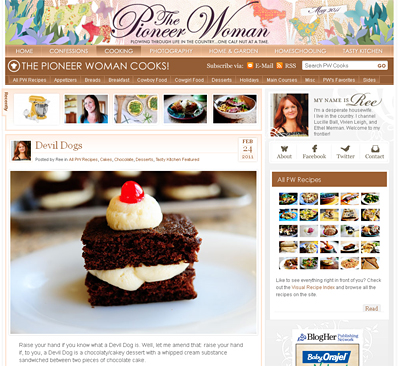
Pioneer WomanThen there are the rock stars of the food blogging establishment, peeps like Ree Drummond who writes under the persona The Pioneer Woman. Check out her impressive stats, courtesy of a recent New Yorker profile: 23.3 million page views per month, 4.4 million unique visitors, a new memoir, The Pioneer Woman: Black Heels to Tractor Wheels–A Love Story, a bestselling cookbook, ad revenue for 2010 at the cool one million mark and counting, oh, and a movie deal, with Reese Witherspoon signed on to star. All this for a gal who chronicles the minutiae of everyday life on an Oklahoma cattle ranch, where she home schools four kids, cooks, and dishes about cleaning out her closet.

Curious about this medium and the food folks who thrive in blogland, I've attended my fair share of blogging meet ups in the past couple of years, including BlogHerFood, International Food Blogger Conference, and, most recently, Camp Blogaway, the second annual sleepover for food bloggers held in the San Bernardino mountains in Southern California. I've also sat in on blogging panels at conferences that include old-media scribes such as the International Association of Culinary Professionals and the Symposium for Professional Food Writers.

What I'm struck by at these sessions is how much the attendees are looking for the keys to success in cyberland. It reminds me of a time, not so long ago, when new writers would pepper panelists at journalism conventions for the one right way to write a pitch letter to break into print magazines, as if starting with "Hi Joe," "Dear Mr. Yonan" or "Yo Joe Yonan" could make the crucial difference between landing a freelance assignment and getting overlooked.

Of course, there are missteps best avoided (if you spell an editor's name wrong you're likely sunk). But the truth is while talent and ideas count, so does experience, connections, timing, and, frankly, a bit of luck. I feel similarly about how things shake out in the food writing world on the Internet.

That said, I offer up five key ingredients gleaned from these long weekend food blogging bashes that may help pave the way to success in the blogosphere, however you define that term. And, thanks for asking, I think I'd choose Cate Blanchett to play me.

5 Keys to Food Blogging Success

Joy the BakerTell stories: Might seem obvious, but having something to say and telling it in an informative and entertaining way is crucial. And, as bloggers like Camp Blogaway keynote speaker Joy Wilson of Joy the Baker exemplifies, it need not be on weighty matters. She writes frequently about the antics of her cat and in two short years saw her readers jump from around 32 to 2 million. (It doesn't hurt that she bakes mouth-watering treats and takes stunning snaps, too, see my next point.)

I'm partial to the prose dispensed by pals Cheryl Sternman Rule (5 Second Rule), Molly Watson (The Dinner Files) and -- rock star alert -- Molly Wizenberg (Orangette, but then savvy blog readers knew that already, right?) Consistently well-crafted tales told with wit and wisdom, typically just once a week, from each of these gals. Newsflash peeps: Pumping out blog copy every day doesn't necessarily make for a great read. Oh, and I'm a food policy wonkette at heart so I read Civil Eats pretty consistently too.

And, here's an interesting tidbit: You know how food blogs are largely about food and frequently contain recipes? Duh. Here's what I've heard confessed recently at these soirees: Many readers gush about being a huge fan of blogger XX, while at the same time confessing to have never, ever, made a single recipe on their site. Wow. Who knew? And what to make of that fact?

tastespottingTake pretty pictures: It’s not enough to have something to say. Food bloggers need to be food photographers and stylists too. I'm no fan of the term food porn, but I get it, and I like a beautiful image of something scrumptious as much as the next voyeur. Judging by the popularity of such sites as TasteSpotting and foodgawker, I'm not alone. Every blogging conference includes panels on how to perfect your happy snaps. Locally, Heidi Swanson at 101 Cookbooks gets props for her photography; check out BAB contributor Megan Gordon’s 5 Beautifully Photographed Food Blogs post or Saveur‘s recent top picks of pics for more. Speaking of rock stars, at Camp Blogaway there was much twittering (both in the new and old sense of that word) about the appearance of Sarah Gim, founder of TasteSpotting, who seems like a perfectly pleasant person to this visually-challenged photog but was treated like royalty by many of the way more camera-savvy scribes at this event. Clearly, image matters in this medium. Get a pic on TasteSpotting, considered the gold standard of food porn sites, and watch that traffic climb.

5 second ruleBuild a genuine community: A well-received panel addressing this very subject occurred at the recent Camp Blogaway, co-presented by my role model in this matter, the consistently generous Cheryl Sternman Rule, and the similarly welcoming Susan Russo of FoodBlogga. In a nutshell: Think about your readers, only promote products you truly value, reach out to new readers and bloggers, champion others, and say thank you. Susan talked about paying it forward and building an authentic following beyond cyberspace (clue: in the real world). Cheryl walks her talk; for a taste, try this bite. My favorite take away from their talk: "Measure your success not in clicks or traffic, but in how well your blog fulfills your personal and professional objectives. Most of all, be kind to yourself."

David LebovitzBe a man: Okay, before all the guys start rolling their eyes here, let me say this: I'm no man hater. I'm a daddy’s girl who adored growing up with four boisterous brothers. I was married to a man for a very long time and we remain firm friends in the Ellen Barkin-Gabriel Byrne kind of way (versus the Ellen Barkin-Ronald Perelman way. No idea what I’m talking about? Take a little pit stop through this New York Times Magazine piece on same and then come back here.) My only child hails from planet XY. Some of my best friends are men…you know where this is going.

Got no issue with the other sex. And yet: Why is it in the blogosphere and at these food writing affairs, which, let's face it, are afloat in a sea of estrogen, do so many men seem to be disproportionately represented in the ranks of speakers and award winners? I'm not the only one who notices. I can only surmise that they simply stand out in an overwhelmingly female field. In true rock star fashion, like Sting, they need only one name to be recognized. Think: Lebovitz, Leite and Ruhlman.

Camp Blogaway. Video by Sippity SupKeep current with social media: Twitter is the new Facebook. StumbleUpon is the new Digg. Video is the new photo. That's right: It's not enough to take fab photos. You have to shoot and edit your own mini-movies now too, another take away from Camp Blogaway, a fact that was echoed at the American Society of Journalists and Authors conference in New York the same weekend, according to food writer friends who attended that event. To which I can only say: Shoot me now.

Speaking of that ASJA conference, the other take-home advice that stood out to me on the Monday morning I scanned email messages coming out of that meeting: Don't let blogging get in the way of your real work. Go figure.

posted by | posted in food bloggers and social media | 34 Comments
tags: , , , , , , , , ,

Google’s New Recipe Search: A Food Blogger’s Dilemma

Thursday, March 17th, 2011

Google is out to tame the Wild West of the food world, and I'm not really sure how I feel about this. A couple of weeks ago, Google introduced Recipe View, a search function Bing had added last year. Initially, I loved the idea that people would be able to search for recipes exclusively and that Google had taken the time to create a recipe search tool specifically for cooks, but then I saw the search results and my hopes deflated. I was disappointed to see that although larger recipe food sites are well represented, nary a blog post was listed for the many searches I initiated. Allrecipes.com, Food.com, the Food Network, About.com and Epicurious made up the majority of search results, while blogs -- both well-known and obscure -- seemed not to have been invited to the party (yet).

The whole point of Google's new recipe search is to allow people to designate what they're looking for in a recipe, which in turn limits the search to recipes only. So if you're looking for information on "sardines" you will end up with just recipes instead of a Wikipedia entry plus a bunch of shopping results. Google Recipes also allows you to limit your search by ingredients (do you want to cook your sardines with fennel and without capers, just check the boxes on the left side of the page), cook time (less than 60 min.), and calorie count (any calories). Helpful and fantastic, right? Yes, but recipe blog posts that might rank high in Google's Everything search due to popularity are not likely to be there. Not yet.

Sardines search using Google Recipe View

Why I am disappointed
It appears that Google has chosen to given preference to large company recipe sites over smaller sites, newspapers, magazine, and blogs. According to The Stew, a food blog put out by the Chicago Tribune who interviewed Jack Menzel, Google's product management director for this project, "About a year ago, Google began asking food sites if they would add a snippet of code to their HTML pages which contained time and servings info." But it seems they primarily asked the larger sites, like FoodNetwork.com, to partner with them in this endeavor. The Stew then goes on to say:

"It's going to favor some of the biggest sites and those who have optimized their content to be found easily by search engines. Expect a lot of FoodNetwork.com and AllRecipes.com recipes to pop up on the first page of any search."

So, how do blogs get included? In order for a site's recipes to be indexed by Google's new recipe search they have to meet some specific and not-so-specific criteria.

Format Recipes Using Rich Snippets and Microformats
Recipes need to be formatted to generate rich snippets. For recipes, using hRecipe microformat is a good way to go especially if you are using WordPress as your blog software since there is a plugin. For those of you who aren't web designers or programmers, I should explain that rich snippets are generated by using specific tags within HTML code that allow Google to recognize data as a recipe along with the various components that comprise a recipe. Here are some good resources to understand the process:

Basically, you should know that recipe data now has to be marked with specific tags so Google's search engine can recognize the information as a specific content type namely, a recipe. Right now, doing this takes time and some coding knowledge, which is a pain, but doable. Hopefully, this process will get easier as more editing tools become available to bloggers.

Submit a Form to Google about Including Your Site
Google suggests you fill out this Interested in Rich Snippets? form to alert them that your site is now using the required markup code and should be indexed by Google Search. You are required to submit four examples of pages that incorporate rich snippet code and have been validated using the Rich Snippets Testing Tool but it is not clear how much of your site needs to be compliant or how long it will take in order for Google to start displaying your results.

Follow the Procedure, Validate your Recipes, No Guarantee
Once your page validates there is this message:

"Note that there is no guarantee that a Rich Snippet will be shown for this page on actual search results. For more details, see the FAQ."

This FAQ seems like an earlier version of the information displayed on the page "Rich snippets not appearing" since the FAQ page does not mention including recipe sites being eligible for rich snippets.

rich snippet testing tool
"Note that there is no guarantee that a Rich Snippet will be shown for this page on actual search results. For more details, see the FAQ."

So, even if you go through the process of tagging and validating your recipes you are not guaranteed that your posts will display as Rich Snippets which I am guessing means that they may or may not show up in the Google Recipe Search. So, you are left to wait and see.

Maybe I'm suspicious, but what seemed like a cool idea -- a search tool that enables readers to quickly find recipes -- now appears to be a tool catering to larger company sites and I'm concerned about what this means for food bloggers. It seems that many established recipe sites started incorporating the markup to generate rich snippets once they were aware of Google's plan to develop the Recipe Search but the urgency to start using microformats did not appear to reach the blogger community. The lack of integrated and easy to use plugins for the various blogging platforms speaks to the absence of this necessity. Elise Bauer points out the irony that Blogger, Google's blogging platform does not have tools developed for recipe markup that would help bloggers generate rich snippets.

Okay. Whine whine, gripe gripe. Poor bloggers. But what about readers and cooks? How does Recipe View change their experience? The average recipe seeker may be unaware of the filtering that is currently going on and miss out on much of the user-generated food content that has accumulated on the web over the years. On the other hand, it will provide a faster and more efficient system to access information they are seeking without having to manipulate their queries or apply advanced search techniques.

Regardless of the effect on my posts, as a reader I'm a bit frustrated that I may lose out on seeing an innovative recipe with a great story, which is why I read blogs in the first place. I love reading about David Lebovitz's various forays into Paris bakeries that end with a lovely tart recipe, or getting inspired to try making a Death in the Afternoon cocktail after giggling over one of Michael Procopio's pieces.

I should note that many major sites with extensive recipe collections (but are not exclusively recipe sites) are also not yet displaying in Google Recipe View. For instance, I haven't seen any New York Times recipes listed (by them) and I am curious about how large sites that have food as a topic area and a wealth of recipes are approaching the situation.

Maybe this will all work itself out soon. The problem, however, is that bloggers and readers alike have now come to expect immediacy. When I post a recipe it shows up without any delays and people can read it. You can twitter about it and the information is distributed without a waiting process. Perhaps we all need to just learn (or relearn) to be patient again and this post is the equivalent of Chicken Little yelling that the sky is falling on food bloggers everywhere. So although I'm finding the new Google Recipe View a bit frustrating, it may not be elitist. I'm keeping my fingers crossed that it ends up being inclusive and helpful in the end.

What do you think?

(Wendy Goodfriend co-authored this post and provided research and experiential information about Google Recipe Search )

posted by | posted in food art, writing, music, dance, food bloggers and social media, food trends and technology | 7 Comments
tags: , , , , ,

Bay Area Foraging with Hank Shaw

Tuesday, February 22nd, 2011

Hank ShawIf there is ever a nuclear war or our food system completely falls apart, I'm heading to Hank Shaw's house. Besides being an avid hunter and gardener, Hank is a highly experienced forager -- which means that he's likely to be one of the few people who continue to eat well when the world is on its last legs (assuming we haven't destroyed all plant and animal life, too). Lucky for us, he chronicles his adventures on his blog, Hunter Angler Gardener Cook, and is about to release a cookbook/wild food guide, Hunt Gather Cook.

I'm excited to interview Hank about his new book and learning to forage in the Bay Area, an area that is teeming with wild edibles. He was also generous enough to provide a recipe for Fennel and Tomato Pasta Sauce, which you will find at the end of the interview.

Happy foraging!

How do you define "foraging?" What sort of things do foragers do?

I think of foraging as the gathering of wild plants and mushrooms, and, to a lesser extent, shellfish such as clams and mussels. For me, foraging is when you go looking for things that don’t run away. Hunting and fishing involves catching more mobile fare.

Foraging can be as easy as eating the weeds around your house -- you’ll likely find dandelion, wild lettuce, chickweed, plantain, wild mustard and possibly wild onions and salsify root in vacant lots and yards around the Bay Area. Or, foraging can be as tough as digging giant geoduck clams (pronounced gooey-duck), which live three feet under the sand and are only accessible at extreme low tides a few times each year. Picking berries is easy. Picking owl limpets off storm-tossed rocks in Bodega Bay is not.

Foraging has become more popular over the past few years. Any ideas why?

People are yearning to be closer to their food, to know where it comes from and to eat with a sense of place on the plate. To eat abalone is to be Californian. To eat wild rice is to link yourself to the great Northwoods of Minnesota, Wisconsin and Michigan. Nothing is more local, more seasonal -- and, when done responsibly, more sustainable -- than incorporating wild food into your diet.

Foraging gets you out into the world, into the fresh air and into close contact with Nature. We are all so busy that maybe the simple act of hiking with a purpose provides the spark we need to get the hell away from the computer, whether it’s to bring back huckleberries for a pie or a deer for a full winter’s worth of meals. Foraging allows us to flirt with the wild.

I can walk nearly anywhere and spot edible plants and animals. Knowing that not everyone possesses that skill is a heady, powerful rush. I know I am not alone in that feeling, and many new foragers describe something similar to me when they find a good stash of nettles, or morels, or butter clams.

What can a Bay Area person find in their area? Any ideas for tasty things the average Joe or Jane should keep an eye out for?

"Yard weeds" are a great place to start. I wrote a primer on lawn foraging a while back that runs through the basics. Mostly these are salad greens, and right now is prime time for them all.

Blackberries are a good one. Everyone knows what they look like, and they are everywhere. Put on some gloves and get out there in July and August. We also have great huckleberry picking around here. Huckleberries are a lot like blueberries, only a little spicier, a little more tart. There are other berries around, too.

Fennel is another easy one. Fennel is native to the Mediterranean, but it was brought to California by Italian immigrants a century ago and has naturalized here. It is the same fennel you get in the store, only denser and more flavorful; it will not have big, fat bulbs, though.

Foraged Salad

Are there any dangerous foods that locals should avoid? What are your thoughts on the general dangers of foraging?

Everything has its dangers. Mushrooms, especially. I came very close to poisoning myself recently. I thought I had a fried-chicken mushroom: It met every descriptor, except the spore print. Had I been foolish enough to not take a spore print, who knows what might have happened? That said, chanterelles and morels are pretty easy to identify. Buy a good guidebook (I recommend David Arora’s All that the Rain Promises and More), learn it, and go slow.

This is also true for plants. There are lots of good guidebooks for West Coast foraging. Pick one up and study it, and then bring it into the field with you. Never eat something you cannot absolutely identify.

You will also meet up with ticks, bees, wasps, and, occasionally, rattlesnakes. It’s an occupational hazard. Bears and lions are around in the mountains, too, but they will not generally bother you. I’ve seen both animals several times while foraging. I gotta admit I was a little unnerved by the kitty, though.

Shaking Fennel Pollen

Say a person wants to learn more about foraging before setting out on their own. Where should they go for more information? Should they take lessons or go on foraging walks? Where can they find such a thing?

I know that some people do conduct foraging walks, but I have not been on one since I was 11 years old -- and that was in New Jersey. I’d contact Iso Rabins with Forage SF for more on that one. As for me, I learned everything I know from experience, from books, and from being with knowledgeable friends. If you are into mushrooms, however, there are several excellent mycological societies around the Bay Area. Join one, go on a foray, and learn. It’s a cool experience.

Hunt Gather CookCan you tell us a little bit about your book? What topics does it cover? Will a Bay Area person be able to put it to good use? How about a person in other parts of the country?

The book is called Hunt, Gather, Cook: Finding the Forgotten Feast, and it is intended as a guide and cookbook for anyone who wants to make wild foods part of their diet -- or for someone who already does fish, forage or hunt, this book will help expand their knowledge. A lot of people just forage, but don’t hunt or fish. A lot of hunters don’t know much about foraging, and a lot of anglers don’t understand hunting. This book brings it all together, with recipes at the end of each chapter. Some of those recipes are basic, like buttermilk fried rabbit, but others push the edges of wild game cooking, like wild boar liver crème caramel.

But I think the most important, the most unique piece of this book is the hunting section. Very few books have ever been written for adults who want to start hunting but have no idea how to go about it. Most intro-to-hunting books are geared for little kids. I include extended chapters on everything from hunting rabbits to deer to waterfowl, wild boar and upland game such as pheasants. Not a week goes by when I don’t receive an email from a reader of my blog who wants more information about how to start hunting. This book is an attempt to help.

As for the Bay Area, it is an integral part of my blog, Hunter Angler Gardener Cook, and since the book is an outgrowth of the blog, it follows that anyone living in the region will get a lot out of the book. There is not one chapter that is not relevant to someone living in NorCal.

That said, I have lived (and fished, hunted and foraged) in New Jersey, New York, Virginia, Minnesota and Wisconsin, and I have visited many other states in search of wild food. Just as there is no chapter that excludes California, no chapter excludes the rest of the country as well. Sure, there may not be highbush cranberries here in NorCal, but the Midwest doesn’t have manzanita or madrone. I write about all of them.

Huckleberry Muffins

When does the book come out, and where can we get more information?


Hunt, Gather, Cook comes out May 26. It is already available for pre-order on the various online booksellers such as Amazon.com and Powell’s. Once the book is released, I will be setting up a series of events in the Bay Area and beyond -- cooking demos, readings, even fishing and foraging trips. You can get updated information about both the book and where I will be doing events on my blog, Honest-food.net, and by following me on Twitter under @Hank_Shaw.


Fennel and Tomato Pasta Sauce
By Hank Shaw, Hunter Angler Gardener Cook

Tomatoes and fennel pair well together, and this recipe is wonderful with the baby fennel that is sprouting all over the Bay Area right now. The sauce gets an added anise hit with a splash of Ouzo or Pernod, just to liven things up.

It is a great vegetarian sauce to serve with pasta, ideally a long pasta like spaghetti, bucatini or even homemade tagliatelle. Once you make the sauce, it will store in the fridge for 10 days or so. You can also freeze it.
Serves 6-8

Ingredients:
4 tablespoons olive oil
1 cup wild fennel, finely chopped
1/2 onion, finely chopped
1 garlic clove, chopped
1/4 cup ouzo or other anise-flavored liqueur
1 quart tomato sauce or crushed tomatoes
1 tablespoon honey
1 tablespoon mint or lemon verbena, chopped
Salt to taste
Pecorino cheese to garnish

Instructions:
1. Heat the olive oil over medium-high heat in a wide, deep pan or a large pot. When the oil is hot, add the fennel and onion and saute for 4-5 minutes, until the veggies are translucent. Don’t let the veggies brown — turn down the heat if you need to. Add the garlic and saute for another minute or two.

2. Pour in the ouzo and let this boil until it is reduced by half. Add the crushed tomatoes, honey and mint and mix well. Taste for salt and add some if needed. Let this simmer gently for 30 minutes.

3. Put the sauce into a blender or food processor and puree. Pour the blended sauce back into the pot and bring to a simmer. You’re ready to serve. This is a powerful sauce, so use less than you think you need at first.

(Note: Photos courtesy of the fabulous Holly Heyser)

posted by | posted in bay area, cookbooks, DIY and urban homesteading, food and drink, food bloggers and social media, gardening and urban farming, recipes, sustainability | 1 Comment
tags: , , , , , ,

Recipe Writing with Dianne Jacob, Amy Sherman & Kristine Kidd

Wednesday, September 1st, 2010

Recipe Writing Panel
Dianne Jacob, Kristine Kidd, Amy Sherman

The first panel at the International Food Blogger Conference (IFBC) this past weekend in Seattle dealt with writing a great recipe, paying for content, and taking your work as a food blogger to the next level. Dianne Jacob, author of Will Write for Food, sat alongside writer and recipe developer, Amy Sherman (BAB blogger) and cookbook author and former food editor of Bon Appetit Kristine Kidd. Each speaker brought their own unique experiences in writing and recipe development, kicking off the session by discussing the importance of being generous and giving proper credit when adapting a recipe. Amy Sherman also urged bloggers and writers not to give recipes away for free. It can be flattering for beginning bloggers to be approached by online sites of print publications requesting to use a recipe. But Sherman noted that this only complicates things for folks trying to make a living by writing and developing recipes. While there were great tips on how to approach editors with recipes and how to take recipe development to the next level, the heart of the panel discussion was based around writing a great recipe. Below you'll find some of the highlights:

Elements of a Recipe
Jacob, Sherman and Kidd discussed the four main elements that make up a recipe--each should be carefully considered to engage your reader, and achieve continuity and clarity:

1) Title: Keep your title straightforward, tempting, descriptive and fun. After all, it's the first thing your reader will see.

2) Headnotes: The headnote of a recipe is the information right after the title and before the ingredient list. It's important here to tempt your readers, give them either sensual or helpful information (or both!), perhaps some cultural or historical tidbits regarding the recipe or a personal story. Kidd discussed the importance of the headnote as an invitation for your readers--make them curious about your food. The headnote is the "why" of the recipe: out of all of the gazpacho recipes in the world, why are readers going to want to make yours?

3) Ingredients: The speakers agreed that it's most common to list ingredients in the order in which they're used. They also encouraged writers to remember that readers also use the ingredient list as a shopping list, so make it easy to shop from. An example Kidd provided was calling for "1 medium onion" instead of "2 cups onion"--people don't shop for 2 cups of onion.

4) Directions: Think about how you'd like to present your directions. Often, if there's an editor involved, you won't have a choice. But if it's on your personal food blog or website, make a decision: do you want numbered steps, bullets, or short paragraphs? Readability and clarity are key.

Conference Attendees
Conference attendees busily taking notes

Recipe Writing Tips
Jacob, Sherman, and Kidd moved on to discuss their own personal tips and advice for crafting an inviting recipe that works:

1) They began by encouraging people to think about their style of recipe writing: are you brief and direct or warm and friendly? Like any kind of good writing, you need to find your voice and make a concerted effort to remain consistent in the way you write your recipes. Chatty is o.k. (although it tends to be longer which Kidd pointed out often discourages readers)--just be chatty consistently.

2) Give more than one indicator: In recipe writing, indicators are descriptions or hints describing when a task is completed. Because all ovens are different, weather conditions vary, and folks have differing levels of cooking experiences, having more than one indicator is critical. An example: "Saute onions for ten minutes or until golden brown" ("ten minutes" and "until golden brown" are your indicators here).

3) Use the word "about" before giving a prescriptive number of minutes. Again, since everyone has different ovens and is working with numerous variables, adding "about" gives the recipe writer a bit of an out--putting some responsibility in the hands of the reader.

4) Give more than one measurement: Giving readers both weight and volume measurements is important, especially with baking Sherman noted. Kidd suggested that with savory cooking like soup, very precise weight measurements are probably not as critical.

5) Think About Your Audience: It's imperative to think about your reader: who are they? How much information do they already know? Of course, these are always mere guesses but you need to decide if it's important to give instructions on sauteing onions. Will this be obvious to them? Where do you draw the line on how much information and instruction to provide?

Recipe Writing Resources
Jacob, Sherman, and Kidd suggested looking at food websites and magazines you like for good models. Sherman encouraged reading international magazines as well to look for new and interesting food trends that haven't quite surfaced here in the States. They also provided a list of the following fabulous recipe writing resources:

Recipe Writers Handbook

The Food Substitution Bible

Food Lovers Companion

Recipes Into Type

Conference Attendees Debriefing
Conference Attendees Debriefing: Denise Woodward (Chez Us), Tracy Benjamin (Shutterbean), and Kristina McLean (TNLocavore)

posted by | posted in events, food bloggers and social media, recipes | 4 Comments
tags: , , , ,

Food Photography Workshop with Penny De Los Santos

Friday, March 19th, 2010

food shots
A few of my pictures from Penny De Los Santos' Food Photography workshop

Last week I had the opportunity to take Penny De Los Santo' food photography workshop here in San Francisco. Penny started as a documentary photographer, but has recently moved into shooting more food. However, her photos aren't glistenny, perfectly placed studio shots (although she's done a few of those, too). Instead, Penny is a magician at lassoing a moment and a sense of place. She takes her background as a documentary photographer and uses it to capture the culture and the stories that take place around the table and in places that people gather.

I was smiling the entire day. But the first smile came when I received a confirmation e-mail from Penny that described what we needed to bring to "make pictures" on Sunday. Then that morning, Penny talked about the difference between taking and making pictures. I've never heard someone speak of photography this way. Essentially, anyone can take a picture, but it takes an understanding of your camera and a certain deliberateness to make a photo. And that's exactly what we worked on. We made photos at Contigo Restaurant in Noe Valley, run by chef Brett Emerson and his lovely wife, Elan.

contigo restaurant
Capturing a few quiet moments at Contigo Restaurant

Brett and Elan brought out a steady stream of beautiful food, from Spanish hot chocolate and churros to asparagus with a perfectly poached egg, ground almonds and hot paprika. We were blessed to have such a canvas. Then in the afternoon, Penny pushed us to get into the action and get up close and personal with people and situations: we made portraits and street shots in the Mission and then went back to 18 Reasons to critique them and debrief.

Why Food?
Penny mentioned how many of her colleagues scoff at her more recent foray into food photography, which is often thought to be "lighter" than other professional work. But Penny sees food photography in a different way than so many others I've ever come across. "My photos show the story behind the food. They show humanity, " she said in our workshop. And if you look at some of her work from Saveur lately (Did you see that Texas issue?!), this is no joke. Penny elaborates, noting that "Food photos are never just about food. They're equally about people, landscapes, capturing moments, and a sense of place." This is why you don't see a lot of glossy studio shots in Penny's portfolio. She's interested in stories. And she discovers those stories through people: "Food is what connects us. It's a wonderful way to discover humanity."

portraits of people in the Mission
Penny pushed us to take portraits in the Mission. Here are a few I "made."

A Few Bits of Inspiration
So about halfway through the morning at Contigo, I started jotting down everything Penny said. She was obviously talking about photography, but I began resonating with her tips in a broader sense. I'll refrain from getting too Zen on you, but here are a few lovely quotes that I took away with me that, I think, have broader implications than just photography:

Take risks...a person's reach should be further than their grasp.

Follow your instincts. That's what makes good pictures.

Energy happens when you have energy.

I'm never ever saying no to myself because I want to explore it, uncover it.

Your instincts are the most important element in making a photograph.

Penny de los Santos
Penny de los Santos doing her thing in San Francisco

Penny's Tips on Food Photography
Unlike most professional photographers I've met, Penny is low-key with a capital "L." She seems a little hesitant to talk about her equipment, she only brings one lens out in the field and actually discourages the use of a zoom lens because she thinks it encourages laziness. She's discreet. She doesn't use fancy flashes nor does she have an assistant. She keeps it inconspicuous so she doesn't stand out or draw attention to herself--something you definitely don't want when you're shooting markets in developing countries or a family gathering in a tiny diner in Texas. That being said, Penny has some great tips on capturing a good photo. In them, you won't find technical details on adjusting your white balance or achieving bokeh. The workshop wasn't that kind of gig. Instead, we focused more on the big picture: on loosening up, gathering the gumption to photograph people fearlessly, waiting and listening for the right moment, and constantly thinking about light. Moments, stories, and light. Isn't that what pictures are comprised of in the first place? Here are a few of Penny's tips from the workshop that you may find helpful:

  • Light. We've all heard it before: it's all about the natural light. But Penny's adamant about this. She simply won't shoot if there isn't proper natural light. She talks about chasing light and capturing light on location, and describes getting up far before the crack of dawn to do so. No speedlights. No fancy flashes.
  • Get in the action: "You have to get in front of people. You need to get all up in there." To do this, she says you must use a fixed lens and just go for it.
  • Layers and details are important. Create layers with the foreground and background of a photo: don't just shoot a flat bowl of soup. Add dimension and layers with color, a few glasses in the background, interesting details.
  • Telling a story about the food is critical. To do this, vary your angles, seek out the light, and photograph different stages of the meal: in preparation, plated, and in process (being eaten).
  • Perspective: Challenge yourself. Try taking photos from above and from below. Shake up the way you usually do things.
  • Camera angles and visual pacing: variety is key. You need to work with many camera angles to keep your shots fresh and interesting. Your go-to angles will be the overhead angle (good for food with lots of color), ¾ view, and side view.
  • Patience. Wait. When photographing people or scenes, Penny makes people comfortable and then sits back and waits for them to begin acting naturally and forget that she's there.

Great Food Photography Links and Resources
So while Penny's workshop completely changed the way I think about shooting food, I realize ya'll weren't there and some of you may be seeking out specific suggestions on F-stops, flashes, indoor lighting set-ups, and photo editing. If that's you, here are some of my very favorite links on food photography. Most of them are from fellow food bloggers, many who have learned the hard way--by teaching themselves. Unanimous is the advice to shoot often. The only way to learn is through practice. Then, eventually, we'll all be making photos.

posted by | posted in food bloggers and social media, tv, film, video, photography | 5 Comments
tags: , , , , ,

Subscribe to BABrss posts

BAB Archives

  • Calendar

  • February 2012
    M T W T F S S
    « Jan    
     12345
    6789101112
    13141516171819
    20212223242526
    272829  
  • Sponsored by