• Bay Area Bites

  • Culinary Rants & Raves from Bay Area Foodies and Professionals

Posts Tagged ‘books’


Slow Down at Two Sisters Bar and Books

Thursday, January 26th, 2012

two girls bar and books

There is a relatively new bar in town. But this isn't just a bar. More accurately: there is a small, unassuming cafe and bar that's successfully blending elements from numerous concepts (small plates, cocktails, draft beer, brunch, book-lending library, book club) with style, comfort and grace. The place is Two Sisters Bar and Books and the story goes something like this: two sisters, Mikha Diaz and Mary Elliott decide to travel before settling down into the job market. In graduate school, Mikha studied continental philosophy and Mary studied Russian language and literature; they decided Poland was a good place to start their journey and they quickly stumbled across Massolit Books in Krakow and fell in love. After just one week in Krakow, the sisters knew they wanted to recreate a similar place in San Francisco. Mary stayed on in New York City (where the gals went to school) and worked from afar helping curate the books for the space. Mikha set to work with her business partners, her husband and parents, on finding a storefront in a desirable neighborhood in the city -- no easy feat.

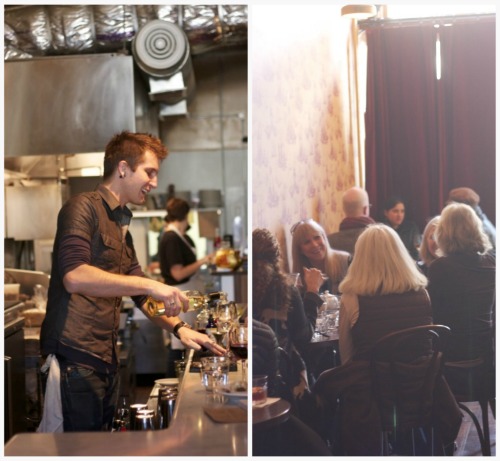
The bar at Two Sisters

It took Mikha one year to find the old Marino's space in Hayes Valley; getting it into ship-shape took some elbow grease and dealing with city permits always takes a whole lot of time and patience, but Two Sisters had their soft opening on Oct 12, 2011 and things have been growing and evolving ever since. When I walked in, I saw old volumes of books lining the wall to my left, tables full of folks reading, chatting, eating and drinking to my right and a welcoming bar towards the back. I asked Mikha to tell me more about the space: are they an actual bookstore? Do they do coffee or is it really more of a bar? They serve dinners, too? In talking to folks around the city, there seems to be a little confusion about the identity of the spot, and after visiting, I think that's actually part of its charm. You need to go and visit to really see for yourself.

But I did learn that it is a charming bar and restaurant, serving wine and beer, specialty cocktails and fermented sodas, snacks and charcuterie plates. They do a $20 fixed-price brunch on Sundays. The rest of the time they serve a few daily plates, such as pork meatballs and kabocha squash bread pudding. Alex Smith is the kitchen manager at Two Sisters, and she and Mikha describe how the price of the plates really reflects the little-bit smaller portions (right inbetween a tapas plate and an entree). They're all particularly excited about the house-smoked blue cheese they've been doing, and the spring menu that will be unveiled towards the end of February. It seems, all around, there's a lot to be excited about.

books
Book-lending library at Two Sisters

Before I left, Mikha and I were just casually talking about the neighborhood and what kind of folks Two Sisters is attracting. She beamed and said it's truly becoming a neighborhood spot where locals come when they don't really feel like cooking. It's not as big of a financial commitment as a true sit-down restaurant so you can just dabble with a few snacks and a small plate. It's also a big day-time hangout with the book-lending library and the (genius) Books and Booze Reading Club where a monthly book is paired with an appropriate cocktail.

Folks can stroll in and pick up a book they're interested in and take it home, replacing it with a book they've decided to leave behind. Mikha described an interesting phenomenon of people wanting to get rid of books but feeling like they were too special to drop off at a nameless donation center, so the lending library has been growing quickly as more and more people want a special home for their books.

And it's clear from the crowd on a cold Saturday afternoon that many San Franciscans are claiming the actual space as a home, too. Just what the sisters had envisioned. Each element (good cocktails, books, and seasonal food) have truly come together in perfect harmony. There's a lot to discover here. It's the kind of spot that makes we wish I, too, lived in the neighborhood. For now, I'm eager to come back when I have a little more time to sit, swap a book, and try a nibble.

Two Sisters Bar and Books
579 Hayes Street (between Laguna and Octavia)
San Francisco, CA 94102
(415) 863-3655
Hours: Tuesday - Thursday 4 pm - 11 pm; Friday 4 pm - 12 am
Saturday 1 pm - 12 am; Sunday 11 am - 10 pm

Happy Hour: 4 pm - 6 pm Tuesday - Friday & 1 pm - 4 pm Saturday
Brunch: Sunday 11 am - 4 pm
Follow them on Facebook or Twitter

posted by | posted in bay area, cocktails and spirits, food and drink, local food businesses, restaurants, bars, cafes | Comments Off
tags: , , , ,

Life After Bike Basket Pies: The Release of Natalie Galatzer’s Pie Booklet

Friday, November 18th, 2011

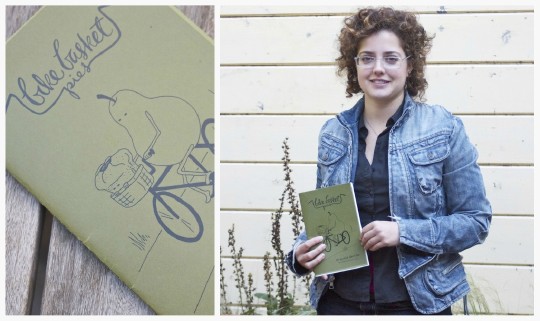
bike basket pies - Natalie Galatzer
It’s been over five months since Natalie Galatzer decided to shutter her bike delivery pie business, Bike Basket Pies. And life already looks a lot different. She’s not schlepping around the Mission doing deliveries, she’s not working well into the night rolling out dough, and she’s not stressing about the seasonality of persimmons or how manageable her to-do list is for the next day. The best thing is that she’s not thinking about tomorrow today—she’s really enjoying today for today, including the ability to make social plans and travel.

Natalie’s currently working at two Bay Area restaurants waiting tables and thinking about what’s next. But the difference is she’s thinking big picture, not about tomorrow’s ingredient lists. And there’s freedom in that space to just breathe, reconsider, and reflect. One thing’s for sure: Natalie’s pretty certain the big picture won't include baking. She always thought that she wanted to be a baker, but isn’t convinced anymore. The act of turning something she loved into a business, made it quickly about the outcome and not the process she once loved. As you can imagine, this eventually killed the joy she once found in baking.

But that doesn’t mean she hasn’t looked back. In between her shifts waiting tables and scheming up new ideas, she needed a creative project and felt like she owed a little something to her loyal pie customers. So she decided to write a pie booklet, entitled Bike Basket Pies: How to Make Handheld Pies for Bicycle Delivery, with 14 of her favorite and most popular recipes and detailed instructions and illustrations on the process of making small (and large) pies. It was time that the recipes lived on somewhere other than within her computer spreadsheets. It was time to give something back.

After two years in business, you can imagine how difficult it was to choose a mere fourteen recipes for the booklet. Natalie organized all of her recipes not just by the seasons but actually by the months she’d make them–heavily dictated by the produce available in the Bay Area during that time. She knew she wanted to structure the book using the seasons, but she also wanted each recipe to be uniquely her own. For instance, in terms of pumpkin pie, there are limited things you can do with a pumpkin pie recipe. Her pumpkin, while wonderful, doesn’t differ all that much from my pumpkin or your mother’s pumpkin. But there are so many of Natalie’s pies that are the exact opposite and that’s what she decided to highlight in her book.

When you hold the booklet in your hands, you’ll notice the charming illustrations by Minty Lewis. They truly make Natalie’s words and recipes come alive: from drawings of the actual pies to step-by-step illustrated instructions on forming small pies and larger pies. Beyond the illustrations, you’ll notice there are 14 recipes (3 for each season along with a few savories). Yes, the Shaker Orange recipe is in there. As is the Pear Ginger. In addition to the recipes, there are little sections on Making Dough, Rolling Out Dough, Forming Small Pies, and Making a 9” Pie. There are clear mini sections on Temperatures and Baking Times, too. You’re in good hands here. While some people find pie-making overwhelming, Natlalie’s assured tone and concise instructions and Minty’s sweet illustrations will force you out of any pie rut. Guaranteed.

The booklet took Natalie a little over a month to write with one of the bigger challenges being how to decide what parts of the pie-making process to illustrate, how much detailed information to provide for the home baker, and how to best layout each step for her readers. The easiest way for her to tackle this was to spend a day making pie and having a friend photograph the process. Then they went through to decide what parts of the process seemed like an actual step and what they could assume the reader would already understand.

When asked about proprietary recipes and whether she was nervous about them being out and available to the public, Natalie replied, “What am I going to do with them? A lot about it is technique and practice anyway, and I’m no longer making pies for people so now I can give then the tools to do it on their own and still enjoy what I make.”

So is Natalie’s day-to-day life one without pie? Largely, yes. She doesn’t make them anymore and doesn’t find herself craving them. That will probably come back in time. For now, she’s excited to produce something tangible that’s different in the sense that it’s a living, lasting artifact. A piece of pie, while lovely in the moment, won’t last for generations. Natalie’s book of recipes will. And lucky for us, she’s decided to share.

Buy the Booklet: Bike Basket Pies: How to Make Handheld Pies for Bicycle Delivery is available for order now on Natalie's website. Orders placed from now until November 29th will be shipped on December 1st. In addition, keep your eyes peeled as Natalie has plans to approach area book shops who may be interested in stocking it.

Join Natalie at Pot + Pantry to help celebrate the release of the booklet. The party is BYOPie with champagne provided, and booklets for sale. Tuesday, November 29th, 6:30 to 8 pm. RSVP here.

posted by | posted in books, magazines, newspapers, dessert and chocolate, food and drink, local food businesses | 2 Comments
tags: , , , , ,

Will Write for Food: An Interview with Dianne Jacob

Tuesday, February 8th, 2011

Will Write for Food
Are you interested in expressing your passion for food, but don't know where to start? Never fear, dear reader -- Dianne Jacob, Oakland resident and author of Will Write for Food: The Complete Guide to Writing Cookbooks, Blogs, Reviews, Memoir, and More, is here to help. Today, she will answer the pressing question: "How can I get started in food writing if I have no formal background?"

As a culinary career coach, Jacob brings to the table an extensive background in writing, editing and teaching. Her work has appeared in Writer's Digest, The San Francisco Chronicle, Gastronomica, Sunset, Salon.com, and a host of other media outlets, and she teaches classes at the local writing organization, The Writing Salon. To learn more about Dianne and hear her ongoing advice for food writers, visit her blog dedicated to the art and craft of food writing or follow her on Twitter under @diannej.


So many people out there want to share their passion for food but don't know how. A food blog is the most obvious place to start. What tips do you have for someone just starting out in blogging?

Go for it! It's fun, its easy, and you'll have the tremendous satisfaction of seeing your work published as soon as you click the "Publish" button. Templates on WordPress, Typepad and Blogger are free and only take a few minutes to set up. You pick a title and background for your blog and you're off. Start small. Write a few paragraphs, insert a few photos, and make it easy to keep posting. Write as though talking to a good friend. Don't take yourself too seriously, but at the same time, edit your work to make it as tight as possible.

How can a food blogger spice up their writing so that it's more than, "I ate eggs today. They were good. Last night I had a steak. It was juicy."

Resist the kind of writing that's based on "and then, and then, and then." Tell a story that has a beginning, middle, and end. What was it about your eggs? Did you fry them in bacon grease with sausages, sprinkle them with smoked paprika, or scramble them with wild mushrooms? Did you eat one boiled egg because you've just started a diet, and how did that feel? Did you get halfway through when the phone rang, and you couldn't bear to not answer? Paint a picture for the reader that includes your life, not just the food. Let them know something about you.

What different kinds of food writing are there? If someone is starting a blog, what areas could they possibly cover? Is it ok to mix and match, or should they stick to one "beat?"

Oh gosh, there are tons of ways to write about food: You're enthusiastic about the Korean taco truck you visited, the new pasta dish you discovered on your last trip to Tuscany, or the salted caramels you served when entertaining guests. You could write about what it's like to have a kid with celiac disease, planting a kitchen garden, spearheading an overhaul of the school lunch program, and about your day trips exploring farmers' markets in the Bay Area. It's really limitless. Some people have general blogs where they write about whatever appeals to them, and some people deal with a specific subject, like baking, nutritious meals, or travel. There is no right way.

Dianne Jacob. Photo by Pamela Zacharias

Dianne Jacob. Photo by Pamela Zacharias

How can a food blogger build a readership? Can you give us some basic tips?

Become a great storyteller. That's the first secret, and the most important one. Find a like-minded community of other bloggers and food-obsessed types and get to know them. Read their blogs and maybe they'll read yours. Get business cards printed with your blog name on it and hand them out at food-based events. Ask your friends to read and leave comments. If you're a terrific photographer or videographer, often those skills can drive people to your posts. When you post, announce it on Twitter and Facebook.

Here's a scenario: Jenny is a food lover who spends most of her time cooking, eating, or thinking about food. Her family is always telling her that she should write a cookbook, but she knows that's probably not realistic since she's never written anything before in her life. Still, Jenny wants to share her love of food. What would you recommend she do? Where should she start, and where should she hope to end up?

Jenny can take inexpensive classes on personal essay writing from the Writing Salon or Book Passage to learn how to express herself. Or she can just dive in and read food blogs to get an idea of how to start out. She also needs to figure out what kind of food appeals to her most. A general cookbook from someone who has never written before is not a winning combination. Is she mad about macaroons, bonkers for bread, or ravenous for raw food? A focus can be worthwhile.

Where should she hope to end up? If she's lucky, she'll be the creator of a popular blog people enjoy. She needs hundreds of thousands of readers across the country to interest a cookbook publisher, and a subject where she has something new to offer. If she's been building that content and readership, publishers might be interested.

posted by | posted in books, magazines, newspapers, food and drink, food art, writing, music, dance, food bloggers and social media | 5 Comments
tags: , , ,

Saul’s Seltzer Saga – Save The Deli

Saturday, October 24th, 2009

sauls seltzerIf you're reading David Sax's recent book, Save the Deli, or follow his blog or moan, as many do, about the general state of the Jewish delicatessen, then you know that it's a pivotal time in this most hallowed bastion of comfort food.

For years, locavores and vegetarians, calorie-counting suburbanites and couscous-loving Sephardim and even heeb-hopping hipsters have been bringing their own favorite dishes to the Jewish table. You might not know this upon stepping into a deli, where piles of salty, fatty meat and schmaltz in the chopped liver and never-ending free pickles every day of the year define good eating. It's supposed to be a carefree zone where all the generations and sects can enjoy some chicken soup in relative peace.

Leave it to Karen Adelman and Peter Levitt in Berkeley to begin shaking up this world a bit. As the owners and hands-on managers of Saul's, these two widely read, passionately opinionated individuals are working hard to keep Jewish delis vibrant, relevant and delicious far into the 21st century. From adding Mediterranean mezzes to offering locally grown, locally made pickles, they're crafting a new sensibility for an old institution.

A multicultural, sustainable deli might seem like a quixotic pursuit, as many would argue that we should leave well enough alone. Any real and authentic Jewish deli doesn't need to concern itself with all this modern fancifying. But if you're a deli owner and you see your customers coming into your dining room less and less often -– how many pastrami sandwiches does one person eat these days? -- you realize that things need to change to keep going.

sauls pickles

Of course, ideals do have a way of bumping up against reality. Let's take the last thing on the menu, that list of drinks at the end of the page. Such a minor thing, no?

Well, as it turns out, simple it most definitely is not.

For diners, drinks are usually just an afterthought. For green-minded business owners, though, the environmental costs of transporting flavored water, the impact of corn syrup and artificial sweeteners in our communities, and the waste of thousands upon thousands of empty cans and glass cannot be ignored. If you're somewhat concerned, you might just put out a recycling bin and offer a few cents off on coffee poured into insulated mugs. If you're a little more committed, you might try sourcing local sodas.

But if you're Karen and Peter, you have a much, much longer road to travel. You begin by studying the history of sodas and the science of bubbles. Along the way, you learn about the monopolistic technologies of multinational food corporations. You connect the dots between individual soda jerks, creative spirit and community values. You daydream down a short detour, one that takes you past designs for a working seltzer tap at each and every booth. You decide to compromise, backtracking to install a central seltzer dispenser. You call up a beer tap specialist to design a brand-new beverage system for you. You track down stronger fittings that can hold up to the pressure of C02. You convince colleagues that going back in time 60 years to revive obsolete tastes and technology will be a good thing for the business. You train special "seltzer baristas" to use the finicky machine with its nonstandard formulations. You develop recipe after recipe from scratch. (Cream Soda #8, you think, seems especially promising.) Then, years later, you launch your own house-made seltzers and, in a moment of unrestrained ambition, you decide to stop selling bottled, commercial sodas entirely. Even Dr. Brown's. Yes, even the Black Cherry and Cel-Ray.

And it's still not done. Now, you smile politely at your customers' dismay when they can no longer grab a can of soda with their take-out lunch and nod synpathetically at those most earnest of drinkers, the Diet Coke loyalists. You accept losing thousands of dollars in beverage sales. At the same time, you account for higher food costs because your drink bases, made from real fruit, are good for only four hours. You create and hope that your customers will enjoy the special syrups that taste slightly different day to day in flavors that come and go with the seasons.

You stand back and imagine a dining room full of people sipping sodas made by friends and neighbors from fresh fruit and whole spices.

You win some -- these sodas are phenomenal and you're proud and ecstatic, if a bit exhausted. They more than make up for past battles lost. There's still that ongoing campaign to source enough briskets from grass-fed cattle to feed your hungry customers. And let's not forget the recent Pickle Squirmish, when you tried charging for kosher dills -- in a deli! -- and took a fatal stab at explaining the seasonality of cucumbers.

Yes, one step at a time, one step at a time.

For now, you're happy to offer a taste of history: the sweet satisfaction and elusive effervescence of real seltzer flavored with homemade syrups.

sauls rugelah

Save the Deli: In Search of Perfect Pastrami, Crusty Rye and the Heart of the Jewish Delicatessen
By David Sax (Houghton Mifflin Harcourt, 2009)
Sax's campaign to save the deli, as one mom-and-pop sandwich shop after another closes, brings him to the Bay Area this week. Stop by and meet him at Saul's this Saturday afternoon or at Book Passage on Monday at the Ferry Building. Listen to him read from his new book and then ask him for yourself: which city makes the best pastrami and why do we have to drink egg creams so fast and, yes, that most important question, what is the future of the Jewish delicatessen?

Saturday, October 24, 2009
4:00 pm
Saul's Restaurant and Deli
1475 Shattuck Ave Berkeley, CA 94709
(510) 848-3354
Map

Monday, October 26, 2009
6:00 pm
Book Passage
1 Ferry Building, #42
San Francisco, CA 94111
(415) 835-1020
Map

posted by | posted in local food businesses, sustainability | 1 Comment
tags: , , , , , , , ,

Books

Wednesday, March 26th, 2008
James Beard Awards 2009 Winners

Cookbook of the Year and Single Subject
Fat: An Appreciation of a Misunderstood Ingredient
by Jennifer McLagan

Cookbook Hall of Fame
Jane Grigson's books
by Jane Grigson

American Cooking
Screen Doors and Sweet Tea: Recipes and Tales from a Southern Cook
by Martha Hall Foose

Baking and Dessert
Bakewise: The Hows and Whys of Successful Baking
by Shirley O. Corriher

Beverage
WineWise: Your Complete Guide to Understanding, Selecting, and Enjoying Wine
by Steven Kolpan, Brian H. Smith, Michael A. Weiss, The Culinary Institute of America

Cooking from a Professional Point of View
Alinea
by Grant Achatz

General Cooking
How to Cook Everything (Completely Revised Tenth Anniversary Edition)
by Mark Bittman

Healthy Focus
The Food You Crave: Luscious Recipes for a Healthy Life
by Ellie Krieger

International
Beyond the Great Wall: Recipes and Travels in the Other China
by Jeffrey Alford, Naomi Duguid

Reference and Scholarship
The Flavor Bible: The Essential Guide to Culinary Creativity, Based on the Wisdom of America's Most Imaginative Chefs
by Karen Page, Andrew Dornenburg

Writing and Literature
In Defense of Food
by Michael Pollan

Photography
The Big Fat Duck Cookbook
by Heston Blumenthal, Photographer: Dominic Davies, Artist: Dave McKean

James Beard Awards 2008 Winners

Cookbook of the Year
The River Cottage Meat Book
by Hugh Fearnley-Whittingstall

Cookbook Hall of Fame
Couscous and Other Good Food from Morocco
by Paula Wolfert

Asian Cooking
My Bombay Kitchen: Traditional and Modern Parsi Home Cooking
by Niloufer Ichaporia King

Baking and Dessert
Peter Reinhart's Whole Grain Breads: New Techniques, Extraordinary Flavor
by Peter Reinhart

Cooking from a Professional Point of View
The Fundamental Techniques of Classic Cuisine
by The French Culinary Institute with Judith Choate

Entertaining
Dish Entertains
by Trish Magwood

Americana
A Love Affair with Southern Cooking
by Jean Anderson

General
Cooking
by James Peterson

Healthy Focus
The EatingWell Diet
by Jean Harvey-Berino with Joyce Hendley and the Editors of EatingWell

International
The Country Cooking of France
by Anne Willan

Reference
A Geography of Oysters: The Connoisseur's Guide to Oyster Eating in North America
by Rowan Jacobsen

Single Subject
The River Cottage Meat Book
by Hugh Fearnley-Whittingstall

Wine and Spirits
Imbibe!: From Absinthe Cocktail to Whiskey Smash, a Salute in Stories and Drinks to "Professor" Jerry Thomas, Pioneer of the American Bar
by David Wondrich

Writing on Food
Animal, Vegetable, Miracle: A Year of Food Life
by Barbara Kingsolver

Photography
The Country Cooking of France
Photographer: France Ruffenach

James Beard Awards and IACP Awards 2007 Winners

The Moosewood Cookbook
by Mollie Katzen
 
From My Home to Yours
by Dorie Greenspan
 
Alain Ducasse's Desserts and Pastries
by Alain Ducasse, Frederic Robertmison
 
The Big Book of Outdoor Cooking and Entertaining
by Cheryl Alters Jamison, Bill Jamison
 
Get Great Food on the Table Every Day
by Roy Finamore
 
Whole Grains Every Day, Every Way
by Lorna Sass
 
A Discovery of the Foods and Flavors of Africa
by Marcus Samuelsson
 
The Cookbook
by Michael Mina, Photographer: Karl Petzktle
 
What to Eat
by Marion Nestle
 
The Omnivore's Dilemma: A Natural History of Four Meals
by Michael Pollan
 
Recipes for Baking and Cooking with Fine Chocolate
by John Scharffenberger, Robert Steinberg
 
Life, Love, and Transformation in the Vineyards of Barolo
by Alan Tardi
 
The Definitive Guide to Pairing Food with Wine, Beer, Spirits, Coffee, Tea -- Even Water -- Based on Expert Advice from America's Best Sommeliers
by Andrew Dornenburg, Karen Page, Michael Sofronski
 
The Lee Bros. Southern Cookbook: Stories and Recipes for Southerners and Would-be Southerners
by Matt Lee, Ted Lee
 
The State of Modern Bread and a Definitive Guide to Baking Your Own
by Andrew Whitley
 
A Cook's Guide
by Allegra McEvedy
 
All-new Complete Cooking Light Cookbook
by Anne C. Cain
 
Modern Garde Manger
by Robert B. Garlough
 
The Spice and Herb Bible
by Ian Hemphill, Kate Hemphill
 
The Improvisational Cook
by Sally Schneider
 
Changing the Way We Feed Our Children
by Ann Cooper, Lisa M. Holmes
 
Home Cooking from the Spice Islands of Indonesia, Singapore and Malaysia
by James Oseland
 
My Life in France
by Julia Child, Alex Prud'Homme
 
95 Recipes for Fabulous Desserts
by Emily Luchett, Sheri Giblin (photographer)
 
Au Pied De Cochon -- The Album
by Martin Picard
 
Memories of Philippine Kitchens
by Amy Besa, Romy Dorotan
 
Simple Chinese Cooking
by Kylie Kwong
 
IACP Awards 2009 Winners

Book of the Year and First Book/The Julia Child Award
A16: Food & Wine
by Nate Appleman & Shelley Lindgren with Kate Leahy

American
Arthur Schwartz’s Jewish Home Cooking: Yiddish Recipes Revised
by Arthur Schwartz

Baking
The Art and Soul of Baking
by Sur La Table and Cindy Mushet

Chefs & Restaurants and Food Photography & Styling
Chanterelle
by David Waltuck & Andrew Friedman, Photographer: Maria Robledo

Compilations
The Bon Appetit Fast Easy Fresh Cookbook
by Barbara Fairchild

Food Reference & Technical
The Science of Good Food
by David Joachim & Andrew Schloss with Philip Handel, Ph.D.

General
Do It For Less! Weddings:How to Create Your Dream Wedding Without Breaking the Bank
by Denise Vivaldo

Health and Special Diet
The Food You Crave
by Ellie Krieger

International
Beyond the Great Wall
by Jeffrey Alford & Naomi Duguid

Literary Food Writing
Bottomfeeder: How to Eat Ethically in a World of Vanishing Seafood
by Taras Grescoe

Single Subject
Fat: An Appreciation of a Misunderstood Ingredient
by Jennifer McLagan

Wine, Beer and Spirits
Ciderland
by James Crowden

Jane Grigson Award
Shark's Fin and Sichuan Pepper: A Sweet-Sour Memoir of Eating in China
by Fuschia Dunlop

Design Award
The Big Fat Duck Cookbook
by Heston Blumenthal, Photographer: Dominic Davies, Artist: Dave McKean

IACP Awards 2008 Winners

Cookbook of the Year & Single Subject Category
Fish Forever: The Definitive Guide to Understanding, Selecting, and Preparing Healthy, Delicious, and Environmentally Sustainable Seafood
by Paul Johnson

American Category
The Pastry Queen Christmas: Big-Hearted Holiday Entertaining, Texas Style
by Rebecca Rather, Alison Oresman, Laurie Smith (Photographer)

Bread, Other Baking and Sweets Category
Local Breads: Sourdough and Whole-Grain Recipes from Europe's Best Artisan Bakers
by Daniel Leader, Lauren Chattman

Chefs and Restaurants Category and First Book: The Julia Child Award Category
Morimoto: The New Art of Japanese Cooking
by Masaharu Morimoto

Compilations Category
Chocolates and Confections: Formula, Theory, and Techniques for the Artisan Confectioner
by The Culinary Institute of America and Peter P. Greweling, CMB

Food Photography and Styling Category
Good Spirits: Recipes, Revelations, Refreshments, and Romance, Shaken and Served with a Twist
by A.J. Rathbun, Melissa Punch (Photographer)

Food Reference/Technical Category
Food: The History of Taste
by Paul Freedman

General Category
Cook with Jamie: My Guide to Making You A Better Cook
by Jamie Oliver

Health and Special Diets Category
How to Cook Everything Vegetarian: Simple Meatless Recipes for Great Food
by Mark Bittman, Alan Witschonke (Illustrator)

International Category
Turquoise: A Chef's Travels in Turkey
by Greg and Lucy Malouf

Literary Food Writing Category
Julia Child
by Laura Shapiro

Wine, Beer or Spirits Category
The World Atlas of Wine
by Hugh Johnson, Jancis Robinson

Jane Grigson Award (tie)
Beans: A History
by Ken Albala

To Cork or Not to Cork: Tradition, Romance, Science and the Battle for the Wine Bottle
by George M. Taber

Design Award
Egg
by Patrick Mikanowski, Lyndsay Mikanowski, Grant Symon (Photographer)

James Beard Awards and IACP Awards 2006 Winners

An Invitation to Indian Cooking
by Madhur Jaffrey
 
Hungry Planet
by Peter Menzel, Faith D'Aluisio
 
Seasonal Recipes from Market to Table
by Suzanne Goin, Teri Gelber
 
Seasonal Menus for Sensational Dinner Parties
by Peggy Knickerbocker, Christopher Hirsheimer (Photographer)
 
The Cook's Book
by Jill Norman
 
327 Simple Italian Recipes to Cook at Home
by Mario Batali
 
Nobu Now
by Nobuyuki Matsuhisa
 
A Connoisseur's Guide to the World's Best
by Max Mccalman, David Gibbons
 
Recipes, History, and Lore
by Jennifer McLagan
 
The Definitive World Guide
by Michael Jackson
 
The New American Cooking
by Joan Nathan
 
ChocolateChocolate
by Lisa Yockelson
 
Everything You Need to Know About Having Parties at Home
by Darina Allen
 
Celebrating 25 Years of Culinary Innovation
by Arlene Feltman Sailhac
 
Simple Contemporary Breads
by Richard Bertinet
 
Confections and Treats to Create and Savor
by Michael Recchiuti, Fran Gage, Maren Caruso
 
More Than 5,000 Substitutions for Ingredients, Equipment And Techniques
by David Joachim
 
A Collection for the Modern Cook
by Susan Spungen
 
Simple and Delicious Recipes for Great Health
by Nina Simonds
 
Culinary Travels Through the Great Subcontinent
by Jeffrey Alford, Naomi Duguid
 
A Bittersweet Saga of Dark and Light
by Mort Rosenblum
 
A Book for Cooks
by Barbara Kafka, Christopher Styler
 
From Prohibition to the Present
by Thomas Pinney
 
Thirty Years Of Food And Art
by Tom Gilliland, Miguel Ravago, Virginia B. Wood
 
Culinary Tales of the Jewish South
by Marcie Cohen Ferris
 
Recipes From The Japanese Home Kitchen
by Elizabeth Andoh, Leigh Beisch
 

James Beard Awards and IACP Awards 2005 Winners

More than 125 Recipes and Inspiring Ideas for Relaxed Entertaining
by Joanne Weir
 
Rick Stein's Complete Seafood
by Rick Stein
 
The Great Scandinavian Baking Book
by Beatrice A. Ojakangas
 
Serena, Food & Stories: Feeding Friends Every Hour of the Day
by Serena Bass
 
Private Lessons in Simple, Contemporary Food from a Master Teacher
by John Ash
 
Eating Well for Better Health
by Donald Hensrud, M.D., Jennifer Nelson, R.D. & Mayo Clinic Staff
 
Native Recipes and Traditions
by Fernando and Marlene Divina
 
The Provence Cookbook
by Patricia Wells
 
A Treasury of Vegetarian Recipes from Jewish Communities Around the World
by Gil Marks
 
The Fate of Taste in a Fast Food World
by Gina Mallet
 
Bouchon
by Thomas Keller
 
The Many Rich Traditions of Jewish Bread Baking Around the World
by Maggie Glezer
 
The Art of Uncomplicated Cooking
by Molly Stevens
 
The Science and Lore of the Kitchen
by Harold McGee
 
Inspired Menus For Cooking with Family and Friends
by George Dolese
 
Unlocking the Spirit of Chinese Wok Cooking Through Recipes and Lore
by Grace Young, Alan Richardson
 
How to Cook the Food You Love to Eat
by Fine Cooking Magazine
 
A Book of Essential Ingredients with 200 Authentic Recipes
by Kimiko Barber
 
Arthur Schwartz's New York City Food: An Opinionated History and More Than 100 Legendary Recipes
by Arthur Schwartz
 
The Lives and Loves of M.F.K. Fisher
by Joan Reardon
 
A Baker's Book of Techniques and Recipes
by Jeffrey Hamelman
 
Everyday Dining with Wine
by Andrea Immer

posted by | posted in | 0 Comments
tags: , , ,

Subscribe to BABrss posts

BAB Archives

  • Calendar

  • February 2012
    M T W T F S S
    « Jan    
     12345
    6789101112
    13141516171819
    20212223242526
    272829  
  • Sponsored by